While Marriott and SPG’s loyalty programmes merger that took place last year August was probably one of the biggest event in the industry in 2018, there are still more changes coming.
Marriott Rewards to be rebranded Marriott Bonvoy
This has been widely reported in many loyalty and hotel news sites, and the new brand will take effect from 13 February 2019. The three programmes that preceded this – Marriott Rewards, Ritz-Carlton Rewards, and Starwood Preferred Guest – will be abandoned after the new brand kicks in.
The other change that comes with the new brand is that the Platinum Premier tier, and the Platinum Premier with Ambassador Tier will be rebranded as Titanium and Ambassador respectively.
The unified tier charts of Marriott Rewards came under fire when it was unveiled last year for having three platinum tiers.
Marriott hotel category changes; new category 8 kicks in March 2019
Another major change coming is the introduction of category 8 award pricing, a new tier above the current 7-tier chart that Marriott Rewards have. The means that the most exclusive properties in the Marriott portfolio will now require a max of 85,000 points, up from the previous cap of 60,000 – a cool 25,000 more points (which you can actually use for a category 4 hotel).
The good news is that while some hotels are already listed as a category 8 hotel, you can beat the price increase by using your points for these hotels before 5 March 2019.
Some popular properties that are category 8 around the world for your consideration include:
The St Regis New York
Prince de Galles, a Luxury Collection Hotel, Paris
The Prince Gallery Tokyo Kioicho, A Luxury Collection Hotel, Tokyo
W Maldives
The St Regis Maldives Vommuli Resort
W Koh Samui
Fortunately (or otherwise), there are none in Southeast Asia save for Thailand (specifically Koh Samui), so that will be of minimum impact if you live in this part of the world. Loyalty Traveler has compiled a full list here, if you are interested.
Every year, Marriott also make changes to the category listing of its hotels globally, mostly to reflect market conditions (or in my words, the popularity).
The full list of category changes can be found here, but some key things to note:
About 380 hotels globally will be changing categories (a bit over 5% of Marriott’s portfolio)
Of which, 340 will be moving up the category ladder, and
About 40 hotels are moving down to a lower category
Also note that Marriott earlier announced the intention of introducing peak and off-peak award charts too, but it seems like this will not be ready in time for a March 2019 launch.
Having not been to Johor Bahru for a while, I decided to get away for a weekend to the southernmost city of Malaysia as what most Singaporeans love to do. This time round, my hotel of choice was Renaissance Johor Bahru Hotel, a Marriott property about 15 minutes away from the Causeway (the bridge link to Singapore).
Renaissance Johor Bahru Hotel
You can spot the hotel as you drive down the highway towards Permas Jaya, given its unlikely existence in an industrial estate. The hotel is a two-wing, 17-storey building that is set in a V-shape if you view from the top. The building, while only five years old, is fairly weathered: external walls are showing signs of peeling and browning.
The hotel is a standalone property complete with its own car park set as part of the building. The car park is classically basic as with most Malaysian car parks: dimly lit, narrow in most places and looking a little terrifying.
Lobby check in desks
However, that impression changes when you first enter the lobby. Rather immaculately decorated, the lobby is voluminous, with a high ceiling and ample space for large crowds to gather if necessary.
Arriving in the evening after an agonising three hours at the Singapore-Malaysia border, check-in was very smooth as there was no one else waiting to check in. In a couple of minutes after explaining the club lounge service hours, we were packed off to our room.
The room
The hotel consist of 325 rooms and 20 suites, along with plenty of meeting rooms that can be combined to form a ballroom, which is perfect for weddings.
The entry level room is the Deluxe Room, sitting at 34-36 square metres in size, depending on which room you get. For a premium you will get a bay view room, or you could also opt for a room on the 6th floor that gets direct access to the swimming pool (tip: not great). The pool terrace rooms, as well as the Club rooms, do get access to the Executive Lounge on 16th floor along with Club benefits.
Renaissance Johor Bahru Hotel, Club Deluxe Room
There are also two types of suites in the hotel: a junior suite which is about 69 square metres, and a Presidential Suite spanning 153 square metres that comes with a separate living room, lavish bedroom and spacious bathroom on the topmost floor of the property.
I booked myself into a Club Deluxe room this time, and I was given a room on one of the Club floors on 15th floor. There didn’t seem to be any material difference between a club and non-club room, apart from the floor.
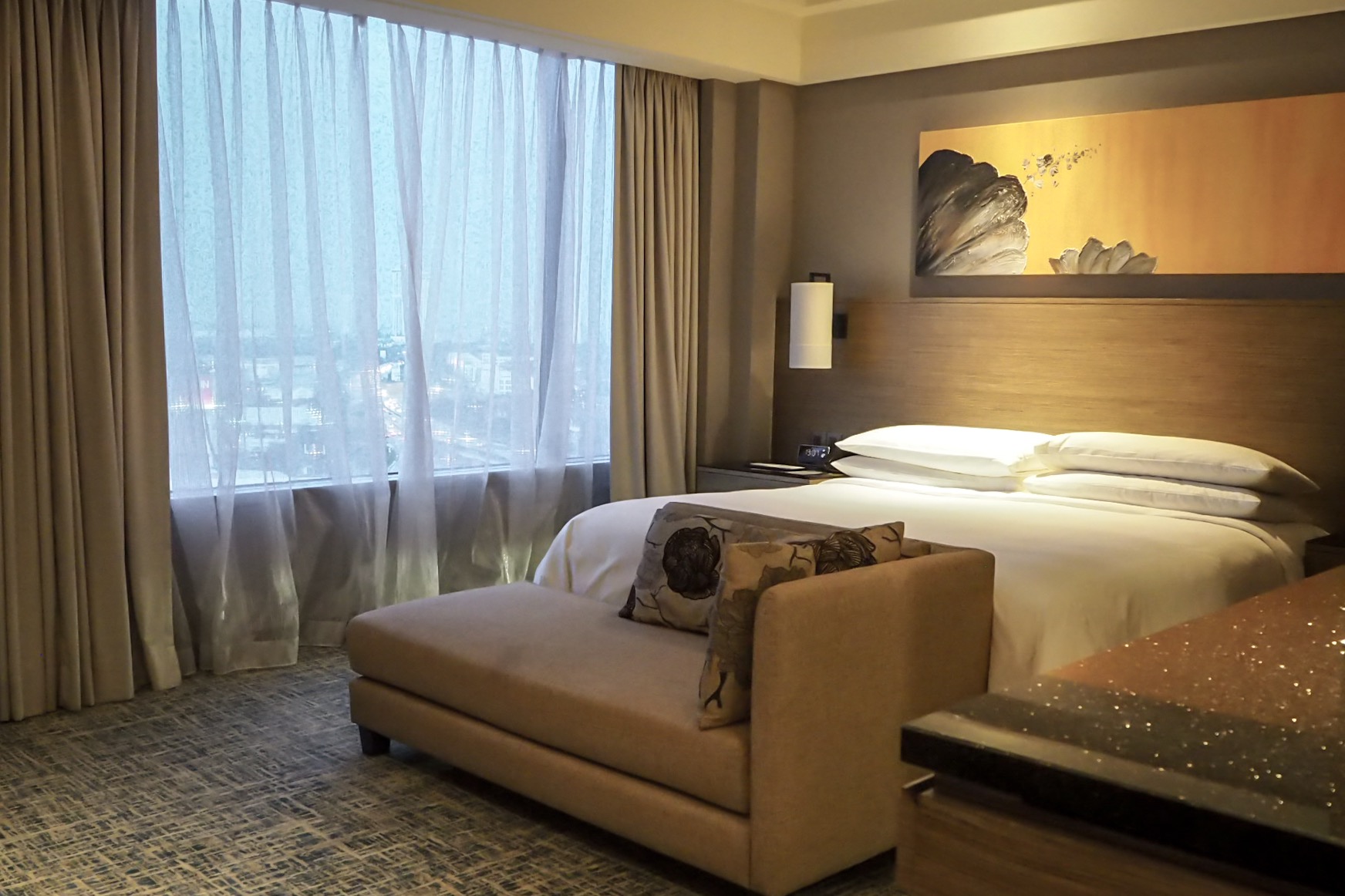
The room was fairly standard, with a king-sized bed coupled with a couch at the foot of the bed facing the TV screen. The room overlooks an industrial area with a mall, Permas Jaya Aeon, not too far away, but overall not a great view.
View from the room
Disappointingly, the bathroom didn’t have a bathtub. Modestly sized, the bathroom had a walk-in rain shower, a simple vanity and a segregated toilet. While it’s not my dream setup, of course I’m also concious I’m not exactly at Capella.
Club Lounge
While only a Rewards Category 2 hotel under Marriott’s new charts, Renaissance Johor Bahru Hotel do offer club rooms with access to the Club Lounge.
The Club Lounge is located on the 16th floor and is open from 6am to 10.30pm daily, offering breakfast in the morning, light snacks in the afternoon and evening cocktails and refreshments from 5.30pm to 7.30pm daily with drinks available for another hour until 8.30pm. Confusing, yes I know.
Club lounge on 16th floor
The layout however baffled me a little. Most hotels that I’ve been to have the Club Lounge close to the lift lobby, or tucked away from most of the guest rooms, if not both.
In Renaissance JB’s case, given the unique layout of the hotel, the Club Lounge was located on one end of the building. While this is not entirely strange, what is strange is that the entrance to the Club Lounge faces a guest room — I would hate to be in that room.
Having said that, having arrived at the hotel only at about 7pm, I immediately dashed to the Club Lounge to check out what’s on offer. To my dismay, most of the snacks have emptied out, even though there was still half an hour to go. When I checked with the staff if they were still refilling the dishes, they initially said no, but I think enough people asked them so they eventually did so about 20 minutes later.
Evening cocktails and refreshments – lamb rendang, fish fritters, fried rice
What was on offer that evening was a chicken wrap, salted fish fried rice, a mushroom fritter and a mutton rendang. On the other side, there were some vegetable sticks and dips, as well as cakes. The food was actually quite palatable, even though the selection wasn’t wide. Perhaps I was running a little hungry, I actually went for a second serving of the fried rice.
The evening cocktail hours were also structured in a very confusing manner. Refreshments were available from 5.30pm to 7.30pm, while alcholic beverages were served from 5.30pm till 8.30pm, and non-alcoholic beverages for the rest of the evening until 10.30pm. It would have been heaps easier if they have aligned the food and alcoholic beverage service timings.
The Club Lounge is also furnished in an incredibly uncomfortable manner. All the seating were in the form of dining tables, and there were no sofa seating save for a couple of armchairs with a coffee table in the library corner. This also means that even if I had arrived earlier, I would have been rather unlikely to spend my day in the lounge reading over a cup of coffee.
Club lounge – Not the best latte I had
With a fairly uncomfortable seating for having a drink and reading a book, I lingered in the lounge up to about 9pm over a few more glasses of drinks, before heading back to my room for the night.
The facilities
Beyond the club lounge, Renaissance Johor Bahru also has a swimming pool and a 24-hour fitness centre, both on the 6th floor. For those who fancy some pampering at a spa, unfortunately there isn’t any at the hotel. However, you will be spoiled for choice with an array of options for massages in Johor, so the lack of a in-hotel spa should not be a problem.
Lap pool
There are two pools, a larger rectangular pool that you can do laps in, and a small whirlpool that’s good enough for you to let your kids play in. Alongside the swimming pool are deck chairs for those who love a good tan, as well as cabanas to lie in if you fancy that instead.
The gym is rather well equipped and spacious, complete with a dumbbell rack, cardio machines and various machines. The gym can be accessed with your key card 24 hours daily, so regardless whether you are an early riser who wants to get a workout before breakfast, or a late night gym junkie, you can get your workout anytime you wish.
The gym
For those who love a good spa facility, there’s only a sauna that’s available within the changing rooms, but not a steam room. The sauna is also fairly small size, but usually unoccupied during the few times I used it.
The food
The next morning, I had breakfast at the lobby restaurant. I typically love Malaysian hotel breakfasts as they have proven time and time again to have fantastic Asian offerings, such as the E&O in Penang which offered my favourites such as cooked-to-order roti canai.
As with most larger hotels, the breakfast restaurant is fairly large sized, with seating of over a hundred people from what I saw. Of course, the restaurants are fully halal, so don’t expect bak kut teh (pork ribs soup) here!
Breakfast restaurant at lobby
Just a sampling of what was available at the buffet: dim sum, roti canai, nasi lemak, congee, along with western options of eggs, sausages, waffles, pancakes, cereal, fruits, and more.
Given the glutton I am, I had to try a little of everything. The roti canai was not cooked-to-order, so there was only the plain ones on offer. However, there was thosai that could be ordered so that more than made up for it. The nasi lemak was pre-wrapped in a banana leaf, and offered the standard condiments including hard boiled eggs, sambal, ikan bilis and cucumber. The rice was on point: fragrant and not too soft, and when paired with the sambal, good enough on its own.
Breakfast at Renaissance JB Hotel
There was also dim sum available, although this was a little disappointing. There wasn’t the usual siew mai (dumplings) available, but instead there was many buns (not my favourites) and also some unidentifiable steamed items.
To top off breakfast, there was a soft serve machine too, serving up chocolate and vanilla soft serve, complete with toppings such as crushed peanuts, candy rice and more. This was certainly a great way to end the morning.
My thoughts
Overall, this is a fairly decent Marriott property, taking into consideration the price you pay for a club room.
The room itself was fairly comfortable, and I loved that couch at the feet of the bed, which allowed me a choice of either lounge on the couch or on the bed to watch TV. As with most hotel rooms, I couldn’t get the smart TV to cast my phone content so that was a pity.
The lounge was clearly a disappointment, since it wasn’t exactly designed for one to lounge in it, but rather built almost like a restaurant. Service was acceptable for the category, so I’m not going to lose much sleep over it. However, there are araes where the service can be tightened or simplified, for instance, ensuring that food is available right to the end of the evening cocktail hours.
Club Lounge
The highlight of the stay would most likely be the breakfast. While it was great on its own, it’s certainly not the best I had in Malaysia before. In fact, DoubleTree by Hilton over at Johor Bahru city centre might offer a better breakfast, although it’s immensely crowded.
Despite the above, Renaissance Hotel Johor Bahru is certainly a great value for money especially if you need a cheap option to clock nights to qualify for the new Marriott Elite status!
While it seemed like a regular weekend, 18 August (or 19 August for this part of the world) was probably the day where members have been looking forward or dreading, depending on which side of the fence you were on.
Both Starwood and Marriott reservation engines were down most of the weekend, with SPG pushing out an app refresh. Starwood.com now also points you to a new Marriott site.
What happens now that the merger is complete?
To recap, this is the key phase where the points, benefits, elite tier qualifications, hotel categories are aligned across all three programmes: Marriott Rewards, SPG and Ritz Carlton Rewards.
These are the key changes that you will see:
After the merger is completed, your SPG account will be given a new number the first time you try to log in. Once inside, you will see that your balance have tripled (converted on a rate of 1 SPG point to 3 Marriott Rewards points). People who are familiar with Marriott will also notice that the booking flow and design is similar, except for the colour scheme.
You will be able to merge your SPG and Marriott Rewards account, if you already have both and linked them earlier. More about that later.
Your elite status will be updated under the new combined programme. So if you were formerly SPG Gold, you will now be Gold Elite. SPG Platinum members will be transitioned to Platinum Elite. There’s also a new Platinum Premier Elite status for those who manage to clock 75 nights a year.
If you are formerly a Marriott Rewards member, your profile will also be updated to reflect the new status that you qualify on. For instance, the old Marriott Gold is now the new Platinum Elite. The full list is below:
SPG and Marriott Rewards account are not automatically combined
If you have both a Marriott Rewards account as well as an SPG account, remember that your account is not automatically combined. You will have to trigger it from your account to have them combined, and any new statuses updated.
And yes, even if you have previously linked your account, you will have to manually work the process to combine the accounts.
To start, choose where you want to combine from. Pro tip: if you wish to keep your Marriott Rewards number, start from the Marriott Rewards account page. If you feel a stronger affinity with your new SPG-converted account number, start from the SPG page.
Start from your Marriott Rewards account page if you wish to keep your Marriott Rewards number
Once you click on ‘Get Started’, you will be prompted for your account credentials for the other account that you wish to combine with. Note that the names on both accounts must match in order to be able to combine them.
Start the process by verifying your other account information
The process will then be fairly straightforward – you will be shown your account balance on both accounts and your final profile, which should retain the number that you have chosen.
Viola! You are almost done
Once done, a summary will be displayed of what to expect next. When you click ‘Confirm’, you will be shown your new total number of points, as well as number of Lifetime Nights.
So now that my accounts are one, what next?
Now… life goes on. For SPG members, the good ol’ days of earning status by stays are soon to be over. To qualify (for the last time) for status by stays, you can still continue to clock stays at Starwood properties by 31 December 2018 for status through next year. That means if you complete 10 stays or 25 nights, you get Gold Elite. For Platinum Elite, that is 25 stays, or 50 nights.
Note that this can only be achieved at Starwood properties, so all Marriott properties are excluded from the stay-based qualification.
For those chasing lifetime status, the Lifetime Gold and Platinum status will translate correspondingly to Lifetime Gold Elite and Platinum Elite status, with their respective revised benefits. For long-time Starwood fans who manage to clock 750 nights so far, you will get the Lifetime Platinum Status status, as long as you meet the mark before 31 December 2018.
Otherwise, if you are a lowly Gold Elite member like me, just weep and see that status go to waste in 2019, given that I’ll be unlikely to clock 25 nights in a given year.
2016 and 2017 were good years for me – I had status in not one, but two hotel programmes, all thanks to Marriott’s acquisition of Starwood hotels. But obviously good things don’t last.
In what seemed like a seemingly long week for SPG, Marriott Rewards and Ritz-Carlton Rewards members, all was finally revealed early today when details of the changes to unify both programmes were announced.
If there are five key takeaways, they are:
All three loyalty programmes are unified essentially with point, elite tiers and earning requirements aligned across, and you can transfer points freely from one to another, or earn elite-qualifying nights from one portfolio towards another programme. Marriott will only rebrand all three into a single programme in 2019.
There will be six tiers in the new programmes. For SPG, this means a new Silver Elite tier at 10 night. Gold Elite will now require 25 nights, while Platinum Elite goes for 50 nights and Platinum Premier Elite at 75 nights.
All elite qualifications will be made based on nights, and not stays, from 2019.
All SPG starpoints will be automatically tripled in August 2018 to match the ‘value’ of Marriott Rewards points.
Award charts across the programmes will be unified with a eight category chart, along with off-peak and peak redemption rates at each level.
News of the announcements were leaked earlier last week (read Loyalty Lobby’s report here) and caused anxiety among many members, on and offline.
Being an SPG Gold Preferred Guest that offered very good value for the elite membership, naturally I was worried if it was going to be tougher to requalify, given the stark difference in both programmes’ requirements (SPG required 10 stays or 25 nights for Gold, while Marriott required 50 nights).
So what has changed for SPG members?
Under the new programme, SPG Gold Elite will now require 25 nights (the same) rather than 10 stays, as Marriott removes the stay-based qualification. This will definitely trim many SPG Gold members as I know a majority of them does a whirlwind survey of Starwood properties in China or Thailand (where they are the cheapest) to requalify for Gold each year.
However, Marriott will continue to honour stay-based qualification for SPG members until the end of 2018, so this is your last chance at Gold (and move one year closer to lifetime Gold Elite) if this is the normal route you take to achieve status. Note that the stay-based qualification will only apply for stays at SPG-associated hotels, so this means you can’t be staying at the (supposedly) cheaper Courtyard by Marriott and count towards your SPG Gold.
You can still get your SPG Gold this year (for the last time) with 10 stays
Alternatively, you could also choose to throw money at Marriott and work towards 25 nights at any Marriott, Starwood or Ritz Carlton properties for Gold. #justsaying.
The update wasn’t too bad and in fact is a boon to Marriott Rewards members – Gold Elite now require only 25 nights to qualify with similar perks to what they currently would get at 50 nights.
So what are you getting with the new Gold Elite?
With the changes, I guess these are the changes I reckoned with the new Gold Elite:
The only upside: More points earned per US$ spent
Downsides:
Late checkout now reduced to 2pm (which is lame)
Welcome gift reduced to points only, with no indication how many points
And the fact that you need 25 stays to qualify
While SPG Gold Preferred Guests get mapped to the new Gold Elite status, on the Marriott end, existing Marriott Rewards Gold Elite are upgraded to the new Platinum Elite while the silvers with 25 nights minimum now gets gold.
New benefit summary table
Earning changes
From August 2018, all your stays across Starwood, Marriott and Ritz Carlton properties will earn a unified 10 points per US$1 spent (exceptions apply for some properties). Elite silver members will earn a 10% bonus, while elite gold and platinum members earn a 25% or 50% bonus.
At first glance this sounds better given that SPG members currently earn 2 or 3 points per US$1 spent, and even after tripling the new deal sounds better. But until we see how the Starwood properties are mapped to the new award chart categories, this remain to be seen.
If SPG maps the property at the same level, it will be good news for SPG members. A current category 6 hotel cost anything from 20,000 to 25,000 Starpoints to redeem, and that translates to 60,000 to 75,000 points after the August conversion. Under the new chart unveiled by Marriott, a category 6 hotel will only require 50,000 points. Even if the hotel is upgraded to the next category, members will not be worse off. But let’s wait and see how the hotels map out come August.
Comparison of existing SPG award chart versus new award chart
Lifetime elite status here to stay, but more difficult to achieve
With the new elite silver level introduced, SPG members will now find it more difficult to achieve lifetime elite gold.
New lifetime elite qualification requirements
You will now need to achieve seven years of elite gold statuses, along with 400 nights stayed across any of the 29 brands combined. This an increase from the 5-year, 250 nights requirement.
Current SPG lifetime status requirements
So if you haven’t already achieved lifetime Gold with SPG – too bad, it’s a further climb now. I figure that is now further out of reach given that I stay in hotels on average 10 nights a year – I might just get there when I’m 70.
Final words
I’m sure that many SPG loyalists saw this coming – a devaluation of their beloved programme, or a hike in the investment required to maintain it. While props to Marriott for merging both programmes and meeting halfway in terms of requirement, the impact is more real for SPG members given the increased spending required, along with the slight reduction of benefits for the programme.
More work for less perks? Sounds like a brilliant business plan, but obviously poorer off for customers. You might be better exploring other programmes given that Gold qualification is now comparable to some other programmes.
Having said that, given that Marriott and SPG together forms the world’s largest hotel chain, it might be a tough choice to shake them off altogether. Even with these revisions, the programme is still relatively competitive.
For the full details of the new programme come August 2018, check it out here.