As part of my mattress run in Shanghai, I took out one night at DoubleTree Shanghai Jing’an, a relatively new property in Shanghai.
Located on the west side of the Huangpu river, the hotel is centrally located near to some of the commercial districts, in the Jing’an district. At the time of my stay, the hotel is only about four months old, having opened only in July 2019.
The 307-room property is the second DoubleTree branded property in Shanghai, with the first one located in the Pudong new district.
Rooms at the hotel run in two towers, up to 28 floor each. At the time of my stay, it seems like all the guests were funneled to only one of the towers, with the other one cordoned off.
This property is located about 15 minutes north of Shanghai’s famed Xintiandi area. The actual distance is not that far, but the traffic in Puxi area leaves much to be desired pretty much throughout the day, no thanks to the many traffic lights.
There is a subway station (Line 8) about 10 minutes walk away, so that is always an option in the cooler months, and you may be surprised it might be faster than taking a car ride at certain times of the day.
As for the distance to the airport, the hotel is about a 30 minutes drive from Hongqiao airport, and 45 minutes away from Shanghai Pudong International Airport.
The room
As a Hilton Honors gold member, I was once again upgraded, this time to an executive room. However, I didn’t have the chance to check out the executive lounge on this trip, as I was out of the hotel most of the time.
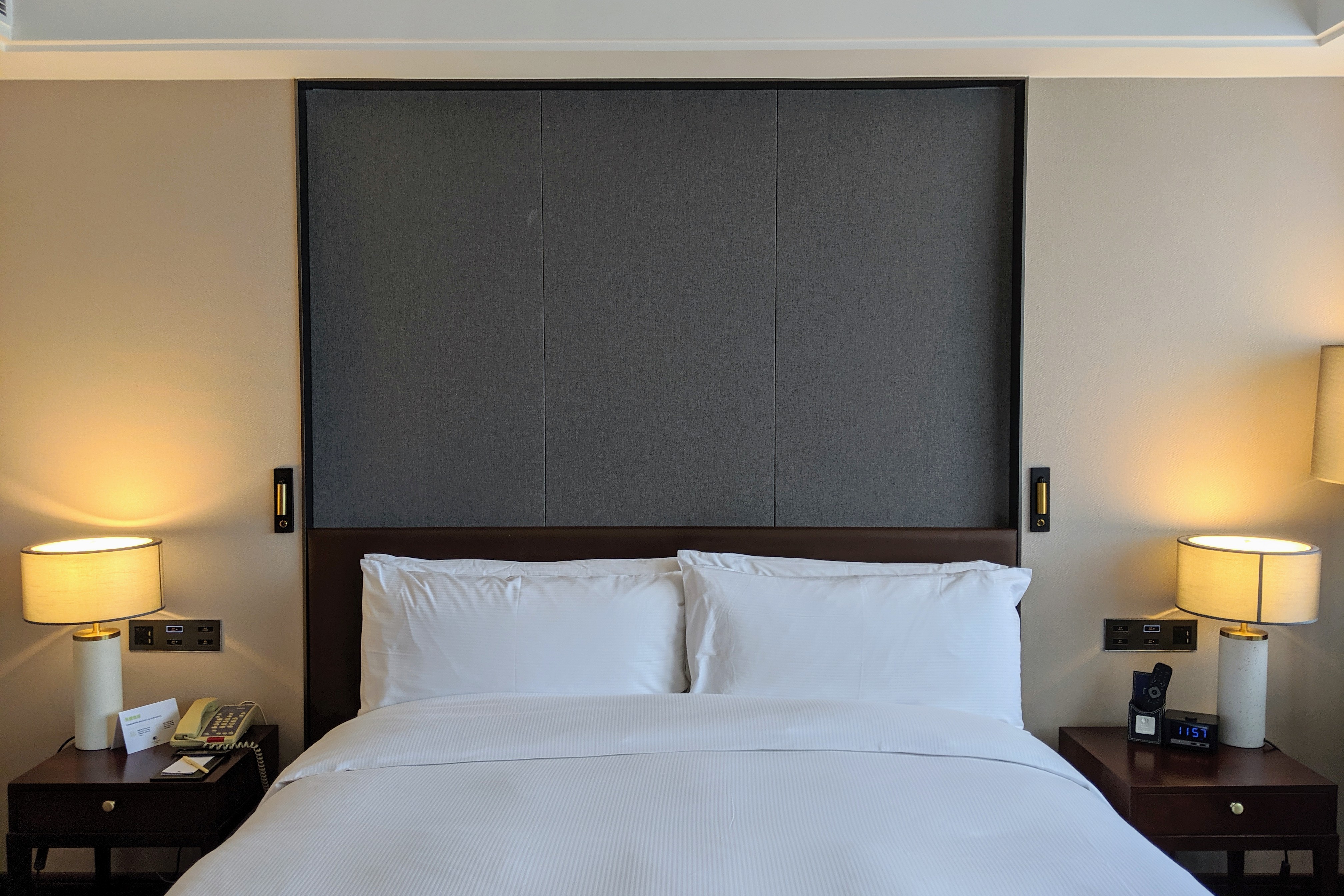
DoubleTree Shanghai Jing’an, King Room
The room itself was pretty much a standard King room, which was fairly small based on the past rooms in China I’ve stayed in before. The room was decked out in modern dark wood finishing, which thankfully was accompanied by pretty decent lighting.
The king bed was generous in space and fairly comfortable, unfortunately the choice of pillows left me with a neckache the morning after as all the pillows are too soft. If you a side sleeper, you may want to use the extra pillow in the closet, or request for even more pillows.
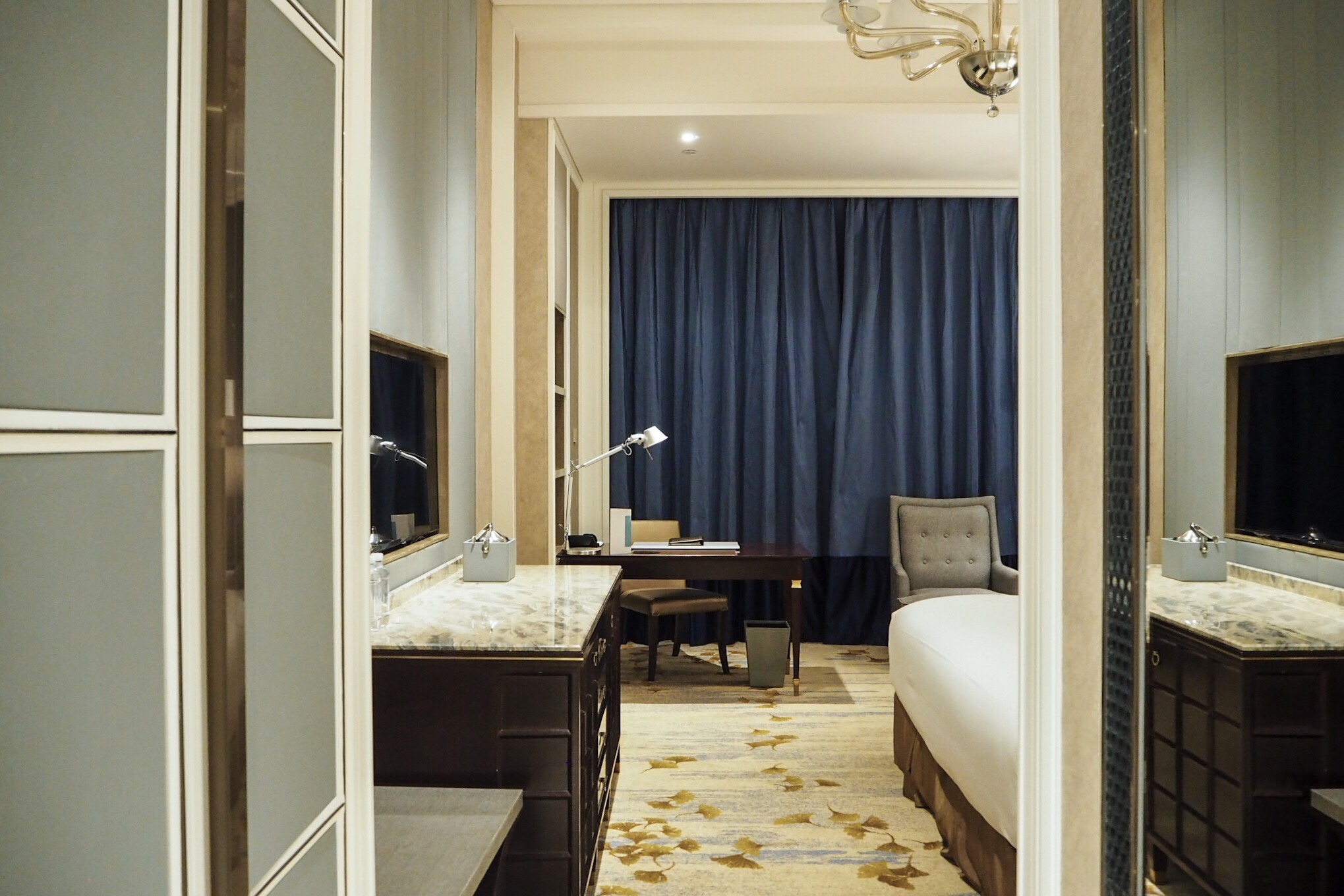
There was also a sizeable work desk, making this a decent hotel to use for business trips.
Working desk in room
The electrical fittings were also pretty well thought out, with an assortment of international sockets available at the work desk, as well as USB charging ports by the bedside. This to me is one of the small but meaningful details hotels can do to make big differences in the experience.
There was also a little armchair and coffee table by the window, which I thought was pretty unnecessary. The chair was stiff as hell so I don’t really lounge there.
Armchair and coffee table that I didn’t use
The bathroom was also pretty compact. There were separate toilet and shower cubicles, each with their own doors.
Bathroom with separate bath and toilet cubicles
I typically prefer this arrangement if I’m travelling with a companion, so that we could both use the bathroom at the same time if necessary. There was also a bathtub next to the shower, which was a rarity in newer DoubleTree properties.
You will be able to find the other standard amenities such as a bathrobe, bedroom slippers, ironing board and iron, hairdryer, all either in the bathroom or in the wardrobe.
Wardrobe situation
Unlike the DoubleTree by Hilton Pudong, the minibar is not filled up. Instead, there was an order chit from which you can order, and the items will be sent up to your room. I personally prefer this model, so I can use the minibar for my personal items.
The facilities
As I had a pretty short stay there, I didn’t have much time to fully check out the hotel.
There is an executive lounge on the 27th floor, which opens from 10.30am daily. Do note that if you have executive lounge benefits either as part of your room or your Diamond status, there is no breakfast served in the lounge so all guests will have to head to the level 2 restaurant for breakfast.
The lounge also serves up afternoon tea as well as evening cocktails daily, but do check with the reception on the exact hours.
All-day dining restaurant on 2nd floor
As for recreational facilities, DoubleTree by Hilton Shanghai Jing’an has a fitness centre in the basement. While I didn’t use it, I went to take a look and found it pretty well equipped.
Fitness centre in the basement
The strange thing about this hotel is: I’m not clear if there was a swimming pool. Based on earlier news reports about the property, there seems to be one. However, it was not mentioned on the hotel official website, neither was it mentioned in the information booklet or any of the signs when I was in the hotel.
Also, there are no spa services or facilities, so in this respect the hotel is pretty no-frills.
Lobby bar
There is a lobby bar on the ground floor for your evening tipple and a Starbucks within the same building accessible from the lobby, even though it is technically not part of the hotel.
Breakfast
Breakfast was served at the all-day dining restaurant located on level two of the hotel.
When I went down for breakfast, I was a little lost. My room number was taken by a staff at the door of the restaurant, but the staff signaled for me to head into the restaurant and look for a table by myself.
DoubleTree by Hilton Shanghai Jing’an breakfast restaurant
I don’t usually like to do that at a hotel breakfast restaurant, as many people are usually walking around taking food, and I certainly didn’t want to accidentally sit at a table that someone else had taken.
Also, at first glance, some of the tables had incomplete settings, so all the more I wasn’t sure if those tables were taken. Eventually, I found a huge booth (ample seats for six people) which wasn’t taken, and I awkwardly took up the table.
A little about the space within the restaurant. The restaurant was huge, but lacking in natural light. There were also not many tables, and while I liked space, I felt this restaurant had too much space.
Plenty of space in this restaurant, but a little too much space
Food selection was terrible. There was a lot of food, but nothing particularly stood out. Some of the food on offer included one entire section of steamed goods, but it turned out to be all root vegetables (potatoes, lotus roots, tapioca). There was also a tray of fried dough items that was present in a pretty haphazard and unappetising manner.
Tray of deep fried dough and spring rolls, anyone?
There was also the usual western breakfast offering, including an egg station, bacon, sausages and bakery items, but none of them looked appetising.
Bakery items
As such, I simply took a croissant and a fried egg to fill myself up a little, before skipping the restaurant and head out for a much better breakfast.
Final thoughts
As with all newly built hotels, the finishing for the hotel is gorgeous. I loved the spacious lobby,
Unfortunately, this strength of the hotel is also its weakness. In my opinion, there was a poor use of space. There was so much more potential in what the hotel could use the abundant space in lobby for, such as a cafe (or two) or perhaps even a bistro.
The rooms on the other hand, are fairly efficient in terms of space to a fault as well. I would have preferred slightly more space to move around within the rooms, particularly the bathroom.
In my previous trips to Shanghai I’ve always stayed at the now-gone Hilton Jing’an, which has always been excellent. Having not visited Shanghai in a while, I was horrified to find out that Hilton Jing’an, a well-known landmark having been around for over four decades, have been sold off and is now rebranded as Kunlun Jing’an Hotel. So now if you are looking for a Hilton-branded property in the Jing’an area, the DoubleTree by Hilton Shanghai Jing’an is your only option.
For my final leg home from Shanghai on a weekend trip, I took advantage of Singapore Airlines’ Spontaneous Escapes offer last month and redeemed a one-way business class seat from Shanghai to Singapore at 27,300 miles.
The usual redemption rate is 39,000 miles each way in business class for PVG-SIN, so this was pretty good value.
I’ve not tried Singapore Airlines’ latest business seat product that was launched in 2017, so I was looking forward to reviewing this seat.
For those who are familiar with SIA’s Spontaneous Escapes, this is a monthly offer which offer select cabins on certain routes at a 30% discount for travel in the following month. SIA’s China services, including Beijing and Shanghai, tend to always be on offer.
SQ operates out of Terminal 2 at Shanghai Pudong International Airport, along with most other Star Alliance carriers including Air China, Thai Airways and United Airlines. Check-in was relatively fuss free, with three dedicated business class check-in counters, so there was hardly any queue.
While there is not a dedicated immigration lane for business class passengers, there was one for security screening right after immigration. The immigration lines can get pretty backed up, so arrive early.
Singapore Airlines does not have its own lounge in Pudong, so guests are directed to the Air China business class lounge.
Singapore Airlines premium cabin customers use the Air China lounge at Shanghai Pudong airport
The flight was scheduled to depart at 1625, and boarding commenced about half an hour earlier. As usual, passengers in suites and business class, as well as PPS members, were invited to board first.
The aircraft
Singapore Airlines deploy an assortment of aircraft on the four times daily Singapore-Shanghai service, including the Boeing 777-300ER, A380 and A330. The service frequency and aircraft type also varies during different times of the year depending on demand.
For the A380, Singapore Airlines is currently undergoing a fleet refurbishment process to install their newest seats and suites. As such, SQ has three different variants at the moment for the A380, given it’s taking time to refurbish the fleet.
Luckily for me, the A380 I was on today was the type with the latest seat products, including the new suites.
On this configuration of A380, there are 6 suites, 78 business class seats, 44 premium economy and 343 economy class seats. The suites and business cabins are on the upper deck, while the premium economy and economy class seats are located on the lower main deck.
The load today was pretty light. Out of 78 seats, the cabin was less than half full with about 34 passengers in business class. My choice of seat for the day was all the way at the rear, at seat 91D.
Singapore Airlines introduced this seat along with the new suites when they refurbished the aircraft in 2017, 10 years after taking in their first A380. In this new configuration, the business class seats and suites are located on the upper deck, with the six suites in front, and the 78 business class seats taking the rest of the upper deck.
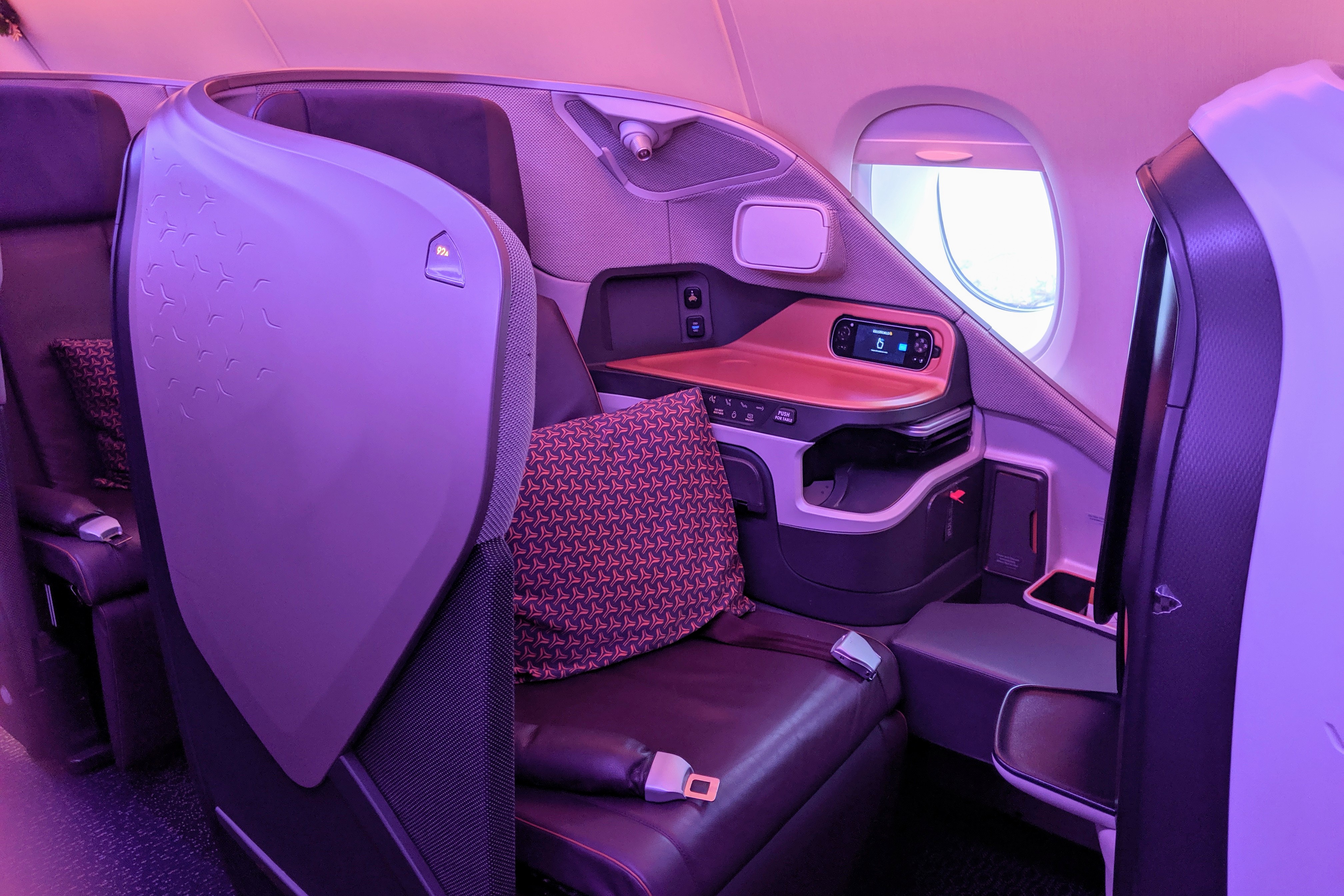
Singapore Airlines 2017 business class seat
The good thing with it is that they can actually do concurrent boarding and disembarking of both decks, although that some passengers in premium cabins may not like that idea, given after all, they love the priority.
The 78 business class seats are spread across three main cabins on the seat map, although in reality the rear two cabins are visually just one. The ‘mini cabin’
Most passengers will like to be at the front of the cabin, but I figured that the rear will be rather empty given the light load. True enough, upon boarding, the cabin crew told me that there was only six passengers in the rear cabin, and I was free to change my seats if I so wanted to.
My middle seat
Now, the seat. The Singapore Airlines 2017 Business Class seats (2017J) measures 25 inches across, and can be fully reclined into a flat bed. In the bed mode, the bed runs about 78 inches head to toe.
The seat also features a larger privacy shell so that you get more privacy from the aisle.
Seats are pretty private, you won’t see your neighbours if you really don’t want to.
At the time of its launch, Singapore Airlines also mischievously marketed the business class seats as best in class for couples travelling together, featuring a ‘double bed’ in the new business class configuration, as exemplified by this marketing imagery:
Singapore Airlines A380 business class double bed (source: Singapore Airlines)
However, the reality is that there are only three such pairs of seats available on each flight, which are seats D & G (middle seats) on the bulkhead rows of 11, 91 and 96.
The only reason why they can be formed into a ‘double bed’ is because these are the only seats that has a full-width footrest area. The other seats all have a side cubbyhole, so when the seat is fully reclined into a bed, the footrest angles away from the middle.
Ample legrest area in the bulkhead seats (Pictured: Seat 91D)Non-bulkhead seats have smaller legrests (Pictured: seat 92D)
Even for three ‘double beds’, note that there is still a hard divider that can be drawn all the way down to bed-level when both are reclined into bed positions. However, the mattress topper will not be able to fully cushion the gap, you will still be able to feel it if you lie across it.
Seat divider
Note that seats 91D & G are bassinet positions, so they can’t be reserved in advance until 48 hours before the flight. Even then there is a chance you might be moved, if there’s a infant that pops up last minute.
All of the seats have a side table that separates the seat from the aisle. While that means that the middle pair of seats are side by side, there is a retractable divider that you can put up if you are travelling alone.
Side table
Storage wise, the seat does have several spaces for you to store personal items around the seat. There is some space under the seat in front of you for a small suitcase or a backpack, so for most travellers there no need to use the overhead compartments.
As for overhead storage, note that there are no overhead storage compartments for the middle seats, so if you need to stow something, it has to be above the window seats.
There are no overhead storage space for middle seats
At the back of the side table, there is a small compartment for storing personal , which is also equipped with a USB charging socket. If you need a power socket, it’s available in front of you just below or beside the IFE screen.
Power socket for your use
At the side of seat near the foot area is also a magazine rack, along with a bottle holder. There’s enough space to also stow a slim laptop if you wish.
Magazine rack and bottle holder
At the side of the seat just below the side table is a control panel for the seat. Unlike previous versions of SIA business class seats, the 2017 version is now fully control by electronics. The seat can be fully converted to a bed at a touch of button, although you can still trouble a cabin crew to do it for you if you prefer that personal touch.
Electronic controls
There is also a thin mattress topper and a blanket, although they are all rather thin, so that means that you will be sleeping on a firm bed.
The service
The service was rather attentive today, as the cabin was pretty empty. I was greeted by name, and the cabin crew also knew my preferences after I stated it once.
When I boarded, the cabin crew quickly came around offering a pre-departure drink. Unfortunately they didn’t offer any champagne, so I settled for a sparkling water.
After doors have closed, another cabin crew came around to take orders for a pre-meal drink. I opted for some decaf coffee given it was relatively late in the day, which was promptly brought to me right after take off.
Post-take off drink: decaf coffee
Shortly after that, they brought around the famed Singapore Airlines canapes of lamb and chicken satay, which I thought signaled the start of the meal service.
Canapes of satay
Surprisingly, I was asked by the cabin crew at that point if I will like to have dinner at 6pm or 6.30pm, given it was rather early in the evening. I thought this was a very nice touch, rather than just assume that everyone wanted to eat right at the beginning of the flight.
Dining
Given the flight duration of five hours, there was only going to be a meal service for the flight. Soon enough, 6.30pm rolled by and the cabin crew came around to lay out the tablecloth and cutlery in preparation for dinner. I was offered a drink once again to go with my meal, and I decided on a red wine, the Chianti.
The SIA business class menu
Now a bit about SIA’s menu: on their China-bound flights, there is one special menu available, Shi Quan Wei Mei, a special Chinese feast designed by a celebrity chef.
According to the in-flight menu, each dish is made using locally sourced ingredients that are in season.
The menu for Shi Quan Wei Mei reads as follow:
Side Dish: Marinated Cucumber and Shimeiji Mushrooms
Cold Appetiser: Red Pepper Pork Roll and Watercress Pine Nuts in Bean Skin
Main Course: Prawns in Pickled Chilli Sauce with stir fried kai lan and purple sweet potato rice
Dessert: Warm Soy Bean Milk with Tofu Skin and Pigeon Egg
If Chinese food is not your style, there’s also the regular menu for your perusal:
Canape: Singapore Chicken and Lamb Satay
Appetiser: Salad of Smoked Salmon with grilled vegetables and herb vinaigrette
Main Course: choice of Grilled Cumin Spiced Lamb Ribs with Lemon Thyme Sauce Sauteed Prawn in Tomato Coriander Sauce Wok Fried Chicken with bamboo shoots and chives, Chinese greens and fried noodles
Dessert: Haagen Dazs Strawberry Ice Cream
Selection of Cheese
Fruit from the Basket
Assorted Bread Rolls and Gourmet Breads
Fine Pralines
Coffee and Tea
The appetiser was served up pretty swiftly. The smoked salmon wasn’t memorable, but I really enjoyed the grilled vegetables as they were pretty crunchy yet juicy. Not a fan of the leafy bits so I left those alone.
And of course, the garlic bread is always such a treat.
Salad of smoked salmon
As I wasn’t particularly hungry, I went for the prawn for my main course. Usually I’m pretty skeptical of prawns as a main dish, given that sometimes that can mean only one single prawn, as mentioned in the menu.
Sauteed Prawn in Tomato Coriander Sauce
However, I was pleasantly surprised with the portions this time round. There was a hearty serving of de-shelled prawns, with a side of vegetables and couscous. The prawns were well flavoured and it’s still pretty substantial, despite being labeled as a low carb option.
My empty plate was removed not too long after I was done, and I was again offered a refill of my wine, which I gladly accepted. The dessert of ice cream (one of my favourites) was also brought to me at this time.
Haagen Dazs ice cream
Unlike Cathay Pacific who serves the ice-cream in its original single-serve tub, Singapore Airlines scoops the ice cream into a bowl, and often garnish it with either biscuit crumbs or some sauce. Personally I actually prefer it to be in the tub, because for some reason when it is scooped out it tends to melt faster.
In-flight entertainment and Wi-Fi
Singapore Airlines equips the 2017 business class seat with an 18-inch Panasonic screen. As I was sitting at a bassinet-available seat, the screen was significantly higher than my eye level when I’m seated to cater space for the bassinet. If people behind me were to stand up, they will be able to see what I’m watching!
My screen is clearly visible even from five rows back
The KrisWorld IFE is pretty world-class, containing a good array of international selection. Note that Singapore Airlines have two IFE systems running through its entire aircraft fleet, and fortunately the A380s have the newer Panasonic ones with a far larger library, inluding over 300 movies and 700 TV shows.
In terms of Wifi, Singapore Airlines offers them on the A350 and A380 fleets as well as select 777-300ER aircraft. In case you haven’t heard, Singapore Airlines now offers unlimited free wifi for its suites and first class passengers, and a reasonable 100MB allowance for passengers in business class, as well as its PPS members.
Complimentary 100MB wifi for business class passengers
If you need more than the 100MB given to you, you can purchase additional data limit at the following prices:
30MB – USD3.99
100MB – USD9.99
200MB – USD15.99
The prices are definitely not cheap, and SIA no longer offers time-based wifi access.
I barely touched the in-flight wifi, as I usually prefer to stay disconnected when I’m flying. Having said that, this is a good consideration if you prefer to work on your flight, and 100MB is sufficient for basic email exchanges, or for your basic messaging apps.
Final thoughts
I must say I really enjoyed this flight and the seat was more than comfortable for this five-hour journey back home.
The seat pretty much works for me. I personally prefer seats with electronic mechanisms, so that I can operate the seat myself without troubling a member of the crew. On previous versions of the business class seats that require manual handling, I often find myself waiting a tad too long for my seat to be converted into a bed.
Fully reclined business class seat, all done by myself!
While some critics may feel that the seat is a distinct departure from the generous width that SIA had in its previous generations of business class seats, I think they are sufficient and pretty within standards of many other airlines’ business class seats.
If there’s one thing that’s lacking, it’s with the amenity kits. SIA is one of the few airlines that doesn’t provide an amenity kit for their business class passengers, although everything you need in the kit is either provided to you at your seat (e.g. eye shades and slippers), or available in the lavatories (e.g. toothbrush).
The service was very attentive, given the relatively light load for the evening. The meal service was again impeccable, but the quality of food is a far cry from what it used to be, if you ask me. For instance, there are practically no choice for appetisers, dessert, or even the famous satay (what if I don’t eat mutton?).
While I was initially a little hesitant in choosing a seat closer to the back of the plane, but I really liked how empty the cabin was. Even though this means you are one of the last few business class passengers to disembark when you arrive at your destination, but the privacy and attentiveness of the crew more than make up for it.
I was scratching my head as to how to get from Bangkok to Shanghai on a one-way ticket, and to my surprise there wasn’t many cheap options for flights during the day.
Strangely, there were a lot of red-eye options, but I’m not particularly excited at doing a five-hour red-eye flight, having travelled from Shanghai to Kuala Lumpur on a red-eye service a year before and trying very hard to survive through the day after the flight.
I then stumbled across Spring Airlines, which seemed like a perfect option given that it had a mid-day departure and arriving into Shanghai at about dinnertime.
About Spring Airlines
Spring Airlines A320 (source: Spring Airlines Facebook page)
Spring Airlines was established in 2004, and operated its first service in 2005. It’s one of China’s first low-cost airline, although in its early days it offered complimentary food and drinks to all passengers.
The Shanghai-based airline operates only the A320, serving over 50 domestic destinations within China and 25 international destinations across Asia.
Bangkok is one of Spring Airlines’ focus cities internationally, serving over 10 Chinese cities, including Shanghai, Guangzhou and Xi’an.
The schedule
Spring Airlines operate three flights daily between Bangkok and Shanghai Pudong.
At the time of writing, the daily schedule is as follow:
Flight
Route
Departure Time
Arrival Time
Day
Aircraft*
9C8892
BKK-PVG
0205
0715
Daily
A320
9C8756
BKK-PVG
1335
1830
Daily
A320
9C8580
BKK-PVG
1810
2330
Daily
A320
9C8755
PVG-BKK
0845
1235
Daily
A320
9C8579
PVG-BKK
1245
1705
Daily
A320
9C8891
PVG-BKK
2100
0105(+1)
Daily
A320
*Aircraft types are always subject to change
How to book
I don’t usually talk about how to go about booking your ticket, but I think in this instance it’s pretty critical.
If you try to book a Spring Airlines ticket through an online third-party site, chances are, you will be booking a ticket without any add-ons. No bags, no food, no seat selection.
To book a Spring Airlines ticket with some choices of add-on, you will have to book directly on its website, ch.com.
Spring Airlines Chinese language site
Being a Chinese carrier, Spring Airlines’ website is available in Chinese, as well as English, Thai and Japanese. If you also read Chinese, you will realise that there’s a lot more options in the Chinese version of the website, but do note that you can only make payment through some of the common Chinese payment platforms, including WeChat Pay and Alipay, or debit cards issued in China.
More bundle options compared to English site
To purchase a ticket using a credit card issued outside of China, you will need to use one of its non-Chinese version of the website. Apart from the awkwardly designed website, the first couple of steps are pretty straightforward.
When you have decided on the flight timing you want, you will have to select either Spring Saver, which simply gives you a seat and a carry-on bag, or Spring Plus, a all-in-one bundle. Note that all fares displayed are before the applicable taxes.
Choose your preferred bundle
Spring Airlines is technically a budget airline, so if you want to purchase a seat only, they have it. Note that if you purchase a seat only, you can only bring one carry-on bag no heavier than 7kg (more on that later).
If you decide to customise your own add-ons, you can add items such as check-in baggage allowance and food in the later steps.
Add-ons can be selected in the later steps
For add-on baggage, the weight comes in 10kg steps and the price goes up accordingly. On my flight from Bangkok to Shanghai, every 10kg cost THB1,000 or RMB220.
Seat selection can also be made from RMB10 onwards. The price of your seat actually defers from row to row, so be sure to check.
Seat selection ranges from RMB10 to RMB70, depending on zones
As for food and beverage, you can pre-order a hot meal at RMB79 (THB340), but everything else is buy-on-board.
SpringPlus Bundle
Being highly uncertain about whether I could survive a 4+ hour flight on a Chinese low cost carrier, I decided to splurge on the best bundle I can find, which is the SpringPlus package, which costs RMB350 (THB1500) more. The SpringPlus bundle is also known as 经济商务座,which can loosely be translated to “economy business seat”.
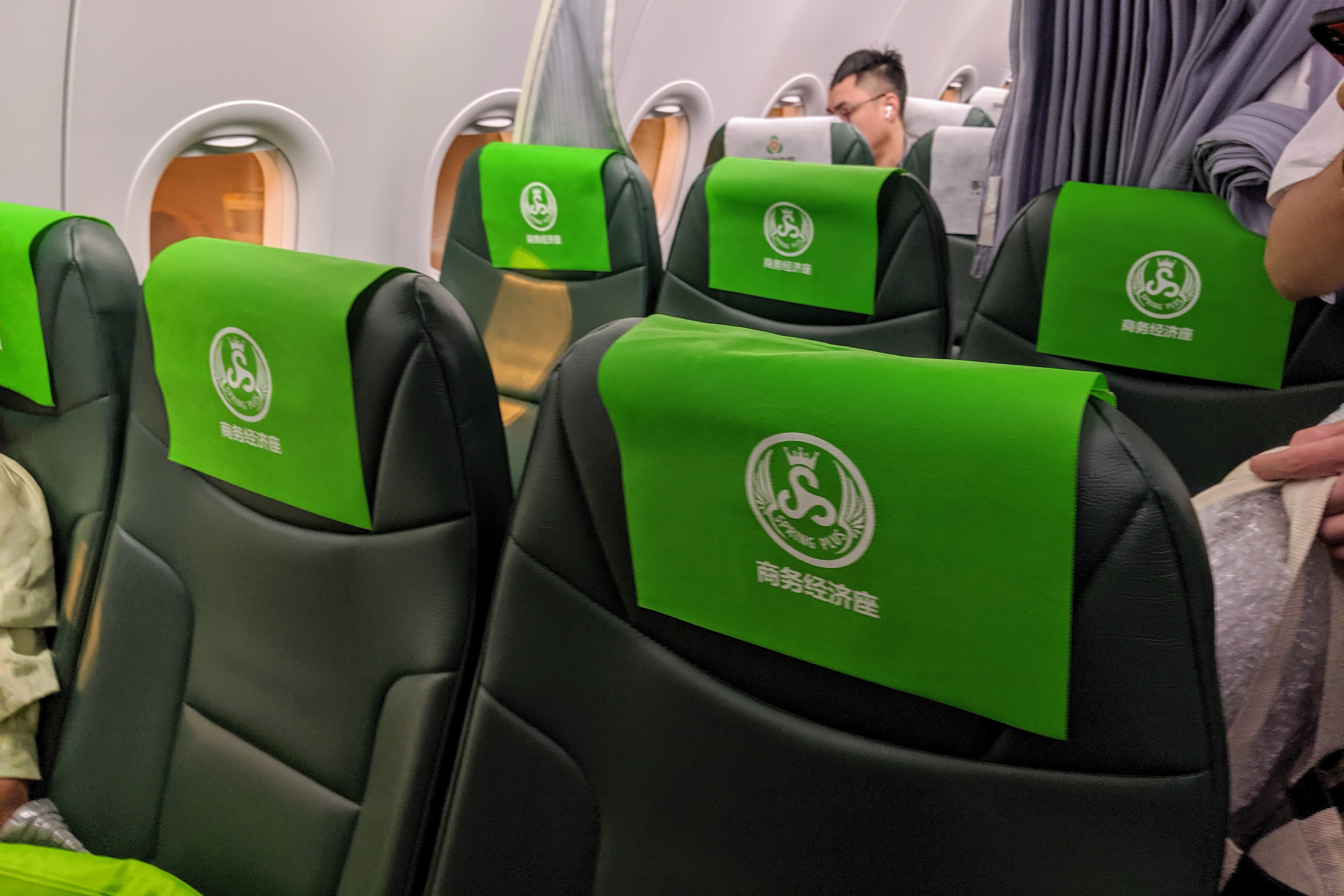
SpringPlus seat
So what does it entail? You get:
A seat in either Row 1 or 2, with free seat selection
30kg of checked baggage allowance
Free meal and unlimited beverages, including wine and beer
Priority boarding and disembarking
A pillow and blanket
Given that 20kg of checked baggage alone will set you back by RMB440, the SpringPlus bundle was a no-brainer. Having said this, I really don’t get how they priced this, but I suppose many Chinese travellers probably travel light.
Note that there’s also a 3% credit card surcharge, and there’s no way to get this fee removed.
Payment options
After making payment, you are all set! However, note that the email confirmation is a little shady as well. There are details of your flight, but it doesn’t state the bundles as well as the entitlements (e.g. baggage allowance) you have on the flight, so just try to remember what you have booked.
At the airport
While the email asked passengers to arrive at the airport 120 minutes before the flight departure time, I arrived only about 75 minutes before.
There were four check-in counters opened for our flight and a good number of people in line waiting to check in. There was supposedly a separate queue for SpringPlus, but it’s only displayed by its Chinese term. I tried to queue up there, but was directed back to the main queue anyway.
Spring Airlines check-in row K at Bangkok Suvarnabhumi International Airport
Never mind that. The queue moved pretty quickly so I wasn’t very bothered.
As I was queuing, I saw a few signages that Spring has put up around hand baggage. The notice was very specific: hand carry items must be 7kg or less, and must be of dimensions 20cm by 30cm by 40cm or smaller. It then goes on to say “if it is found at the boarding gate that passengers’ luggage does not meet the requirements for free luggage entering the cabin, a luggage fee will be charged for passengers’ excess luggage.”
Hand-carry baggage advisory
The price for checking in bags at boarding gate? Pretty horrific:
THB3500 (RM820) per piece for luggage under 20kg, and
THB7000 (RMB1640) per piece for luggage over 20kg, but under 32kg.
That’s some really expensive ‘fines’ for exceeding the hand carry limits, which I’m very happy for some other low cost carriers such as Jetstar to pick up.
More warnings about hand-carry baggage on the boarding pass
To drive home the point, there was the same notice, in Chinese, being stamped on my boarding pass when I received it. By this time, I was dead certain they were going to weigh my carry-on bags.
The aircraft
Spring Airlines A320
Spring Airlines operate a dedicated fleet of A320 only, in a single class configuration with 6 seats per row, 3 on each side for a total of 180 seats.
The first two rows are dedicated for customers who have bought the SpringPlus bundle, while row 3 onwards are for the other customers. This also means that there are only 12 SpringPlus bundles per flight, and some customers may be ‘upgraded’ if the flight is really full.
SpringPlus seats
When the flight was ready to board, SpringPlus customers get to board first.
However, I chose to wait to board last, as I had an aisle seat. The A320 only has a single door for boarding, so that means if I boarded first, I’ll be greeting every other passenger who has to flow through the single aisle.
Also, a word about budget carrier travellers. Regardless of length of flight, customers on these flights tend to bring too many carry-on items. So that means overhead cabin space is a premium on a first come, first served basis.
I forgot this, and I realised that boarding last was a mistake. By the time I was on board, there was no more space in the overhead cabins. My seat neighbour had not one or two, but four bags – including two cabin suitcases – that couldn’t be stowed overhead. Once again, I wonder if the warnings about carry-on bags were a lie. The cabin crew couldn’t find a space for all their bags, and had to stow them somewhere in the galley in the end.
So I had to keep my bag under the legs for take off, which I’m sure is a breach of safety, and also incredibly uncomfortable.
The seat
Spring Airlines install 180 seats on its A320, in a 3-3 configuration across 30 rows. As mentioned earlier, the first two rows are reserved for SpringPlus passengers.
Each passenger in rows 1 and 2 receives a green blanket and a pillow, which are pretty ugly. The seats are upholstered in a faux leather skin, making it easy to clean and fairly comfortable for a mid-haul flight. The seatbacks are also quite thin, maximising the legroom.
Complimentary blanket and pillow
The seats are standard width at about 17 inches wide, which is slightly narrower than most other airlines. There is also more legroom for the first two rows, at about 30 inches. All other seats have a standard pitch of 28 inches, which is fairly reasonable for the Asian traveller.
Main cabin
If you are in the main cabin, there are also extra legroom seats at the exit rows of 12 & 13.
Each seat comes with a fold-down dining table, and for the first row the table comes up from your armrest. There are also individual air nozzles and reading lights for every seat located above.
Reading lights and air nozzles
One critical point of all Spring Airlines seats is that: the seats do not recline. This to me isn’t really a bad thing. Most of Spring Airlines’ routes are anywhere between short to mid-haul, and in my opinion, disabling the very limited recline in an all-economy layout is probably a lot more beneficial (by preventing disputes), than whatever marginal comfort you may get with a 2-inch recline.
The service
Once we are safely in the air and the seatbelt signs have been turned off, the cabin crew in front swiftly went behind row 2 to draw the curtains, making the front cabin even more exclusive.
The very lovely crew then went around to each row of three to greet us by name, and then provided an overview of today’s flight, such as the flight duration, estimated landing time and meal service. She also gave us a bottled water each. I was impressed.
Shortly after that, the meal service commenced. The meal was fairly simple: pieces of chicken along with some potato wedges, pumpkin cubes and long beans, along with a slice of chocolate cake and a packaged bread roll. Everything was nicely encased in a plastic box and served up at once, with the entree piping hot.
SpringPlus complimentary meal
In terms of beverage, this is where it got a little interesting. Unlike some other low cost carrier which only offered water or one single drink along with the purchased meal, Spring Airlines offered unlimited drinks, including soft drinks, coffee, tea, beer and wine. Even though the cart had a limited choice of drinks, the sheer fact that drinks were unlimited was, again, impressive.
Complimentary unlimited beverages on Spring Airlines with SpringPlus
I had a soda water to go with my meal, followed by a coffee after. Meal service was pretty prompt, and collected shortly after I was done with it. Once again, service was very attentive. As my finished meal was collected, the cabin crew asked if I’ll like another drink. I saw that they had small bottled red wines on the cart, so I decided to give it a try.
You even get China wine!
The red wine turned out to be a China-made Cabernet Sauvignon (China Wine, ha!), produced in a vineyard from Ningxia. Having not tried Chinese wine before, I took a sip and as it turns out, it was pretty decent. I made a quick search online about Chinese wines and the region has apparently been known to produce some award-winning wines in recent years.
The wine was served in a paper cup as the crew has run out of plastic ones. Personally, I do feel that has affected the taste a little, but the wine was delicious so I had three glasses.
If you are reading this and decided not to buy the SpringPlus bundle, the buy-on-board menu is very affordable. Meals begin from RMB20 (THB87) and all drinks from water to beer were RMB10 (THB43).
Spring Airlines buy-on-board food menuSpring Airlines buy-on-board drinks menu
With about 90 minutes to go before landing, the purser opened up the curtains, and I thought this a little too early to prepare for landing. He then started wheeling out a cart, and took out the in-flight PA to start speaking.
As it turns out, he was starting to peddle the in-flight duty free items for sale, in Mandarin, of course. While he was very good, being incredibly knowledgeable and persuasive in selling the wide-range of items (I did a rough count, he mentioned no less than 20 items in the catalogue – including cigarettes, SK-II, Disney products, and electronics – over the 15 to 20 minutes of speaking), I can imagine that if you didn’t understand Mandarin, you might find it a little annoying.
In-flight magazine (largely duty free catalogue), menu and safety card
After he was done, there was indeed a flurry of duty-free sales going on within the cabin. For one, the Chinese traveller likes to buy cartons of cigarettes back home, and apparently they always run out on Spring flights.
Shortly after, it was time to prepare for landing. The cabin crew once again came to thank customers one-by-one, as well as provide landing information including estimated time of arrival and weather. While this was something fairly simple, I personally was really impressed at the level of service for a supposedly no-frills flight.
Final thoughts
After the flight
I came off the flight more than impressed with what Spring Airlines have packed into a ‘value-added’ bundle.
While Asia is no stranger to low cost carriers and their ancillary products, the SpringPlus bundle that Spring Airlines offer is equivalent to a full-service economy class product, sans in-flight entertainment.
The little more, such as priority check-in, boarding, disembarking and priority baggage handling, made the entire experience even more worth it for the additional cost.
What truly impressed me was the quality of service. Chinese carriers used to be associated with poor quality food and service, but I found both to be more than acceptable in this instance. I’m not sure if this is a one-off experience or representative of the entire fleet, but I’m very sure I’ll be giving this another try if the opportunity arises.
Book Spring Airlines at CH.com
That said, the only downside to the experience is the quality of your travel companions on the same flight. This is a common problem with Chinese travellers, particularly those who are venturing internationally for the first time as they tend to be from smaller cities and may have different levels of refinement and cross-cultural appreciation as those living in the tier-one cities.
Also, Spring Airlines obviously do not belong to any alliance, so if you are more concerned about earning miles, this will obviously not be an option for you.
The lounge reopens after nine months of upgrading works.
Cathay Pacific has reopened its lounge at Shanghai Pudong International Airport earlier this week (18 July), offering an upgraded lounge experience for its customers.
The new space, located near gate D69 in Terminal 2, can seat up to 305 customers. Opened from 0530H to 2100H, it primarily caters to the Cathay Pacific and Cathay Dragon flights, although eligible frequent flyer members of other oneworld carriers may also use it.
This is what the PR promises out of the new lounge:
Cathay Pacific is “moving beyond” for its customers with a superior experience at every stage of their journey. The new Shanghai Pudong Cathay Pacific Lounge will be another reason for customers to arrive early, rest and recharge in the welcoming atmosphere of comfort and wellbeing before their flight.
Cathay Pacific press release
What can you expect out of the new lounge?
The marketing photos honestly look amazing, and one should expect no less from a Cathay Pacific lounge. This is what you can expect from the new Shanghai CX lounge:
Cathay Pacific new Shanghai Pudong lounge (Photo credit: Cathay Pacific)
Feels like home
If you have been to Shanghai Pudong airport, let’s call it – it’s not the best airport experience you can get. What Cathay Pacific promises with this new lounge is that you will be “transported to an oasis of serenity designed to reflect the comforts of a modern apartment.”
Perosnally what I love about Cathay’s lounges is the fact that they use a lot of wood and earth tones, which calms the mind either in the day or at night.
The Noodle Bar
This is a perennial favourite and arguably Cathay Pacific’s best selling point of its lounges. Of course, the Shanghai lounge must have one of these, given that Shanghai is also home to some of the best noodles in the world.
You can expect Cathay Pacific’s signature wanton noodles, as well as a rotation of other options and dimsum choices too, including Shanghai’s very own xiao long baos!
The Cathay Pacific Shanghai Lounge will also feature a quasi-outdoor seating area, with a good view of the apron and runway. There will be a selection of seating, and I’ll imagine this area will be quiet than the indoor areas.
There will be self-service food and beverage options available at The Terrace, including international hot and cold dishes, freshly baked treats, cheeses and cold cuts, as well as a selection of wines, spirits and other non-alcoholic options.
Unfortunately, as with many other Cathay Pacific lounges in Asia, the lounge does not have showers, although I’ll be hard-pressed to understand why you will need one for a two-hour flight to Hong Kong.
Access
As with other Cathay Pacific lounges around the world, access to the lounge is limited to:
Cathay Pacific and Cathay Dragon business and first class passengers
Marco Polo Club silver members and above travelling on Cathay Pacific and Cathay Dragon services
oneworld Emerald and Sapphire members travelling on oneworld member services
Passengers holding an eligible lounge pass
Given the lounge operating hours of 0530H to 2100H daily, this lounge unfortunately will not be able to cater to some of the red-eye oneworld services, including Qatar’s services to Doha and Finnair’s services to Helsinki. There are also a handful of oneworld carriers, including Qantas, that operates out of Terminal 1, so passengers will not be able to access this lounge given the terminals are not linked.
Final thoughts
China is a critical market for Cathay Pacific. After all, it is in direct competition with the big three Chinese carriers, particularly in the mid- and long-haul markets.
The Chinese traveller has become more and more sophisticated over the years. While airlines in the past could get away with a subpar lounge experience, the travellers have become more discerning over the years, and this investment is definitely well-timed for Cathay Pacific to provide an edge over its competitors.
The lounge is definitely a step up for Cathay Pacific in serving the Chinese market, and also in line with keeping the lounge experience consistent across the world. The offering is definitely one of the best in class, and I’m expecting that the other lounge operators in Shanghai Pudong to step up their game at some point.
Travelling to the China International Import Expo (CIIE) in Shanghai, I had the chance to stay at the Sofitel Shanghai Hongqiao together with some of my colleagues.
The luxury hotel is located close to the Hongqiao CBD and within a shrt ride away from the Hongqiao international airport and railway station. Located near by was also the National Expo and Convention Centre, the venue for the CIIE.
The location is somewhat off if you are visiting the city for leisure, as most of the places of interest are closer to the Bund. However, many companies and larger enterprises are starting to move towards Hongqiao, so that part of the Greater Shanghai area has been developed at a fairly quick pace over the last few years.
The hotel
The hotel is a magnificent building constructed not too long ago, having only started operations in 2016. Boasting 354 rooms and suites, the eight-storey hotel is located what is called Hongqiao CBD. Within the same compound are some private residences which also boasts some of the most expensive properties in the area.
When you first walk through the revolving door, you will find yourself standing in a grand lobby, adorn in class and grandeur. A large chandelier hung down from what seem to be a double volume ceiling, adding to the elegance.
I was booked into an executive floor room for the next four nights. Upon arrival, executive floor guests had a choice to check in at the Club Millesime if they wanted to. As I usually prefer to get check-in formalities done quickly so I can get to the room and dump my bags, I stayed at the check-in desk while my check-in was processed in record time. Soon, a bellboy was guiding me to my room on the eighth floor.
The room
The room for my stay was on the top floor of the hotel, where Club Millesime was also located. I was booked into a Club Luxury Room. According to the hotel, there’s only 61 club rooms over the top two floors of the hotel, which tips about 20% of all available rooms.
Measuring 44 square metres, the room has a high ceiling, with an incredibly large window, extending from the ledge to the ceiling. The room is designed in a modern French style, but if you honestly ask me I couldn’t really tell the distinction. The room was made to look even more spacious with a see-through bathroom, equipped with a privacy blind that can be pulled down if you are staying with another person.
Each room comes with Sofitel’s signature MyBed, a King-sized bed generous in size too, soft to the touch yet slightly more firm, which I found very comfortable. The pillows are excellent too. I had very good sleep for the few nights I was there.
Probably one of the disappointment was a lack of view from the room. Funnily, the windows sit slightly below the facade walls, so what I saw when I looked out of the window was a little service balcony which was pretty dirty by the way.
The room is fully packed with a mini bar (albeit not complimentary), as well as free coffee and tea packs. But if you are staying in the club room, save yourself the trouble and just walk over to the club lounge if you need a coffee or a drink in the middle of the day.
The bathroom consisted of a full bathtub, a large vanity and a separate shower and toilet cubicle. The rug at the vanity was fluffy and comfortable to step on (excellent for cold winters). Sofitel Shanghai Hongqiao uses Lanvin amenities, and that comes in a range of shower gel, shampoo, conditioner and body lotion.
The bathroom is right beside the glass pane separating the bathroom and the bedroom, so I reckon that’s pretty good for watching TV while you are soaking it up.
If there’s one thing lacking from a luxury hotel, that was a double vanity, although that’s a tad too minor a point to dent the experience.
The hotel also offers daily turn down service, and each day I received a fruit platter, which I thought was rather elaborate. As it was the week of CIIE, there was also some extra treats in the room as well, such as pastries and chocolates.
Club Millesime
One word to sum up my experience: excellent.
The club lounge, which Sofitel styles as Club Millesime, is an exclusive lounge only for guests staying in rooms and suites on the executive floors. Guests staying in these rooms can check in and out at the lounge as well, if they prefer.
The decor is immaculate, with modern European furnishing. There was a good array of seats, from sofas, to armchairs, dining tables and chairs, and even bartop tables. There was even a glass wine cellar in a corner, although I’m not sure if the wines are actually used or part of the decoration.
There’s also a meeting room that users could book, although every room is limited to a two-hour slot per day.
Club Millesime offers all-day complimentary beverages, including soft drinks, coffee and tea. There’s also high tea available from 3pm to 5pm, with an array of savoury and sweet snacks available. In the evening, free cocktails and hor d’oeuvres are available from 6pm to 8pm. Alcohol on offer include red, white and sparkling wines, as well as spirits and beer. I personally liked the fact that they have sparkling wine (even though it’s not champagne), given that not many hotels offer that in their lounge.
There was a mini buffet for both high tea and evening cocktails, featuring both sweet and savoury light bites. The lounge seem to fare better in its pastries, as I recalled going back for second servings of its cakes and puffs. The savouries however was pretty much forgettable, but then again, this is not meant to be a full meal but instead an accompaniment for your drinks.
The first night I was in the club lounge with my colleagues, both Peter, the Director of guest services, and Guido, the General Manager, came by to say hi to everyone in the lounge. I reckon that was also because it was a big week for Shanghai, given that it was the inaugural CIIE, held at the National Exhibition and Convention Centre minutes away.
I spent quite a fair bit of time in the club lounge throughout my stay, given the lack of amenities nearby, as well as the distance from the main city. I reckon I had at least two dozen beers during my stay there and many more sparkling wines.
One thing to note though, the lounge doesn’t serve up breakfast for executive floor guests. According to the hotel, the lounge wasn’t quite ready to serve breakfast yet, so all guests had to go down to the main breakfast restaurant, Kwee Zeen, instead.
The restaurants
Kwee Zeen is the mainstay restaurant of the hotel. For those familiar with the Sofitel brand, you’ll note that Kwee Zen is usually a buffet restaurant which also serves up as the breakfast restaurant. While I’m not a big fan of hotel breakfast (I think there are only a handful that serves up quality hotel breakfasts for the price you pay), Kwee Zeen was pretty impressive.
First, the space. It’s a double volume, spacious hall decked in the basement of the hotel. Glamourously adorned with some of the most ridiculously ornate decorations, the restaurant is pretty classy and not really tacky as I thought it might be.
For the executive floor guests, the hotel has kindly cordoned off an area in the breakfast restaurant for their exclusive use. Apart from the exclusive seating area, there are also dedicated wait staff for the area, making the service really attentive.
The breakfast spread is probably one of the best I had in China. There are ample live stations, including an egg station and my favourite noodle station. Apart from the usual Oriental and Western food options, what I liked was how they included local delicacies as well, such as the famous Shanghainese egg pancakes.
Of which, I thought the pastries were the best. I couldn’t resist a croissant every morning even though I was stuffed. There is also ice cream and waffles available, if that’s what you fancy as part of your breakfast.
Outside of breakfast, Kwee Zeen offers an international ala carte menu during lunch and dinner, as well as buffets on special occasions.
Beyond Kwee Zeen, the hotel also has two other restaurants: Le Chinois, a modern Cantonese restaurant, as well as Ocho Tapas and Wine, a Spanish tapas bar. There’s also a lobby bar which was opened from late afternoon if you need a tipple and had no access to the lounge.
I managed to check out Le Chinois with several of my colleagues one evening, which I found was excellent value for the price you pay. (RMB250 for a Peking Duck!) The food was top-notch, and I couldn’t find much fault with any of the dishes we had.
The facilities
As a full service hotel, the facilities were all present and in tip-top condition. The hotel features So Fit, their signature gym, tucked away in the basement of the hotel.
Don’t let the location ‘basement’ fool you, because the back of the gym walks out to a back common space shared by the gym, swimming pool and Kwee Zeen, featuring an outdoor mini waterfall, making the entire place so picturesque.
Back to the gym. It’s probably one of the largest I’ve seen in a hotel, with equipment fairly spaced out so there’s no fear of the guy running on the treadmill next to you peering over wondering how much (or how little) you have run.
There are plenty of machines available, from cables, to free weights and cardio, enough for half the hotel to be there and still not feel overcrowded. (Of course, I kid.)
Next to the gym, there’s an indoor swimming pool. By the side of it are some aqua deck chairs in the shallow part of the pool which I believe has some bubble jets coming out of it for a good water massage.
There’s also a spa, Le Spa, in the hotel, which was unfortunately closed during the entire time I was there. However, there’s also a sauna and steam room in each of the changing rooms, so you can still enjoy some relaxation facilities without heading into the spa.
Final thoughts
This was indeed one of my most memorable hotel stays in Shanghai – Gorgeous property, impeccable service, excellent dining.
While it could have been a one-off instance due to the CIIE happening nearby, but the extra mile in the hospitality is very much commendable, and also not an easy feat given the large team needed to ensure that all guests’ needs were met.
The rooms were incredibly well appointed, and everything works – the bed was incredibly comfortable, the bathroom was very enjoyable. The rest of the hotel, from the lounge to all the other facilities, were also very impressive.
The only shortcoming of the hotel was the distance. Being in the heart of Hongqiao CBD, that also means that you are terribly far from everything else downtown. A taxi ride from the hotel to Jing An district (where most of the shopping would be), took me about 30 minutes and almost RMB100.
The sheer distance in itself limits the possibility of recommending it to other people who goes to Shanghai for leisure, but if you ever have business in the Hongqiao area, this is certainly the hotel to choose next time.