Latest Posts

Qantas cancels all international services until end-October

The Australian carrier is also set to mothball all its A380s.

Qantas has extended the suspension of all international flights until 24 Oct 2020, excluding services to New Zealand.

Flights to New Zealand has also been provisionally cancelled until end of June, although New Zealand’s Prime Minister Jacinda Ardern has earlier said that September was a more “realistic” timeframe for Trans-Tasman travel to resume.

An internal note sent to employees by Qantas International CEO, Tino La Spina, also said that most staff engaging with international operations will continued to stood down until then.

The international cancellations has already been reflected on Qantas’ website. Qantas is currently also not operating any international repatriation services nor charter flights.

All Qantas A380s grounded; half of fleet tipped to go into long-term storage

Executive Traveller earlier this week reported that Qantas is expecting its entire flagship Airbus A380 fleet will be grounded for a while.
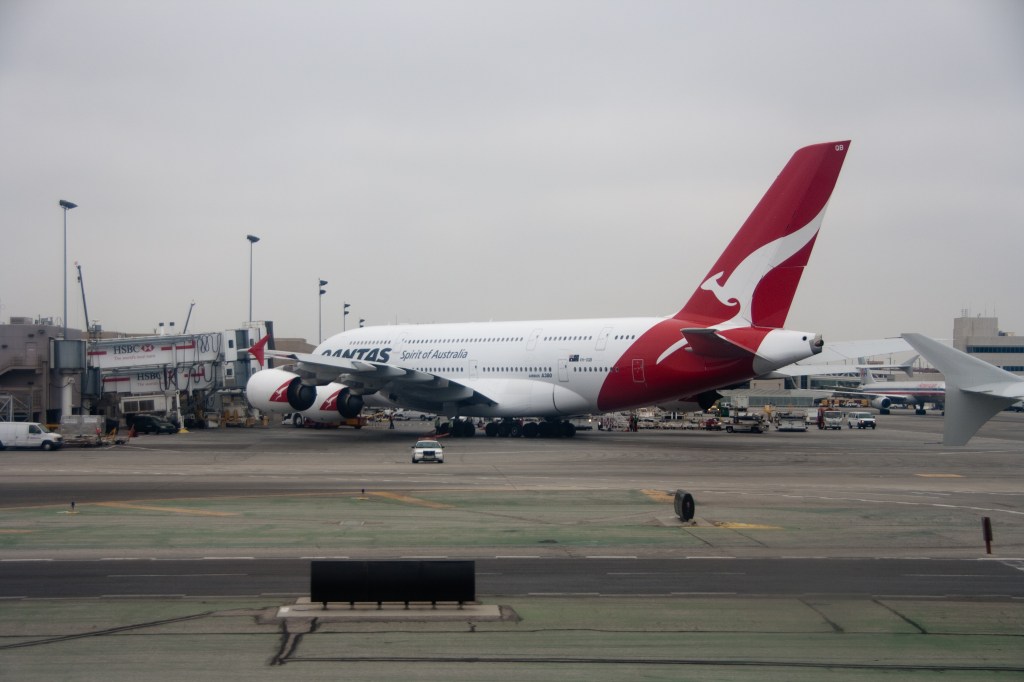
Qantas A380 at Los Angeles International Airport

The A380s typically serve high traffic, slots-constraint air corridors, including Sydney-London via Singapore, as well as Sydney-Los Angeles and Sydney-Dallas Fort Worth.

Qantas has earlier said in April that its A380 upgrade programme was still on track, but later reversed its position in May, saying that it will be pausing the upgrades as it reviews its fleet.

Qantas Group chief executive Alan Joyce has said several times in the past months that the global demand for air travel will take years to recover and hence the airline has is undertaking the review to reshape the airline’s future around a post-Covid-19 travel landscape.

For now, all 12 A380s that Qantas has under its fold will be stored, with six that are yet to be refurbished likely to be sent for long-term storage at California’s Mojave Desert, according to Executive Traveller.

Qantas has not committed to whether it will return all 12 A380s to flying in the future, but if the fleet is indeed reduced, the six refurbished aircraft will be the first to take to the skies.

Australia will probably not admit leisure travellers until 2021

Australia’s trade minister Simon Birmingham has said earlier this week that the country is unlikely to reopen its border to international travellers until 2021. However, it’s looking at how it can to relax entry rules for students and other long-term visitors.

What does it mean for Singapore?

Simply put: don’t expect to step foot onto a Qantas flight, nor into a Qantas lounge in Singapore anytime this year.

Qantas Singapore First Lounge, opened in late 2019

While many are hopeful for another trip this year, given how countries has now started implementing laborious requirements including mandatory quarantine and pre- and post-travel tests, leisure travel just doesn’t seem anywhere near.

As such, it’s unlikely that Qantas will send the A380s back into Singapore any time soon, nor continue its fifth-freedom service to London from Singapore. If at all, Qantas will likely serve Singapore as an end-destination with smaller aircraft such as the Airbus A330s and the Dreamliner Boeing 787-9s.

Marriott Bonvoy credit extra elite nights for elite members; offers off-peak award rates for stays up to 31 Jul

Marriott Bonvoy is offering off-peak redemption rates at more than 5,500 properties globally, although some properties in Singapore are excluded

Given how Covid-19 has disrupted the travel industry this year, Marriott has come up with kind of a two-in-one promotion.

Marriott Bonvoy offer 50% elite nights for current elite members

The first part of it is that Marriott will be giving all members bonus elite night credits. The number of credits given the each member will be 50% of the elite tier they earned in 2019.

Note that this is not the actual number of nights you clocked last year, but rather, the number of nights you need to qualify for the tier. This means:

  • Silver Elite members will get five elite nights
  • Gold Elite members will get 13 elite nights
  • Platinum Elite members will get 25 elite nights
  • Titanium Elite members will get 38 elite nights
  • Ambassador Elite members will get 50 elite nights

The elite nights will be deposited into members’ accounts by the end of July. According to View from the Wing, Marriott will also count these elite nights towards lifetime statuses. 

Off-peak award redemption

Marriott is also concurrently offering more than 5,500 properties under its portfolio available for booking at off-peak rates. To book these cheaper awards, the bookings must be made between 15 Jun and 30 Jun for stays by 31 Jul 2020. Note that this is not implemented across all properties.

Marriott has introduced a three-tier award pricing since mid 2019, and expectedly it was rather difficult to look for off-peak awards. With this ‘promotion’, members can expect to save up to a third of the points required for a standard tier redemption.

For most people, this promotion will probably means cheaper staycation options within your countries, given that international travel is going to be highly unlikely before the end of the year.

In Singapore, these are the properties available and their categories:

HotelCategory
Sheraton Towers Singapore5
Singapore Marriott Tang Plaza Hotel5
St Regis Singapore6
Warehouse Hotel5
Four Points by Sheraton Singapore5
Westin Singapore5
W Singapore Sentosa Cove6
Le Meridien Singapore Sentosa5
Courtyard Singapore Novena5
JW Marriott Singapore6

A quick check on the Marriott website showed that not all properties were offering the off-peak pricing, so be sure before you book. Also, most properties are offering room rates at an all-time low, so you might be better off paying cash than burning your points.

Final thoughts

This promotion is rather well timed, as Singapore further liberalises its Covid-19 control measures to allow for socialisation and hopefully, staycations as well.

While the elite nights make it a worthy cause to chase after a higher elite status for next year, given that international travel is going to be severely restricted for the rest of the year, it’s going to be highly unlikely to clock those additional nights to jump to the next level.

Jetstar Asia extends validity of credit vouchers to 12 months

The vouchers were previously only valid for six months from date of issue.

Many people are probably be holding on to a handful of travel credit vouchers from airlines, given the spate of cancellations that happened since Covid-19 hit the world in a big way.

As the pandemic stretches out and continue to batter the aviation industry, Jetstar has updated its policy around the credit vouchers that it has earlier issued for cancellations.

Jetstar Asia extends the validity of vouchers to 12 months

Good news to those who are holding Jetstar Asia credit vouchers: the validity of the vouchers have been extended from six to 12 months, from the date of voucher issue.

In addition, the credit voucher can now be used over several transactions, instead of a single one under its usual terms and conditions.

This news was made known in an email to customers today:

We wanted to let you know that we’ve made the Jetstar credit voucher you received for booking [redacted] even more flexible.

From today, all new and existing unused vouchers issued by Jetstar Asia in relation to COVID-19 will be valid for 12 months from the date of issue and can be used across multiple bookings.

We usually make flights available 12 months in advance, so you’ll now have about 2 years to take your next trip with us and if you have enough credit, you’ll be able to book more than one trip and head off on more than one adventure.

We’ve updated the rules on our end so if you’ve already received your voucher – you don’t need to wait for a new one, it’s been updated in our system & it will work for 12 months and on multiple bookings as long as you have credit remaining.

The other terms and conditions and the way you redeem your voucher on Jetstar bookings won’t change. And, you’ll be able to check how much credit you have left at any time by going to the voucher balance portal and entering your First Name, Surname and Voucher number. You can find more details on our terms and conditions here

We hope this change means that you get the best possible value from your voucher and we’re looking forward to welcoming you onboard soon.

Yours sincerely,

Jennifer Armor

This enhancement is in line with what its parent company Qantas has implemented for its customers, where customers holding travel credit can utilise their credit value in parts, rather than having to use it in a single transaction.

As an enhancement, customers can also check on how much they have left on their voucher in a new portal that Jetstar has set up. Note that the validity has not been extended, so it should be updated to 12 months in due time.

Screenshot of the Jetstar voucher portal

Jetstar Asia has one of the most restrictive credit voucher terms

Jetstar is a group of airlines that has three legal entities: Jetstar Airways (JQ), registered in Australia; Jetstar Asia (3K), registered in Singapore; Jetstar Pacific (BL) registered in Vietnam; and Jetstar Japan (GK) registered in Japan.

As a low-cost carrier, Jetstar only allow refunds under very specific circumstances, but they usually come as an option if you purchase a Max Bundle, which affords customer some flexibility. While you will not get your cash back, you will be able to cancel your ticket for a credit voucher.

This is when it starts to get complicated. For refundable tickets, the different airlines have different Jetstar Airways allow passengers to hold the value in credit for up to three years from the date of cancellation, while Jetstar Asia, Jetstar Pacific and Jetstar Japan only allow six months.

Jetstar credit voucher terms and conditions

Another key condition was that the value of the voucher must be fully utilised in a single transaction for future use – that means that a customer couldn’t use a S$100 voucher for a S$50 fare twice.

Specific to Covid-19, Jetstar Asia has allowed all customers to either make a one-time change, or refund for a credit voucher. For customers who have opted for a refund in March, the expiry would have been in September. With the expiry being three months away from today, and with no signs of travel restrictions being lifted — it’s not a pretty picture.

Final thoughts

While Jetstar isn’t really going to extra mile for customers, this is definitely a good move, even though it barely matches up with what other airlines offer.

Most other airlines had outright offered either a refund or a credit voucher since early days of Covid-19. To entice customers not to refund their tickets, some airlines such as Scoot and Singapore Airlines have offered bonus credit vouchers.

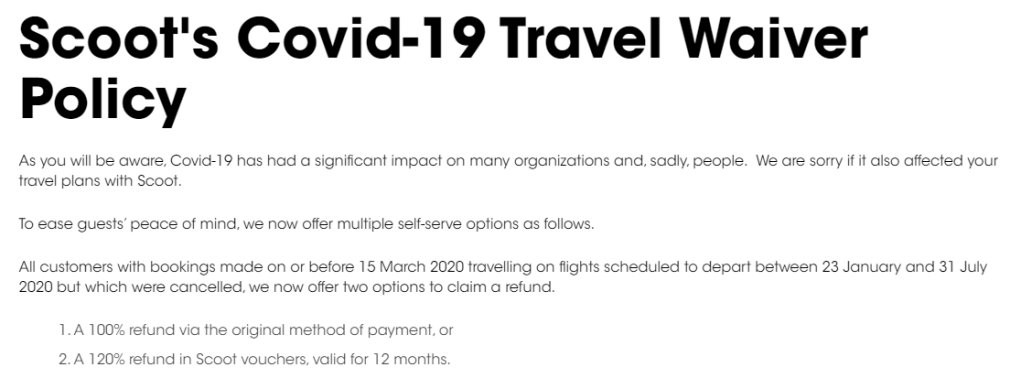
Scoot offering 120% credit voucher

Nonetheless, this is still a good development for customers with Jetstar vouchers. As travel restriction remains in place, we can only wait to see when can these vouchers be utilised for future travel.

American Express adds Qantas as a redemption partner

You can now convert your American Express Membership Rewards points to Qantas Frequent Flyer points

American Express has added Qantas to its fold of frequent flyer programmes partners, the fourth Oneworld programme to be added. This latest addition will allow both its charge card and credit card members to convert their Membership Points into Qantas points.

The details

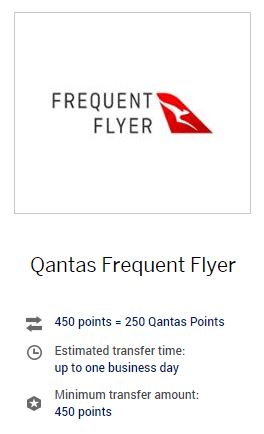
Cardholders with Membership Rewards (MR) points will be able to convert 450 MR points to 250 Qantas points. This conversion rate is similar to what Amex offers for other FFPs, including Krisflyer, Asia Miles and Emirates Skywards.

For Amex Centurion or Platinum Charge cardmembers, the conversion rate is a preferential 400 points to 250 airline miles.

Second widest range of conversion partners

This brings the total number of transfer partners for Amex to nine partners, tied in the second spot with Standard Chartered. Citibank remains at top spot with the most number of redemption options for your credit card points.

The full list of airline frequent flyer programme conversion partners for Amex is as follow:

  • British Airways Avios (Oneworld)
  • Cathay Pacific Asia Miles (Oneworld)
  • China Airlines Dynasty Flyer (Skyteam)
  • Eva Air Infinity Mileagelands (Star Alliance)
  • Emirates Skywards
  • Malaysia Enrich (Oneworld)
  • Qantas Frequent Flyer (Oneworld)
  • Singapore Airlines KrisFlyer (Star Alliance)
  • Thai Royal Orchid Plus (Star Alliance)

But… should you convert your points to Qantas?

The short answer: no.

And the reason for that is not because Qantas has a bad programme inherently, but because of the way Qantas points are valued.

Qantas structures its frequent flyer programme rather differently, so the value of a Qantas point is not within the same range as what you’d value a mile from most other programmes.

I have long argued that the value of Qantas points should not be equated to other frequent flyer programmes for two reasons: first, the redemption award charts are always significantly higher than what other programmes charge for a similar trip; secondly, Qantas typically awards significantly more points for a flight segment than many other carriers would for a similar trip.

Award chart

Qantas uses a distance-based chart for flight awards, which is similar to many Oneworld programme, and you can refer to the full chart here. For simplicity sake, this is what Qantas and other Oneworld airlines charge for a one-way journey on Qantas from Singapore to Sydney:

EconomyBusinessFirst
Qantas Frequent Flyer25,20068,400102,600
British Airways Executive Club20,75062,00082,500
Cathay Pacific Asia Miles27,00061,00087,000
Award rates for one-way ticket from Singapore to Sydney

As you can see, Qantas comes up being the most expensive in the premium cabins across all carriers, requiring up to 25% more points than what the partners will charge. To add salt to the wound, Qantas slaps on a hefty charge for award tickets, further diminishing the value of the award. Fancy shelling out $350 in fees for an award ticket from Singapore to Sydney?

Earn rate

Now, to paint you another perspective, this is how many miles you will earn on the operating airline’s frequent flyer programme for a one-way flight from Singapore to Sydney.

Note that both Qantas and British Airways offer bonus points for members with elite tiers, but we will exclude that for now.

Airline / ProgrammeEconomy Saver
(or equivalent)
Economy
(highest fare class)
Business
(lowest fare class)
Business (flexible)First
(lowest)
Singapore Airlines / Krisflyer19563912489058687824
British Airways / Executive Club9793916587497909790
Qantas /
Qantas Frequent Flyer
260052007800845010400
Earn rates for one-way trip from Singapore to Sydney

In all cases, you easily earn over 30% more Qantas points than Krisflyer miles. Compared to BAEC, the number varies, but you are likely to benefit more if you are flying cattle class and if you don’t have status with BAEC.

Having said that, Qantas doesn’t nab you as many points when you fly other oneworld airlines, but that’s a common practice.

For instance, if you were to fly to Hong Kong on Cathay Pacific:

Airline / ProgrammeEconomy Saver
(or similar)
Economy Standard
(or similar)
Economy
(highest fare class)
Business
(lowest fare class)
First
(lowest fare class)
Cathay Pacific /
Asia Miles
1,0001,8002,0002,5003,500
British Airways / Executive ClubNone4001,6012,0012,402
Malaysia Airlines /
Enrich
None7941,5881,9852,382
Qantas /
Qantas Frequent Flyer
None1,0002,0002,5003,000

While not fantastic, Qantas doesn’t come up too short – as compared to other oneworld members, it usually dishes out the most number of points for a similar itinerary.

Final thoughts

Transferring any credit card reward points to Qantas Frequent Flyer programme is a dead no for me, given the relative lower value of a Qantas point compared to many other programmes. Qantas probably know that its own currency is worth less than other airlines’ miles, but has always stuck to parity when it comes to conversion rates vis-a-vis other programmes.

The best way to rack up Qantas points is in flying and not through credit card conversions, unfortunately. So this means that the programme is only useful insofar as frequent flyer programmes were originally designed for: rewarding those who actually fly.

So if you find yourself heading Down Under pretty often, you will find yourself benefitting more from earning points by flying Qantas and placing your points with Qantas Frequent Flyer than those who rely mostly on credit card spending. If you do a lot of flying within Southeast Asia, you can also earn a fair number of points from flying Jetstar, especially if you buy bundles often. This is a much better proposition than trying to earn Krisflyer miles on Scoot flights.

Having said that, there have been instances where banks run bonus rates for conversions, such as the DBS offers last year where you get up to 25% bonus. Where they happen, the programme may still offer good value.

Singapore Airlines commences transit arrangements for passengers from Australia, New Zealand

Transit via Singapore only applicable for customers travelling one-way from seven cities in Australia and New Zealand

Singapore Airlines announced Tuesday (11 Jun) that it has gotten regulatory approvals to facilitate transit journeys from a handful of cities in Australia and New Zealand.

Singapore authorities have earlier announced that it will allow transit passengers once again from 2 Jun, subject to regulatory approval of airlines’ plans to manage these passengers. The onus was on airlines to submit a proposal in managing to health risks and segregating transit passengers away from departing passengers.

Singapore Airlines transit-approved origin cities

Customers travelling from the following cities will be allowed to transit in Singapore:

  • Australia:
    • Adelaide
    • Brisbane
    • Melbourne
    • Perth (on Scoot)
    • Sydney
  • New Zealand:
    • Auckland
    • Christchurch

Note that the transit arrangement is only applicable one-way from Australia and New Zealand to any other SIA destinations. There is currently no transit arrangements for journeys via Singapore into Australia and New Zealand, so customers from anywhere else wanting to visit these two countries will have to find alternative routings.

New Transit Holding Areas

Singapore Airlines and Changi Airport has published their plans to manage these transit passengers, with the setup of dedicated Transit Holding Areas (THAs) to segregate transit and departing passengers.

One distinct feature of Changi Airport main terminals (1, 2 & 3) is the fact that departing, arriving and transit passengers all pour into the same transit area without segregation, as security screening are done only at the gate. This allows a seamless transit experience, allowing passengers who have just landed to pour directly into the transit area, without having to navigate through a labyrinth of walkways to get to a central security screening area.

With the setup of the THAs, this will no longer be possible.

The new transit experience

So how will the new transit experience look like?

The experience, in fact, begins at the departing city. Passengers who will be transiting in Singapore will be boarded first (regardless of cabin), and seated in a designated zone in their respective cabins on the aircraft away from the other passengers who are terminating their journeys in Singapore.

Once in Singapore, transit passengers will disembark last, after all the other passengers leave the aircraft. This group of passengers will be escorted to the THAs by ground staff. Transit passengers will not be allowed to visit any shops, restaurants, lounges and any amenities along the way.

There will be a temperature screening area at the entrance of all the THAs, and only authorised passengers and staff will be allowed into the THAs. Transit passengers should also note that they are required to wear a mask at all times, except when they are eating, drinking or smoking.

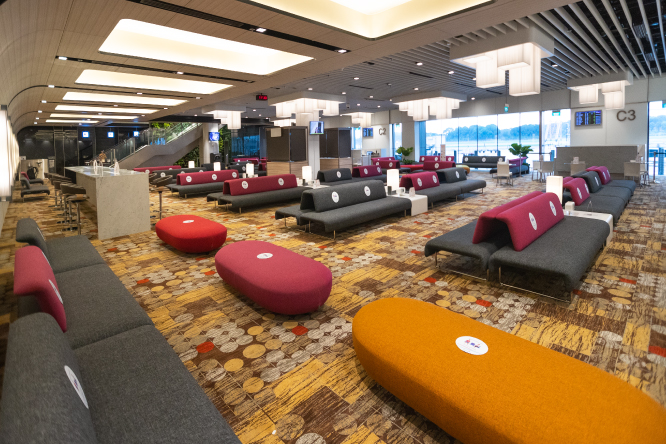
Based on photos published by Changi Airport, it seems like there are two THAs: one at A21, and one at C3 (ground floor gate holdrooms at gate C1).

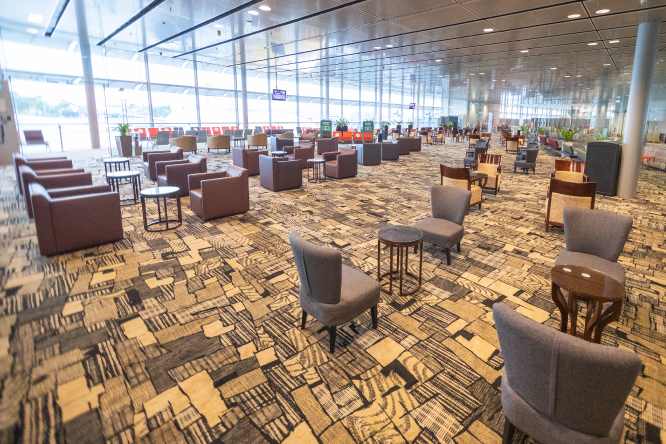
Transit Holding Area (Gate C3)
Transit Holding Area (Gate A21)

Once in the THAs, passengers will not be allowed to roam anywhere else within the airport.

The amenities within the THAs include:

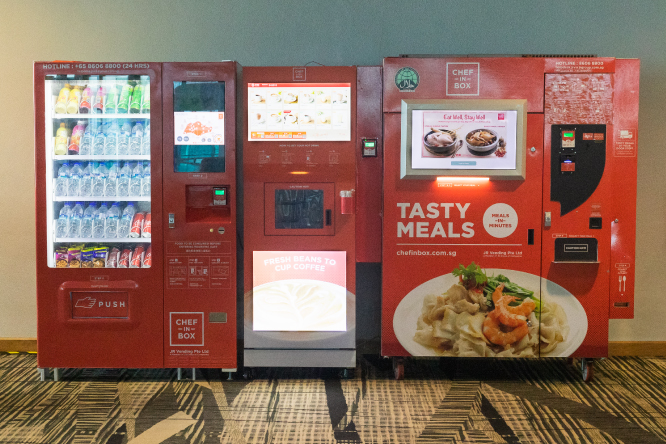
  • Vending machines
  • Mobile food kiosks
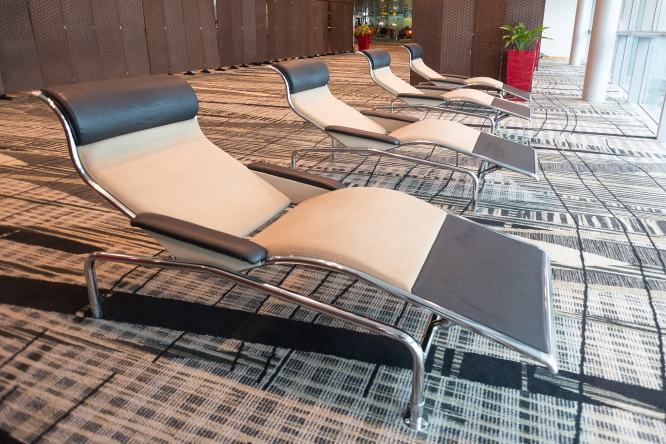
  • Sleeping recliners
  • Restrooms
  • Wi-fi (complimentary across the airport)
  • Smoking room
  • Shopping concierge service

Customers who wish to shop may utilise Changi’s shopping concierge service to purchase cosmetics or other tax-free items. Unfortunately, the concierge will not be able to purchase duty-free alcohol products on behalf of customers.

Vending machines
Snooze areas

Customers who wish to order food and drinks from any of the airport restaurants, cafes or bars can also place their orders by scanning a QR code and ordering online. The orders will be brought to them.

What about lounges?

Changi Airport has left it to airlines to decide if customers can visit a lounge, and SIA has decided to set up a ‘lounge’ (kind of) within the THAs for their premium customers.

For premium passengers, including suites, first class, business class and PPS Club passengers on Singapore Airlines who are transiting in Singapore, they will not be allowed to visit the SilverKris lounge at Terminal 3. Instead, they will be directed to a premium waiting area at the THAs.

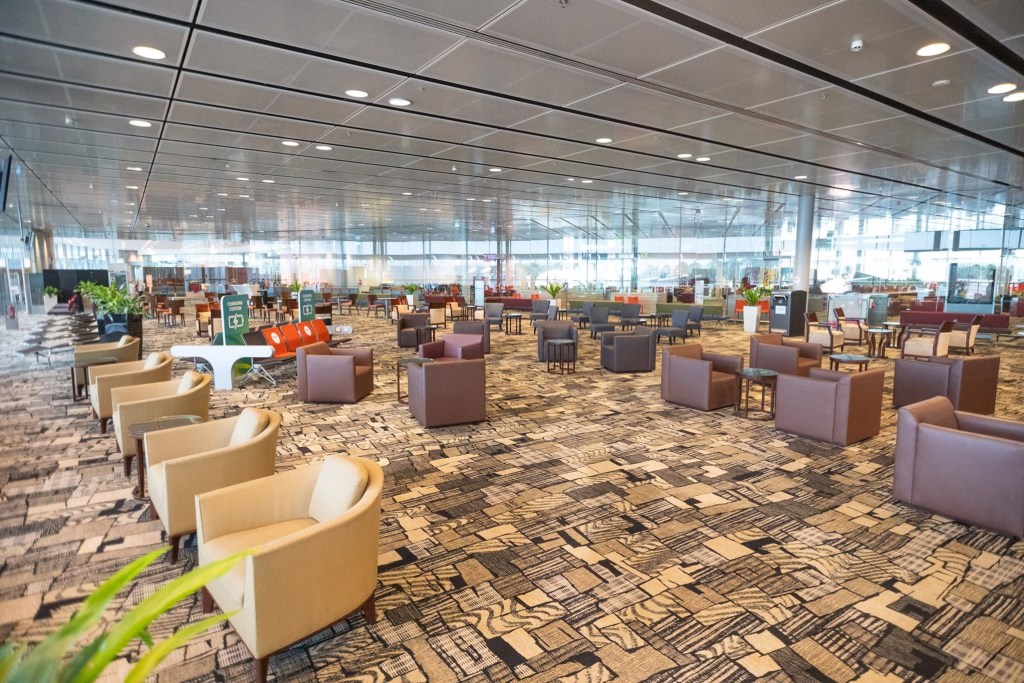
Premium passengers transit area

As you can see from above, Changi Airport has made some effort in sprucing up the area with armchairs and tables similar to some of the lounges’ offerings, although this is definitely far from the actual lounge experience.

SIA will also make complimentary food and beverages available for its premium customers, although no further details are available.

No limit to transit duration

Neither Changi Airport nor Singapore Airlines have imposed a maximum layover duration, so that means it’s technically possible to do a 23-hour layover if you will like to.

However, this new arrangement will require transit passengers to remain in the THAs at all times until their next flight. Note that all the transit hotels are closed at the moment, so passengers with long layovers should note that they have practically no other options.

All transit hotels, including Aerotel Singapore, are temporarily closed

Final thoughts

It is definitely yet another good step towards recovery, as details on how transit arrangements are unveiled by Singapore Airlines today. Of course, we will expect the airline to expand this arrangement to passengers travelling from other regions in time to come.

The transit arrangement is definitely far from ideal, but in the usual Changi fashion, you can trust the airport to still try their best to make the transit experience as comfortable as they can.

It’s hard to say if and when we will return to the previous ‘free-flow’ model where passengers are free to mix around. We are definitely moving towards a new normal, and this episode may perhaps nudge the airport into rethinking its airport experience and passenger flow model.