Fuel surcharge on most sectors to be removed for tickets issued from 1 May
Cathay Pacific updated yesterday (14 Apr) that it will axe fuel surcharge on most tickets, with few exceptions.
From 1 May, Cathay Pacific will remove fuel surcharges, better known as YQ within the industry, for all flights, except for select journeys from Japan and the Philippines. Note that this date applies for tickets issued from 1 May onwards, and not for tickets issued now for travel from 1 May.
The details
Cathay Pacific long had a fuel surcharge component that ranges around USD48.7 (~S$70) at present, with some exceptions.
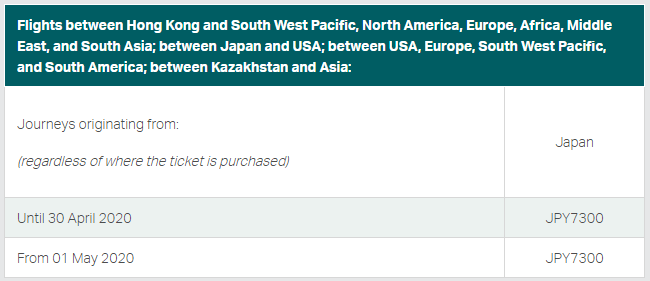
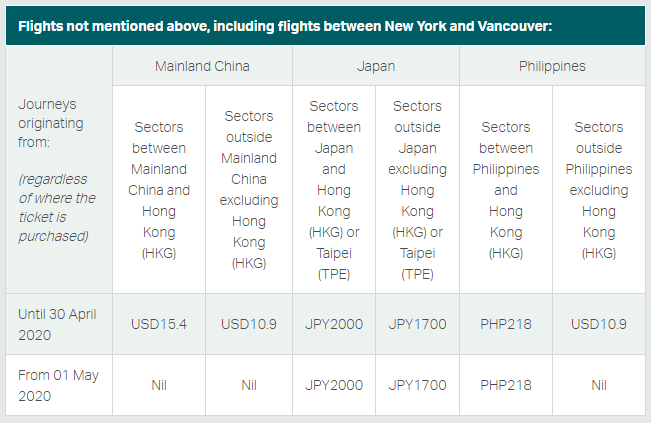
From 1 May, all fuel surcharges will be removed, except the following:
For example, if you bought a ticket that starts from Tokyo to Sydney via Hong Kong, you will pay JPY2,000 (Tokyo to Hong Kong) + JPY7,300 (Hong Kong to Sydney) each way in fuel surcharge – and this will continue after 1 May.
Wait, what is fuel surcharge?
Fuel surcharge was a concept introduced back more than a decade ago when oil prices skyrocketed, so this gives airlines a bit of a cost relief by passing on these surcharges to the customers.
Over the years, oil prices have moderated itself. In many countries, airlines are also required by law to advertise all-in fares, and pricing strategies have also gotten more complex and so many airlines such as Singapore Airlines and Qantas have simply removed the YQ component of the fare and folded them into the base fare instead.
One Mile at a Time has a pretty long essay on fuel surcharge, which you can read more about here if you are interested.
What does this mean for customers?
In theory, this should mean you would be able to shave about USD48 (SGD70) off your fares per sector, but in reality you probably won’t feel a difference given that airlines have long been displaying ‘all-in’ fares, which will have these fuel surcharge included anyway.
The key target group who will feel the impact of this will be those using their miles for award tickets, they will typically have to fork out in cash any additional charges, including airport fees and fuel surcharges. With the removal of this charge, they will simply be paying just the airport charges in most cases.
Having said that, if you are using Asia Miles to redeem for other oneworld partner airlines such as British Airways who still has the fuel surcharges, these charges will still be passed on to you.
Flights from Auckland, Hong Kong, London and Los Angeles to Australia will be available for those looking to return to Down Under
Qantas has announced a series of rescue flights to bring back Australians to Australia over the next few weeks.
Four cities are chosen: Auckland, Hong Kong, London and Los Angeles – arguably the most significant city for Australia in each continent – where there will be at least one flight a week.
Qantas said that these flights are mounted to facilitate essential travel as well as for Australians who with to return home. For those who wish to book, you will have to book direct on Qantas.com.
The fine print
Given that these flights are mounted under extraordinary circumstances, there are some caveats for these flights, which Qantas has listed on their page. In essence:
Only economy class seats will be available for booking.
There will be limited onboard food and beverage service – which we can presume
There will be no in-flight entertainment, as Qantas has suspended its licencing agreement with the supplier at the moment
No Qantas Frequent Flyer benefits will be given. This means that the flight will not earn status credits and Qantas points, nor will seats be bookable with points.
Seat selection is also unavailable to enable Qantas to allocate seats factoring in social distancing requirements.
Full schedule
The schedules and fares are as follow:
Sector
Dates of ops
Flight no.
Dep / Arr (flight time)
Aircraft
Fare (one-way, Economy)
HKG-BNE
15, 17, 22, 24 & 29 Apr; 1 & 6 May
QF98
1930 – 0615 (+1) 8h 45m
B787-9
HKD3499
HKG-MEL
18, 20, 25 & 27 Apr; 2 & 4 May
QF30
1930 – 0655 (+1) 9h 25m
B787-9
HKD3497
BNE-LAX
16, 23, 30 Apr
QF15
1000 – 0600 13h
B787-9
AUD749
LAX-BNE
17 & 24 Apr, 1 May
QF16
2230 – 0520 (+2) 13h 50m
B787-9
USD461
MEL-LHR
19 & 26 Apr, 3 May
QF10
1515 – 0505 (+1) 22h 50m
B787-9
AUD1335
PER-LHR
19 & 26 Apr, 3 May
QF10
1850 – 0505 (+1) 17h 15m
B787-9
AUD1335
LHR-MEL
22 & 29 Apr, 6 May
QF9
1210 – 1855 (+1) 21h 45m
B787-9
GBP721
BNE-AKL
16,18, 23, 25 & 30 Apr; 2 May
QF119
0925 – 1435 3h 10m
B787-9
AUD335
MEL-AKL
19, 20, 26 & 27 Apr; 3 & 4 May
QF151
1030 – 1535 3h 5m
B787-9
AUD335
AKL-BNE
16,18, 23, 25 & 30 Apr; 2 May
QF126
1715 – 1855 3h 40m
B787-9
NZD320
AKL-MEL
19, 20, 26 & 27 Apr; 3 & 4 May
QF156
1610 – 1805 3h 55m
B787-9
NZD320
Qantas has tentatively listed that it will be using the Boeing 787-9 Dreamliner to operate these flights, but I will imagine that it will deploy an aircraft that will best suit the demand closer to date.
For instance, for the Hong Kong and Los Angeles services, Qantas can possibly deploy the A380 if there’s a huge demand, while still maintaining a social distancing policy on the flight.
How do these fares compare?
Virgin Australia is also mounting some flights to Hong Kong and Los Angeles from its Brisbane base.
Virgin’s fare is somewhat comparable to Qantas’, with the biggest difference being about AUD100 between the two:
Sector
Qantas fare
Virgin Australia fare
Hong Kong to Brisbane
HKD3499
HKD2983
Brisbane to Los Angeles
AUD749
AUD855
Los Angeles to Brisbane
USD461
USD475
Unlike Qantas who is only selling seats on the Hong Kong to Australia sector, Virgin Australia is also selling flights from Brisbane to Hong Kong at AUD625, one way.
Comparing these to regular fares before COVID-19 consumed the aviation industry, the fares can be a little pricier than usual, given that you can get a return sale fare from Hong Kong to Australia from HKD3500.
But of course, these are extraordinary times, so the price is very reasonable for a rescue flight, and even more reasonable than the AUD1000 that Qantas originally wanted to charge passengers on its Wuhan rescue service back in January (this was later retracted when the government footed the bill).
1 point per S$1 spent via delivery; double the points if you buy directly from the restaurant and pick up yourself.
Accor is offering bonus points for all takeaway and delivery orders from its restaurants during Singapore’s ‘circuit breaker’ month between 7 Apr and 4 May.
The offer
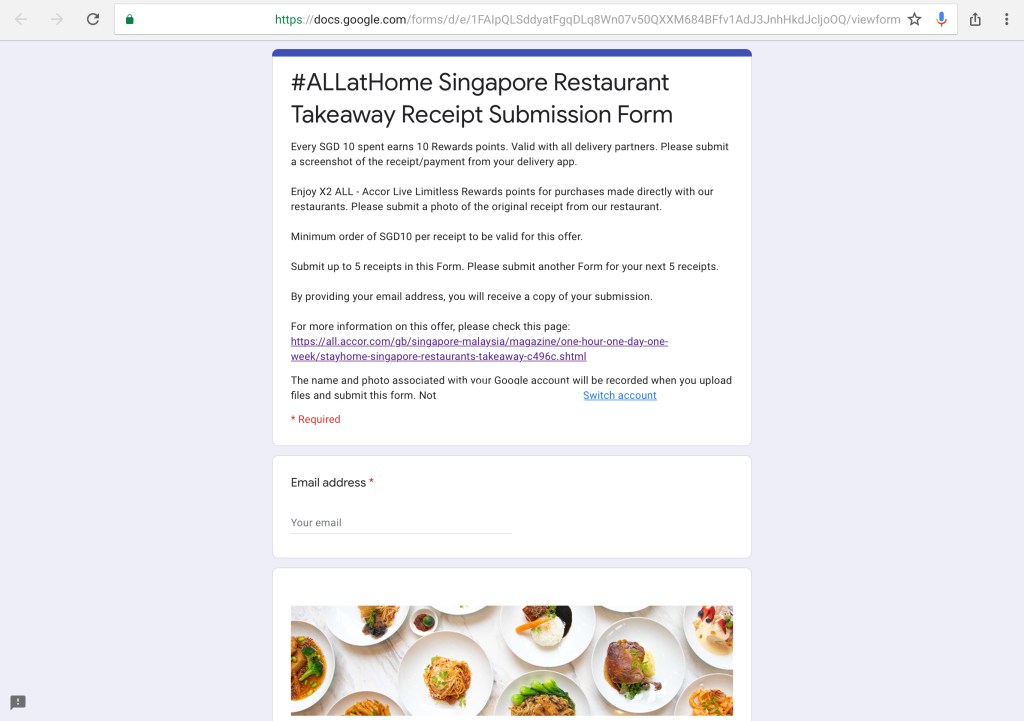
Accor will award 1 point per S$1 spent via delivery service partners (i.e. Deliveroo, GrabFood & Food Panda), or 2 points per S$1 spent if you order directly from the restaurant and pick it up yourself.
Given that the normal earn rate is 1 point per EUR1 (which translates to 0.65 points per S$1), this translates to a roughly 50% or 200% bonus points respectively.
Note that there’s a minimum spend of S$10 per receipt, not that it matters because I’ll be hard-pressed to find anyone spending under that amount if you were to order from a hotel’s restaurant anyway.
How to register for the promotion
Unfortunately the promotion is a little backwards in terms of mechanism – first you collect all the receipts, then you slowly fill up this Google Doc by 5 May 2020.
All points will be credited by June 2020.
Which restaurants qualify?
The promotion page does provide a short list of restaurants that are open for delivery and takeaway, including:
Enjoy delicacies from Racines, Sofitel Singapore City Centre in the comfort of your home
Under the terms and conditions, all restaurants that earn points for dining normally would be considered a participating restaurant, but it seems like many restaurants are closed during this period of time.
Most Star Alliance airlines are moving to Terminal 3
Updated 29 April 2020: Changi Airport has published the full list of terminal moves, with most of the previously reported moves still accurate. The only exceptions are those who are supposed to move to T4, of which all of the airlines are currently suspending operations.
Changi Airport made a brief update on their website last night on the move since the announcement to close Terminal 2, although this was quickly removed.
For those who have not been following this development, Singapore Transport Minister Khaw Boon Wan announced in Parliament that given the on-going Covid-19 development, Terminal 2 will be shut for 18 months to facilitate the upgrading works from 1 May 2020 through October 2021.
As such, airlines currently operating out of Terminal 2 will move to the other three terminals, which will provide some cost savings and accelerate the Terminal 2 upgrading works by as much as a year.
List of new terminals
The full list of airlines was originally published as follow, but Changi Airport has since updated to list them all as “TBC”:
[Update 29 Apr 2020] Changi Airport has updated the confirmed list of terminal moves, as below.
Airline
Terminal
Air India (AI) – currently suspended
4 TBC
Air India Express (IX) – currently suspended
4 TBC
ANA (NH)
1
Ethiopian Airlines (ET) – currently suspended
3
Etihad Airways (EY)
3
Indigo (6E)
4 TBC
LOT Polish Airlines (LO) – currently suspended
3
Lufthansa (LH)
3 TBC
Malaysia Airlines (MH) – currently suspended
1
Royal Brunei Airlines (BI)
1
Sichuan Airlines (3U)
1 TBC
Swiss International Airlines (LX)
3 TBC
United Airlines (UA) – currently suspended
3
This move seems to make sense, as Malaysia Airlines now belong with its other oneworld partners, including Qantas, Qatar and Japan Airlines. This move will allow a better transfer option with its partners, as well as lounge access for eligible customers.
Terminal 1 now has probably the strongest offering of lounges by a single alliance, with three business class lounges (Qantas, Qatar and British Airways), and one dedicated first class lounge by Qantas.
Qantas first class lounge at Changi Airport Terminal 1
Having said that, given the earlier announcement on a deeper partnership between Singapore Airlines and Malaysia Airlines, the separation of both airlines across different terminals at Changi may be a temporary arrangement.
For the bulk of the Star Alliance airlines moving to Terminal 3, this is also a logical move given that Singapore Airlines is operating out of that terminal. Similar to its arrangements at Terminal 2, passengers travelling on these other Star Alliance airlines will be able to access Singapore Airlines’ SilverKris or Star Alliance Gold lounge, depending on the class of travel or elite status.
Final thoughts
As I’ve mentioned in my previous article, this downturn in passenger numbers may be a silver lining during this coronavirus episode, given that Changi Airport was on its way to hitting the ceiling in handling a good number of passengers comfortably within its four terminals.
While drastic and somewhat tragic for the aviation industry, this hard pause allows Changi to close off one terminal entirely and focus on relooking its operations while it has the space to. Many times in the past, the key challenging with any infrastructure work at Changi Airport is limited by its ability to manage on-going operations.
This allocation of terminals somehow has also cement Terminal 1 as a oneworld fort, while moving all the Star Alliance members to Terminal 3. There are obvious benefits for this, but the flip side of it is that airport resources are usually not optimised, given that not all alliances are equally represented and have equal operational loads at every airport.
Given Changi’s principles of pushing connectivity even across alliances and also wanting to optimise operations for passengers, my guess is that this arrangement most likely will be temporary at best, until things are somehow back to normal in a few years’ time.
Till then, I’ll be flying Malaysia Airlines quite a bit so I can enjoy Qantas’ lounges.
Move will help to accelerate the upgrading works, will be completed by up to one year ahead of schedule
Singapore Transport Minister Khaw Boon Wan announced yesterday (6 Apr 2020) in Parliament that Singapore Changi Airport will shutter Terminal 2 1 May 2020 onwards for 18 months.
The airport operator does not think that traffic will return to its former levels for the rest of this year as a result of the coronavirus pandemic, as such, it only makes sense to do a full closure of the terminal to facilitate the previously announced upgrading works, which was slated for a 2024 completion.
Along with Terminal 2’s temporary closure, Changi Airport Group has also said that it may suspend Terminal 4’s if all the airlines operating out of the terminal suspend flights.
In view of the very small number of flights at Terminal 4 (T4), operations at the terminal have been scaled down considerably with a small number of aircraft boarding gates kept in use and shops allowed to close early after the last flight for the day. If the remaining airlines at T4 choose to suspend or adjust their flight schedule, CAG will also consider suspending operations at T4 temporarily but with the objective of restarting operations quickly when airlines confirm the resumption of flights.
Passenger traffic numbers at Changi Airport has fallen off a cliff since beginning of the year. In February, Changi recorded only 3.45 million, a drop of over 30% as compared to the same month in 2019. This is also the lowest monthly passenger traffic number since February 2011, which saw 3.39 million passenger movements.
This number is expected to further dive in March and April, given that air traffic has almost come to a grinding halt given all the border control measures many countries have enacted, with a third of the world in isolation or quarantine.
According to some sources, aircraft movements for March have decreased by up to 90% at Changi Airport. What this means is that passenger traffic for March should have collapsed, given that none of the flights were anywhere close to full. We will only know later this month when Changi Airport Group reveals the numbers.
Singapore Airlines and Silkair to consolidate at Terminal 3 from 8 April
With the upcoming closure of Terminal 2, Singapore Airlines and Silkair announced that it will consolidate all its flights to Terminal 3 from 8 Apr 2020.
With this move, Singapore Airlines has closed its Terminal 2 SilverKris lounge as well, leaving the Terminal 3 SilverKris business class lounge as the only SIA lounge opened worldwide for the time being. The other Singapore Airlines lounges in Terminal 3, including the Krisflyer Gold Lounge, the First Class Lounge and the Private Room, are also all temporarily closed.
Singapore Airlines SilverKris LoungeTerminal 3is the only lounge operating in the SIA network right now
Move of other Terminal 2 airlines to be announced later
While Changi Airport has announced the closure of the terminal from 1 May, the move of other airlines will only be announced later.
As Scoot has moved to Terminal 1 since late 2019, we suspect that most of the airlines will be moved to either Terminal 3 or 4, given that Terminal 1 airlines are also now ‘encroaching’ onto B gates in Terminal 3 and E gates in Terminal 2.
The following airlines are currently operating out of Terminal 2:
Air India (AI)
Air India Express (IX)
ANA (NH)
Ethiopian Airlines (ET)
Etihad Airways (EY)
Indigo (6E)
LOT Polish Airlines (LO)
Lufthansa (LH)
Malaysia Airlines (MH)
Royal Brunei Airlines (BI)
Sichuan Airlines (3U)
Swiss International Airlines (LX)
United Airlines (UA)
Most of these airlines have suspended services to Singapore for the time being, so moving them around will be relatively easier.
Update: Changi Airport has made a brief announcement on where these airlines will move to. The list has since been removed, so we are expecting more changes.
Terminal 2 upgrading to be accelerated
Changi Airport Group announced earlier that Terminal 2 is going to under major upgrading works, which started in Feb 2020.
The refurbishment works were originally going to take place while the terminal is still in operation, all the way through 2024. This was also the same process when Changi refreshed Terminal 1 years ago, in keeping the terminal operational while upgrading the building section by section.
With this closure, it is expected that the upgrading works will now be accelerated and completed up to a year earlier than the 2024 deadline.
The refreshed terminal will have more space and can accommodate up to 5 additional million passenger movements a year.
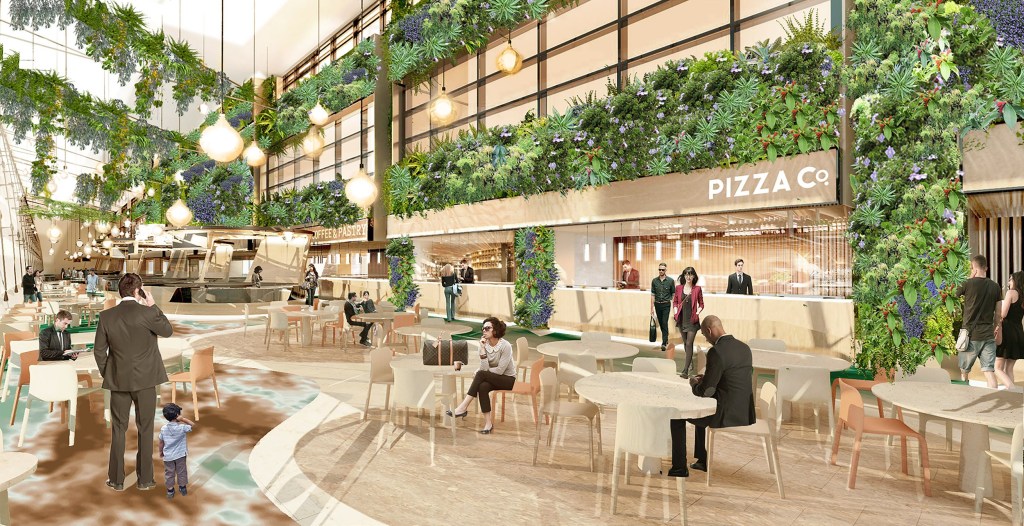
Artist’s impression of upgraded Terminal 2at Changi Airport
Final thoughts
This is no doubt a darker period for the airport, who have seen many years of record passenger numbers for the better part of the past decade.
It will be without doubt that this year will see significantly smaller number, which may be a blessing in disguise for Changi Airport, given that the increasing number of passengers handled each year slowly inched towards the maximum capacity.
During peak seasons, many passengers would have noticed particularly crowded terminals and long queues at check-in and at immigration. This slowdown will perhaps help to moderate growth a bit until Terminal 5 is ready in 2030, although I personally think this may be delayed given the current outlook.






 Shanescape