Earn up to 31,000 miles if you become one of the top three referrers in the month of February.
To celebrate its 21st anniversary, Krisflyer has launched a member-get-member promotion, giving out bonus miles for referrers and those referred.
Earn up to 31,000 Krisflyer miles for referring new members
Each referral made will earn the referrer 500 miles if certain conditions are met, while new sign-ups will enjoy 500 miles, no questions asked.
The new sign-ups must be done between 31 January and 29 February to qualify for the promotion.
How to refer?
Very simple: simply go to Singaporeair.com and click on the ‘Sign Up’ link on the top right corner.
Sign up link on Singaporeair.com
There’s no personalised link to send out, but the new member will have to indicate the referrer’s Krisflyer number when signing up:
New members should remember to key in their referrer’s Krisflyer numbers when signing up
Some might find this a little cumbersome, but I think it’s a good way to prevent mass spamming of sign-up links we see on many websites and social media platforms today. To be a referrer, you will have to provide your Krisflyer number to someone (preferably someone you trust), so you will think twice before placing it on a public platform (such as this website).
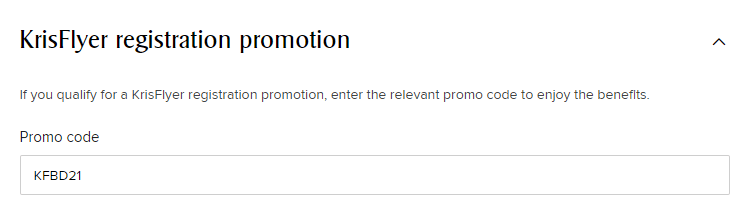
Next, the new member must also put in the promo code KFBD21 in the Krisflyer Registration Promotion field:
Enter KFBD21 in this field. No code, no referral recorded, no miles!
Then, the new member will have to have a qualifying transaction on or before 31 May 2020, which can include:
Miles accrued or redeemed on flown flights on Singapore Airlines, SilkAir and Scoot
Miles accrual from partners
Transfer of points from partner programmes to KrisFlyer
Submission of retrospective mileage claims for flown flights
KrisShop accrual transactions
KrisPay accrual transactions and miles conversions
New sign ups get 500 miles
For those who signed up during this promotional period, they get 500 miles upon signing up as long as they key in the promo code KFBD21 in the Krisflyer registration promotion field.
Referrers’ bonus miles capped at 10,000 miles; top referrers get additional 21,000 miles
If you are referring new members, note that you can only earn up to 10,000 miles, which makes 20 referrals. However, if you are one of the top referrers during the promotion period (31 Jan to 31 May), you will get an additional 21,000 miles.
When will I get the miles?
If you are a new member who just signed up, you will get the miles within 4 to 6 weeks after the sign-up promotional window (i.e. after 29 Feb).
If you are a referrer, you will only get the miles if those you referred make the eligible transaction by 31 May. The bonus miles will be credited 4 to 6 weeks after 31 May.
Final thoughts
While it’s common for Krisflyer (or any other frequent flyer programme for that matter) to offer sign-up bonuses, this is one of the rare times they are encouraging referrals.
Given the referral count is not based on a link but instead relies on new members to key in their referrers’ Krisflyer number, I suspect the participation rate may not be high, as it’s very likely to miss out either one of the fields and thereby voiding the referral. On top of that, the new member has to make a qualifying transaction to be counted as a valid referral.
I’ll be keen to know who even make the 20 successful referrals, which seems quite difficult to achieve!
Full details of the promotion, including terms and conditions can be found here.
With connections from Singapore to over 20 cities in China, which flights are still operating, and which are not?
Note: This is a developing article, updates will be made periodically.
Last update: 10 Feb 11pm, Singapore Time: – Further reductions to Singapore Airlines & Silkair services to China
Update on 5 February 10am, Singapore Time: – Update to Scoot in-flight services to Macau & Hong Kong – Update to Jetstar schedules
The Wuhan coronavirus (nothing to do with Corona beer, guys) is definitely making everyone sit up and mask up, with many countries issuing travel advisories to defer or cancel non-essential travel to China.
Some airlines, such as British Airways and Qantas, have gone a step further to cancel all flights to China, so if you still have to make that trip for one reason or another, it can be pretty confusing trying to find out how and if you can still get in.
Last update as of 10 Feb
Singapore Airlines have announced further cuts to their flights following a plummeting of demand to Mainland China, despite efforts to maintain connectivity.
Their statement below:
As a result of the novel coronavirus outbreak, demand for air travel between Singapore and China has declined significantly.
Singapore Airlines and SilkAir will be further rationalising our flights to China temporarily. Services to some destinations will be temporarily suspended until the situation improves. Details of the affected flights can be found here.
The Singapore Airlines Group has had a long history of operating to China. There are still many Singaporeans working and living in China now, many of whom will still require connectivity between Singapore and China. As the national carrier, we will continue to maintain minimum connectivity to the key cities of Beijing, Shanghai, Guangzhou and Chongqing for now despite the reduced demand.
With Singapore’s DORSCON Level now at ‘Orange’ and with more local cases than imported cases, some countries have started issuing travel advisories against travelling to Singapore. These include:
Kuwait
Qatar
Sarawak in Malaysia – with a mandatory 14-day quarantine
Latest update as of 5 Feb
Singapore-based low cost carriers (Jetstar Asia & Scoot) have suspended all Mainland China flights from 8 Feb to 29 Mar (Scoot) or 31 Mar (Jetstar Asia).
Jetstar has announced extended suspension up to end May for its Shantou and Haikou flights. Jetstar also announced that it will terminate its Hong Kong service (for commercial reasons), and will bring forward the termination date to 15 Feb.
Scoot will suspend all in-flight sales (food, beverage and duty-free items) for services to Hong Kong and Macau as well.
Singapore Airlines have reduced capacity drastically, so if you still need to travel to China, please check with the airline before your travel. (My advice: don’t travel!)
Chinese carriers have also drastically reduced services into Singapore. Air China is the only one that has officially published cancellations, while China Eastern and China Southern seem to be reviewing flights on a daily basis.
Spring Airlines have cancelled its daily Singapore-Shanghai service until end of Feb.
Entry restrictions
As of 2 Feb, several countries have announced entry restrictions for Chinese nationals, and/or foreigners who have been to mainland China in the preceding 14 days. Most countries will still allow foreigners on long term visas (e.g. student visas, work passes, etc) to enter, subject to a 14-day quarantine. Check with individual countries for more info.
The countries and territories who have initiate a temporary ban include:
Singapore
Australia
Canada
Hong Kong SAR
India
Indonesia
Israel
Japan
Philippines
Myanmar
New Zealand
North Korea
Russia
Taiwan
USA
Singapore’s Ministry of Health advisory
MOH has placed the following advisory for the general public:
Singaporeans are advised to defer all travel to Hubei Province and all non-essential travel to Mainland China.
All travellers should monitor their health closely for two weeks upon return to Singapore and seek medical attention promptly if they feel unwell. Travellers should inform their doctor of their travel history. If they have a fever or respiratory symptoms (e.g. cough, shortness of breath), they should wear a mask and call the clinic ahead of the visit.
Travellers and members of the public should adopt the following precautions at all times: · Avoid contact with live animals including poultry and birds, and consumption of raw and undercooked meats; · Avoid close contact with people who are unwell or showing symptoms of illness; · Observe good personal hygiene; · Practise frequent hand washing with soap (e.g. before handling food or eating, after going to toilet, or when hands are dirtied by respiratory secretions after coughing or sneezing); · Wear a mask if you have respiratory symptoms such as a cough or shortness of breath; · Cover your mouth with a tissue paper when coughing or sneezing, and dispose the soiled tissue paper in the rubbish bin immediately; and · Seek medical attention promptly if you are feeling unwell.
Cancelled between 4 to 16, 25 to 28 Feb Cancelled from now until 28 Mar
SQ806/801
Cancelled all days in Feb except 2 & 3 Feb (SQ806), 3 & 4 Feb (SQ801) Cancelled from now until 28 Mar
SQ802/807
Cancelled on 5, 7, 10 Feb
Shanghai
PVG
SQ826/827
Cancelled between 4 to 16 Feb Cancelled from now until 28 Mar
SQ828/831
Cancelled all days in Feb except 2 & 9 Feb Cancelled from now until 28 Mar
SQ830/833
Operating as per normal
SQ836/825
For the month of Feb: SQ836 only operating on 2, 3, 17, 18 Feb SQ825 only operating on 3, 4, 18, 19 Feb Cancelled from now until 28/29 Mar
Guangzhou
CAN
SQ850/851
Only operating on the following days: Feb: 2, 3, 5, 10, 16, 17, 19, 21, 23, 24, 26, 28 Feb Mar: Mon, Wed, Fri
SilkAir
Destination
Airport code
Flight
Status
Shenzhen
SZX
MI962/961
Only operating on 10 Feb, then cancelled until 28 Mar
MI968/969
Cancelled until 28 Mar
MI966/965
Only operating on 16 Feb, then cancelled until 28 Mar
Xiamen
XMN
MI922/921
Only operating on 10 Feb & 15 Feb, then cancelled until 28 Mar
Chengdu
CTU
MI938/937
Cancelled from now until 28 Mar
Chongqing
CKG
MI972/971
Only operating on 14 Feb, 17 Feb, 24 Feb, 2 Mar, 9 Mar, 16 Mar, 23 Mar
MI976/975
Cancelled from now until 28 Mar
MI980/979
Cancelled from now until 28 Mar
Scoot
Destination
Airport code
Flight(s)
Status
Harbin
HRB
TR154/155
Suspended between 5 Feb – 28 Mar
Hangzhou
HGH
TR188/189
Suspended between 5 Feb – 28 Mar
Shenyang
SHE
TR156/157
Suspended between 5 Feb – 28 Mar
Xi’an
XIY
TR134/135
Suspended between 5 Feb – 28 Mar
Nanning
NNG
TR114/115
Suspended between 5 Feb – 28 Mar
Zhengzhou
CGO
TR116/117
Suspended between 5 Feb – 28 Mar
Ningbo
NGB
TR176/177
Suspended between 5 Feb 8 Feb – 28 Mar
Jinan
TNA
TR172/173
Operating on 3 & 7 Feb, suspended between 5 Feb 8 Feb – 28 Mar
Nanchang
KHN
TR112/113
Suspended between 5 Feb 8 Feb – 28 Mar
Wuxi
WUX
TR170/171
Suspended between 5 Feb 8 Feb – 28 Mar
Changsha
CSX
TR124/125
TR124 operating on 3 & 7 Feb, TR125 operating on 4 & 8 Feb, suspended between 5 Feb 8 Feb – 28 Mar
Fuzhou
FOC
TR174/175
Reduced from 4x weekly to 2x weekly, operating on Wed & Sun between 1 Feb to 28 Mar Operating only on 2 Feb & 5 Feb, suspended between 8 Feb – 28 Mar
Guangzhou
CAN
TR100/101 TR106/107
TR100/101 cancelled; TR106/107 operates daily as usual TR106/107 operating daily as usual until 7 Feb, suspended between 8 Feb – 28 Mar
Haikou
HAK
TR118/119
Reduced from 4x weekly to 2x weekly, operating on Thu & Sat between 4 Feb to 28 Mar Operating only on 6 Feb, suspended between 8 Feb – 28 Mar
Kunming
KMG
TR162/163
Reduced from 4x weekly to 2x weekly, operating on Thu & Sun between 11 Feb to 28 Mar Suspended between 8 Feb – 28 Mar
Nanjing
NKG
TR180/181 TR182/183 TR184/185
TR182/183/184/185 cancelled; TR180/181 operating Tue, Thu & Sat between 11 Feb to 28 Mar TR180/181 operating 2 to 6 Feb, TR182/183 operating 7 Feb, suspended between 8 Feb – 28 Mar
Qingdao
TAO
TR186/187
Reduced from 6x weekly to 3x weekly, operating on Tue, Fri & Sun between 5 Feb & 28 Mar Operating on 2, 4, 7 Feb, suspended between 8 Feb – 28 Mar
Tianjin
TSN
TR138/139
Reduced from daily to 2x weekly: operating Tue & Sat from 1 to 29 Feb, operating Wed & Sun from 1 to 28 Mar Operating 4 Feb, suspended between 8 Feb – 28 Mar
Macau
MFM
TR902/903 TR904/905
TR902/903 cancelled; TR904/905 operates daily as usual
Wuhan
WUH
TR120/121
Suspended between 23 Jan – 28 Mar
Scoot will also be reducing in-flight services on flight to Hong Kong & Macau from 5 Feb to 28 Mar. There will be no sale of food and duty-free items in flight, but instead all customers will be provided with a food pack and water.
All pre-paid meals and items will be refunded to the customer’s original mode of payment.
Jetstar Asia
Destination
Airport code
Flights
Status
Guiyang
KWE
3K827/828
Suspended from 31 Jan to 31 Mar
Hefei
HFE
3K885/886
Suspended from 31 Jan to 31 Mar
Xuzhou
XUZ
3K831/832
Suspended from 31 Jan to 31 Mar
Haikou
HAK
3K817/818
Operating as usual until 7 Feb 8 Feb, suspended from 8 Feb 9 Feb to 31 Mar 31 May
Shantou
SWA
3K823/824
Operating as usual until 7 Feb, suspended from 8 Feb to 31 Mar 31 May
Jetstar has earlier announced that it will be terminating its Hong Kong service, and this will be brought forward to be effectively 15 February.
Air China
Destination
Airport code
Flights
Status
Beijing
PEK
CA775/776
Suspended between 3 to 29 Feb
CA969/970
Operating as usual
Chengdu
CTU
CA403/404
Suspended between 2 to 29 Feb
China Eastern
All flights from China (Shanghai, Changchun, Yantai) are mostly cancelled. While some of these flights still appear as ‘scheduled’, no tickets are bookable and it seems like the cancellations are reviewed daily.
China Southern
Select flights from Guangzhou are cancelled, reviewed daily. On average about 50% of the flights are cancelled.
Other Chinese carriers
Spring Airlines
Destination
Airport code
Flights
Status
Shanghai
PVG
9C8549/8550
Suspended between 3 to 29 Feb
Juneyao Airlines
Destination
Airport code
Flights
Status
Shanghai
PVG
HO1397/1398 HO1605/1606
Suspended between 3 to 29 Feb
Cathay Pacific
Cathay Pacific has announced the following cancellations from Hong Kong:
Destination (from Hong Kong)
Airport code
Status
Hangzhou
HGH
Suspended from 2 Feb to 28 Mar
Ningbo
NGB
Suspended from 2 Feb to 28 Mar
Wenzhou
Suspended from 2 Feb to 28 Mar
Sanya
SYX
Suspended from 2 Feb to 28 Mar
Haikou
HAK
Suspended from 2 Feb to 28 Mar
Guangzhou
CAN
Suspended from 5 Feb to 28 Mar
Chongqing
CKG
Suspended from 5 Feb to 28 Mar
Wuhan
WUH
Suspended from 21 Jan to 31 Mar
Changes, cancellation and rebooking policies
Of course, with such a volatile situation, many airlines are offering free cancellation and rebooking options. See below for each airline’s options:
Scoot
For Mainland China services: Affected customers booked on affected flights will receive a 100% refund of their unused itinerary value via original mode of payment, and no further action is required. Bookings with multiple sectors that include the above stations are eligible for automated refunds as well.
For flights to Hong Kong & Macau: Between 1 Feb 2020 and 28 Mar 2020, there will also be ad-hoc cancellations of Singapore-Hong Kong and Singapore-Macau flights. If your flight is affected, you will receive an email from Scoot with the following options:
Re-book the flight to a later travel date (within 14 days from original flight date) with same origin and destination, subject to availability, with change fee and fare difference waived.
100% refund of unused itinerary value via original mode of payment.
Customers with flight bookings made before 29 January 2020 (travel period till 29 February 2020) to/from Hong Kong and Macau, whose flights continue to operate as scheduled but wish to change their travel plans, may contact our Facebook page or Weibo page or Call Centre page to avail of the following options:
Re-route to another Scoot destination (travel date up to 31 May 2020), subject to availability. Change fee will be waived, fare difference applies.
Re-book the flight to a later travel date (up to 31 May 2020) with same origin and destination, subject to availability. Change fee will be waived, fare difference applies.
100% refund of unused itinerary value via original mode of payment.
Singapore Airlines / SilkAir
Waiver of all cancellation and change fees for customers with tickets issued on or before 30 January 2020 for travel to and from Mainland China, Hong Kong and Macau from 24 January 2020 to 29 February 2020.
New travel date must commence on or before 31 May 2020.
For travel within five business days, customers should contact the Singapore reservations team at +65 6223 8888. Otherwise, please email your request to sq_support@singaporeair.com.sg.
Jetstar
In response to the current coronavirus infection originating in Wuhan, China, Jetstar is offering flexible options to customers booked to travel to, from and via mainland China between 24 January and 31 March 2020 (inclusive).
Customers with bookings departing between 24 January 2020 and 31 March 2020, who no longer wish to travel, can rebook their flight to depart after 31 March free-of-charge or cancel their bookings and obtain a full refund or credit voucher.
However, this is still not the world’s shortest first class flight.
In a surprise move, Emirates will start operating to Penang from 9 April 2019. The daily service will be operated via Singapore using a Boeing 777-300ER aircraft offering three cabins.
Emirates is probably the world’s largest operator of fifth-freedom flights, given its reputation as the world’s super connector. However, there are still some cities that it is not serving at the moment, such as Penang.
After Emirates announced that it was going to pull its EK432/433 Dubai-Singapore-Brisbane flights, this new service came as a surprise, although not unexpected. Anna.aero has observed that with the cessation of the Dubai-Singapore-Brisbane flights, this new Dubai-Singapore-Penang service will allow Emirates to maintain the number of services between Singapore and Dubai at four daily.
Emirates will also be the only airline operating a widebody between the two city, and the only airline offering a first class service between both cities. This is, however, not the world’s shortest first class flight – that honour goes to Emirates’ Dubai-Muscat service, at 40 minutes long.
The schedule
The service will operate daily with the following schedule:
Sector
Flight No.
Departure
Arrival
Duration
Days
Aircraft
DXB-SIN
EK348
0230
1405
7h 35m
Daily
B777-300ER
SIN-PEN
EK348
1535
1715
1h 40m
Daily
B777-300ER
PEN-SIN
EK349
2220
2350
1h 30m
Daily
B777-300ER
SIN-DXB
EK349
0140
0455
7h 15m
Daily
B777-300ER
The aircraft
Emirates will be using the Boeing 777-300ER for this service, similar to the ones that they are using for the Singapore-Brisbane and Singapore-Melbourne service.
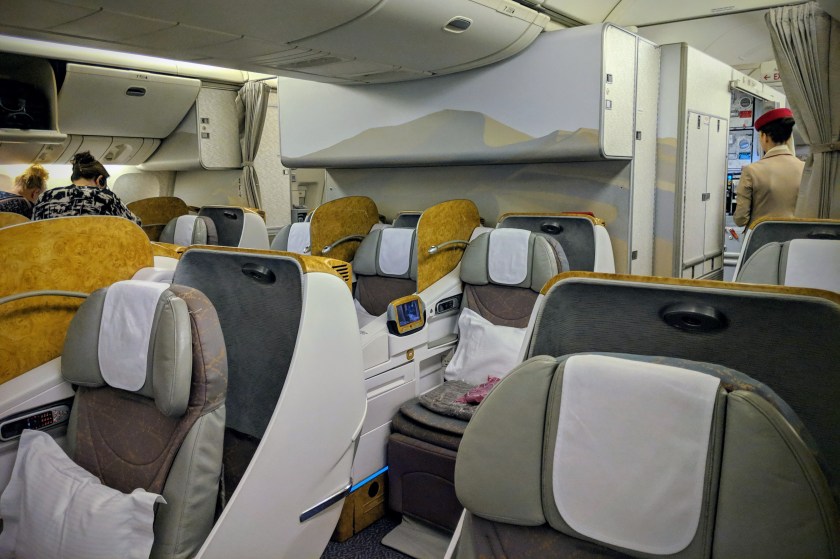
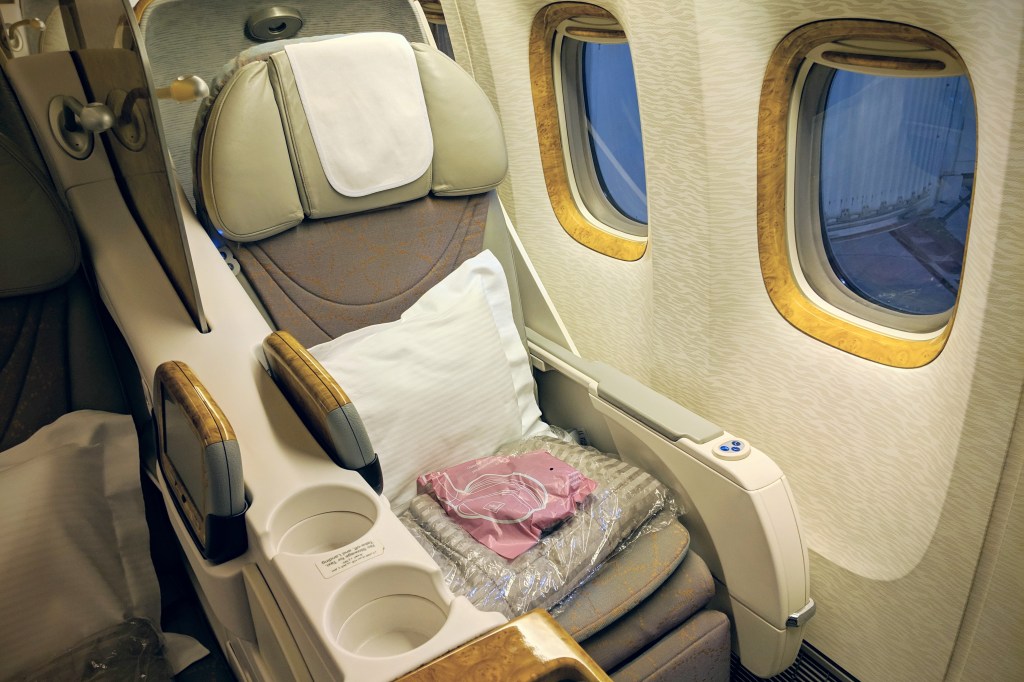
The aircraft carries 8 first class seats, 42 business class seats and 304 or 310 economy class seats, depending on which variant you are on.
In economy class, this will be in a 3-4-3 configuration, and I’ll be horrified to be disembarking in Penang with 300 other people on the same flight – the immigration facility there can be a little small so this will be a race to the front of the line.
Very affordable economy class fares
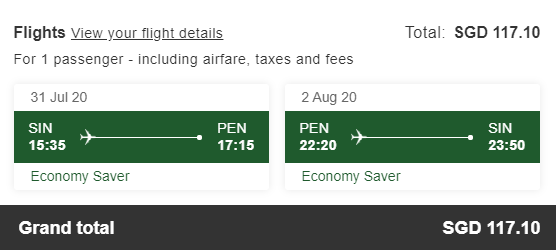
The launch fare for economy class is a very affordable… $117.10.
Emirates economy class fare from Singapore to Penang
The $11710 price is in T class under the Saver fare family, with a base fare of $50. In case the T class fares run out, the next two fares, L & Q classes (also in the Saver family), runs at $70 or $90 respectively, so they are still very affordable after adding taxes and surcharges.
Redemption using Qantas Frequent Flyer
If you are thinking of splurging but refuse to pay $1,000 for a return business class fare, you can also use your Qantas points to redeem for Emirates flights.
Qantas and Emirates have a joint venture, which means that frequent flyer members of both airlines can use their points to redeem for virtually all flights on both networks.
While the flights have not been loaded into the award availability system, a look at QFF’s chart priced the flight at the following mileage:
Class of travel
One-way QFF points required
Economy
8,000
Business
18,400
First
27,600
No. of QFF points required for award ticket on SIN-PEN, one way
Note that Qantas imposes a surcharge for award redemption, so be sure to find out how much they are before redeeming your points.
But if you do splurge for a first class ticket, it’s a great chance to use the Qantas First Class lounge at Changi, given that Emirates customers and elite frequent flyer members will have access to Qantas’ network of lounges.
Qantas Singapore First Class Lounge
Final thoughts
This is definitely a rather intriguing new service, given that Singapore-Penang has been served by low-cost carriers for a while now.
For the record, the other carriers on this route include Silkair, AirAsia, Jetstar and Scoot, with Silkair being the only full service airline.
It will be interesting to see how this pans out, given that airlines typically try new markets as a tag-on service, especially when they are not confident of the financial viability of the market. Using Singapore as the intermediary point, this will allow Emirates to soften the potential downside of the Penang route.
For now, I’ll be keen to hear if anyone is willing to blow $1,540 on a return first class ticket to Penang!
Get up to 40% bonus miles in the first sale of 2020
Alaska Air Mileage Plan has launched its first sale of the year, offering up to 40% bonus miles. The sale runs from now till 17 February 2020, 3.59pm Singapore Time.
The offer given to me is as below, but do check your own account as the offers may be personalised:
Under 5,000 miles – no bonus
5,000 to 19,000 miles – 20% bonus
20,000 to 29,000 miles – 30% bonus
30,000 to 60,000 miles – 40% bonus
At the maximum purchase, you can buy 84,000 miles (60,000 + 24,000 bonus) at US$1,809.23 (tax included), working out to an average of 2.15 US cents per mile, or about 3 Singapore cents.
This is normally higher than what I’d recommend people to buy miles at, but there are good reasons to do so.
Price per mile has gone up
Alaska has quietly revised its prices for miles.
Previously, the base price of a mile is US$30 (S$40.50) per 1,000 miles before tax, but this has since gone up to US$30.25 (S$40.88), a 0.83% increase.
The increase is not linear though, as it varies accordig to how many miles you buy. For instance, the price previously was US$1,650 before tax for 60,000 miles, and this has since increased to US$1,683, a 2% increase.
With JAL trick gone, what is Alaska miles good for?
Pre-October 2019, the open secret out there is how you could use Alaska Air Mileage Plans for a cheap pseudo-roundtrip business class ticket from Southeast Asia to Japan, which will cost you under US$600 for the ride to Tokyo and back.
Despite that, there are still some pretty decent redemptions you can make with your Alaska miles, such as:
One-way first class trip from Southeast Asia to USA on Cathay Pacific – 70,000 miles
Intra-Australia Qantas business class – 20,000 miles (perfect for Perth to Sydney/Melbourne)
One-way first class trip from Australia to USA on Qantas – 70,000 miles
Final thoughts
This is definitely not a spectacular sale, but a good time to start planning your holidays in 2020 if you haven’t done so. Of course, as we always advise, do not buy miles speculatively if you have no immediate use for them.
Remember, sale ends 17 February 2020, 3.59pm Singapore time.
Grab has announced an upcoming devaluation for Singapore-based users, probably one that’s gonna really hurt this time.
Learning from the strong backlash the last time they devalued their rewards system without notice, Grab has now put out a five-week notice on an upcoming devaluation happening in March.
There’ll be a reduction in how many points you earn per transaction, and an increase in the number of places you can earn points at, from 2 March 2020.
Grab Rewards, January 2020
In gist, Grab will be lowering Grab reward points earned across all use categories, and across all tiers. To add salt to the wound, Grab will also be raising redemption rates for Grab vouchers.
Adding the both together, this development is a double whammy, resulting in significantly lower the yields henceforth for using Grab.
The low down: How much less points will you earn
The headline sounds gloomy, but here’s the specific changes:
All Grab transactions will earn between 2 to 4 points, depending on tier.
All Grab transactions with payment made through GrabPay will earn the same number of points across all categories.
Paying for Grab rides with cash will no longer earn any points.
Existing Grab Singapore rewards earn chart up to 1 March 2020
New Grab Singapore earn table effective 2 March 2020
At present, entry and silver members can earn either 2 points (GrabExpress), 3 points (for Grab rides) or 5 points (for GrabPay in-stores or online), while gold members earn 50% more at between 3 to 7.5 points. Platinum members can earn twice of that, between 4 to 10 points.
With the revised earn rates, that represents an up to 60% slash rate off the number of points earned.
Redemptions for Grab vouchers will also go up
Apart from lowering the amount of points you will receive, Grab is also raising the number of points required to redeem for Grab vouchers.
New Grab redemption rates
If you recall, Grab tried to do it once back in 2018, but suffered a huge backlash due to its no-notice revision. In a bid to calm things down, Grab then reverted the number of points required for redeeming Grab vouchers for its silver, gold and platinum members.
And the revised rates compare to the current redemption rates:
S$1
S$5
S$10
Before 2 Mar 20
After 2 Mar 20
Before 2 Mar 20
After 2 Mar 20
Before 2 Mar 20
After 2 Mar 20
Member
500
550 (+10%)
2,200
2,500 (+14%)
4,200
5,000 (+19%)
Silver
500
550 (+10%)
2,100
2,500 (+19%)
4,000
5,000 (+25%)
Gold
500
550 (+10%)
2,000
2,500 (+25%)
3,800
5,000 (+32%)
Platinum
500
550 (+10%)
1,900
2,500 (+32%)
3,600
5,000 (+39%)
With these changes in redemption rates, it will now take a Grab user – at member level – to rack up $275 in spend in order to redeem $1 rebate (0.36% effective rebate), up from the previous $167 (0.6% rebate).
If you are an entry-level member and intending to save up for a $10 voucher, you will need to spend $1,825 on Grab rides first before redemption, making it a 0.55% value. While you are at it, you will achieve platinum status too! Previously, you will only need to spend $1067 to get enough points for a $10 voucher (0.94% value).
If you use GrabPay a lot, the drop is even more stark: previously you could simply spend $125 in-store via GrabPay and get a $1 voucher (a 0.8% value), but now you will will need to spend $275 to get the same voucher, making it a 0.36% value.
Platinum members has it worst: it used to take $360 of GrabPay spending in stores to get a $10 voucher (a 2.7% rebate value), but moving forward it’s gonna take a holy $1,250 to get the same voucher, reducing the rebate value to a measly 0.8%.
Qualification for higher tiers remain the same
While the rewards earn rates has gone down significantly, Grab has not revised its qualification requirements for the higher tiers. This will also mean a significantly higher spending to achieve the higher status, and the rewards may not be entirely worth.
Tier
No. of points required
Cumulative spend required (based on highest earn category, i.e. GrabPay)
Before 2 Mar 20
From 2 Mar 20
Member
None
None
None
Silver
300
$60
$150
Gold
1,200
$240
$600
Platinum
4,500
$680
$1,700
It’s noteworthy to mention that it is now much tougher to earn Platinum status. At $1,700, that’s a holy 170 rides in a year with an average cost of $10, equating to about 1 ride every two days.
Grab Vietnam & Indonesia also hit by devaluation; GrabMalaysia stops awarding points for cash transactions
Grab Indonesia was hit by a drastic devaluation in its rewards programme since 9 January 2020. Previously Grab users in Indonesia could earn 8 to 16 points if they paid by GrabPay wallet or 4 to 8 points if paid by cash, but since 9 January 2020, the rate has been reduced drastically to 1 to 2 points for GrabPay payment, depending on your tier.
Grab Indonesia reward points table before and after 9 Jan 2020
Grab Vietnam has also undergone a similar devaluation effective today (22 Jan 2020), where users earn a reduced earn rate of 3 points (member, silver members) to 9 points (platinum members) per VND10,000 (SGD0.60) spent.
Previously, users could earn anything from 9 to 18 points on select categories, so this represents a 50% reduction.
The only other country that has a slight change is Malaysia, where Grab will stop awarding reward points for cash payments.
So where’s the best place in SEA to earn Grab Rewards now?
With the changes that have been introduced in some of the markets, Malaysia remains the best place to use Grab. For the equivalent of S$1, you will get at least 4.5 Grab points. There’s also a limited time bonus from now until 15 March 2020, where you get 3x bonus if you use your GrabPay wallet in Malaysia, so if you are a platinum member, you get a whooping 27 points per S$1 (RM3) spent. Note that the GrabPay wallet is separated by country; you will need to top up your RM wallet if you use GrabPay in Malaysia.
Other countries good for earning Grab rewards include Thailand (4.23 to 8.45 points per S$1 spend), and Philippines (4.53 to 9.06 points per S$1 spend). Vietnam’s a little tricky – you need a Vietnamese bank account to set up the e-wallet in order to earn the attractive rates of up to 15.52 points per S$1 spend, so that’s practically out of reach for foreigners.
Comparison table of Grab Rewards across countries (view PDF here)
Singapore is after all not the country with the worst rewards value, the honour goes to Indonesia at a miserly 1 point per S$1 spent.
It’s worthy to note that the Grab reward points pool across all the different countries, even though you may have a separate GrabPay wallet for each country. This means that points earned overseas can be redeemed in Singapore and vice versa, so if you play it well you can still get a good rebate.
Final thoughts
Given the massive reductions in Grab reward points earned across some markets, it’s safe to say that Grab is probably feeling the pain of the generous rewards it has dished out in the past years, in hope to make their app ‘sticky’.
As recently as 2018, when GrabPay wallet was newly introduced in Malaysia, I recalled that a RM90 purchase instantly netted me 1350 points – almost enough for a $5 Grab voucher.
Good things definitely won’t last for long, as we all know very well. The writing is definitely on the wall, given the last devaluation exercise back in 2018, it was about time that Grab did another round of devaluation, given that these rewards has a cost to them, at least for Grab.
This is on the heels of more and more banks not giving out miles/points for GrabPay top-ups, making it even harder to choose GrabPay at places when I can use credit cards.
What this round of devaluation also means to me is that, I will probably be using Grab even less frequently than I current do. As it is, the surge pricing for Grab rides are ridiculous at times (S$20 from City Hall to Tanjong Pagar, anyone?), I find myself turning to ComfortDelgro’s app more often today.
Despite the lowered valuations of the rewards, there are still instances where it still makes sense to use GrabPay, given that there aren’t really any other mobile wallets that has a rewards programme. I foresee that this will be my last year as a Platinum member with Grab, but seriously, it doesn’t quite matter.








 Shanescape