Latest Posts

Cathay Pacific Asia Miles and Marco Polo Club

Singapore-based members who are very familiar with Krisflyer (Mainly Miles have an incredibly resourceful guide) may fumble at the first glance of Asia Miles.

Asia Miles is travel rewards programme, a fully-owned subsidiary of Cathay Pacific Group. Members of Asia Miles can earn miles through everyday activities such as dining, hotel stays and flights, and use the miles for flights, hotel stays, and even lifestyle goods.

Marco Polo Club (MPC) is Cathay Pacific’s loyalty programme, rewarding frequent flyers with perks as they move through the tiers by accumulating club points. When you accumulate enough club points, you will get to a certain tier which will give you extra benefits from extra checked baggage allowances to lounge access.

While Asia Miles is free to join and use, there is a first-time joining fee of USD100 for MPC, payable every year unless you earn a minimum of 20 club points, which can be earned rather easily with any return flight from Singapore to Hong Kong on Cathay Pacific.

Note that club points cannot really be used to redeem for anything; these club points are simply a count on how much you fly in a year. For those familiar with Qantas Frequent Flyer and British Airways’ Executive Club, the club points are synonymous with status credits and tier points respectively.

Marco Polo Club

Frequently Asked Questions

I have included some Asia Miles 101 FAQs below, so you can either click directly to it or slowly read through this lengthy article.

What’s the difference between Asia Miles and Marco Polo Club? Are they the same?

Asia Miles is a travel rewards programme, meaning you get miles (the programme currency) for your activities, i.e. flying with Cathay Pacific, dining, credit card points, etc. This is a free programme, similar to Krisflyer. There are no tiers or levels in this programme – everyone earns at the same rate, and uses the same redemption charts.

Marco Polo Club (MPC) is Cathay Pacific’s loyalty programme, which give you status points (Club Points) when you travel with them or other oneworld airlines. There’s no other way to earn Club Points. There is also an annual fee of USD100 to join the MPC, but this can be waived if you earn at least 20 Club Points in any programme year.

Back to top

How do I earn Asia Miles?

There are several ways to earn Asia Miles.

Flights: This is the most straightforward way. Flying with Cathay Pacific, Cathay Dragon or oneworld airlines will earn you both Asia Miles and Marco Polo Club points.

Cathay Pacific has moved towards a fixed miles award system since 2018, so the amount of miles you earn from flying depends on (i) the fare class of your ticket,and (ii) which distance category your journey fall into.

This is the chart:

Standardised mileage earn chart with Asia Miles

Hotels: Asia Miles also partners many hotel partners that allow you to convert your hotel loyalty points to Asia Miles.

Some examples below:

  • LeClub Accor: 2 points to 1 Asia Mile
  • Hilton Honors: 10 points to 1 Asia Mile
  • World of Hyatt: 2.5 points to 1 Asia Mile OR 500 Asia Miles per stay
  • IHG Rewards Club: 5 points to 1 Asia Mile OR 500 Asia Miles per stay
  • Marriott Rewards: 3 points to 1 Asia Mile, bonus of 5,000 Asia Miles for every 60,000 points converted; OR 1 Asia Mile per USD2 spent on stay

And many more. For more details, refer to Asia Miles website.

Credit Cards: Asia Miles is probably the second most accessible mileage conversion programme after Krisflyer in Singapore. Many credit card rewards programme in Singapore will allow you to transfer your points to Asia Miles. See more details in the question below.

Of course, there are other ways to earn Asia Miles, including car rentals and other obscure manners which I will not cover. For details, refer to the Asia Miles website.

Back to top

Can I transfer credit card points to Asia Miles?

Credit Cards: Asia Miles is probably the second most accessible mileage conversion programme after Krisflyer in Singapore. Many credit card rewards programme in Singapore will allow you to transfer your points to Asia Miles.

For starters, some of the most widely-used miles earning credit cards are existing partners of Asia Miles:

  • UOB PRVI MasterCard
  • UOB PRVI Amex
  • DBS Altitude Visa
  • BOC Elite Miles MasterCard
  • Citibank PremierMiles
  • Citibank Rewards
  • Standard Chartered Visa Infinite
  • American Express Platinum Credit Card, and many more.

Most bank programmes in Singapore already have Asia Miles have a conversion partner, and the rates are similar to what you get with Krisflyer.

From time to time, Asia Miles run targeted offers to encourage members to transfer to Asia Miles. For instance, DBS was running a 15% bonus offer to transfer DBS reward points to Asia Miles in early 2019, so you shouldn’t rule out similar offers in future.

Back to top

What can I use my Asia Miles for?

Asia Miles can obviously be used to redeem for Cathay Pacific, Cathay Dragon and many oneworld flights, including those operated by Qantas, Japan Airlines and American Airlines. For more details on redeeming flights on Cathay Pacific, as well as tips and tricks, click here (coming soon).

Beyond the oneworld alliance, Asia Miles has also gotten some other partner airlines on board, including Air Canada, Air New Zealand, Alaska Airlines and Lufthansa.

On top of that, like many other airline frequent flyer programme, you can also use your Asia Miles for hotel stays, attractions, and lifestyle awards, although these are really not the best way to use your miles.

One unique proposition of Asia Miles is the ability to use your miles for Asian pop concerts, typically held in Hong Kong, Macau or Taiwan. Some of the concerts that you could previously book for included Andy Lau, Khalil Fong and Mayday. The redemption rates are not that cost effective – for instance, a Mayday concert going for JPY12,800 (~SGD158) was going for 24,000 miles, working out to 0.6 cents per mile, which is not a great use of miles unless tickets are sold out everywhere else.

Back to top

How much is one Asia Mile worth?

This is a perennial question on top of everyone’s mind – how much is one mile worth?

The usual answer will be: it depends.

For an economy class redemption (which is highly not recommended), the value can go down as low as under 1 cent, to over 3 cents.

Business class redemptions can range between 3-6 cents per mile, depending on destination, airline and dates.

First class redemptions can go as high as 10 cents per mile, but not likely achievable given that the inventory is typically limited.

Of course, the above valuation is a simple one: it takes the commercial value of the ticket, divided by the number of miles required for a similar class of travel. There’s also the other school of thought on how much you are willing to pay for the ticket, that’s probably closer to the actual value you attach to a mile.

Back to top

What are the different statuses you can achieve with Marco Polo Club?

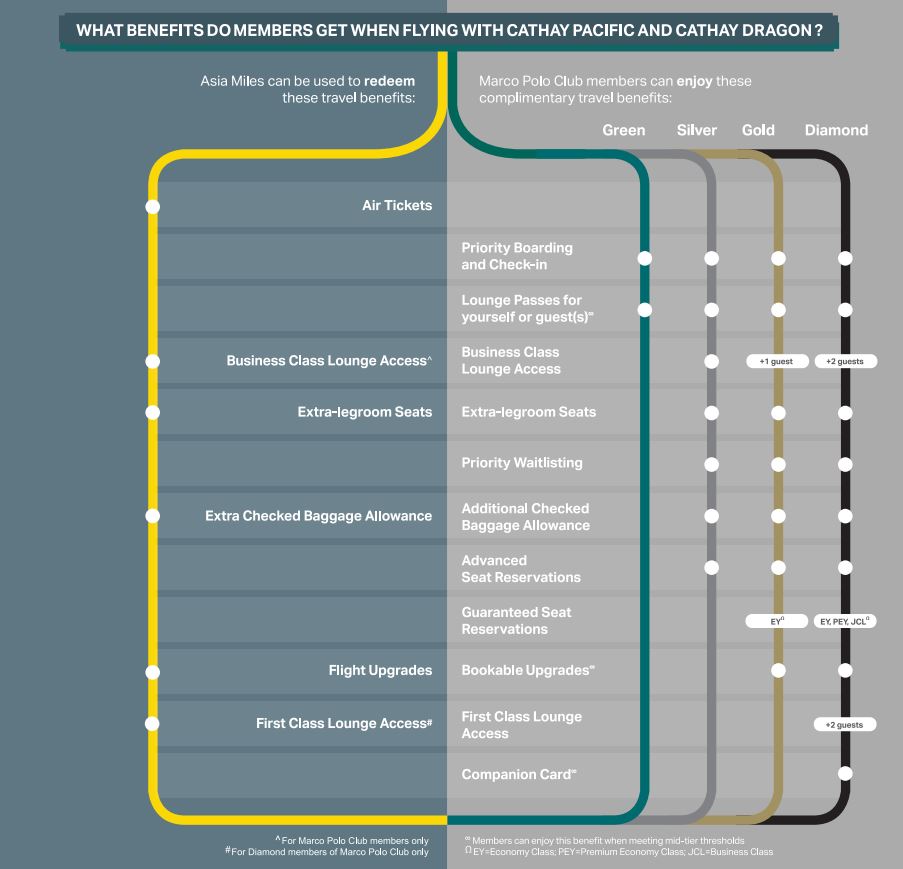
Marco Polo Club offers four tiers to its members: Green, Silver, Gold and Diamond. Green is the entry level tier, while Silver, Gold and Diamond comes in after accumulating Club Points within a programme year.

To requalify for Green each year, you will need to accumulate 20 club points each year. That’s pretty simple – the cheapest return economy fare from Singapore to Hong Kong that’s eligible for Asia Miles will get you 20 club points. If you fail to earn at least 20 club points, note that you will have to pay the USD100 fee in lieu of it.

Silver, Gold and Diamond will come at 300, 600 and 1,200 club points respectively. That sounds like an awful lot but trust me, there are too many diamond members in the programme.

One important thing to note if you are starting from the bottom (i.e. Green): each time you reach a new tier, your club point resets. So if you are starting from Green and wants to achieve Gold or Diamond within a single year, you will need 900 club points for Gold, and 2,100 club points for Diamond. Ridiculous, I know.

For a summary of what Asia Miles can be used for and what each MPC tier offers, see the table below:
Back to top

How do I earn status with oneworld?

Silver, Gold and Diamond also correspond to oneworld’s Ruby, Sapphire and Emerald status respectively, which standardises the tiers across its member airlines. This also means you get corresponding benefits when travelling with oneworld member airlines. For instance, if you are an MPC Diamond, you will be treated like a Qantas Frequent Flyer Platinum member when you travel with Qantas.
Back to top

Changes to Emirates and Qantas chauffeur drive service

Emirates and Qantas both offer a chauffeur drive service to their business and first class passengers for the longest time, but this is now set to be tightened from 1 March 2019.

Emirates changes

Emirates will no longer offer complimentary chauffeur drive service for customers on any redemption tickets after 1 March 2019. This includes tickets redeemed using Emirates Skywards, or any other frequent flyer programme such as Qantas Frequent Flyer or Alaska Mileage Plan.

The service will also no longer be given to those who use miles to upgrade economy class tickets to business class.

Qantas changes

Qantas changes are a little more complex. From 1 March 2019, they will no longer offer chauffeur drive service to business and first class customers in Singapore and New Zealand, meaning that customers departing and arriving in these two countries will have to arrange their own transport. This also includes customers transiting in Singapore, who will no longer receive the service.

The service will also be scaled back in London to a 50-mile radius, down from 70 miles. Any customer travelling to outside of the 50-mile radius will now be required to pay an extra distance fee of GBP24.30 for every 10 miles.

Qantas First Class

The service remains unchanged in Australia, where its available at most major cities. Also, unlike Emirates, redemption tickets on Qantas-operated services are also still eligible for the service, where it is available.

What it means for customers in Singapore

For business and first class customers travelling on QF1/2 from Singapore to London, this means that they will no longer get chauffeur drive service in Singapore, but they will still get it in London.

However, for those a little savvier and book a business class seat on a Qantas codeshare service operated by Emirates, they are still eligible for a chauffeur drive service in Singapore and their final destination.

For redemption bookings, it’s a little more complicated. If you are redeeming your miles for a business or first class seat on the Qantas flight (QF1/2) between Singapore and London, you will get the chauffeur drive service in London. But if you use your miles to redeem for a seat on Emirates service via Dubai, tough luck – you will not get the chauffeur drive service.

Emirates B777-300ER First Class 

Some history

Emirates was the first airline ever to introduce a chauffeur drive service for its premium customers. Qantas later introduced its chauffeur service in April 2013 to match what Emirates was offering, as part of the then newly-formed alliance, offering the same service to business and first class customers travelling from Australia/New Zealand to London, Dubai and the USA. However, over the years this has been scaled back, and now only the London-bound services receive the service.

FLIGHT REVIEW: Emirates B777-300ER Business Class, Dubai – Singapore

Emirates / 10 Jan 19 / B777-300ER / EK432 DXB-SIN / Business Class / 16A

After spending a day to check out Hilton Dubai Creek and to wander around the scarily huge Dubai Mall, I was back at Dubai International Airport at Terminal 3 barely 20 hours after touching down the night before from London, to catch my connecting flight back to Singapore.

Emirates provides four shuttles on the seven-hour hop between Dubai and Singapore each day. Of the four flights, two are A380 services that terminates in Singapore, while the other two are B777-300ERs that operates onwards to Melbourne and Brisbane.

For my flight to Singapore today, I’ve decided to check out the Boeing 777-300ERs, which Emirates has a handful of in addition to its humongous A380 fleet. I have tried the A380 business class from London the day before, so I wanted to see what’s the difference.

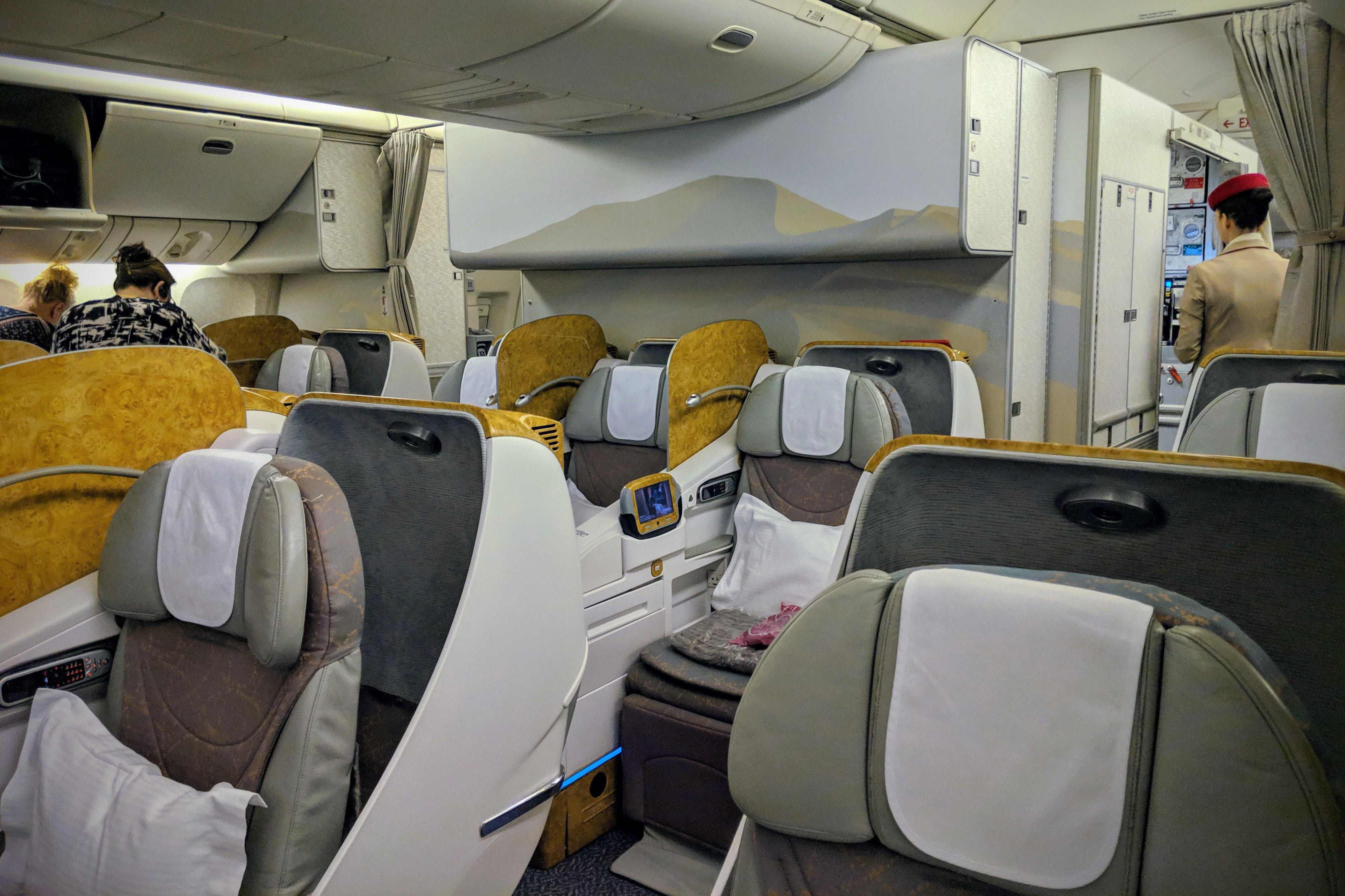
While Emirates most recently made news with its brand new B777-300ER first class product, the business class on the B777s have been under fire for its 2-3-2 configuration, which pales in comparison to many other airlines who have opted for a 1-2-1 configuration that gives every premium customer direct aisle access.

Emirates B777-300ER business cabin

A little more about Dubai International Airport (DXB): There are three terminals at the airport. All Emirates services operate out of Terminal 3 at Dubai International Airport (DXB), with other airlines operating at Terminal 1 & 2.

My check-in at the terminal was generally very smooth. Business and first class passengers have their own driveway and dropoff points, which leads to dedicated check-in counters, and also its set of immigration and security checkpoints. From the time I arrived at the curbside, I reckon I was in the transit area less than 20 minutes after I was done.

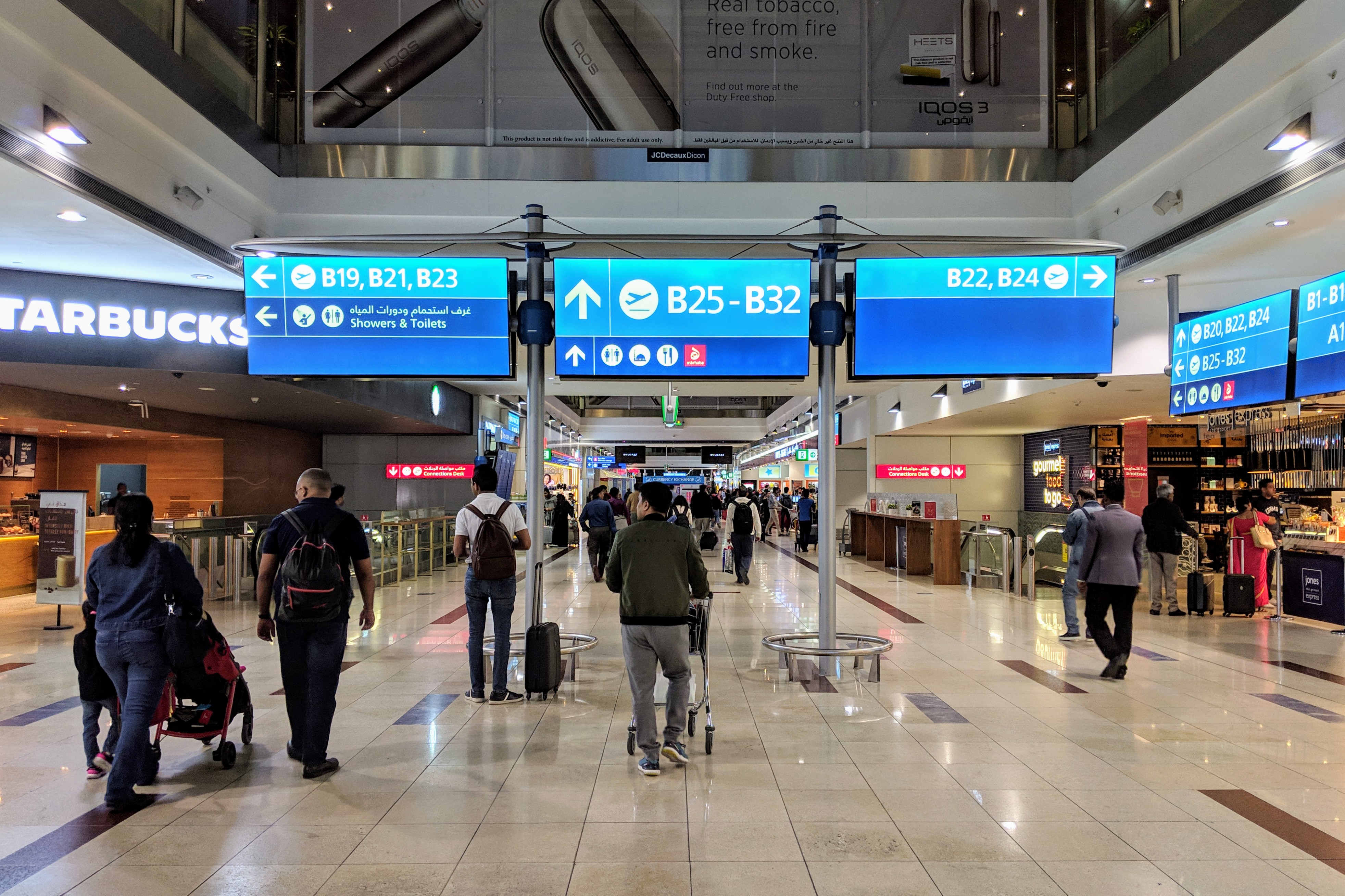
Dubai International Airport (DXB) Concourse B

Note that Dubai Terminal 3 is huge – there are three concourses: A, B & C. The check-in area will lead you directly to concourse B after you clear immigration and security, so please leave ample time if you are flying out of A or C gates.

Frequent flyers travelling through Emirates will know that business class passengers will be able to board directly from the lounge onto the upper decks of the A380 flights from Concourse A. My flight today was at one of the gates at the far end of Concourse B, so that means that premium cabin passengers will have to leave the lounge to head to the gate for boarding.

Given that the B777-300ER is a single-deck aircraft, boarding for business and first class passengers are done through the front door, while economy class customers boarded through the second door.

The seat

The Emirates Boeing 777-300ER is a three class product, with 8 first class seats, 42 business class seats and 310 seats in economy.

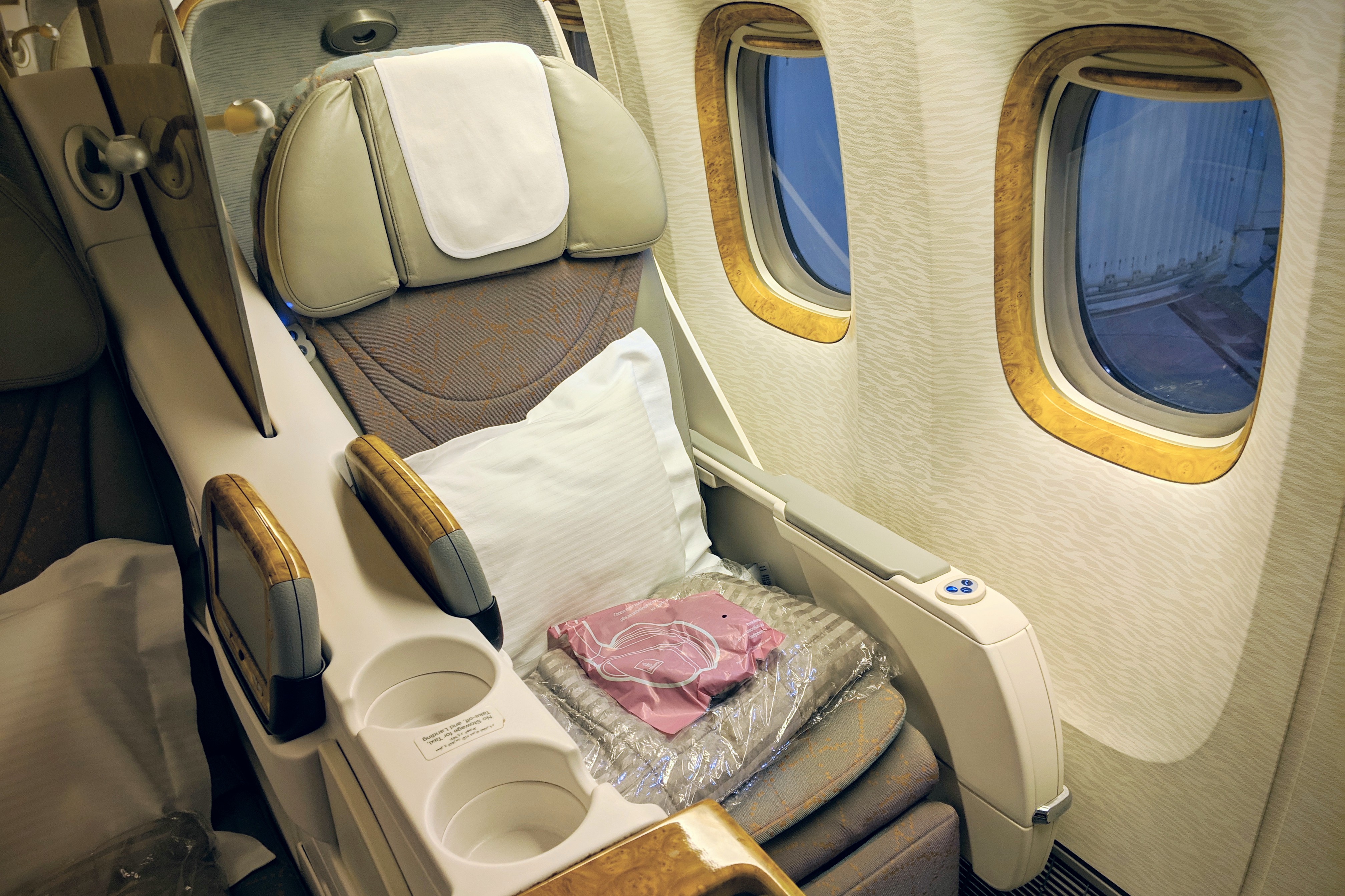
I was in seat 6A today, the first of the business class seats. Emirates seat business class passengers in a 2-3-2 configuration across 6 rows.

Emirates B777-300ER business class, seat 6A

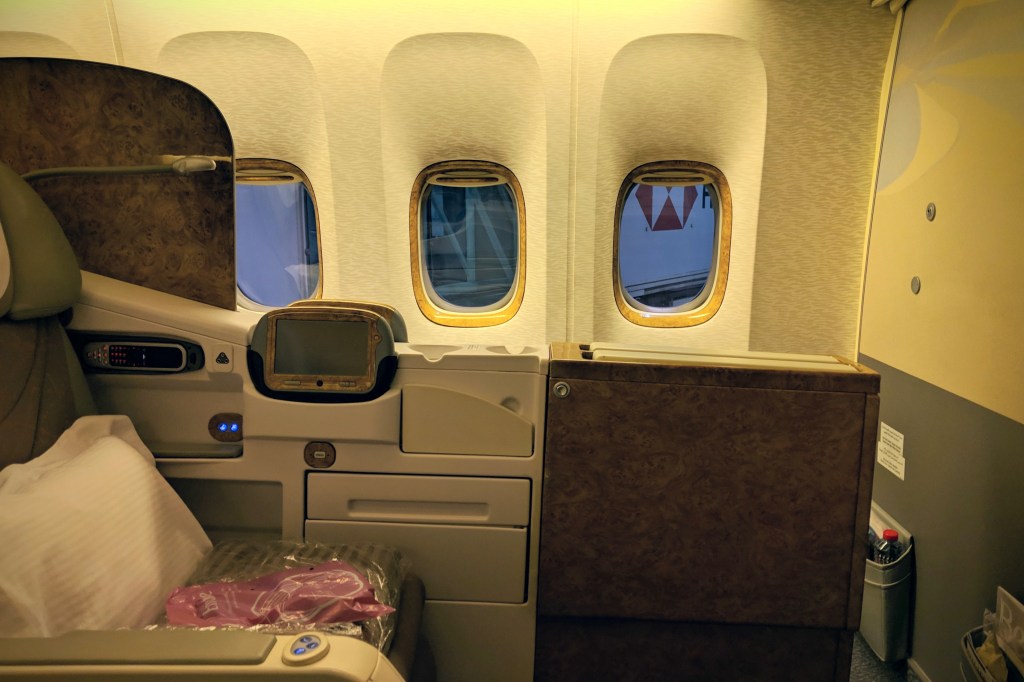
My seat was a window bulkhead seat. Being at the bulkhead, the divider between me and my seat partner was extended, where the in-flight entertainment screen was stowed.

Note that this doesn’t extend to the middle column seats (seats DEF), as the entertainment screens are mounted on the cabin divider wall in front of them. For the rows behind, the screen is mounted on the seatback, so they do not have similar extensions in the seat divider.

Emirates B777-300ER business bulkhead seats

Honestly, the protruded extension was both a pro and a con: the benefit was that the window seat (16A & 16K) felt incredibly private, particularly in bed mode, but getting in and out was a little bit of a challenge.

The seat measured 20.5 inches across, not terribly generous, but fairly comfortable for the Asian frame. Right on the side of my seat was a little compartment good for an iPad or a laptop to be stowed by your side.

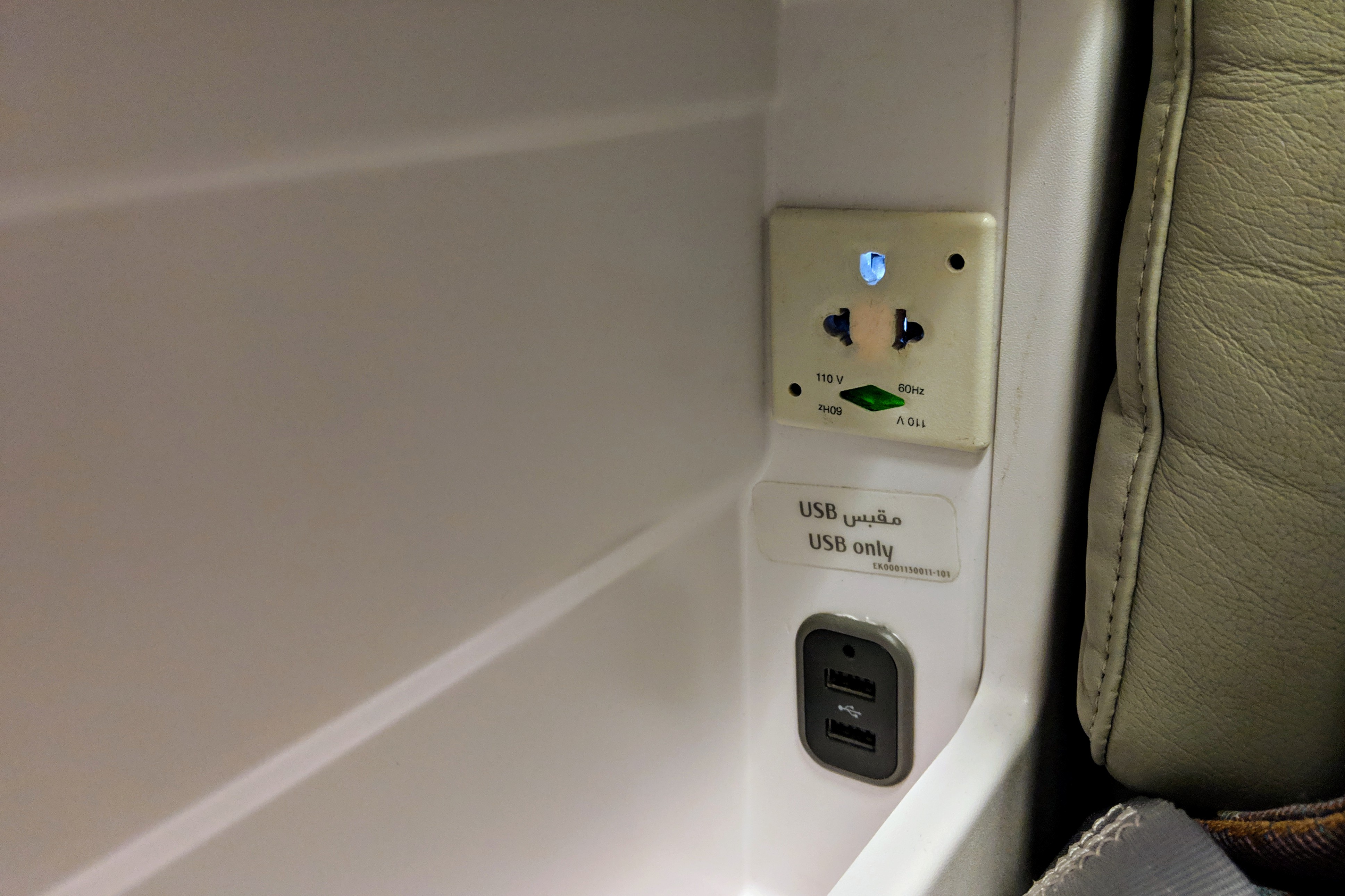
USB and power socket

In that little space was also a power socket, as well as two USB ports that you could use to charge your devices throughout your flight.

Between you and your seat partner was a drink holder, as well as a mini fold down panel that you could use to hold a small dish of nuts or a drink. I’m not sure if it’s due to wear and tear, but I found this very scary, it felt like my champagne will slip off and spill on me any time.

The service

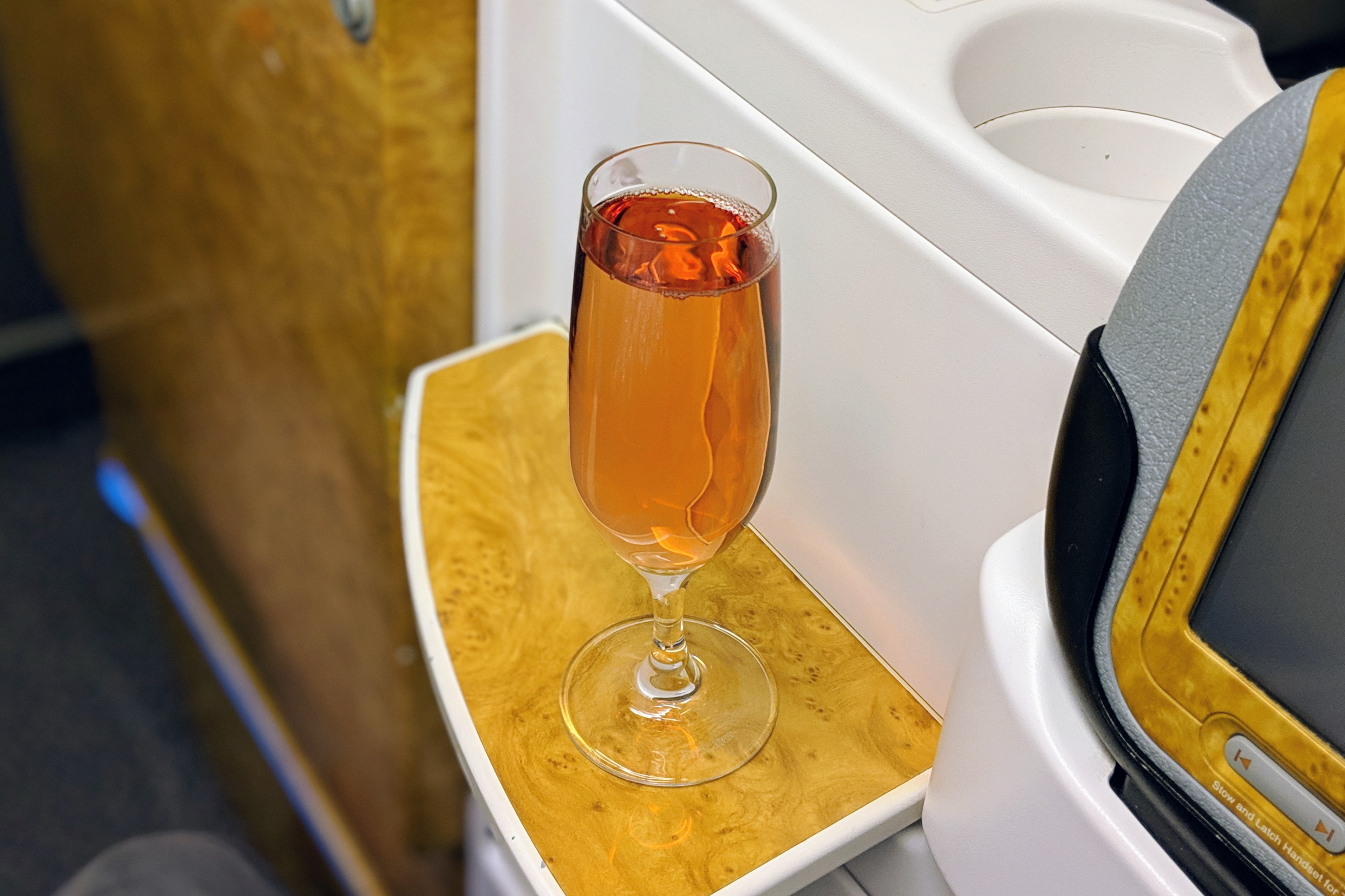
As the economy class passengers were still boarding, the cabin crew came around to offer a round of drinks. To my surprise, there was a rose champagne available for pre-departure drinks, which I naturally opted for.

Rose Champagne for pre-take off drinks

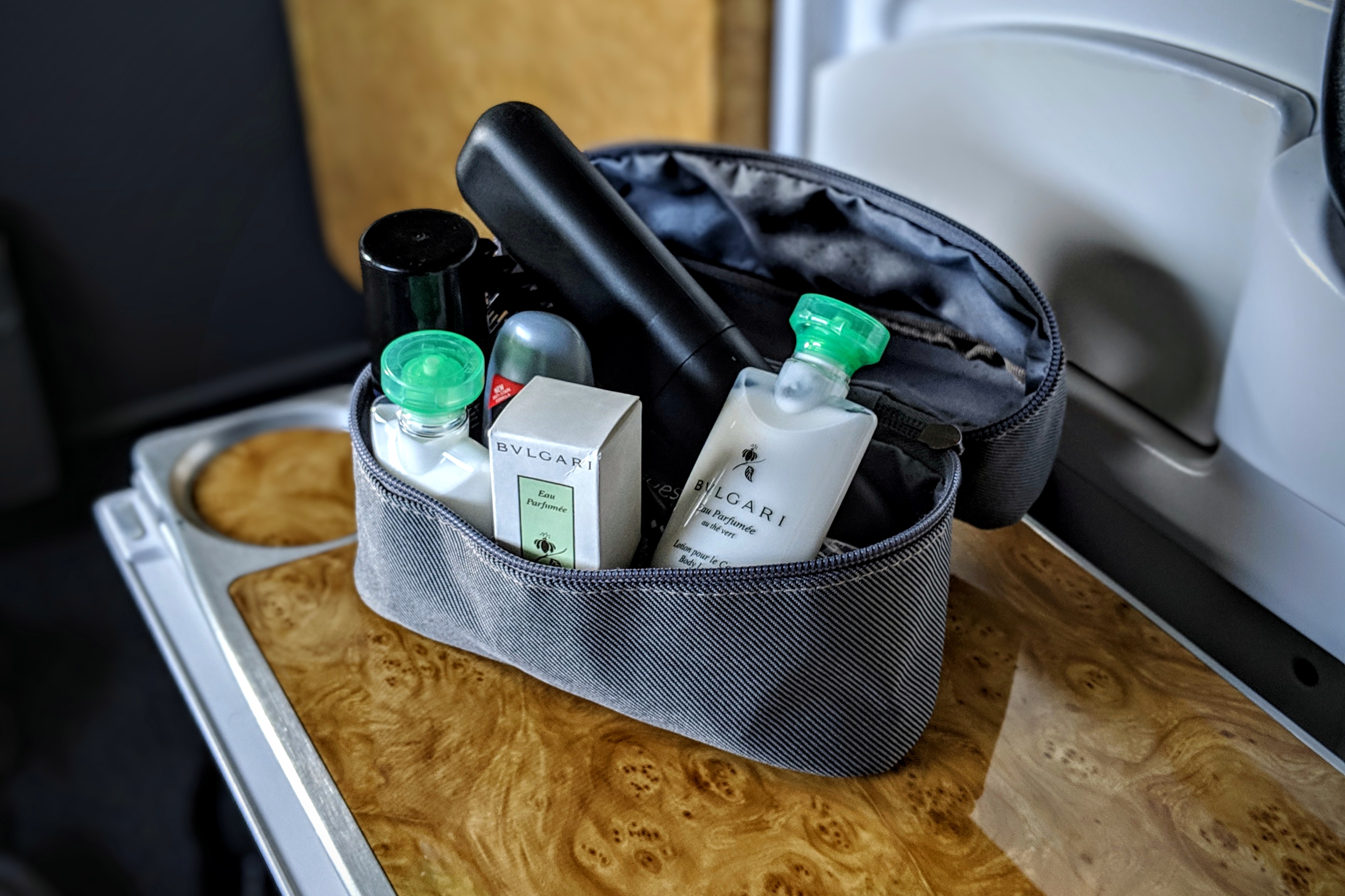
The crew also came around offering an amenity kit. The kit bag itself wasn’t branded, but the amenities were from Bvlgari, containing: a body lotion, after shave balm, shaving cream, anti-perspirant, a small eau de cologne, shaver, dental kit and a pack of tissue paper. Pretty extensive!

Bvlgari amenity kit

Once we are at cruising altitude, the cabin crew came around to offer mattresses for all the business class passengers, as well as a round of drinks and nuts before dinner was served. As I really liked the Shiraz I had on the the earlier flight from London to Dubai, I decided to stick with that since it was served on this flight as well.

While dinner was being prepared, the cabin crew also came around to ask if we needed breakfast before landing. There was an option of a continental breakfast consisting of fruit, yoghurt and pastries, or an express breakfast consisting of a pastry of choice with coffee or tea. I opted for an express breakfast.

Dinner only commenced about 90 minutes into the flight, which in my opinion, was a tad too late. Bear in mind that this is a seven hour redeye flight that departed at 9pm, so as I didn’t eat anything before the flight, I was famished by the time I got on the flight. Even though I was watching a show on the in-flight entertainment, I found myself turning around every 15 minutes or so to see if dinner service was going to start.

Dinner service

The menu for the evening read as follow:

Appetisers

  • Roasted tomato soup with thyme and balsamic shallots
  • Cold-smoked ocean trout served with pickeld potatoes, caper berries and herb creme fraiche
  • Roasted beef carpaccio with pepper, persian feta,poached fig and tomato relish

Main course

  • Seared beef tenderloin with mushroom jus, colcannon potatoes and buttered green beans
  • Roasted chicken fillet with cacciatore sauce, sauteed green beans and creamed potatoes with tarragon
  • Lamb rendang; slow-cooked spicy lamb and coconut curry, served with cauliflower masala and tumeric rice

Dessert

  • Chocolate coffee crokine; dark chocolate and coffee mosse, layered with crunchy croustillant, topped with chocolate-coated coffee beans
  • Jasmine tea baba cake; baba cake infused with jasmine tea and ginger syrup, topped with apricot ginger cream
  • Seasonal fruit
  • Cheese board

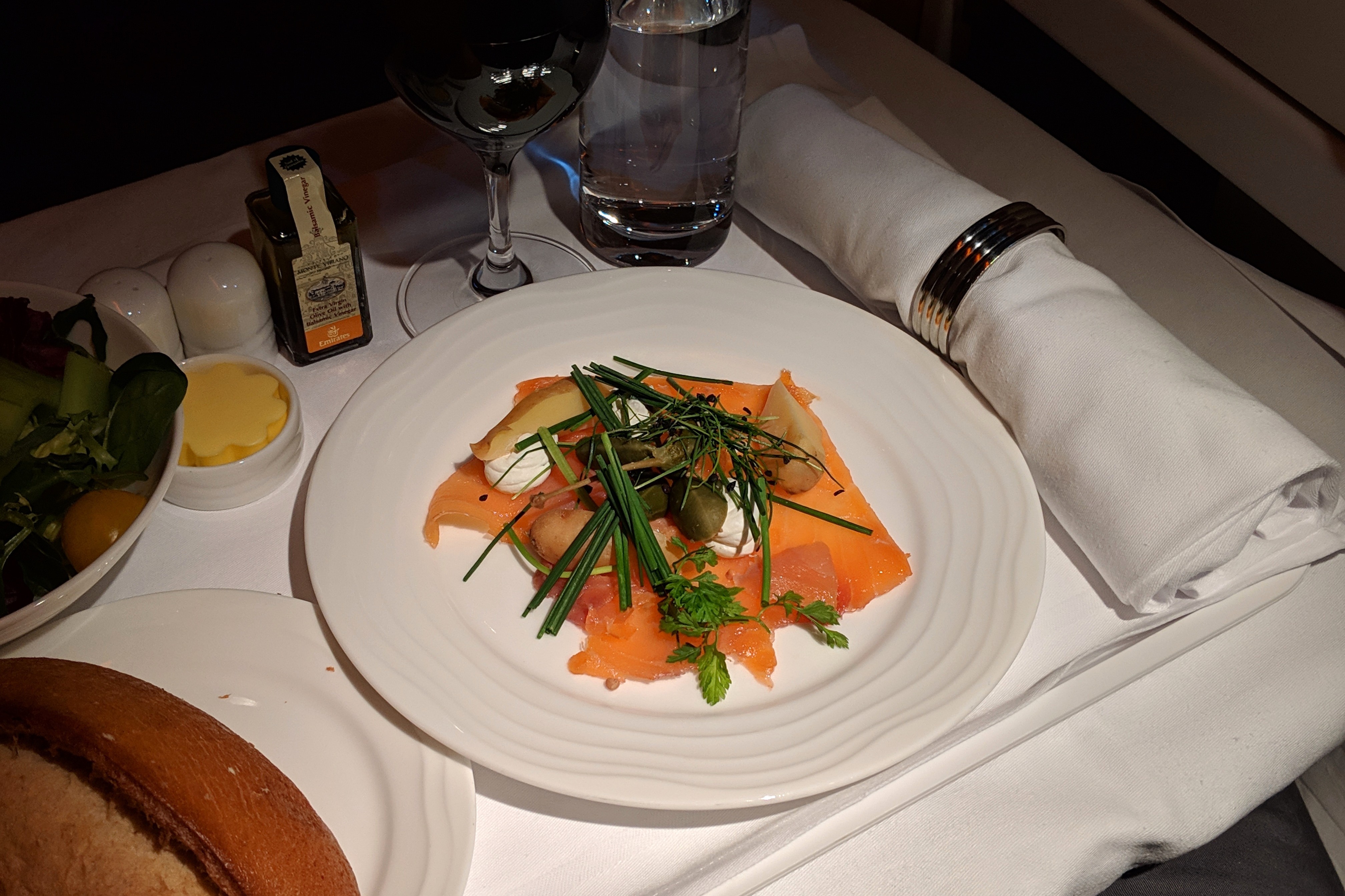
The appetiser options were… not great. I went with the ocean trout, which was pretty much standard. The appetiser came with a side salad and a bread roll, which unfortunately wasn’t sufficiently warm nor fluffy.

Smoked ocean trout appetiser

While I walloped the appetiser within a minute, it probably took the crew another 20 minutes before the main course came about. By this time, I was both hungry and sleepy, which wasn’t the best state to be in. When my main course was set down in front of my, I swear I almost bit the cabin crew’s head off screamed at someone.

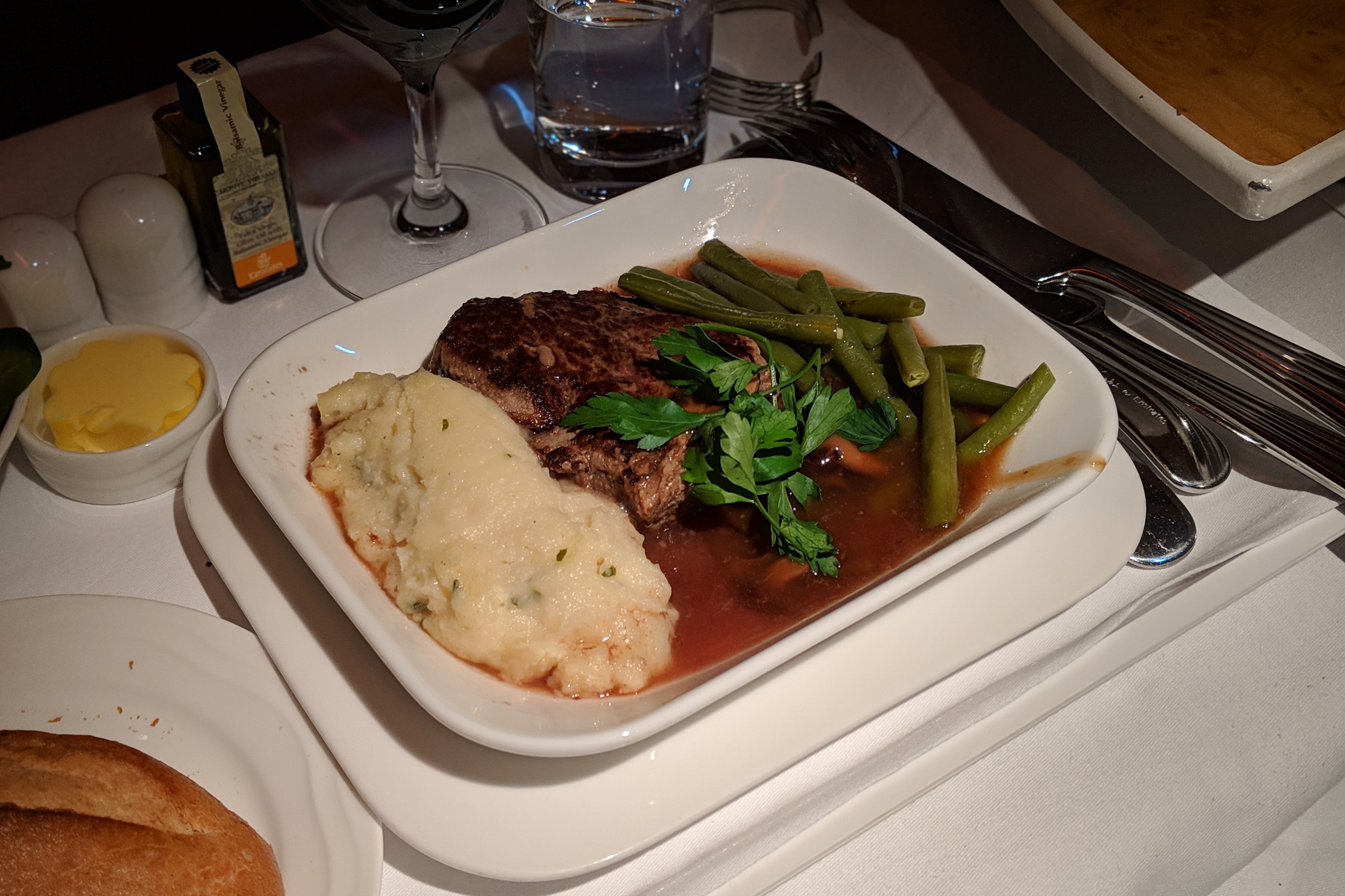
Now, back to the topic at hand: the food. I went for the beef tenderloin, even though frequent flyer collective wisdom typically advise against steaks of any sort. Surprisingly, this was good. Now, I wasn’t sure if that’s an effect of my hunger, but every bite of the beef was sufficiently tender and not overly chewy, which tends to be the case for airline catered beef. I wasn’t expected mash potatoes (it wasn’t clear from the menu), so that on the side was a perfect match to the protein.

Seared beef tenderloin with mushroom jus, colcannon potatoes and buttered green beans

By the time I was done with my main course, my seat partner gave up on wanting his dessert and decided to head to bed instead. I pressed on.

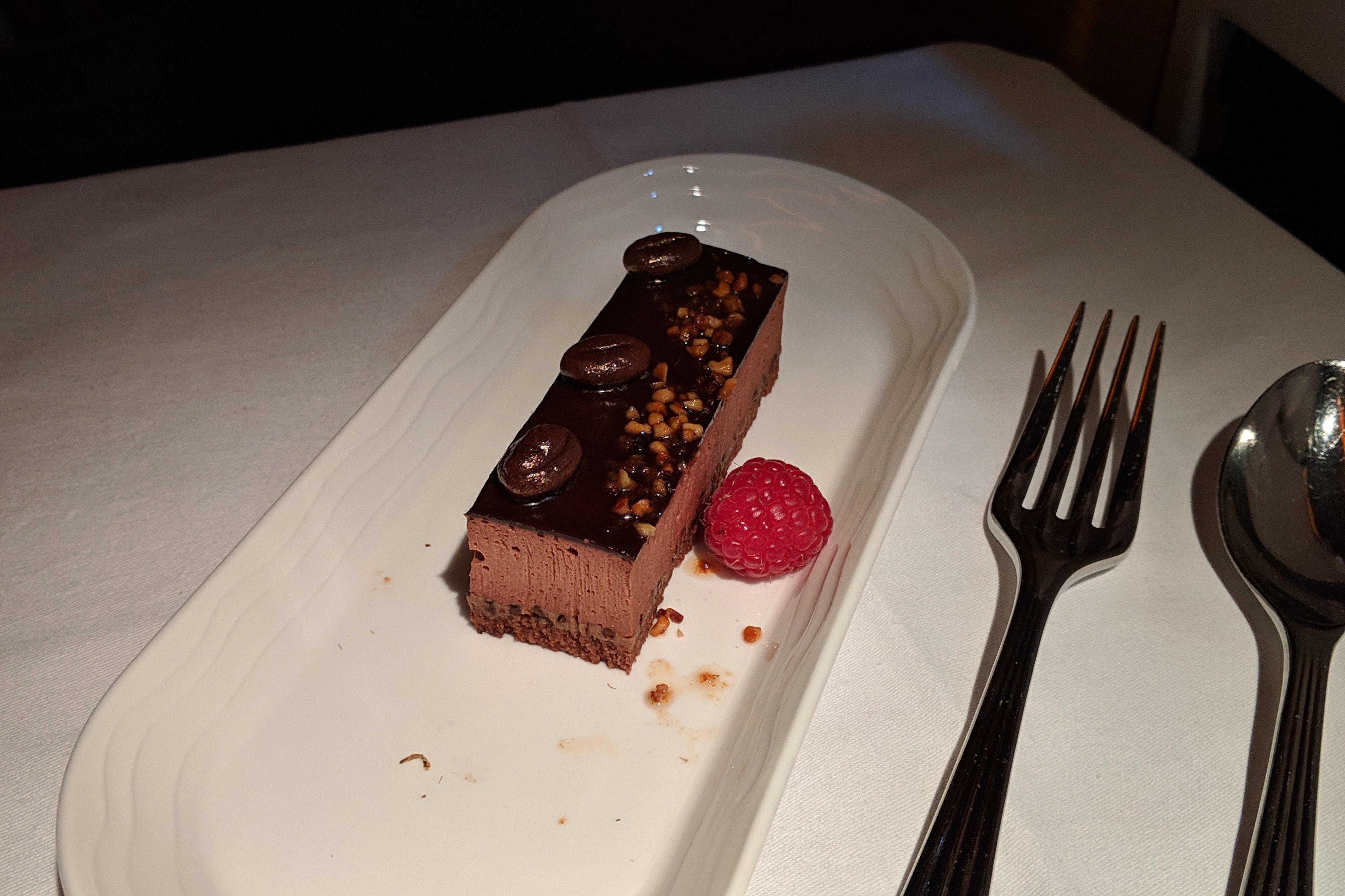
For dessert, I chose the chocolate coffee crokine (when in doubt, always go for chocolate unless you have an allergy). It was way too sweet for me, and the texture was also too sticky for me. I took two bites out of it and, swiftly cleared my own setting, and brought everything back to the galley myself. I think the cabin crew was shocked.

Chocolate coffee crokine

After that, I requested for a peppermint tea, my usual go-to end-of-day drink, before heading to the restroom. When I got back to my seat, my tea took yet another long while to come. I had to go the galley to ask for it again, only to figure that the cabin crew who took my order earlier forgot about it.

When the tea finally came, I took two sips, and went to bed.

The next thing I knew, I woke up with less than an hour to go on the flight. I quickly changed up, and slowly figured that breakfast service was over. I asked for a coffee, which again, took forever to come.

Final thoughts

The service I received on this flight was probably the weakest link. Maybe it’s because my expectations were set from my last flight, and the exceptionally slow service really killed me.

It simply doesn’t make sense to have a 2.5-hour dinner service for a 7-hour redeye flight. While I understand most customers would have taken their meal at the lounge and went straight to bed, I observed that there were still plenty of customers eating. Some of these customers were travelling onwards to Australia, so all the more they needed their sleep given it was 3am in Brisbane at the time they boarded the flight, but chose to stay up for dinner anyway.

It could be a one-off incident, but the attention and speed to requests was simply appalling in a business cabin. Many a times, I found that I had to ask for items for than once, or in the case of my peppermint tea, it seemed like it was forgotten. This is clearly unacceptable for a business class service for a world-class airline.

If we put that aside, the seat actually worked for me. While the 2-3-2 arrangement may not work for solo travellers, I saw how it worked for families: two parents with a kid in tow enjoyed having the 3 middle seats, while couples who wanted to seat together weren’t limited to just middle seats. The Emirates seat was adequately designed, with sufficient storage for small items, even though there still isn’t a space for bags. Everything else worked: there was a power socket, USB ports, space for a drink and a place for me to stow my iPad or laptop.

A peek at the Emirates B777-300ER first class cabin

The food was tip-top, even if I’m not a fan of the plating, but bearing in mind that’s a very subjective matter. The choice of wines was adequate to a layman like me too, but the offering of rose champagne really blew me off.

Overall the Emirates Boeing 777-300ER business product is still a strong one. While this competes with the more private, 1-2-1 direct aisle access seats that airlines like Singapore Airlines and Qantas are offering, but if you add in other aspects, including its incredibly well-stocked in-flight entertainment, this is definitely no pushover.

FLIGHT REVIEW: Emirates A380 Business Class, London (Gatwick) – Dubai

Emirates / 9 Jan 19 / A380-800 / EK16 LGW-DXB / Business Class / 19G

Returning from my trip to London after the New Year holiday, I booked myself on Emirates business class via Dubai back to Singapore. I was pretty excited since it was my first time trying out their business class product.

On this journey, I deliberately booked myself on both the A380 and the Boeing 777, which are the only two aircraft types that Emirates operate, to get a taste of what the business products Emirates serves its customers.

London’s many airports

Travellers familiar with London will definitely know Heathrow Airport, one of the main gateways in and out of London. That is also the airport many international airlines fly into as a first choice airport to access London, so chances are you will land at Heathrow on your first visit.

There are several other airports connecting to central London, including Gatwick, Stansted and London City airport. Of which, Gatwick is often the next most popular airport, albeit a little further than Heathrow is to central London.

For my flight to Dubai, I’ve taken a slightly different route to fly out of London Gatwick, instead of the usual Heathrow departure. For those who are not aware, apart from the hefty UK air passenger duty you pay when travelling out of any UK airport, each airport also levy its own passenger service charge. Heathrow tops the UK airport list with a fee of GBP44 in departure fees, while Gatwick charges only GBP14.

Emirates operate 10 services to London a day – six A380s to Heathrow, three A380s to Gatwick and one daily Boeing 777 service to Stansted. That’s an awful number of passengers travelling via Dubai.

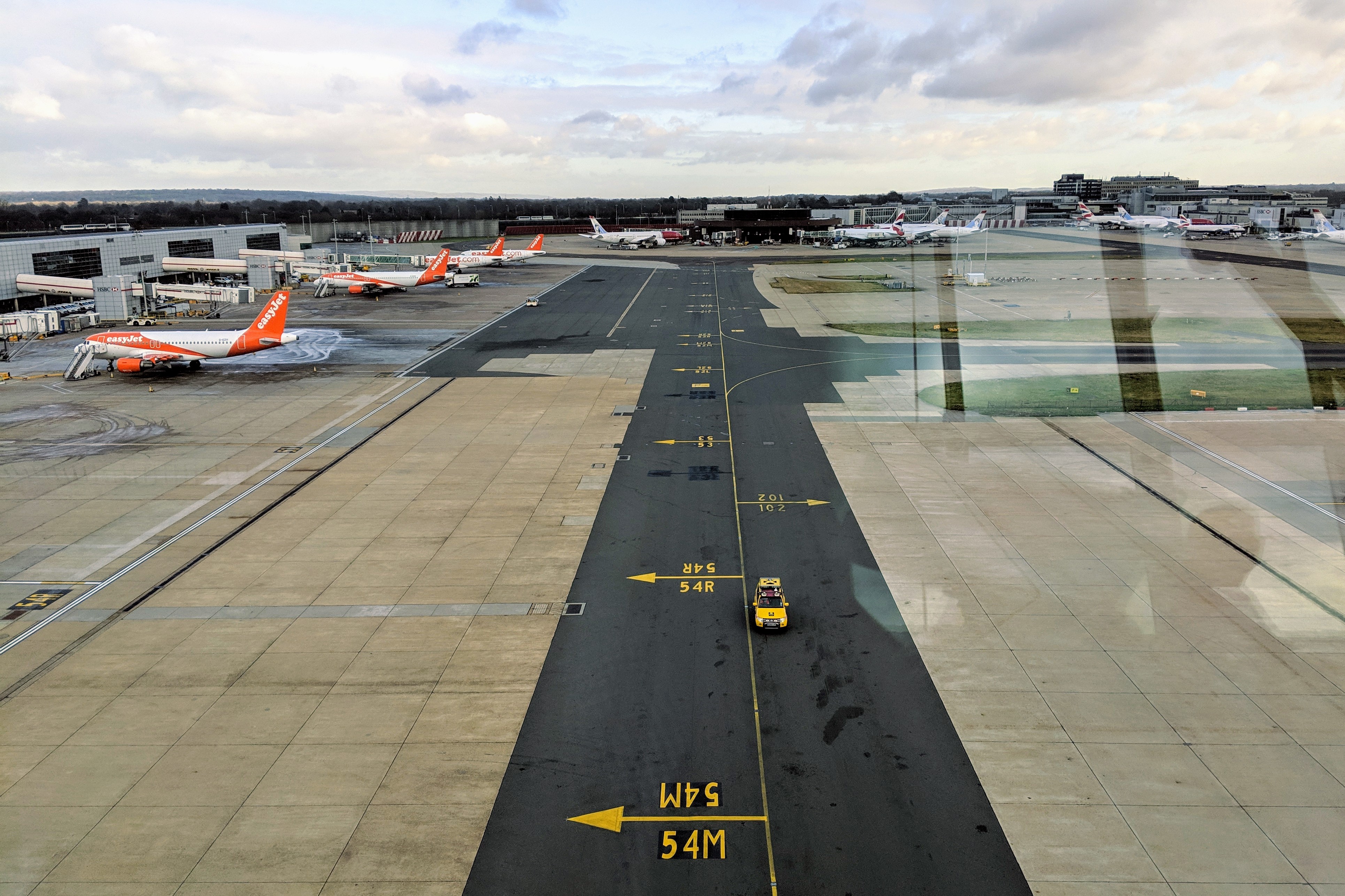
Gatwick International Airport

Gatwick airport is located about half hour away by car or train from London. The airport is a second home to British Airways, but also served by several key airlines, including easyJet, Norwegian Air, TUI Airways. For Asian services you can count on Qatar, Emirates, Cathay Pacific and some Chinese airlines.

Singaporeans used to have a direct flight from Changi to Gatwick, served by low-cost carrier Norwegian Air. Unfortunately, that route has been suspended less than a year after it began.

London Gatwick International Airport

While Gatwick airport is not connected to the London Underground like Heathrow airport, travellers can make use of the Gatwick Express trains (GBP19), or regular trains to London Victoria station. For those who are travelling outside of the morning and evening peak hours, the regular train fares can be as low as GBP8.30 (off peak fare) each way. Taxis are also widely available, although that will set you back by about 50-60 GBP each way.

Emirates is located at the North Terminal at Gatwick airport. If you are arriving at the airport by train, you will need to follow signs to the North Terminal via a shuttle train.

The Emirates A380

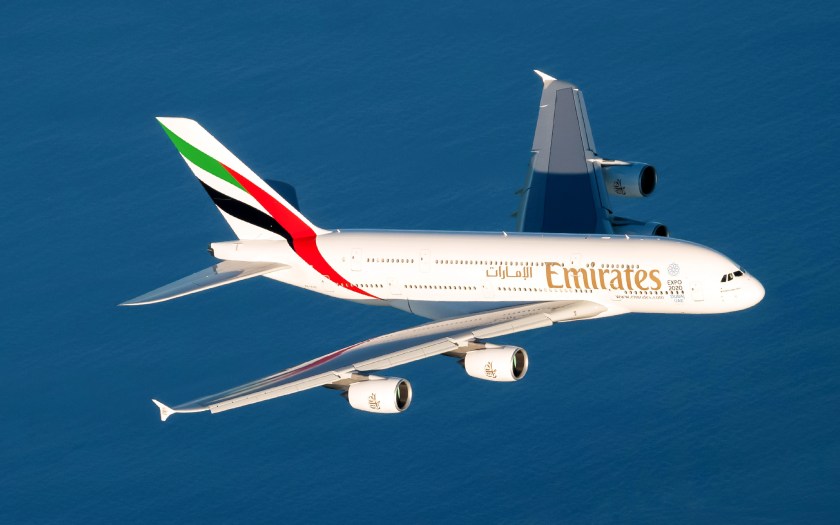
The Emirates A380

Emirates operate only the A380s to both London Heathrow and London Gatwick airports. Given that they have well over 100 A380s in their fleet, you may get subtly different configurations, but by and large all the London services will feature a three-class configuration, offering First, Business and Economy class. Emirates have a small fleet of two-class A380s as well, although the business class cabin will remain similar.

The Emirates A380 is only of the most densely packed aircraft in the world. In a three-class configuration, they carry 489 to 517 passengers. If you are on one of the two-class A380s they have, you are sharing the air with 614 other passengers.

In contrast, Singapore Airlines carry between 379 to 471 passengers, while British Airways and Qantas carry 469 and 474 passengers respectively.

The seat

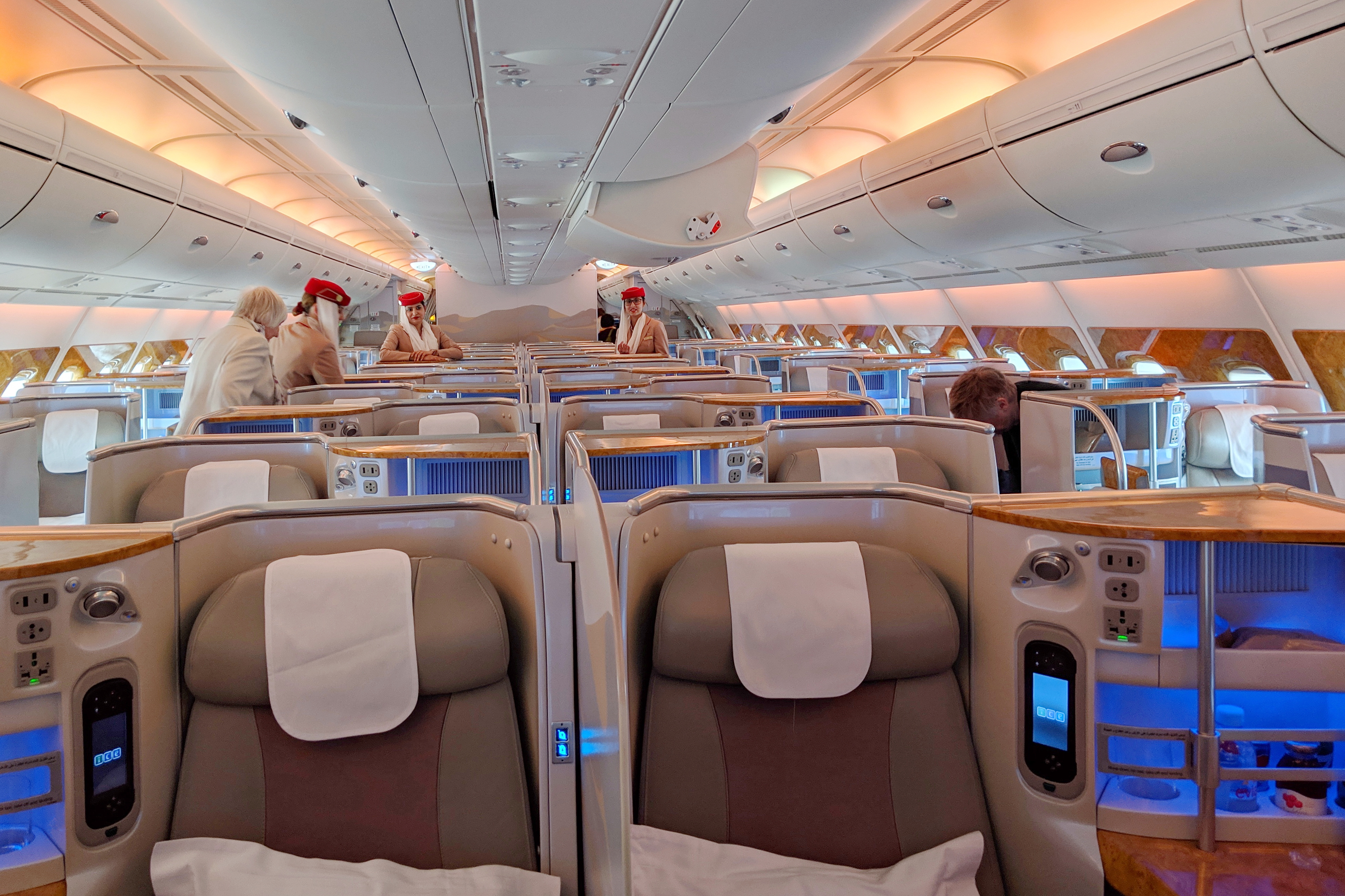
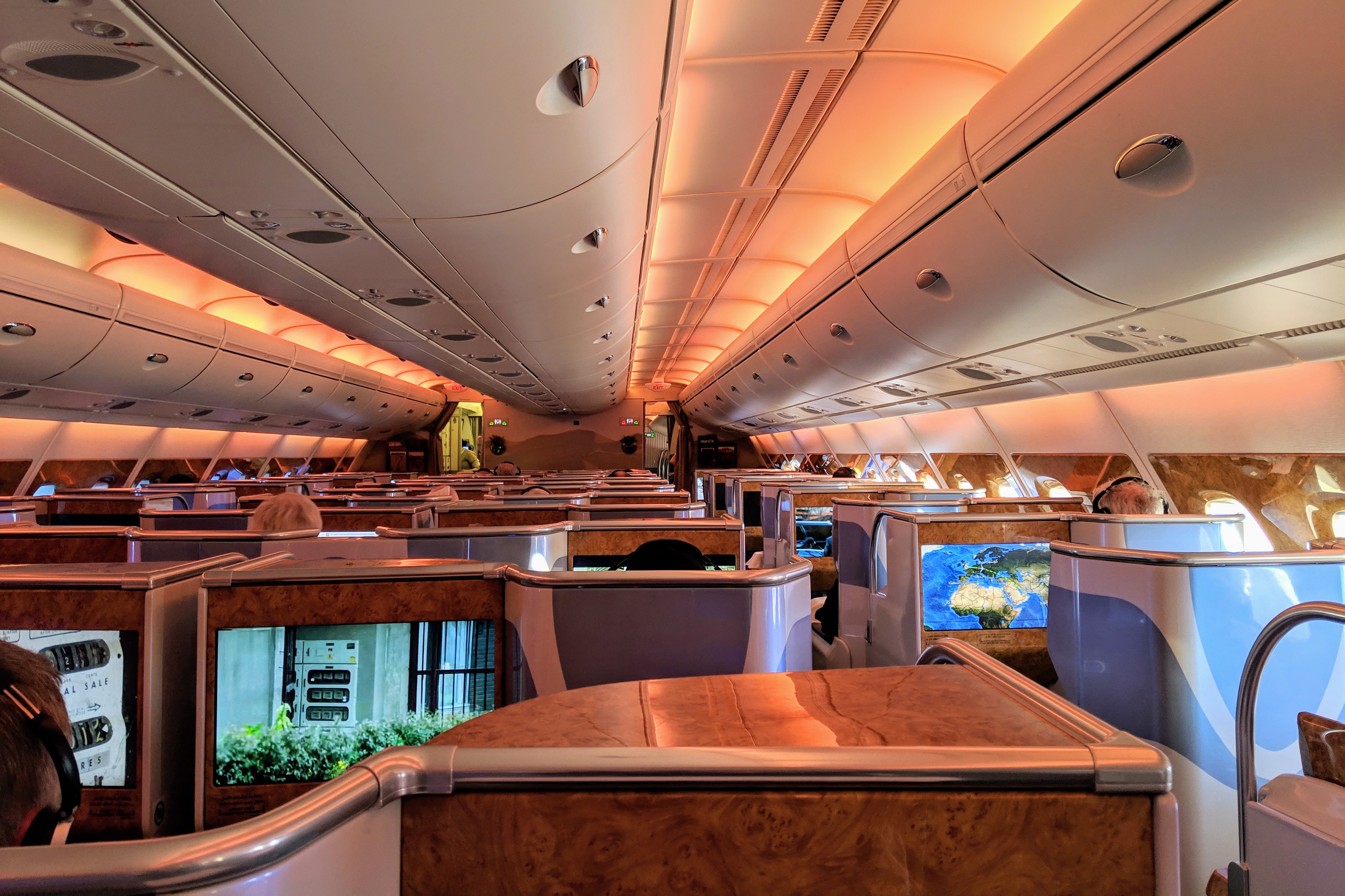
The Emirates business class cabin is on the upper deck of the aircraft, right behind the first class cabin extending all the way to the back of the aircraft. The lower deck is fully economy class, so that means that no one is likely to use the stairs between the two decks.

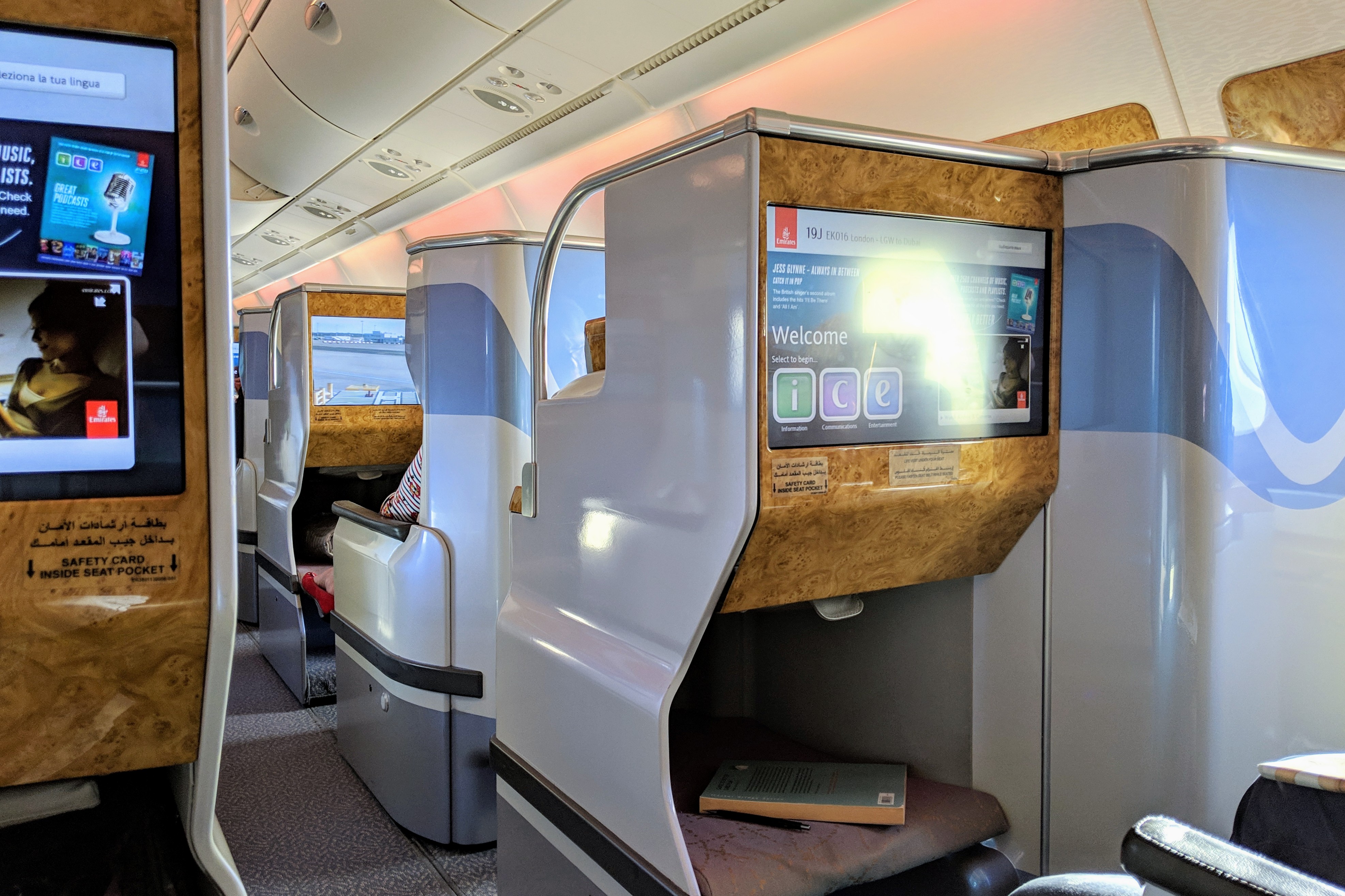
Emirates A380 business class on the upper deck

The layout in business class features a 1-2-1 seating arrangement, so all seats have direct aisle access. Each seat comes with a side table console, with a private minibar stashed with soft drinks and water.

The seats are all forward facing, with each seat’s foot hold extending into the side table of the seat in front. This means that the seat alternate between having your side table on the left and on the right. And with this configuration, couples travelling together have a choice of some middle seats where they are seated right next to each other and the side tables between them and the aisle.

Boarding was relatively fuss free, with first and business class passengers boarding first. Given that there’s a direct bridge to the upper deck of the aircraft, you get to avoid the crowd going to the economy sections.

The seats are all forward facing, and can be fully converted into a flat bed at a touch of a button.

On board service

After I got into my seat and checked out every nook and cranny, I realised the crew hasn’t come around to serve drinks. And true enough, they were pretty busy although I wasn’t sure what with.

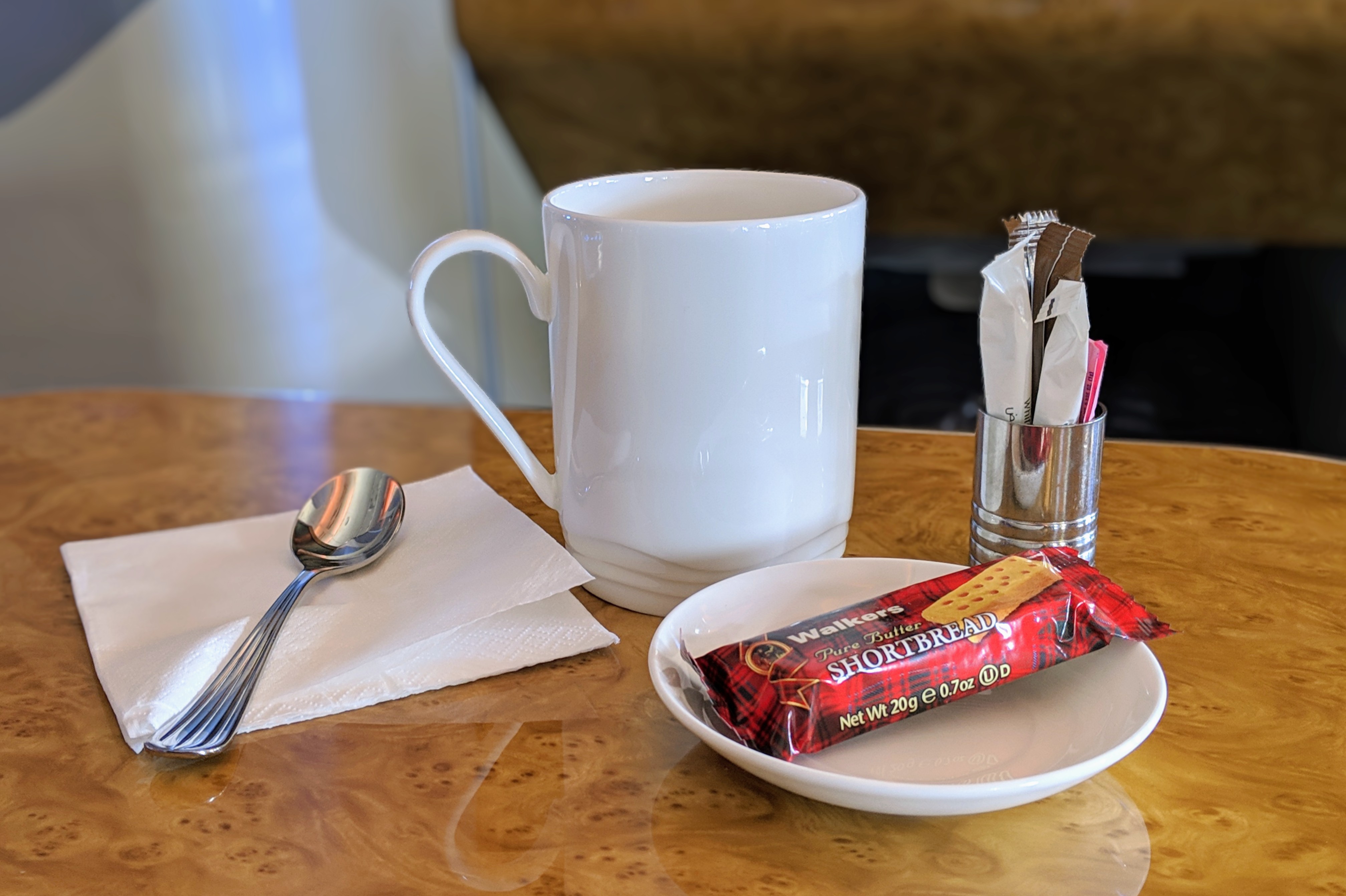
Just as I thought that they weren’t going to serve drinks after all, the crew started coming around to offer champagne, juices and water. I was craving for a coffee, and thought I’ll have a final cuppa for the day.

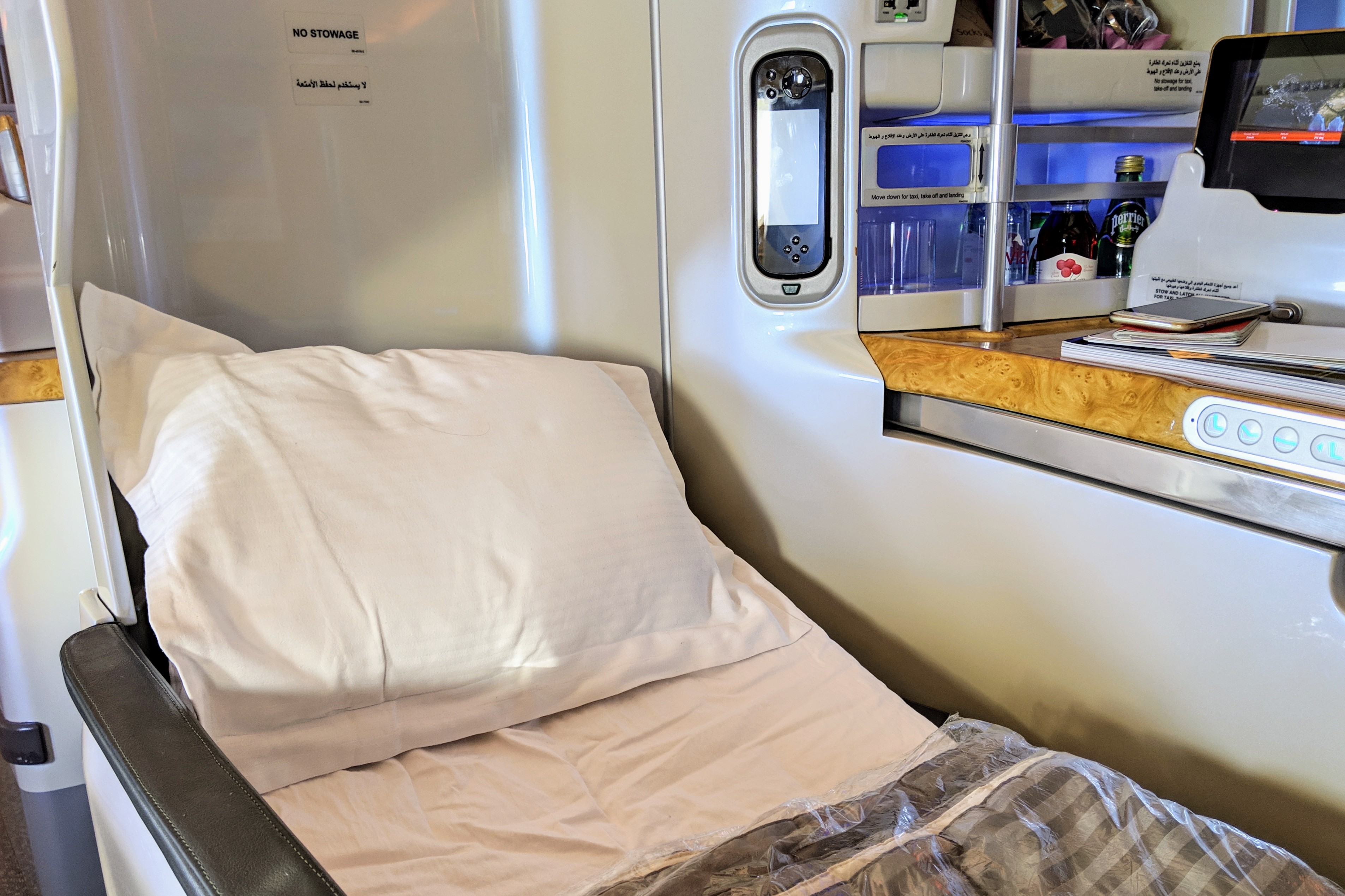
Once we are up in the air and the seatbelt signs have been turned off, the cabin crew got down to work real quick. First matter of the day was to offer a mattress to all passengers, even though this technically was a day flight. The mattress was simply a foam padding placed atop the seat. I honestly didn’t feel any material difference.

Emirates A380 business class bed

Next, the crew was busy setting up the bar area. As I was seated close to the bar, you could hear a fair amount of activity coming from that area. I went out to take a look, the crew was placing all the alcohol bottles, glassware and laying out the snacks at the bar in double quick time.

Finally, the crew got around to begin meal service. Menus were presented, and a short while after, they came around taking orders for lunch and drinks.

Pre-meal drink service

A bit more about the meal service.With a flight time of six hours, there was only one meal service. I was pretty alarmed to begin with, but trust me, it was more than enough.

As the galley prepares the lunch, a drink was served first, although that took a while to come as well. I was long done with my champagne before my table was finally dressed for lunch.

One thing you will notice is that Emirates kind of operate a no-trolley service, so everything is carried out from the galley to you by hand. With over 60 business class passengers that’s an awesome lot of walking on the plane!

The menu for lunch today consisted of three courses:

Appetisers

  • Cream of celeriac soup with sauteed mushrooms
  • Smoked duck on cucumber capaccio with sesame seeds, shiso cress and masao sauce
  • Portland crab involtini – crabmeat rolled in cucumber ribbons, served with pickled celery and virgin Bloody Mary gel

Main course

  • Seared beef fillet with horseradish jus, served with grilled asparagus, carrots and buttered cauliflower topped with pine nut crumble
  • Chicken baharat, roasted chicken with Arabic seven-spice, served with fragrant rice with minced lamb, fried cashew nuts and pistachios
  • Samundari khazana, seafood curry served with tempered green beans and steamed rice
  • Pulled chicken sandwich, barbecue chicken with emmental and onion jam in focaccia, served with coleslaw and potato crisps

Dessert

  • Chocolate and walnut torte, chocolate cremeux on a brownie base, topped with dark chocolate served with fruit and nut compote
  • Raspberry and coconut tart, coconut mousse layered on raspberry cream, served with mango compote
  • Seasonal fruit
  • Cheese board

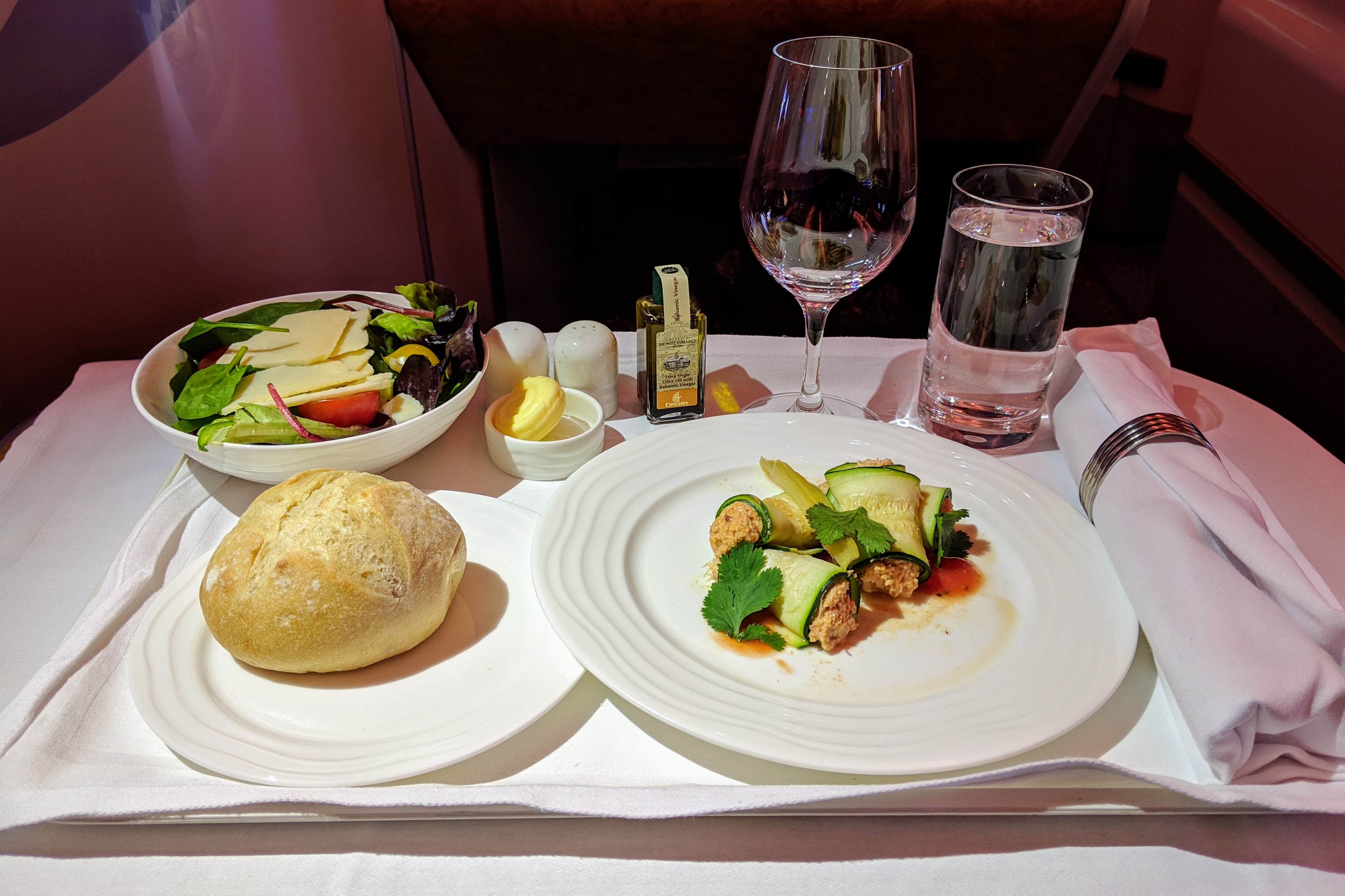
I went with the Portland crab involtini for my appetiser. It came out quite differently from how I expected it to be, it was essentially a cucumber roll filled with the crabmeat (I think it’s crabmeat) filling.

Appetiser – Portland Crab Involtini

The resulting combination was good, you get the crisp refreshing bite from the cucumber, combined with the savouriness of the crabmeat paste. I found the crabmeat mix a little too salty for my liking, but that is a known problem for airline food.

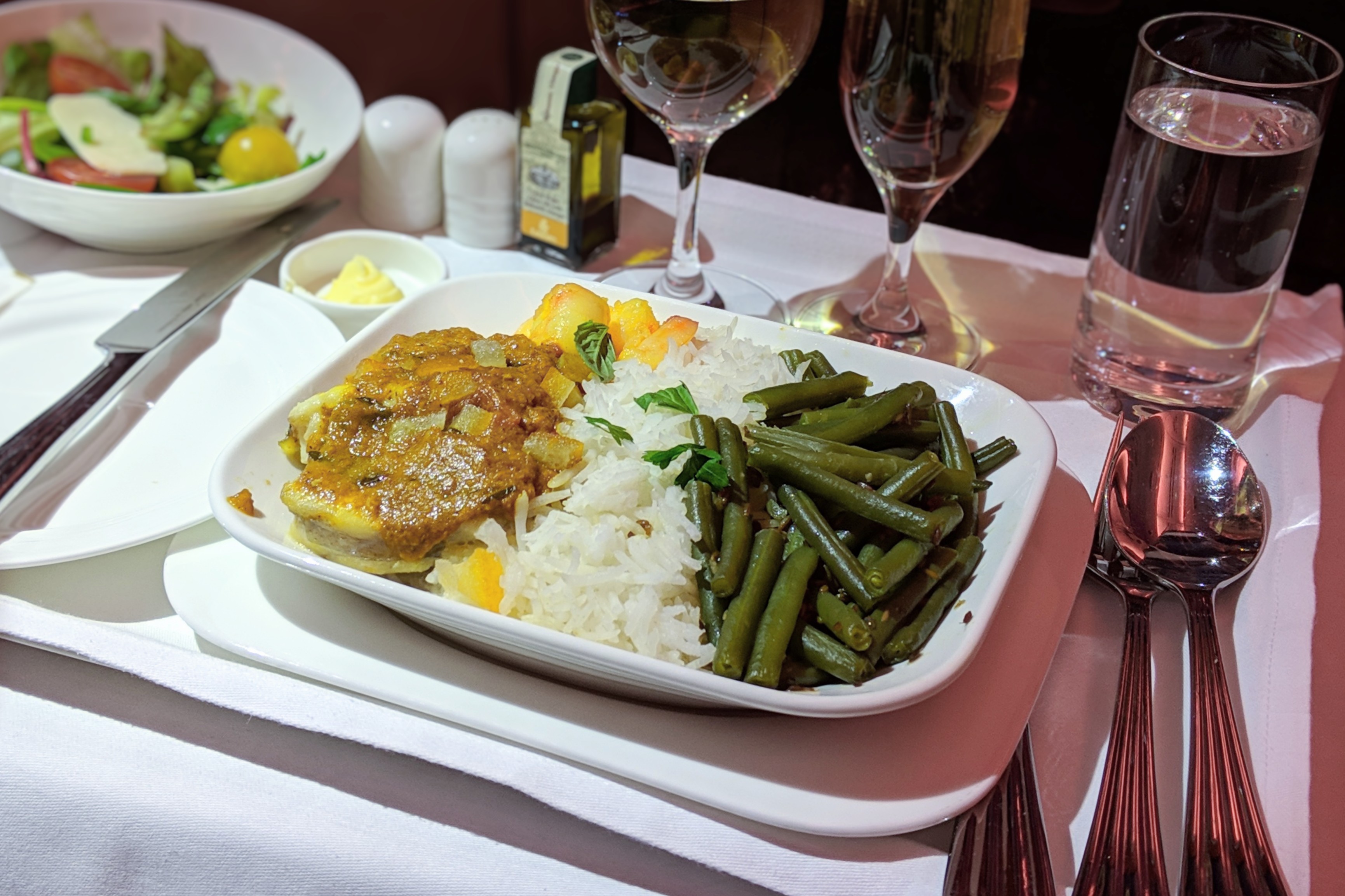
For my main course, I decided on the samundari khazana, which is a seafood curry.

Main Course – Samundari Khazana

When the portion first came along, I was slightly disappointed. It looked almost like a premium economy casserole: a lot of food crammed into a small dish. This is similar to what Cathay Pacific does, but I always tend to like larger plates (like how Qantas or Singapore Airlines does it), which gives the impression of grandeur.

When I dug into my first bite, all was forgiven. It was yummy like hell. The choice of a long grain rice complemented the curry very well, and the fish didn’t crumble like it usually does for airplane food. I definitely walloped all of it pretty quickly, along with another glass of shiraz.

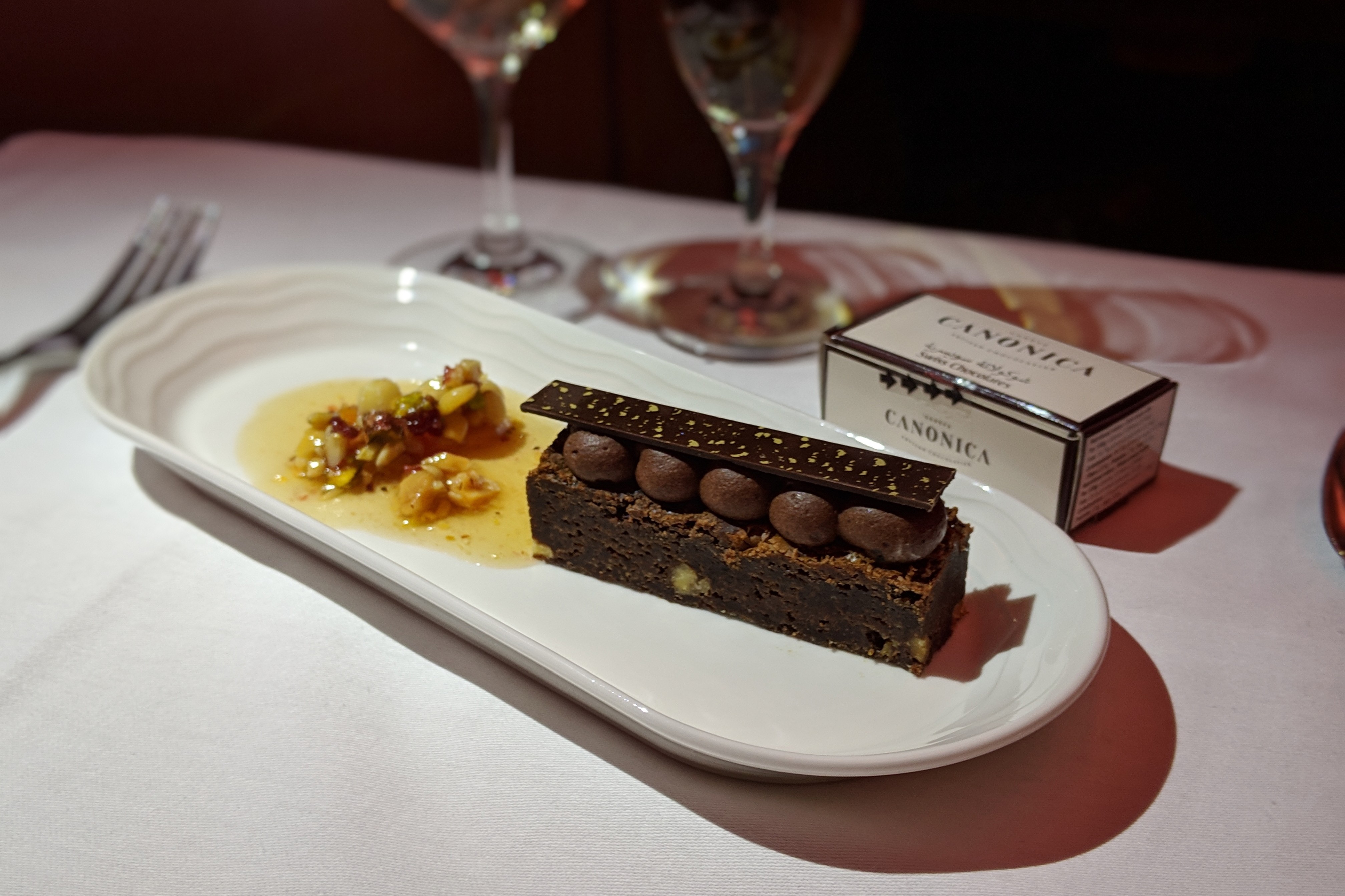
Finally, it was time for dessert. I was a tad sad that they didn’t offer ice cream, so I went with a safe choice, which is typically anything chocolate. The Chocolate and walnut torte came as a long and thin slice of cake on a brownie cake base. I took two bites into it and left the rest alone; it was too sweet for my liking.

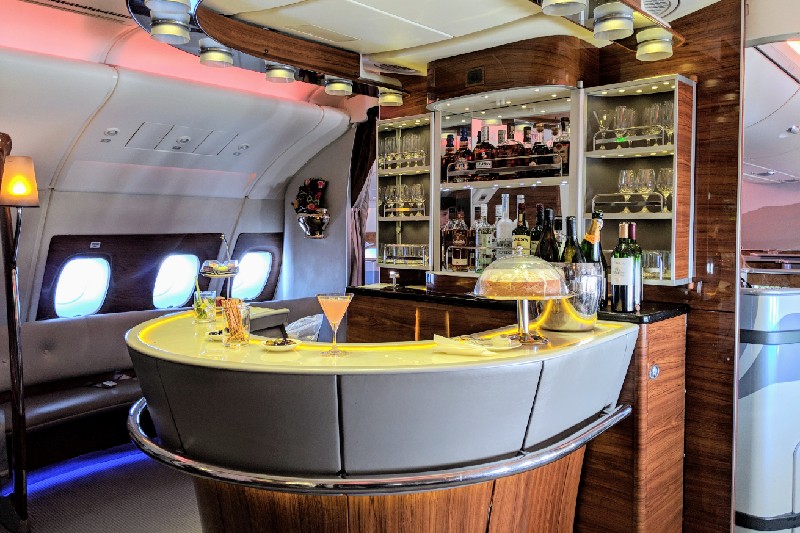
The Emirates A380 bar

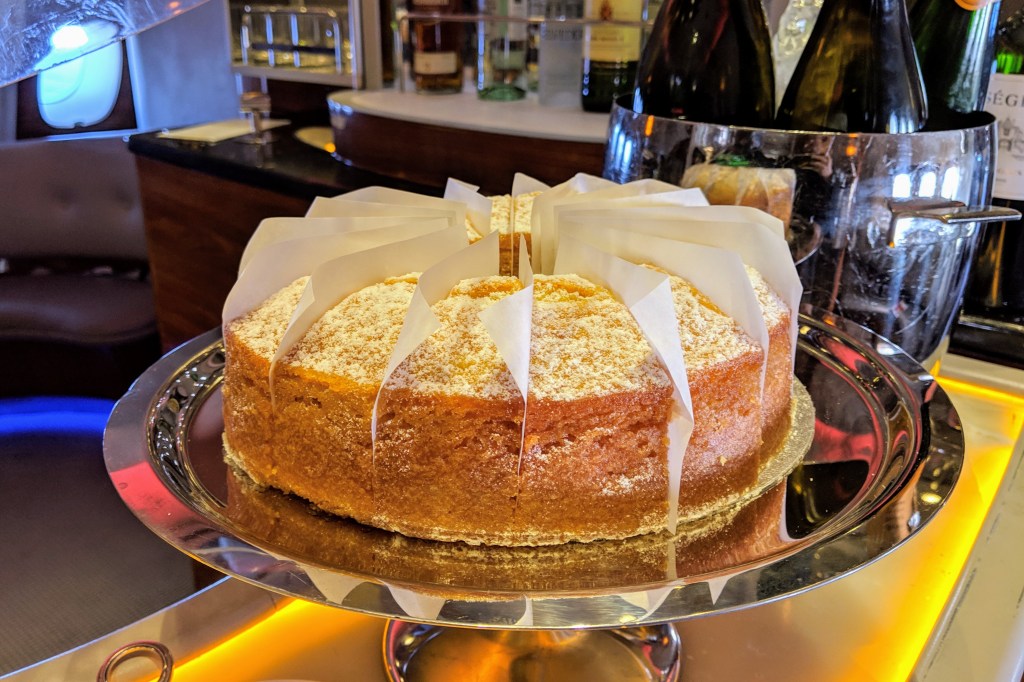
After lunch service was done, I decided to visit the bar at the rear of the deck. When I got there, there was only one other passenger there. The bar is a pretty compact one, but pretty well stocked. There was even a small tray of condiments – Tabasco sauce, syrups, garnishes, lemons and limes. On the bar was also a cake stand with a whole orange sponge cake, all sliced up ready to be served, as well as fruits, pretzel sticks and other little bites.

Soon enough, several other passengers came around, asking for drinks, wines, and snacks. With about two more hours to go on the flight, the crew came around offering ice cream to everyone too. This is when I realised that I was still pretty full and actually didn’t need more food, even though it was a six hour flight.

The bar is an incredibly good idea. Passengers were gathering around, chatting up with one another, and at one point in time, a mother brought along her very young toddler and the entire bar, both passengers and crew, was watching this little pack of joy crawling around and taking turns to carry the young boy.

Whole cake at the Emirates A380 Bar

I surveyed the space and saw that it could easily fit in another 6-8 business class seats, translating to potentially several million more dollars in revenue each year, per aircraft. But instead, Emirates have decided to devote a social space on the aircraft, which has become a signature and one of the strongest reasons why people want to fly with them.

Final thoughts

The Emirates A380 business class is a solid product. While gaudy at first glance given its predominantly brown and gold fittings, everything works. The in-flight entertainment system is extensive, the seat was comfortable, and I liked the idea of a minibar so I didn’t have to trouble the cabin crew for my first drink (at least).

In terms of catering, the food was good, although not exceptional. The main course was tasty, but I felt the portion could be a little more generous. Having said that, this is not uncommon across many business class cabins. Despite the food, the service was attentive. During the course of my lunch, I had the crew walking around to top up my drink every so often.

Emirates A380 Business Class (Upper deck)

The only thing that was less than stellar was perhaps the speed of dining. As an Asian, I’m incredibly accustomed to speedy service, even in business class. I like my meal to be completed within the first two hours so that I can do my own stuff. However, having said that, this is a personal preference; I do know of many travellers who like to dine at a leisurely pace and could do a full business class meal over the length of a movie or even two.

Emirates reduces baggage allowance for its cheapest fares

Emirates has quietly reduced the check-in baggage allowance for its cheapest fares in Economy.

From 4 February 2019, economy fares in the cheapest Special fare type will only receive 15kg check-in baggage allowance, down from the current 20kg. Saver fares will see their allowance drop to 25kg, down from 30kg.

Changes to weight concept (for travel on all routes except to and 
from Americas, as well as originating from Africa)

Economy Flex and Flex Plus fares will continue to receive 30kg and 35kg respectively. There is also no change to business and first class baggage allowances, which remains at 40kg and 50kg respectively.

What remains unchanged are the frequent flyer extra baggage allowances for Emirates Skywards members. Silver, Gold and Platinum members will continue to receive between 12kg and 20kg extra baggage allowances on top of what is provided in the fare.

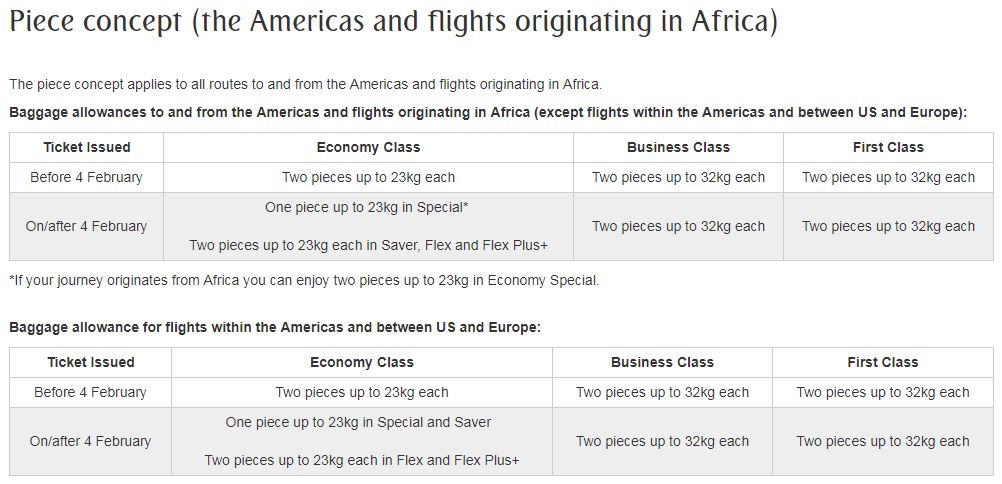
Changes to piece concept (for travel to and from Americas, and 
for travel originating from Africa)

For travel to and from Americas and for flights originating from Africa where check-in baggage allowance is by the number of pieces, Special fare type will receive only one single piece of baggage allowance, up to 23kg. Saver, Flex and Flex Plus customers continue to receive 2 pieces up to 23kg each.

For travel between Europe and Americas, Special and Saver fares both get only one piece of baggage allowance.

So where is Special fare sold?

A quick check on sale fares on Emirates for travel out of Singapore revealed that most of the cheapest fares are in the Saver category. That means that you are likely to get 25kg of checked baggage allowance if you book after 4 February 2019.

Emirates fare from Singapore to Melbourne (source: Emirates.com)

There is also no guarantee that Emirates will not start using fare classes within the Special fare type for fares to Australia and Europe from Singapore.

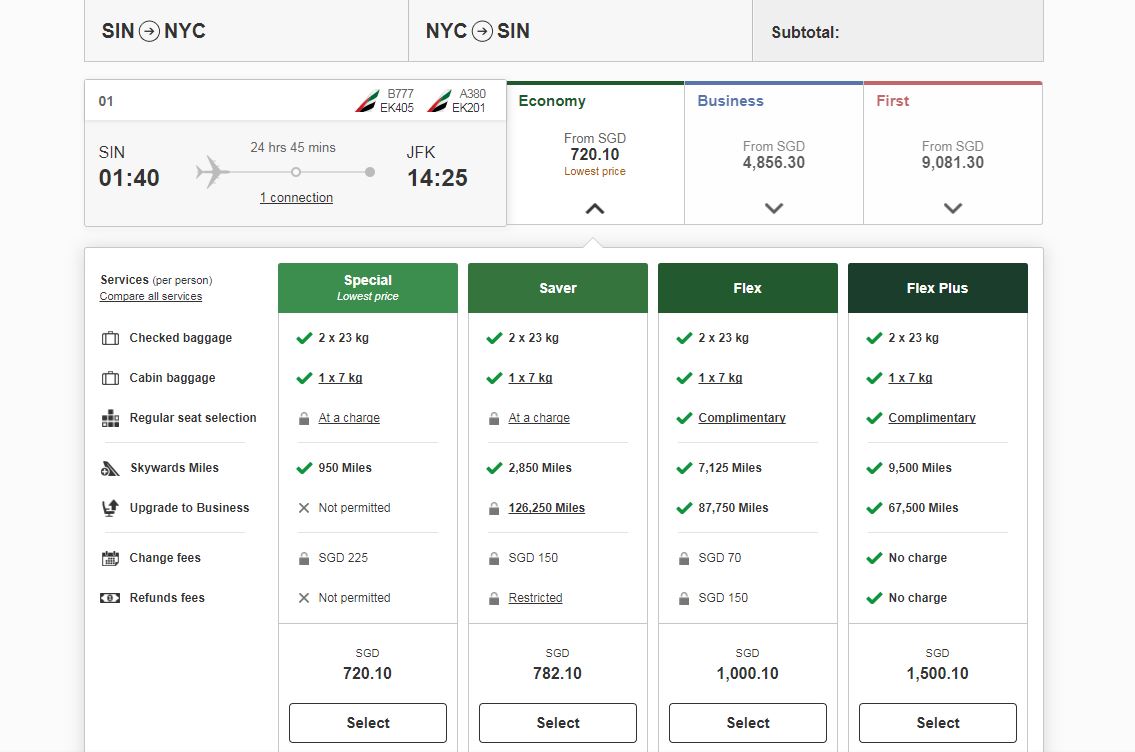
However, for travel to the US, there are Special type fares available for travel from Singapore. This means that if you book a Special fare on or after 4 February 2019, you will only get to check in one single piece of luggage no heavier than 23kg.

Emirates fares from Singapore to USA  (source: Emirates.com)

Each additional bag will set you back by USD200, up to 23kg. If you prebook additional bags, you will get a 50% discount off the first additional bag (if you are travelling in economy), and 20% discount thereafter, or if you are travelling in business or first class.

So if you know you will be travelling with more than one piece of checked baggage to and from the Americas, it might make plenty of sense to ‘upgrade’ your fare type just to have that extra bag.

Any other way to get more bags?

One other way to still retain your 30kg allowance is to book on a codeshare flight operated by Emirates.

For instance, Qantas codes Emirates’ flights from Australia and Singapore to Dubai, as well as services between Dubai and Europe. This means you can effectively book a Qantas-code flight that is operated by Emirates, and still enjoy Qantas check-in bag allowance.

However, that means some other things are at risk: for instance, you won’t receive any Emirates Skywards miles if you are a member of that programme.

For the details on the changes, visit Emirates’ checked baggage page here.