Marriott Bonvoy is offering off-peak redemption rates at more than 5,500 properties globally, although some properties in Singapore are excluded
Given how Covid-19 has disrupted the travel industry this year, Marriott has come up with kind of a two-in-one promotion.
Marriott Bonvoy offer 50% elite nights for current elite members
The first part of it is that Marriott will be giving all members bonus elite night credits. The number of credits given the each member will be 50% of the elite tier they earned in 2019.
Note that this is not the actual number of nights you clocked last year, but rather, the number of nights you need to qualify for the tier. This means:
Silver Elite members will get five elite nights
Gold Elite members will get 13 elite nights
Platinum Elite members will get 25 elite nights
Titanium Elite members will get 38 elite nights
Ambassador Elite members will get 50 elite nights
The elite nights will be deposited into members’ accounts by the end of July. According to View from the Wing, Marriott will also count these elite nights towards lifetime statuses.
Off-peak award redemption
Marriott is also concurrently offering more than 5,500 properties under its portfolio available for booking at off-peak rates. To book these cheaper awards, the bookings must be made between 15 Jun and 30 Junfor stays by 31 Jul 2020. Note that this is not implemented across all properties.
Marriott has introduced a three-tier award pricing since mid 2019, and expectedly it was rather difficult to look for off-peak awards. With this ‘promotion’, members can expect to save up to a third of the points required for a standard tier redemption.
For most people, this promotion will probably means cheaper staycation options within your countries, given that international travel is going to be highly unlikely before the end of the year.
In Singapore, these are the properties available and their categories:
Hotel
Category
Sheraton Towers Singapore
5
Singapore Marriott Tang Plaza Hotel
5
St Regis Singapore
6
Warehouse Hotel
5
Four Points by Sheraton Singapore
5
Westin Singapore
5
W Singapore Sentosa Cove
6
Le Meridien Singapore Sentosa
5
Courtyard Singapore Novena
5
JW Marriott Singapore
6
A quick check on the Marriott website showed that not all properties were offering the off-peak pricing, so be sure before you book. Also, most properties are offering room rates at an all-time low, so you might be better off paying cash than burning your points.
Final thoughts
This promotion is rather well timed, as Singapore further liberalises its Covid-19 control measures to allow for socialisation and hopefully, staycations as well.
While the elite nights make it a worthy cause to chase after a higher elite status for next year, given that international travel is going to be severely restricted for the rest of the year, it’s going to be highly unlikely to clock those additional nights to jump to the next level.
You can now convert your American Express Membership Rewards points to Qantas Frequent Flyer points
American Express has added Qantas to its fold of frequent flyer programmes partners, the fourth Oneworld programme to be added. This latest addition will allow both its charge card and credit card members to convert their Membership Points into Qantas points.
The details
Cardholders with Membership Rewards (MR) points will be able to convert 450 MR points to 250 Qantas points. This conversion rate is similar to what Amex offers for other FFPs, including Krisflyer, Asia Miles and Emirates Skywards.
For Amex Centurion or Platinum Charge cardmembers, the conversion rate is a preferential 400 points to 250 airline miles.
Second widest range of conversion partners
This brings the total number of transfer partners for Amex to nine partners, tied in the second spot with Standard Chartered. Citibank remains at top spot with the most number of redemption options for your credit card points.
The full list of airline frequent flyer programme conversion partners for Amex is as follow:
British Airways Avios (Oneworld)
Cathay Pacific Asia Miles (Oneworld)
China Airlines Dynasty Flyer (Skyteam)
Eva Air Infinity Mileagelands (Star Alliance)
Emirates Skywards
Malaysia Enrich (Oneworld)
Qantas Frequent Flyer (Oneworld)
Singapore Airlines KrisFlyer (Star Alliance)
Thai Royal Orchid Plus (Star Alliance)
But… should youconvert your points to Qantas?
The short answer: no.
And the reason for that is not because Qantas has a bad programme inherently, but because of the way Qantas points are valued.
Qantas structures its frequent flyer programme rather differently, so the value of a Qantas point is not within the same range as what you’d value a mile from most other programmes.
I have long argued that the value of Qantas points should not be equated to other frequent flyer programmes for two reasons: first, the redemption award charts are always significantly higher than what other programmes charge for a similar trip; secondly, Qantas typically awards significantly more points for a flight segment than many other carriers would for a similar trip.
Award chart
Qantas uses a distance-based chart for flight awards, which is similar to many Oneworld programme, and you can refer to the full chart here. For simplicity sake, this is what Qantas and other Oneworld airlines charge for a one-way journey on Qantas from Singapore to Sydney:
Economy
Business
First
Qantas Frequent Flyer
25,200
68,400
102,600
British Airways Executive Club
20,750
62,000
82,500
Cathay Pacific Asia Miles
27,000
61,000
87,000
Award rates for one-way ticket from Singapore to Sydney
As you can see, Qantas comes up being the most expensive in the premium cabins across all carriers, requiring up to 25% more points than what the partners will charge. To add salt to the wound, Qantas slaps on a hefty charge for award tickets, further diminishing the value of the award. Fancy shelling out $350 in fees for an award ticket from Singapore to Sydney?
Earn rate
Now, to paint you another perspective, this is how many miles you will earn on the operating airline’s frequent flyer programme for a one-way flight from Singapore to Sydney.
Note that both Qantas and British Airways offer bonus points for members with elite tiers, but we will exclude that for now.
Airline / Programme
Economy Saver (or equivalent)
Economy (highest fare class)
Business (lowest fare class)
Business (flexible)
First (lowest)
Singapore Airlines / Krisflyer
1956
3912
4890
5868
7824
British Airways / Executive Club
979
3916
5874
9790
9790
Qantas / Qantas Frequent Flyer
2600
5200
7800
8450
10400
Earn rates for one-way trip from Singapore to Sydney
In all cases, you easily earn over 30% more Qantas points than Krisflyer miles. Compared to BAEC, the number varies, but you are likely to benefit more if you are flying cattle class and if you don’t have status with BAEC.
Having said that, Qantas doesn’t nab you as many points when you fly other oneworld airlines, but that’s a common practice.
For instance, if you were to fly to Hong Kong on Cathay Pacific:
Airline / Programme
Economy Saver (or similar)
Economy Standard (or similar)
Economy (highest fare class)
Business (lowest fare class)
First (lowest fare class)
Cathay Pacific / Asia Miles
1,000
1,800
2,000
2,500
3,500
British Airways / Executive Club
None
400
1,601
2,001
2,402
Malaysia Airlines / Enrich
None
794
1,588
1,985
2,382
Qantas / Qantas Frequent Flyer
None
1,000
2,000
2,500
3,000
While not fantastic, Qantas doesn’t come up too short – as compared to other oneworld members, it usually dishes out the most number of points for a similar itinerary.
Final thoughts
Transferring any credit card reward points to Qantas Frequent Flyer programme is a dead no for me, given the relative lower value of a Qantas point compared to many other programmes. Qantas probably know that its own currency is worth less than other airlines’ miles, but has always stuck to parity when it comes to conversion rates vis-a-vis other programmes.
The best way to rack up Qantas points is in flying and not through credit card conversions, unfortunately. So this means that the programme is only useful insofar as frequent flyer programmes were originally designed for: rewarding those who actually fly.
So if you find yourself heading Down Under pretty often, you will find yourself benefitting more from earning points by flying Qantas and placing your points with Qantas Frequent Flyer than those who rely mostly on credit card spending. If you do a lot of flying within Southeast Asia, you can also earn a fair number of points from flying Jetstar, especially if you buy bundles often. This is a much better proposition than trying to earn Krisflyer miles on Scoot flights.
Having said that, there have been instances where banks run bonus rates for conversions, such as the DBS offers last year where you get up to 25% bonus. Where they happen, the programme may still offer good value.
Qantas Frequent Flyers need to use more points to redeem seats on Emirates from 1 Sep 2020
Qantas has recently raised the number of Qantas points required for an award ticket on its long-time partner Emirates. From 1 Sep 2020, members will need up to 20% more points to book the same seat as before.
To be sure, Qantas did not revise any other award charts, but instead, moved Emirates from the Qantas Classic Flight Reward table to a seperate chart, the Partner Classic Flight Reward table. The latter chart is used for redemptions on oneworld partners, and requires more points for seats.
How much will it increase by?
If you are based in Asia, this how the adjustments will change the rate of one-way redemptions:
Singapore – Melbourne (on Emirates-operated flights) Singapore – Dubai
Qantas has a bad reputation for charging sky-high ‘additional carriers’ fees’ along with award tickets redemption for both its own tickets, as well as tickets on partner airlines.
Breakdown of additional fees and taxes for one-way Qantas Frequent Flyer award ticket on Emiratesfrom Singapore to Milan
Emirates has most recently reduced its surcharges off award tickets, but it will remain to be seen if this savings will be passed on to Qantas Frequent Flyer members from 1 Sep when the higher award rates kick in.
Mixing Qantas and Emirates awards will cost you more
The move of Emirates from the Qantas chart to the partners’ charge will now mean that any itinerary with a mix of Emirates and Qantas flights will now use more points than before, as the Emirates leg and Qantas leg of the trip will be calculated separately.
For instance, if you were to redeem a trip from Singapore to Hobart in business class, travelling on Emirates from Singapore to Melbourne, and Qantas from Melbourne to Hobart:
Before 1 Sep: you will pay 68,400 points + fees for the entire one-way trip.
From 1 Sep: you will have to pay 75,000 points for the Emirates leg plus 18,400 points for the Qantas flight, and taxes for the entire one-way trip.
In points alone, you will need to fork out 18,400 or close to 25% more points.
Why the move?
This move here is perhaps another signal towards the slowly fading partnership between Qantas and Emirates, most possibly due to the latest developments.
A bit of history here: Emirates entered into a joint venture with Qantas back in 2013 when Qantas adjusted its Europe strategy. By joint venture, this doesn’t mean a new business, but instead, allows both airlines to legally cooperate and coordinate schedules, fares and other details without flouting competition laws.
Singapore-based readers will remember that this is also the year Qantas temporarily ended its London service from Singapore, as Qantas moved its offshore hub to Dubai, where it could leverage Emirates’ network to serve other destinations in Europe.
This worked out well for Qantas’ cost base, given that it can reduce its own footprint into Europe while still serving the needs of Australians who need to go between Australia and Europe. This partnership was one of the lifelines during that time, allowing Qantas to review and transform its business into a highly profitable one over the next few years.
In 2017, both airlines sought regulators’ approvals to renew the partnership for another five years, but this time round the realities are a little different. Qantas was on a streak of a few record-profit years by this time and was financially a lot more stable. While the partnership was renewed, Qantas moved its hub back to Singapore. More critically, Qantas also launched the much awaited Perth-London service in March 2018, a historic moment given its the first commercial non-stop UK-Australia service. This is another move towards less reliance on an Asian or Middle East hub for the Australian carrier.
Final thoughts
First things first: it would have been nice if Qantas had sent out any type of communication to its customer on this change, although some avid followers may argue that this point is moot, as availability on Emirates has been severely limited for a while now.
This move has effectively diminished the role of Emirates in the Qantas network from an important ally to just any other partner, which is such a pity. The Emirates experience has been a strong pull to earn and keep Qantas points, given that Qantas Frequent Flyer programme is one of the handful of FFPs that allow a redemption on Emirates since the Middle Eastern carrier is not affiliated with any global alliances.
For those who have been saving up points for a seat on Emirates, you have some time to lock in an award booking before 1 Sep, so do so quickly.
In the midst of a world pandemic, airlines are desperately trying to conserve cash burn as they receive practically near-zero revenue given the halting of international travel.
Alaska Air has turned to its usual tactic to raise some money, by ‘selling’ future travel in the form of miles. This time, Alaska Air is offering up to 60% bonus miles, a never-seen-before offer.
Note that Alaska Air is currently selling these miles tax-free, so this brings the per-mile cost down to 1.72 US cents.
The offer
Alaska Air has targeted some members with the whopping 60% bonus. This is not a straight-off bonus, but tiered according to how much you buy:
Buy 10,000-19,000 miles: 20% bonus (i.e. 2.29 US cents/mile)
Buy 20,000-39,000 miles: 40% bonus (i.e. 1.96 US cents/mile)
Buy 40,000 miles and above: 60% bonus (i.e. 1.72 US cents/mile)
This is a targeted offer, so that means that your offer may differ from other people. As far as articles have suggested, there are two offers: one for 60% bonus, the other for 40% bonus.
The 40% bonus is a lot more sedated (and definitely not worth considering):
Buy 3,000-14,000 miles: 20% bonus (2.29 US cents/mile)
Buy 15,000 miles and above: 40% bonus (1.96 US cents/mile)
To find out what’s your offer, you will need to log into your account here.
Should you really be buying miles now?
This is no doubt an incredible offer, given that Alaska Air has historically offered only up to 50% bonus miles. At 1.72 US cents per mile, the famed Singapore-Tokyo redemption on JAL business class will only set you by USD429.70 (S$613), or somewhere close to USD860 (S$1,226) for a roundtrip ticket, an incredible value for a business class mid-haul ride.
The key risk here is obvious: we don’t know when the global travel economy is going to recover, and that has a hinge on flight capacity. Historically, airlines will prioritise revenue tickets over award tickets, so if there’s a situation where demand outpace the available air capacity, you could be left in a situation of too many miles, too few redemption options.
While Alaska Mileage Plan last for two years before expiring, bear in mind that Alaska is due to join oneworld in summer next year, so award prices may change by then.
Final thoughts
The worst of situations often brings out the best promotions, and this is probably one of those classic examples.
As the other mileage experts always say: don’t buy these miles speculatively. Only do it if you have a plan to use them in the near future.
Several airlines frequent flyer and hotel loyalty programmes have announced membership extensions for affected members. Here are the details.
LAST UPDATED: 29 April 2020
With Covid-19 entering now heading into its fifth month soon and seeing no signs of easing, global travel has taken a severe beating. Airlines have made drastic cuts to their capacity, while hotels are reporting all-time low occupancy rates.
Moreover, China now makes up one of the most significant group of members that any airline or hotel will want, so I will imagine any loyalty programme manager will want to ensure that this group returns to the fold once the crisis is over.
Several programmes have announced expiry extensions for their elite members, almost most of them are targeted at members in Greater China. See below for details.
[Updated] Singapore Airlines have announced a one-year extension for all KrisFlyer Elite Silver, Elite Gold, PPS Club and Solitaire PPS Club membership which are expiring anytime this year till Feb 2021.
If you have already earned enough elite miles to renew your membership, note that you won’t get another free year (e.g. if your membership was going to expire in May 2020, and you have earned the pre-requisite 50,000 miles for Elite Gold for your next membership year of Jun 2020 to May 2021, you won’t get another free year till 2022).
Note that despite the one-year extension, your accrued elite miles and PPS value will still reset on your anniversary month, so you will have to earn them again in the new year.
All rewards (Elite Gold, PPS Rewards) that are expiring between July and Dec 2020 will also be extended until 31 Mar 2021.
Cathay Pacific
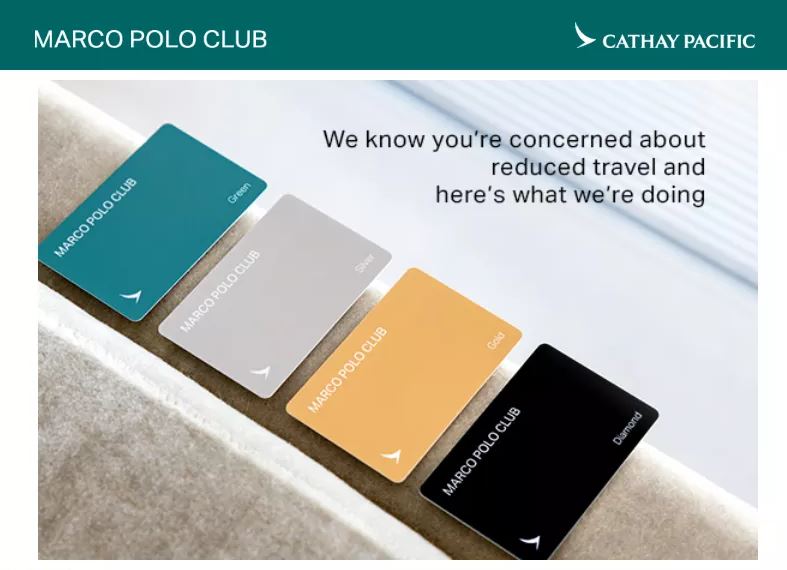
In an email sent to all members, Cathay Pacific informed Marco Polo Club members (separate from Asia Miles) of an extra Club Points credit given to every member, regardless of residency. It’s interesting that Cathay Pacific is not giving an automatic status extension, but instead be given three allotments of Club Points instead for the months of Feb, Mar and Apr 2020.
The number of club points given to each member for month differs by status, as follow:
Green: 10 club points
Silver: 30 club points
Gold: 65 club points
Diamond: 140 club points
All points will be credited by the end of each month. For those whose status expires in Feb, the points will be credited by end of Fen and the remaining points will be credited by the end of the subsequent months, depending on the new status qualified for.
Qantas will provide a 12-month extension on your current membership tier for all current Silver, Gold, Platinum and Platinum One members, starting with members whose membership year ends in March. Those with statuses expiring in March 2020 would have them extended till March 2021, with the last batch of members whose statuses originally expiring in Feb 2021 now extended till Feb 2022.
Email confirming extension of QFF status
Marriott Bonvoy
Updated 29 Apr: Marriott Bonvoy announced on 8 Apr that it will (finally) be extending status earned in 2019 by 12 months.
The status will normally expire in Feb 2021, but it will now expire in Feb 2022 instead, giving you an extra year. This will apply at all elite levels (i.e. Silver, Gold, Platinum, Titanium, Ambassador). The extended year of status will count towards lifetime status in the Bonvoy program.
All points will not expire before Feb 2021, after which if it will only expire if there was no activity in the past 24 months (i.e. since 1 Mar 2019).
Suite Night Awards will be have their validity extended until end 2021, while any free night awards expiring in 2020 will be extended until Jan 2021.
Early in January, Marriott Bonvoy announced its extension policies on their Chinese social media platform WeChat on 22 Feb 2020. Members residing in Mainland China, Hong Kong, Macau and Taiwan as of 1 Feb 2020 will be given the following extensions:
Members who qualified for elite status in 2019 will have their status expire by 28 Feb 2022 instead of 28 Feb 2021.
Any associated rewards or privileges with status will also be extended to expire 31 Dec 2021, instead of 31 Dec 2020.
All points will not expire before 28 Feb 2021. From 28 Feb 2021, normal expiry rules will apply.
Read the Chinese article here. For an English translation, refer to Loyalty Lobby’s article here.
Hilton Honors
Hilton Honors announced their provisions through their Chinese social media platform WeChat on 19 Feb 2020.
Members whose residential address is listed in Mainland China, Macau, Hong Kong or Taiwan as of 19 Feb 2020 will be given effectively a year’s extension on their status.
For those whose status was going to be downgraded on 31 Mar 2020 will have it extended through Mar 2021. Those that qualified in 2019 will have it until Mar 2022.
World of Hyatt
World of Hyatt will extend the status of all members in Asia Pacific for a year.
Qualifying World of Hyatt Discoverist, Explorist and Globalist members with status expiring on 28 Feb 2020 will now be extended all the way to 28 Feb 2022, rather than a previously announced 28 Feb 2021.
All Suite Upgrade Awards, Club Access Awards and Free Night Awards that are expiring in 2020 for qualifying members will also be extended through 31 Dec 2021.
What is even better is that World of Hyatt is also working to evaluate tier and benefit extensions for members outside of Asia Pacific, but travels frequently to the Asia Pacific region. More information will be shared with qualifying members as it becomes available.
IHG Rewards Club has announced an extension for its elite members. Members with status, and who are residing in Mainland China, Hong Kong, Macau or Taiwan as of 17 Feb 2020 will be extended by a year. Points expiry will also be extended by at least a year.
For those who have purchased the InterContinental Ambassador membership between 1 Jan and 30 Jun 2019, the membership validity and free weekend night voucher expiry has been pushed back by six months.
Accor Live Limitless
Accor announced 27 Feb 2020 status extensions for all members residing in Mainland China, Hong Kong, Macau and Taiwan.
All members with status expiring Dec 2020 will be extended through Dec 2021, while points expiring between 1 Feb 2020 and 31 Jan 2021 will be ‘halted’.
Platinum and Diamond members with suite upgrade vouchers will have their validity extended until Dec 2021.
GHA DISCOVERY
In an email sent by Pan Pacific Hotel Group last week, the hotel will be extending the status of all Platinum and Black members until 31 December 2021.
This appears to apply to all DISCOVERY members, regardless of which hotel chain they signed up with.
Specifically for Pan Pacific members, members will be able to enjoy savings of up to 25% across all participating restaurants and bars at properties under the Pan Pacific Hotels Group from 1 Jun 2020.