
Tag: Cathay Pacific

  • Cathay Pacific Asia Miles and Marco Polo Club

    Cathay Pacific Asia Miles and Marco Polo Club

    Singapore-based members who are very familiar with Krisflyer (Mainly Miles have an incredibly resourceful guide) may fumble at the first glance of Asia Miles.

    Asia Miles is travel rewards programme, a fully-owned subsidiary of Cathay Pacific Group. Members of Asia Miles can earn miles through everyday activities such as dining, hotel stays and flights, and use the miles for flights, hotel stays, and even lifestyle goods.

    Marco Polo Club (MPC) is Cathay Pacific’s loyalty programme, rewarding frequent flyers with perks as they move through the tiers by accumulating club points. When you accumulate enough club points, you will get to a certain tier which will give you extra benefits from extra checked baggage allowances to lounge access.

    While Asia Miles is free to join and use, there is a first-time joining fee of USD100 for MPC, payable every year unless you earn a minimum of 20 club points, which can be earned rather easily with any return flight from Singapore to Hong Kong on Cathay Pacific.

    Note that club points cannot really be used to redeem for anything; these club points are simply a count on how much you fly in a year. For those familiar with Qantas Frequent Flyer and British Airways’ Executive Club, the club points are synonymous with status credits and tier points respectively.

    Marco Polo Club

    Frequently Asked Questions

    I have included some Asia Miles 101 FAQs below, so you can either click directly to it or slowly read through this lengthy article.

    What’s the difference between Asia Miles and Marco Polo Club? Are they the same?

    Asia Miles is a travel rewards programme, meaning you get miles (the programme currency) for your activities, i.e. flying with Cathay Pacific, dining, credit card points, etc. This is a free programme, similar to Krisflyer. There are no tiers or levels in this programme – everyone earns at the same rate, and uses the same redemption charts.

    Marco Polo Club (MPC) is Cathay Pacific’s loyalty programme, which give you status points (Club Points) when you travel with them or other oneworld airlines. There’s no other way to earn Club Points. There is also an annual fee of USD100 to join the MPC, but this can be waived if you earn at least 20 Club Points in any programme year.

    Back to top

    How do I earn Asia Miles?

    There are several ways to earn Asia Miles.

    Flights: This is the most straightforward way. Flying with Cathay Pacific, Cathay Dragon or oneworld airlines will earn you both Asia Miles and Marco Polo Club points.

    Cathay Pacific has moved towards a fixed miles award system since 2018, so the amount of miles you earn from flying depends on (i) the fare class of your ticket,and (ii) which distance category your journey fall into.

    This is the chart:

    Standardised mileage earn chart with Asia Miles

    Hotels: Asia Miles also partners many hotel partners that allow you to convert your hotel loyalty points to Asia Miles.

    Some examples below:

    • LeClub Accor: 2 points to 1 Asia Mile
    • Hilton Honors: 10 points to 1 Asia Mile
    • World of Hyatt: 2.5 points to 1 Asia Mile OR 500 Asia Miles per stay
    • IHG Rewards Club: 5 points to 1 Asia Mile OR 500 Asia Miles per stay
    • Marriott Rewards: 3 points to 1 Asia Mile, bonus of 5,000 Asia Miles for every 60,000 points converted; OR 1 Asia Mile per USD2 spent on stay

    And many more. For more details, refer to Asia Miles website.

    Credit Cards: Asia Miles is probably the second most accessible mileage conversion programme after Krisflyer in Singapore. Many credit card rewards programme in Singapore will allow you to transfer your points to Asia Miles. See more details in the question below.

    Of course, there are other ways to earn Asia Miles, including car rentals and other obscure manners which I will not cover. For details, refer to the Asia Miles website.

    Back to top

    Can I transfer credit card points to Asia Miles?

    Credit Cards: Asia Miles is probably the second most accessible mileage conversion programme after Krisflyer in Singapore. Many credit card rewards programme in Singapore will allow you to transfer your points to Asia Miles.

    For starters, some of the most widely-used miles earning credit cards are existing partners of Asia Miles:

    • UOB PRVI MasterCard
    • UOB PRVI Amex
    • DBS Altitude Visa
    • BOC Elite Miles MasterCard
    • Citibank PremierMiles
    • Citibank Rewards
    • Standard Chartered Visa Infinite
    • American Express Platinum Credit Card, and many more.

    Most bank programmes in Singapore already have Asia Miles have a conversion partner, and the rates are similar to what you get with Krisflyer.

    From time to time, Asia Miles run targeted offers to encourage members to transfer to Asia Miles. For instance, DBS was running a 15% bonus offer to transfer DBS reward points to Asia Miles in early 2019, so you shouldn’t rule out similar offers in future.

    Back to top

    What can I use my Asia Miles for?

    Asia Miles can obviously be used to redeem for Cathay Pacific, Cathay Dragon and many oneworld flights, including those operated by Qantas, Japan Airlines and American Airlines. For more details on redeeming flights on Cathay Pacific, as well as tips and tricks, click here (coming soon).

    Beyond the oneworld alliance, Asia Miles has also gotten some other partner airlines on board, including Air Canada, Air New Zealand, Alaska Airlines and Lufthansa.

    On top of that, like many other airline frequent flyer programme, you can also use your Asia Miles for hotel stays, attractions, and lifestyle awards, although these are really not the best way to use your miles.

    One unique proposition of Asia Miles is the ability to use your miles for Asian pop concerts, typically held in Hong Kong, Macau or Taiwan. Some of the concerts that you could previously book for included Andy Lau, Khalil Fong and Mayday. The redemption rates are not that cost effective – for instance, a Mayday concert going for JPY12,800 (~SGD158) was going for 24,000 miles, working out to 0.6 cents per mile, which is not a great use of miles unless tickets are sold out everywhere else.

    Back to top

    How much is one Asia Mile worth?

    This is a perennial question on top of everyone’s mind – how much is one mile worth?

    The usual answer will be: it depends.

    For an economy class redemption (which is highly not recommended), the value can go down as low as under 1 cent, to over 3 cents.

    Business class redemptions can range between 3-6 cents per mile, depending on destination, airline and dates.

    First class redemptions can go as high as 10 cents per mile, but not likely achievable given that the inventory is typically limited.

    Of course, the above valuation is a simple one: it takes the commercial value of the ticket, divided by the number of miles required for a similar class of travel. There’s also the other school of thought on how much you are willing to pay for the ticket, that’s probably closer to the actual value you attach to a mile.

    Back to top

    What are the different statuses you can achieve with Marco Polo Club?

    Marco Polo Club offers four tiers to its members: Green, Silver, Gold and Diamond. Green is the entry level tier, while Silver, Gold and Diamond comes in after accumulating Club Points within a programme year.

    To requalify for Green each year, you will need to accumulate 20 club points each year. That’s pretty simple – the cheapest return economy fare from Singapore to Hong Kong that’s eligible for Asia Miles will get you 20 club points. If you fail to earn at least 20 club points, note that you will have to pay the USD100 fee in lieu of it.

    Silver, Gold and Diamond will come at 300, 600 and 1,200 club points respectively. That sounds like an awful lot but trust me, there are too many diamond members in the programme.

    One important thing to note if you are starting from the bottom (i.e. Green): each time you reach a new tier, your club point resets. So if you are starting from Green and wants to achieve Gold or Diamond within a single year, you will need 900 club points for Gold, and 2,100 club points for Diamond. Ridiculous, I know.

    For a summary of what Asia Miles can be used for and what each MPC tier offers, see the table below:

    Back to top

    How do I earn status with oneworld?

    Silver, Gold and Diamond also correspond to oneworld’s Ruby, Sapphire and Emerald status respectively, which standardises the tiers across its member airlines. This also means you get corresponding benefits when travelling with oneworld member airlines. For instance, if you are an MPC Diamond, you will be treated like a Qantas Frequent Flyer Platinum member when you travel with Qantas.
    Back to top

  • LOUNGE REVIEW: Cathay Pacific Singapore Lounge, Changi Airport Terminal 4

    LOUNGE REVIEW: Cathay Pacific Singapore Lounge, Changi Airport Terminal 4

    The Hong Kong Singapore Lounge is one of the latest in the Cathay Pacific’s network, opened less than 18 months ago when Singapore Changi Airport opened its newest terminal, Terminal 4.

    Being one of the major airlines operating out of Terminal 4 since the terminal opened back in 2017, the Cathay Pacific Singapore lounge is the only airline lounge at Terminal 4. It is a fairly cosy one, with 849 square metres of space and offering seats for over 200 customers at any point in time.

    Who can access this lounge?

    Apart from Cathay Pacific’s own business and first class passengers, Marco Polo Silver, Gold and Diamond members can also access the lounge when travelling on a Cathay Pacific flight out of Singapore. Oneworld sapphire and emerald members may also use the lounge as long as they are travelling on a oneworld-member operated flight on the same day, although I’m not sure if you should make the trek to Terminal 4 just for this lounge when the Qantas lounge at Terminal 1 is probably a better choice.

    The lounge

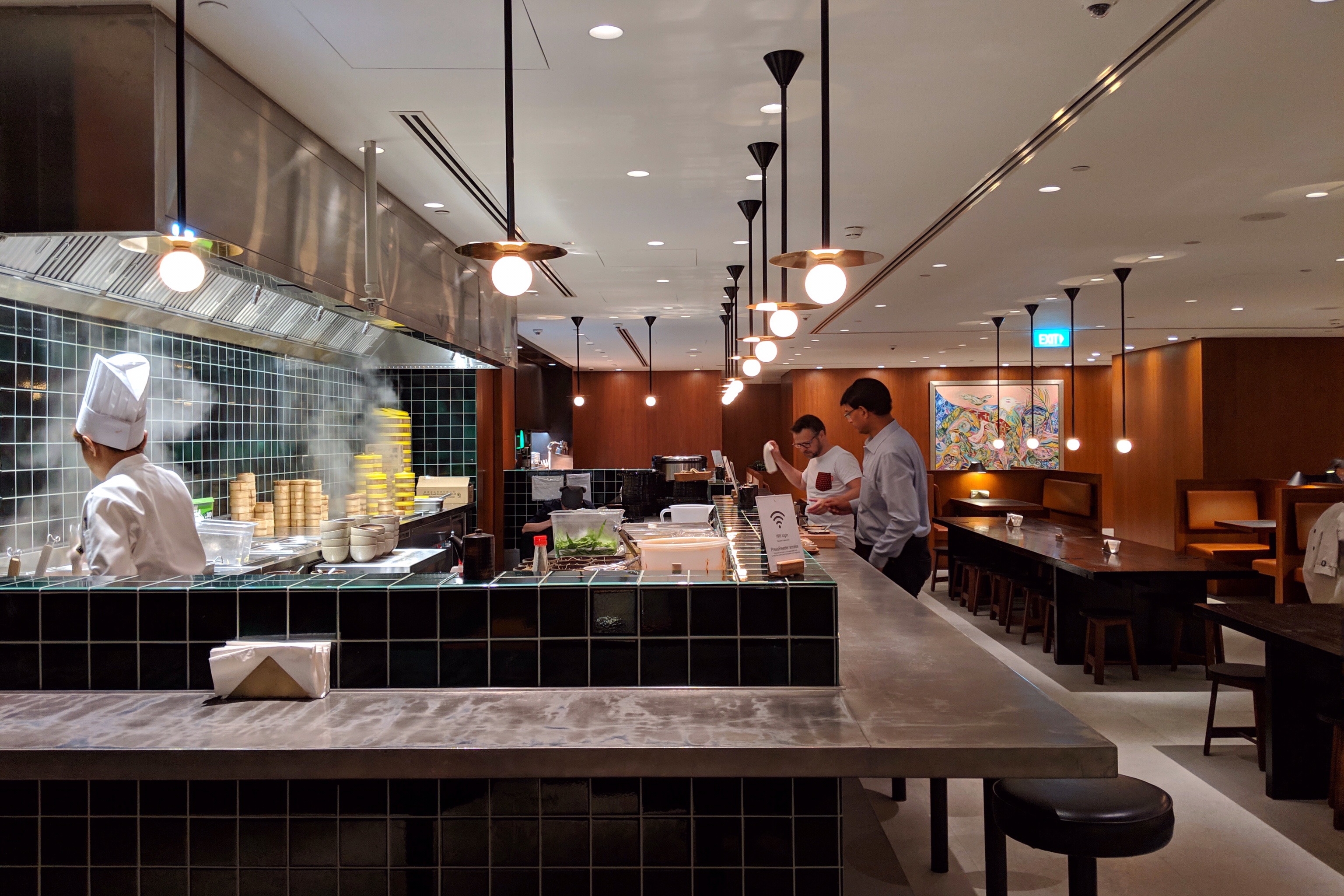
    The Cathay Pacific Singapore lounge features two main seating areas. The first is at the noodle bar, with plenty of two and four-seater booths, along with bar seats at the noodle bar and a long communal table adorned with stools.

    On the terrace overlooking the transit area of the terminal features several armchairs and coffee tables, perfect for a late night pre-departure drink. This is also where the self-service buffet area is placed.

    Cathay Pacific brought its famous noodle bar to the Singapore lounge as well, which has become a perennial favourite for customers around the world.

    The noodle bar serves up small bowls of the signature Hong Kong Wanton Noodles, along with other type of cooked-to-order items that reflects the local culture. For instance, the Singapore lounge serves a version of laksa as well, similar to the Qantas Singapore lounge.

    Another thing on offer was the steamed chicken dumplings (siew mai). While this is traditionally made with pork, I guess chicken may be a little more palatable to the diverse range of customers passing through.

    On the buffet table was also the standard western breakfast offering, including scrambled eggs, bacon, sausages and also a Chinese favourite, rice porridge.

    The lounge also offer a range of reading materials such as newspapers and magazines, although I didn’t really see anything picking something up to read while I was there.

    The only difference between the Singapore lounge and the Hong Kong lounges is the absence of shower rooms, given that Cathay Pacific only flies to Hong Kong and Bangkok from Singapore. Also, no other oneworld airlines are operating from Terminal 4, so that lessens the need for shower rooms.

    Final words

    The Cathay Pacific Singapore lounge is probably one of the newest ones on its network. While fairly small when you compare it to the labyrinth in many of the Hong Kong lounges, this lounge contain many wins – such as the noodle bar – which sufficient catered to the needs of the customers.

    I am a fan of Cathay Pacific’s lounges in Hong Kong, having been to several of them, including the Deck and the Wing business lounges. Cathay is known to provide a solid lounge product, with good space design, ample seating and very decent food. Of course, given its popularity, the lounges in Hong Kong International Airport are usually very packed, so it’s pretty refreshing to go into a less crowded Cathay Pacific lounge.

  • PROMO: Cathay Pacific is giving away a million miles to Singapore Asia Miles members

    PROMO: Cathay Pacific is giving away a million miles to Singapore Asia Miles members

    Singapore-based Asia Miles members stand to win up to 300,000 miles if they purchase a Cathay Pacific or Cathay Dragon ticket from now until 26 August 2018.

    Cathay Pacific will give out a total of one million miles to a total of 11 members. The lucky draw is only open to Singapore-based customers, and travel must originate from Singapore

    D2FB6F82-6C4D-4811-B514-8B9CA17A92B1.jpeg

    One key thing to note is that you will have to manually enter the contest using the online form here.

    The good news is that the lucky draw is open to customers who booked through any booking channel, whether they do on Cathay Pacific’s website, mobile app or through a travel agent. And also, looking at the T&Cs there doesn’t seem to be a restriction on the travel dates.

    CX-HKG-TheWing-15
    Don’t forget to check out Cathay Pacific’s lounges in Hong Kong!

    The top prize of 300,000 miles is good for a round trip first class ticket to US or Canada, or six round trip tickets in business class to Hong Kong. That’s enough Hong Kong trips to get you sick and tired of wanton noodles and dim sum.

    So if you are already planning to buy a ticket with Cathay Pacific, don’t forget to take part!


  • Asia Miles programme changes from 22 June 2018: What you need to know

    Asia Miles programme changes from 22 June 2018: What you need to know

    Most people will be familiar with Cathay Pacific and their loyalty programme Asia Miles as many credit cards across Asia Pacific allow you to transfer miles into the programme, which serves as a good alternative to KrisFlyer and Singapore Airlines, especially if you travel a lot on oneworld carriers.

    In particular, Asia Miles is also rather popular with some Australians given its relatively cheaper redemption rates than Qantas Frequent Flyer. Hence this change is likely to impact many members across this part of the world.

    AMHP.JPG
    Asia Miles to change earn and burn rates from 22 June 2018

    In a nutshell, here are some of the changes they will be introducing come 22 June 2018:

    Miles earned will no longer be based on distance travelled, but by distance zone, if you are travelling on Cathay Pacific and Cathay Dragon.

    Also, the exact fare class within each cabin class matters too: for the lowest fare classes, you get the least miles. Even in Premium Economy and Business, the cheapest fare class for each cabin will also get you lesser miles.

    All routes are now categorised into six different distance zones: ultra-short all the way to ultra-long. These are the same categories used by Marco Polo Club’s tier points accrual, as well as the new redemption charts (more on that below), providing more uniformity across the two programmes.

    Asia Miles Earn Chart
    Source: Asia Miles

    Asia Miles claim that members will “earn more miles on 80% of the airlines’ tickets, including to popular destinations such as Shanghai, Osaka and London.” Obviously this is written for a Hong Kong base, but let’s take a look at some of the common ones out of Singapore:

    Cabin

    Economy Premium Economy Business

    Route

    Current New Current New Current New
    Singapore- Bangkok

    878

    1800- 2000 969 2000- 2300 1098

    2500- 2700

    Singapore-
    Hong Kong

    1592

    1800- 2000 1751 2000- 2300 1990

    2500- 2700

    Singapore- Taipei

    2093

    2390- 2650 2302 2650- 3050 2616

    3310- 3580

    Singapore-
    Tokyo Narita

    3433

    3600- 4000 3776 4000- 4600 4291

    5000- 5400

    Singapore- Los Angeles

    8840

    7790- 8650 9724 8650- 9950 11050

    10810- 11680

    Singapore-
    New York

    9651

    9630- 10700 10616 10700- 14610 12064 13380- 14450

    Seems like members are generally better off for a short- to mid-haul trip out of Singapore, but not so for transpacific flights.

    If you frequent earn miles on partner airlines, the good (or bad, depending on who you are travelling with) news is that mileage earned on partner airlines remains the same.

    Asia Miles will price all redemptions as a one-way, adjusts all redemption rates

    Customers familiar wtih Asia Miles will know that it is typically cheaper to redeem a roundtrip ticket on Cathay Pacific/Dragon, but this will change come 22 June 2018.

    To simplify its redemption requirements, all redemption tickets will now be priced one-way, so a return ticket will now simply cost twice as much as two one-way tickets. Kudos to Asia Miles for being upfront in saying that long haul flights in premium cabins will now also cost more.

    AM-stdaward.jpg
    Asia Miles Standard Award Chart (source: Asia Miles)

    Also, the redemption chart is now aligned to the Marco Polo Club’s 6 categories of distances, rather than the existing 7. This is a good move because I have seen so many people being confused by the Marco Polo Club tier points earning table and the Asia Miles redemption table.

    It wasn’t clear from Asia Miles’ website, but I wrote to clarify if multi-sector itineraries (as most itineraries originating from outside of Hong Kong would be) will be priced as a sum of two sectors under the new charge, or as though its a single sector. Asia Miles confirmed in writing that it will be priced as a single sector. That means, if you are flying from Singapore to New York, it will cost you as much as flying from Hong Kong to New York. This means great value 

    Let’s compare some of the redemption rates for routes out of Singapore (one-way, in ‘000 miles) before and after the changes:

    Cabin Economy Premium Economy Business
    Route Current Standard Current Standard Current Standard
    Singapore- Bangkok 15 10 18 18 25 25
    Singapore-
    Hong Kong
    20 10 24 18 30 25
    Singapore- Taipei 20 10 24 18 30 25
    Singapore-
    Tokyo Narita
    25 22 30 30 45 45
    Singapore- Los Angeles 55 42 66 60 85 85
    Singapore-
    New York
    55 42 66 60 85 85

    (All mileage are one-way, in ‘000 miles)

    At first glance it look like you will get a better deal off almost every route (except in Business), but that’s if you only redeem one way. Now let’s take a look at redemption for a return ticket:

    Cabin Economy Premium Economy Business
    Route Current Standard Current Standard Current Standard
    Singapore- Bangkok 20 20 24 36 40 50
    Singapore-
    Hong Kong
    30 20 36 36 50 50
    Singapore- Taipei 30 20 36  36 50 50
    Singapore-
    Tokyo Narita
    45  44 54  60 80 90
    Singapore- Los Angeles 90  84 108  120 145  170
    Singapore-
    New York
    90  84 108 120 145 170

    (All mileage are one-way, in ‘000 miles)

    You will almost end up paying more for all premium classes mid- and long-haul flights. For instance, for Singapore to LA, this is at 170,000 miles return in Business (at the same level as what KrisFlyer requires), up from 145,000 miles previously.

    As a sweetener, Asia Miles has announced that they have made redemption seats more accessible, by increasing availability by 20% or more. While no one is really sure how accurate is this, a comparison of the charts do see a slight reduction in the number of miles overall.

    Asia Miles is now introducing two more levels of redemption levels – Choice & Tailor

    Obviously you should never be burning miles at these levels, but Asia Miles has now unveiled two additional levels of redemption levels with “improved availability” and also allows you to select your seat in advance. This is similar to the previous Priority Tiers 1 & 2, except that this provides a little better clarity as to what ‘perks’ these higher redemption levels accord, such as advance seat selection.

    AM-choiceaward.jpg
    Asia Miles Choice Award Chart (source: Asia Miles)

    Side note: I’m constantly amused at how seat selection is such a great tool used by airlines to encourage people to spend more money (and miles in this case).

    The skeptic in me feels that the bulk of the overall ‘improved’ award availability is going to go to the higher levels of redemption, given that at first glance Asia Miles is giving out more miles than before.

    There will be changes to partner airlines redemption rates too

    But this will be unveiled only on 22 June 2018. Based on some of the sample itineraries shown, it seems like across the board the mileage required will increase for round-trip itineraries, consistent with what it has applied for Cathay Pacific and Cathay Dragon prices.

    More to come on this on 22 June 2018.

    My take on the changes

    Overall, this change looks good at first glance, in the sense that everyone will end up earning more miles. However, with more miles flooding the market, this will also mean that the miles will lose their value over time and lead to an increase in redemption rates down the road (which is already reflected), or resulting in Standard awards being harder to find.

    Furthermore, Asia Miles is one of the few programmes (including Singapore Airlines’ KrisFlyer) that held steadfast in refusing to accord any status bonuses for Marco Polo Club elite members. Whether you are a Diamond, or a Green, you still earn the same number of miles. So this is somewhat unattractive as compared to some other programmes, such as Qantas Frequent Flyer, that awards a bonus for status holders.

    Celebrate for now, especially if you fly a lot on Cathay Pacific because you are about to get a whole lot more miles. However, if I were you I will also not hoard too many miles and try to get award availability as soon as you can – you will never know if prices will rise again.

  • Black Friday Airfare Deals from Singapore

    Black Friday Airfare Deals from Singapore

    November and December are really some of the hottest sale periods traditionally for retail, but in recent years airlines and hotel partners have also jumped on the bandwagon to offer their own irresistable (some not so) sale to customers too.

    This year for Black Friday, here’s a round up of some of the deals available:

    Screen Shot 2017-11-24 at 8.28.01 am

    Cathay Pacific two-to-go fares

    Booking period: 24 November 2017 only

    Travel period: 5 January 2018 to 30 April 2018 (except departures from Singapore on 9-18 February; 10-16 & 28-30 March)

    Return fare to Economy
    Hong Kong S$208
    Taipei S$388
    Beijing S$408


    Screen Shot 2017-11-24 at 8.26.37 am.png

    British Airways 

    Booking period: Now to 28 November 2017

    Travel period: Now to 31 March 2018

    Return fare to Economy Premium Economy Business
    Sydney S$684 S$1484 S$3682
    London S$1210 S$2390 S$5579
    Barcelona S$1118 S$2354 S$5355
    Amsterdam S$1123 S$2459 S$5373
    Dublin S$1135 S$2721 S$6462


    Screen Shot 2017-11-24 at 8.28.56 am.png

    Singapore Airlines two-to-go fares (technically not a Black Friday sale, but still on sale)

    Booking period:
    Economy class: Now to 15 December 2017 (except to Hong Kong, which ends 30 November 2017)
    Premium Economy and Business class: Now to 3 December 2017

    Travel period (blackout periods apply):
    Economy class: 1 January to 31 March 2018
    Premium Economy and Business class: 20 November 2017 to 31 March 2018

    Special conditions:
    Economy: booking must be made with OCBC cards
    Premium Economy and Business: booking must be made with Mastercard

    Return fare to Economy Premium Economy Business
    Bangkok S$208 – S$898
    Bali S$248 – S$938
    Hong Kong S$188 S$808 S$1538
    Beijing/Shanghai S$398 S$1358 S$2458
    Seoul S$588 S$1418 S$2268
    Tokyo S$628 – S$3368
    Melbourne S$628 S$1488 S$3638
    Sydney S$658 S$1498 S$3648
    London S$1028 S$2688 –
    Los Angeles S$1178 S$2638 S$5738
    San Francisco S$1318 S$2978 S$6078