Asia Miles will be kept active as long as there’s an activity once every 18 months. Sounds good at first glance, but that means you need to keep your account active more often.
Cathay Pacific loyalists can cheer: Asia Miles earned from 1st January 2020 will no longer expire, as long as you earn or redeem at least one mile every 18 months.
Note that this will only apply for miles earned from 1st January 2020, and any miles earned before that will still expire under the current rules.
Current system
Under the current rules, all miles earned within a membership year will expire three years after the current membership year.
For example, if your membership year (based on your sign-up month) is from April to March the following year:
If you earned 10,000 miles in May 2018, they will expire in March 2022 (i.e. end of membership year in March 2020 plus three years).
If you earn another 5,000 miles in December 2019, they will expire in March 2023.
New system
The new system will automatically extend your miles expiry date by 18 months from the date of your latest crediting and debiting activity. This is a similar system used by Singapore Airlines as well as British Airways Executive Club, except that the latter two programmes have a longer shelf life of 3 years.
‘Crediting and debiting activity’ refers to the date that miles were added (or deducted) from your account, and not the date when you took the flight, or redeemed the miles.
As an example:
If you earn 10,000 miles in 1 January 2020, the miles will have an expiry date of 30 June 2021.
Following that, if you earn another 3,000 miles on 15 March 2020, all 13,000 miles (assuming you didn’t use any) will now expire on 14 September 2021.
Eligible transactions are pretty broad so it’s quite easy to keep your account active. The eligible transactions are:
Earning miles
Redeeming miles
Purchase of miles (top-up)
Points exchange
Member-to-member transfer
Miles renewal
Bonus miles credit
Gift miles (from someone else)
How to check when are your miles expiring?
To check when your miles are expiring, you can log onto your Asia Miles account, click on the top-right corner dropdown menu, and click “Manage your Miles”.
Scroll down and click on “Renew your miles”.
Inside, you will see how many of your miles and their respective expiry dates.
Asia Miles offer an option for your renew the validity of your miles for another three years, albeit at a very hefty USD40 per 2,000 mile block.
Note that from 1 January 2020, all renewed miles will fall under the new expiry rules (i.e. expire 18 months after the last activity).
There are also no renewal option for all miles earned or renewed after 1 January 2020, so please be careful.
How will Asia Miles use my miles between the old and system?
Asia Miles uses a ‘first in, first out’ system, using up the oldest miles in your account first when you redeem them.
That means, any miles you have that fall under the time-based expiration system will be spent first, before the ‘newer’ miles earned under the activity-based expiration system.
Final thoughts
This is a good move, especially if you are what I call a leisure supporter of Cathay Pacific or other Oneworld airlines. Under the old fixed time-based expiration rules, leisure fliers may fine it very difficult to rack up enough points to redeem for a trip before their miles expire.
If you have an Asia Miles account and want to keep your account active, you should ideally try to maintain an activity once a year, rather than cutting it very close to the expiration date.
New collaboration the UK brand will see new amenity kits and bedding in first class and business class
Cathay Pacific has refreshed its service offering in its first and business class cabins with a series of enhancements. In its PR, the airline promises the changes are geared towards “indulging passengers with an elevated premium travel experience”.
Expectedly, the enhancements ride on the current wave of health and wellness focus by airlines, ranging from providing in-seat exercise videos to healthier options for in-flight menus.
First class enhancements
In first class, passengers will be treated with a personalised welcome note along with a hot towel and a glass of refreshing sparkling jasmine silver needle tea from their current tea partner, JING.
I’m personally not a big fan of JING teas, but I’ll be curious to see how this sparkling tea will be like.
New wellness dining in Cathay Pacific first class
In the food department, Cathay Pacific cater a range of lighter (which are supposedly healthier) options for the main and breakfast meals as well as healthy alternatives such as superfood bowls and lighter protein side dishes. Notably, Cathay Pacific will provide cold-pressed juice from Hong Kong brand Bless for its most premium passengers.
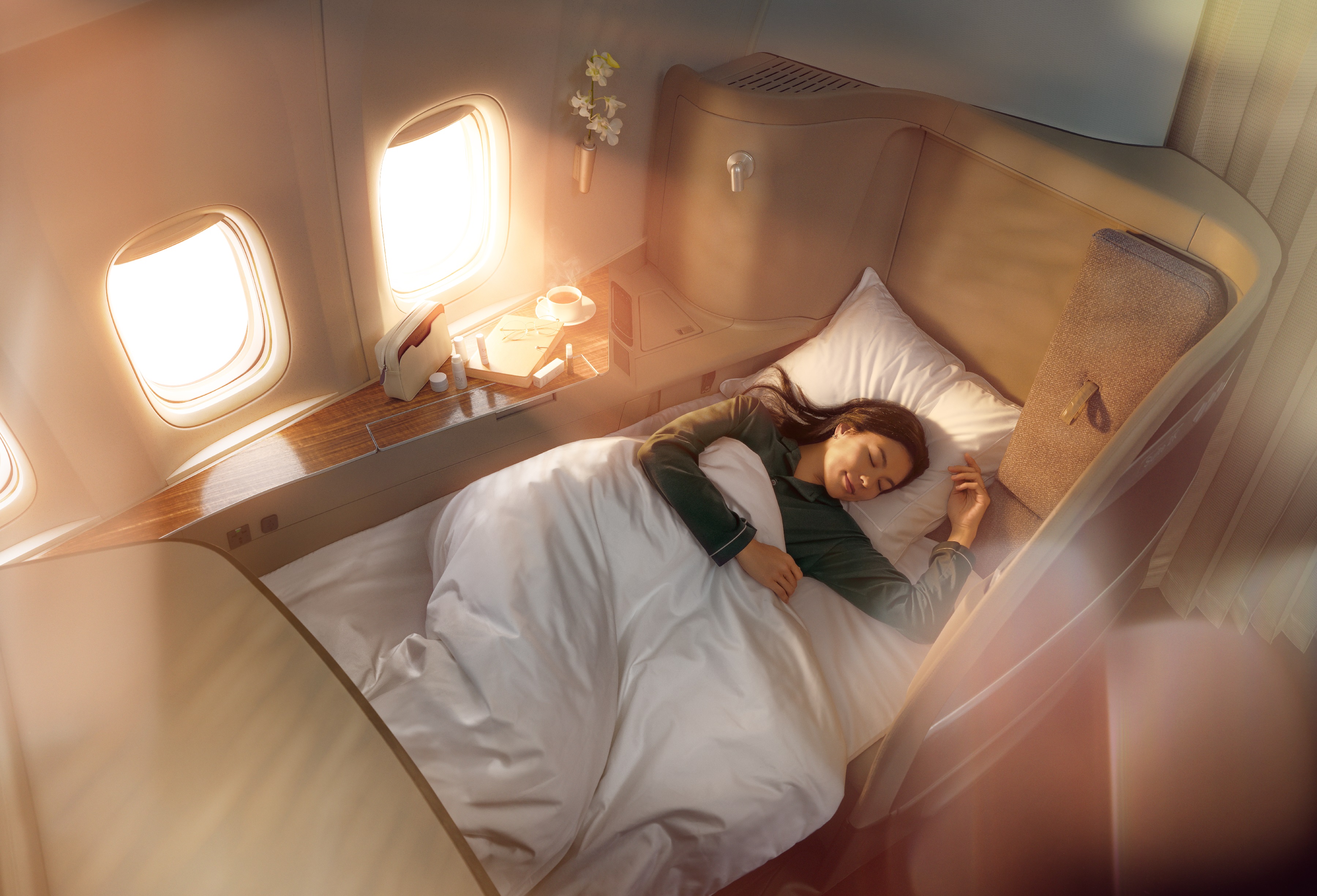
For the ultimate comfort for first class passengers, Cathay Pacific will offer a cosy 600-thread-count, 100 percent sustainably sourced cotton mattress and duvet, as well as a soft full-size pillow in the cabin, all by Bamford. Coupled with a turndown service (essentially setting up your bed in the air), there’s also a pillow mist that promises to put you to sleep.
Each passenger will also receive a Bamford amenity kit, which will include natural skincare products presented in glass bottles.
Business class enhancements
Cathay Pacific has also amped up the business class offering with some updates to its bedding.
In terms of comfort, Cathay Pacific will be offering a soft mattress topper along with a larger, plusher sleeping pillow and premium-quality slippers. While the pillows have always been there, the mattress topper and slippers will be new to the cabin, which are very much welcomed additions. There will however still be no pyjamas offered to business class passengers.
New mattress topper and Bamford amenity kits
The business class amenity kits – only available on long-haul flights – will also be refreshed. The new amenity kits are unisex and also designed by Bamford, available in four colours and rotated around the year.
The lounge reopens after nine months of upgrading works.
Cathay Pacific has reopened its lounge at Shanghai Pudong International Airport earlier this week (18 July), offering an upgraded lounge experience for its customers.
The new space, located near gate D69 in Terminal 2, can seat up to 305 customers. Opened from 0530H to 2100H, it primarily caters to the Cathay Pacific and Cathay Dragon flights, although eligible frequent flyer members of other oneworld carriers may also use it.
This is what the PR promises out of the new lounge:
Cathay Pacific is “moving beyond” for its customers with a superior experience at every stage of their journey. The new Shanghai Pudong Cathay Pacific Lounge will be another reason for customers to arrive early, rest and recharge in the welcoming atmosphere of comfort and wellbeing before their flight.
Cathay Pacific press release
What can you expect out of the new lounge?
The marketing photos honestly look amazing, and one should expect no less from a Cathay Pacific lounge. This is what you can expect from the new Shanghai CX lounge:
Cathay Pacific new Shanghai Pudong lounge (Photo credit: Cathay Pacific)
Feels like home
If you have been to Shanghai Pudong airport, let’s call it – it’s not the best airport experience you can get. What Cathay Pacific promises with this new lounge is that you will be “transported to an oasis of serenity designed to reflect the comforts of a modern apartment.”
Perosnally what I love about Cathay’s lounges is the fact that they use a lot of wood and earth tones, which calms the mind either in the day or at night.
The Noodle Bar
This is a perennial favourite and arguably Cathay Pacific’s best selling point of its lounges. Of course, the Shanghai lounge must have one of these, given that Shanghai is also home to some of the best noodles in the world.
You can expect Cathay Pacific’s signature wanton noodles, as well as a rotation of other options and dimsum choices too, including Shanghai’s very own xiao long baos!
The Cathay Pacific Shanghai Lounge will also feature a quasi-outdoor seating area, with a good view of the apron and runway. There will be a selection of seating, and I’ll imagine this area will be quiet than the indoor areas.
There will be self-service food and beverage options available at The Terrace, including international hot and cold dishes, freshly baked treats, cheeses and cold cuts, as well as a selection of wines, spirits and other non-alcoholic options.
Unfortunately, as with many other Cathay Pacific lounges in Asia, the lounge does not have showers, although I’ll be hard-pressed to understand why you will need one for a two-hour flight to Hong Kong.
Access
As with other Cathay Pacific lounges around the world, access to the lounge is limited to:
Cathay Pacific and Cathay Dragon business and first class passengers
Marco Polo Club silver members and above travelling on Cathay Pacific and Cathay Dragon services
oneworld Emerald and Sapphire members travelling on oneworld member services
Passengers holding an eligible lounge pass
Given the lounge operating hours of 0530H to 2100H daily, this lounge unfortunately will not be able to cater to some of the red-eye oneworld services, including Qatar’s services to Doha and Finnair’s services to Helsinki. There are also a handful of oneworld carriers, including Qantas, that operates out of Terminal 1, so passengers will not be able to access this lounge given the terminals are not linked.
Final thoughts
China is a critical market for Cathay Pacific. After all, it is in direct competition with the big three Chinese carriers, particularly in the mid- and long-haul markets.
The Chinese traveller has become more and more sophisticated over the years. While airlines in the past could get away with a subpar lounge experience, the travellers have become more discerning over the years, and this investment is definitely well-timed for Cathay Pacific to provide an edge over its competitors.
The lounge is definitely a step up for Cathay Pacific in serving the Chinese market, and also in line with keeping the lounge experience consistent across the world. The offering is definitely one of the best in class, and I’m expecting that the other lounge operators in Shanghai Pudong to step up their game at some point.
Many people associate Cathay Pacific with its home base of Hong Kong, which isn’t surprising given that there are over 50 flights a week from Singapore to Hong Kong. While Cathay Pacific is one of the preferred choice when travelling to Hong Kong, what some people may not know is that Cathay Pacific also offers a daily service to Bangkok from Singapore.
The Cathay Pacific Singapore-Bangkok daily service is one of Cathay’s unique fifth freedom flights around the world, and the only one operating between the two Southeast Asian cities.
I decided to take a slight detour to Bangkok today while on my way to Hong Kong, to check out if this option is indeed a much better choice than other full service carriers.
The schedule
Cathay Pacific runs a return flight between Singapore and Bangkok daily, in addition to its eight daily services to Hong Kong.
At the time of writing, the daily schedule is as follow:
Flight
Route
Departure Time
Arrival Time
Day
Aircraft*
CX712
SIN-BKK
1320
1500
Daily
A330-300 / A350-900
CX717
BKK-SIN
1155
1525
Daily
A330-300 / A350-900/1000
*Aircraft types are always subject to change
While Cathay has an issue of aircraft consistency, they don’t really have an issue with cabin product consistency. Unlike Singapore Airlines, Cathay essentially only have two business class seat types – the regional business class and the long-haul business class product, both of them are used on services to Singapore.
The lounge
All business and first class passengers will be able to access the Cathay Pacific lounge at Terminal 4 before their flight. The lounge is pretty new, having opened back in November 2017 when Cathay Pacific moved to Terminal 4.
Cathay Pacific Changi Airport Terminal 4 lounge
Of course, if you are holding a oneworld Emerald equivalent status (including British Airways Executive Club Silver, Qantas Frequent Flyer Gold), you will also be able to access the lounge as well.
The aircraft
On my A330 aircraft today, there are three classes: Business, Premium Economy and Economy. In business, there are 39 seats over 10 rows. There’s a small premium economy section consisting of 21 seats over three rows, while in economy there are a total of 191 seats. It’s a fairly loose configuration, given that an A330 can carry over 300 people at max.
Pre-departure drinks
Note that there are three versions of the A330 that Cathay Pacific operates. Two of them have the long-haul Cirrus business class seats, while the last one uses the regional recliner business seats, which unfortunately is used on the Singapore-Hong Kong services at times. If you are not sure, just check up the seat map of the flight before you book.
The seat
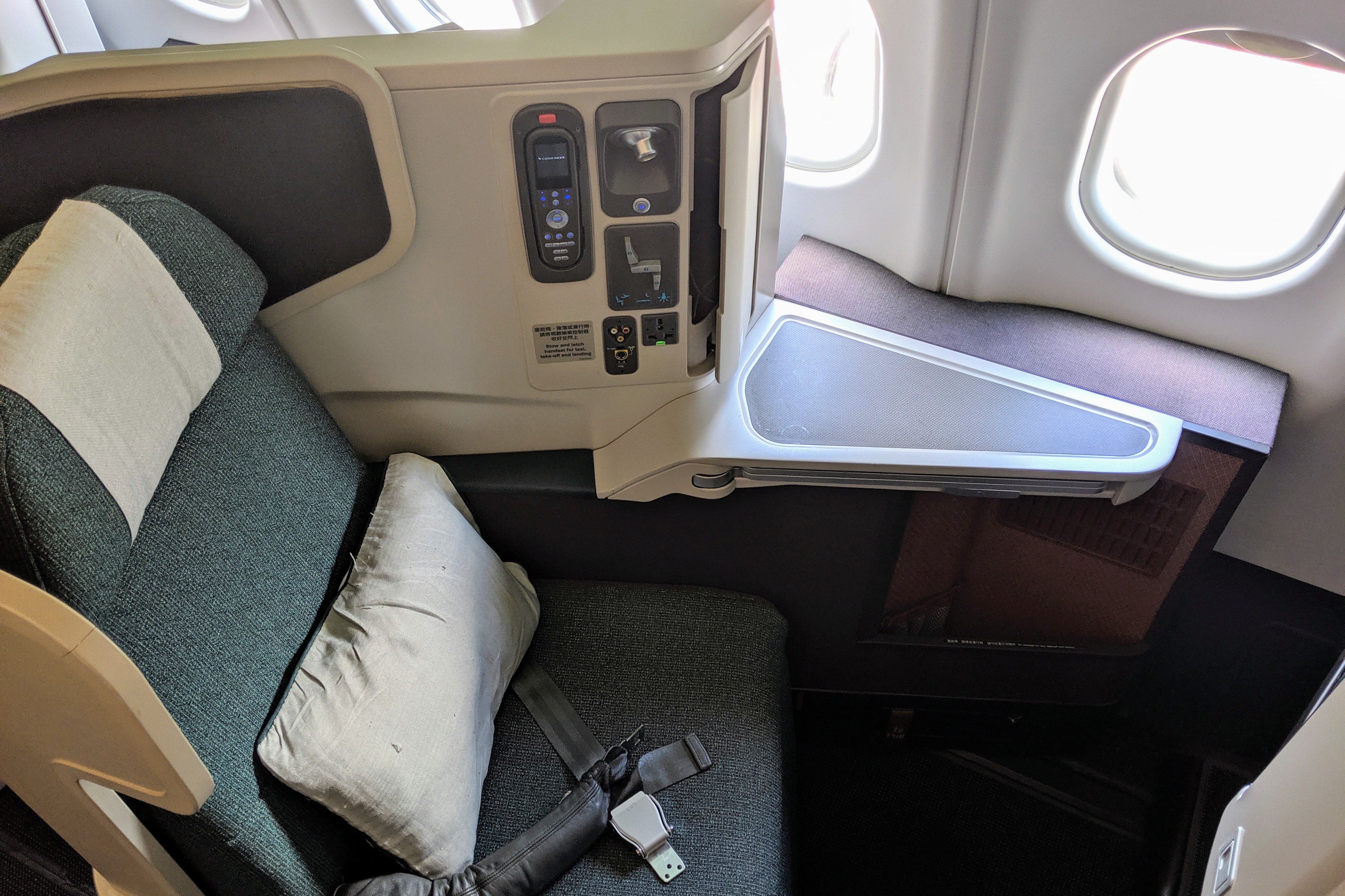
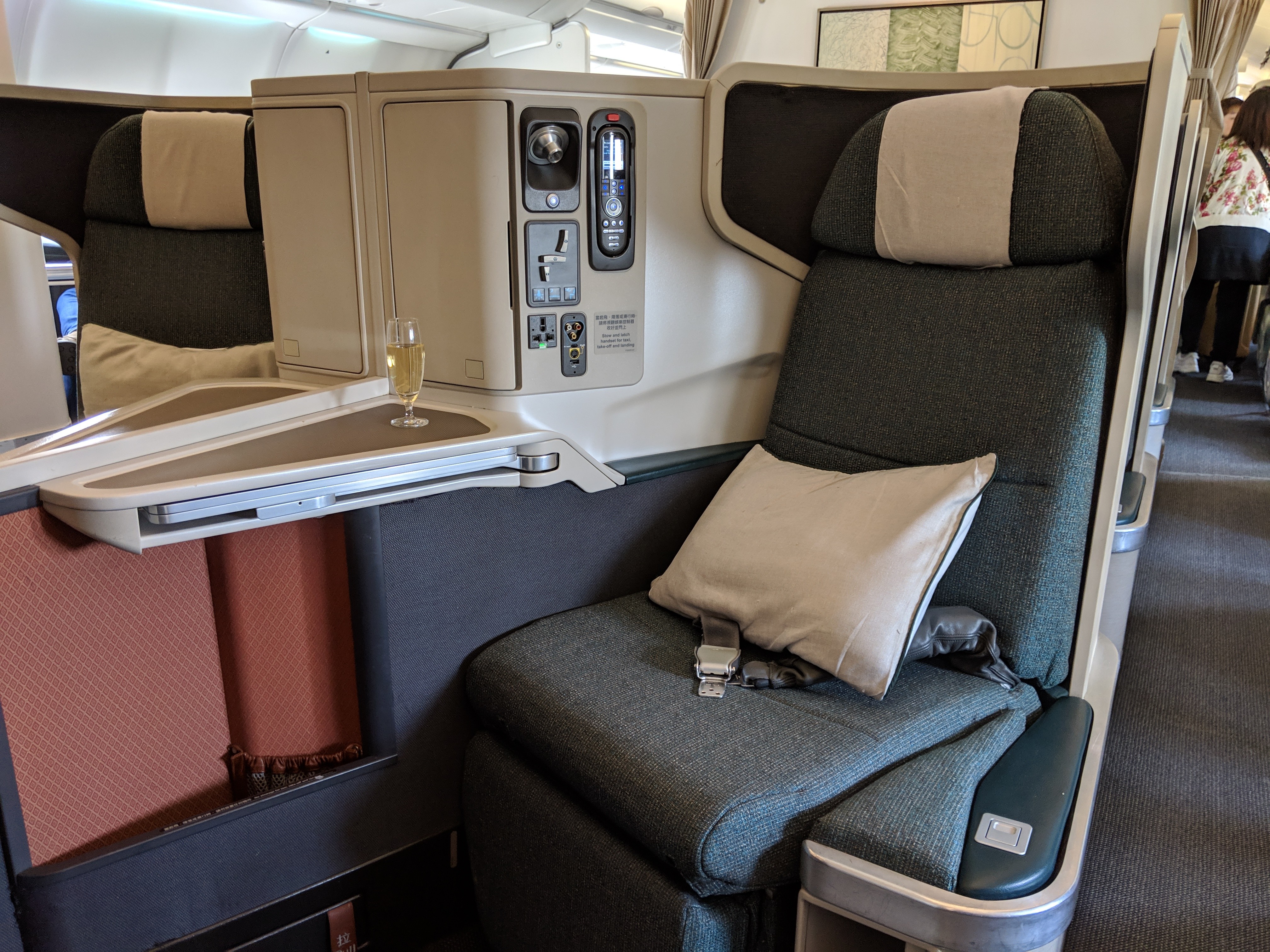
Fortunately for me today, the cabin product on the Singapore-Bangkok sector was the long-haul business product. The cabin is laid out in a 1-2-1 configuration in a reverse herringbone format, with all seats having direct aisle access. Seats are Cirrus seats, designed by Zodiac Aerospace, and can be found on several other carriers including Air France, American Airlines, and Delta.
The beauty of such 1-2-1 configuration is that it works for both couples and solo travellers. If you are travelling solo, the window seats work best, but if you are travelling as a pair, the middle pair seats will be your ideal positions.
Given it’s a long-haul business class product, the seat can be converted into a lie-flat bed at a touch of the automatic controls, with the seat flushed with the ottoman in front of the seat.
Ottoman that can be used as a footrest too
Every seat has a in-flight entertainment screen that folds out from the seat in front of you. When stowed in the original position, the screen will be at a 90 degree angle from you, so that means that you don’t get any entertainment during take-off, landing and taxiing. If you ask me, this is about the only weakness of the seat design.
Seat controls, power sockets are conveniently located next to you
The seat controls are conveniently located at the side of the seat. The entertainment control handset is stowed next to you, with the power socket and audio inputs right next to it. This makes it very convenient to access and use, particularly with the side table right next to all the sockets.
The service
The flight time today is under two hours, making it a very short flight for a meal service. Given it’s a mid-day flight, lunch was served.
For those who are familiar with Cathay Pacific’s services to Hong Kong, you will know that it usually does a three course meal in business class, with each course served separately.
Given the short length of today’s flight, the meal service is therefore similar to what Singapore Airlines offer on its short haul services, where everything is served on a single tray.
For starters, there was a bowl of fresh fruit, with no other options available.
There was three choices of main course:
Stir fried beef, sha cha sauce, kailan, oyster mushroom and egg fried rice
Pan fried salmon fillet with sumac spice, carrot potato mash, quinoa with zucchini, peas, sun blushed tomato and dill mustard sauce
Grilled chicken with Bali sauce, fried noodles with vegetables and chilli sauce
Apart from the menu that was already placed on my seat, what’s good about the Cathay Pacific business class meal service was that the cabin crew will wheel out a trolley with all the mains available, so you can visually take a look at the options before deciding what you want. I always thought this was a much better option, because words can only conjure an image of what the dish might look like, which more often than not turns out to be different from what is plated.
I went with the salmon with quinoa. Shortly after the main was served, another cabin crew trailing behind came around with a basket of bread, and I gladly chose garlic bread to go with my meal.
What differentiates Cathay Pacific from Singapore Airlines was their dessert service. Singapore Airlines typically does a cake or a room temperature dessert service.
Loyalists will know that Cathay Pacific dishes out Haagen-Dazs ice cream for its passengers, and this is no different even for this short-haul service and definitely a plus for me.
For those who are interested in the beverage list, here are the wines and champagne on offer today:
Cathay Pacific ex-Singapore wine list
The Entertainment
I am a huge fan of Cathay Pacific’s in-flight entertainment system. As earlier mentioned, the only draw back was the design of the screen, which flips away from the seat during take-off and landing, so that means that you won’t be able to watch your shows from gate to gate.
Cathay Pacific in-flight entertainment system
Back to the content. Cathay Pacific boasts a wide variety of entertainment options on its IFE, and what I personally enjoyed the most was the huge range of Chinese and Asian content. I find that particularly lacking on other carriers, including Singapore Airlines.
Beyond Hong Kong produced shows, they also carry a healthy amount of China, Taiwan, Japan and Korean content, including some more obscure options that may be hard to find. Some of the best shows I’ve watched are on Cathay flights. Having said that, they are also pretty strong in their Hollywood offerings – you will be able to find some of the hottest films on their system.
Noise-cancelling earphones
Final thoughts
The Cathay Pacific fifth freedom service between Singapore and Bangkok is a very much welcomed competition if you are looking beyond the Star Alliance carriers (i.e. Singapore Airlines and Thai Airways).
While it’s pretty much a very short flight, coupled with its brand-new lounge at Changi Airport, this is a product that works and is a very worthy alternative to what Singapore Airlines can offer. Schedule wise, while it only offer one flight a day, the middle-of-day timing also works pretty while for both business and leisure traveller – I could still head to work in the morning and still make it on the flight, while the return flight affords me some time in the morning in Bangkok before coming back to Singapore in time for dinner.
For those with Asia Miles, the redemption on this flight is however slightly more pricey than Krisflyer. You will need 25,000 Asia Miles each way in business class on Cathay, as compared to 21,500 Krisflyer miles each way on Singapore Airlines.
Offer only open to residents of Southeast Asia. Register and fly from now to 31 July 2019.
Cathay Pacific is currently running an Asia Miles promotion, offering up to 20,000 bonus Asia Miles for trips between Southeast Asia and USA.
The promotion
Current Asia Miles members will earn between 5,000 and 10,000 each way between Southeast Asia and select destinations in US.
You will receive 5,000 Asia Miles each way for economy class, 8,000 Asia Miles each way for premium economy and 10,000 Asia Miles each way for business class. There is unfortunately no bonus for first class (then again, if you can afford to buy a first class ticket, you really shouldn’t be worrying about bonus miles).
Marco Polo Club membership cards
To receive the bonus miles, you must register for the promotion here, before you begin your trip. Registration of the promotion and the entire trip have to be completed before 31 July 2019. The bonus miles will be credited 6 to 8 weeks after your trip, although in reality Asia Miles usually comes in pretty quickly.
The fine print
This offer is only valid for Asia Miles members who resides in Southeast Asia, i.e. Cambodia, Indonesia, Malaysia, Myanmar, Philippines, Singapore and Thailand. Residency is determined by the member’s preferred mailing address as registered with Asia Miles.
The offer is only valid for flights marketed and operated by Cathay Pacific and Cathay Dragon (i.e. has a CX or KA flight number, and is operated by Cathay Pacific and Cathay Dragon) the entire journey. If any part of your journey involves a codeshare flight, tough luck.
All miles-earning fare classes across business, premium economy and economy are eligible for this offer. Yay.
The class of travel for the bonus miles will be determined by the sector between Hong Kong and US. So if you are travelling in business from Southeast Asia to Hong Kong, and then premium economy to US, you will receive 8,000 bonus Asia Miles as opposed to 10,000.
One-way journeys and mixed class travel are allowed for this promotion. and the bonus will be awarded on a per-way basis.
So are the bonus miles worth it?
For the purpose of comparison, here are some of the usual mileage of trips to US from Southeast Asia:
One-way mileage from: Singapore, Malaysia, Indonesia, Thailand, Cambodia, Vietnam (Ho Chi Minh City)
So as you can see from above, the best bonus comes either when you are flying the cheapest economy fares, and if you are flying to the west coast of US (i.e. Seattle, San Francisco or Los Angeles).
For a return trip from Singapore to Los Angeles for a week in June, you will be paying S$1,584 roundtrip, and that will earn you 18,660 Asia Miles including the bonus miles, enough for a one-way premium economy award ticket from Singapore to Hong Kong or Taipei.
Singapore to Los Angeles round trip fare
If you are based in Hanoi or the Philippines, you will get the best deals, with almost 100% or more bonus miles if you are booked in the cheapest economy fares, or in the premium cabins.
A sample search out of Manila to San Francisco priced the ticket at about USD825, which is a steal for 17,320 miles.
And of course, if you are a Marco Polo Club member, you will also continue to earn club points on these trips. If you are at least a Silver member, you will also enjoy lounge access each time you travel with Cathay Pacific or Cathay Dragon, even if you are travelling in economy or premium economy.
Don’t forget to register for the promotion before you travel. Register here.