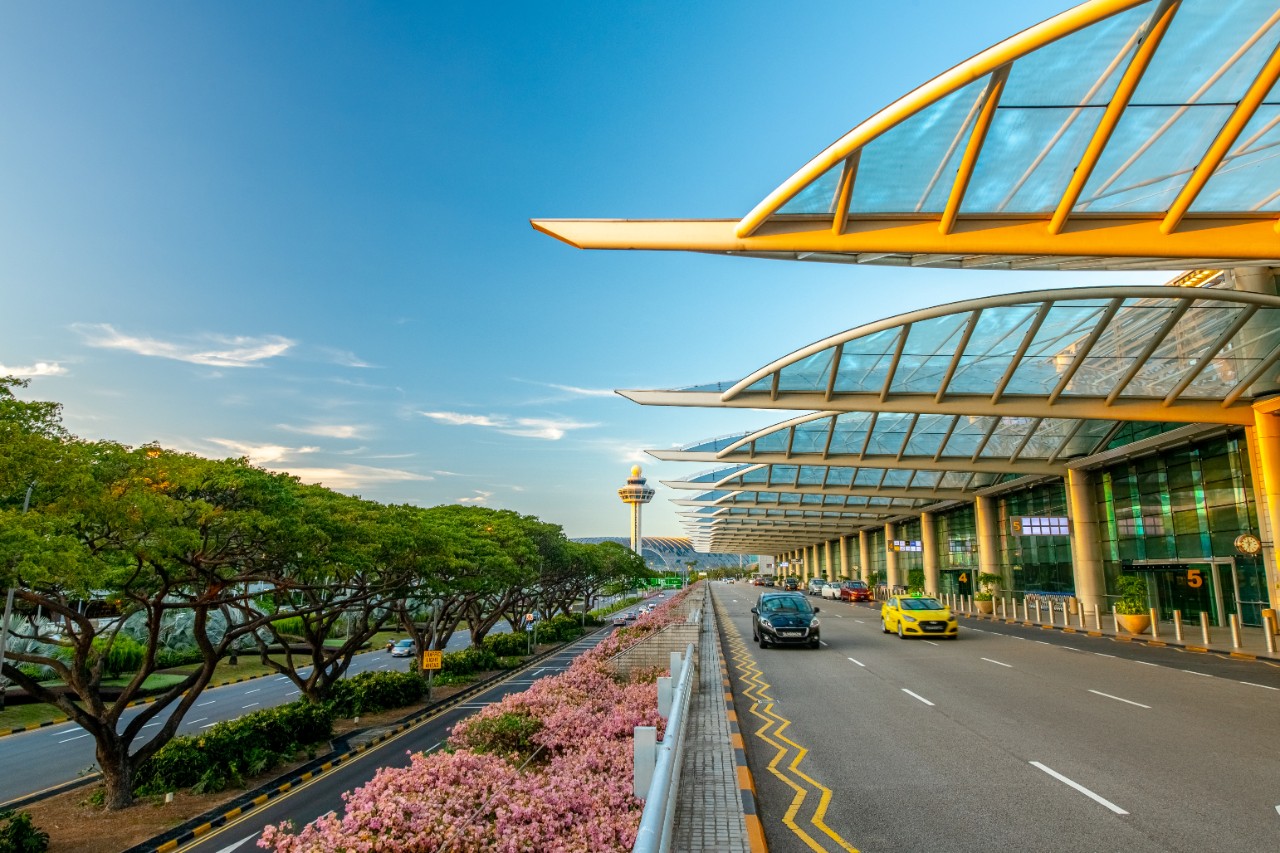
In the same announcement, Singapore Transport Minister Khaw Boon Wan did hint at closing Terminal 4 if all airlines adjusted or suspended operations.
The time should be now.
Cathay Pacific announced last week that it will be temporarily relocating to Terminal 1 since last Friday (10 Apr).
Announcement on Cathay Pacific’s website
With its lounge at Terminal 4 temporarily shut, this move does make sense.
Cathay Pacific still operating flights to Singapore
At the time of writing, Cathay Pacific did say that it will be operating three flights a week to Singapore. However, a quick look on its website showed that it was operating on average about two flights a week, with five more flights scheduled for the remainder of April.
From 10 Apr, Cathay Pacific will be using rows 12 & 13 of Terminal 1 for the few flights that it will be operating, until further notice. Eligible customers will be directed to the dnata lounge.
Terminal 4 likely to shut
With Cathay Pacific moving to Terminal 1, Terminal 4 is looking to be certainly shut, at least for a short while.
This makes perfect sense, given that Changi is looking at an all-time low passenger traffic and aircraft movements. The shuttering will allow Changi to consolidate operations to terminals 1 & 3, and save on operating the other terminals which are only seeing sometimes a single flight on any given day.
There are some other moving parts to consider though. With Terminal 2’s closing, some airlines will definitely be asked to move to Terminal 4, including Air India, Air India Express and Indigo, from 1 May. Of which, only Air India is still operating flights, so it remains to be seen whether they will be moving as originally planned, or moving to Terminals 1 or 3.
Final thoughts
We are definitely living in interesting times. While recent history has seen epidemics popping up every couple of years, Covid-19 has practically halted the world’s economy, with some analysts calling this the equivalent of the 1930s Great Depression.
The standstill of international air travel has resulted in the once-glamorous industry to fall off the cliff, with many jobs being put on hold, or even at risk of being lost as countries around the world continue to restrict travel for the sake of public health.
As recent as last year, I could never have imagined that a shining star like Changi Airport – the envy of many other airports in the world – will also see a day where not one, but two terminals suspending operations. This follows almost a decade of record-breaking passenger numbers every year.
Some analysts expect that air travel will remain low for as long as the next two years, and if the Covid-19 situation reports in every country is anything to go by, my bet is that most people are going to stay in their country for a long while.
Who knows what’s going to happen over the next couple of months, or even years?
Most Star Alliance airlines are moving to Terminal 3
Updated 29 April 2020: Changi Airport has published the full list of terminal moves, with most of the previously reported moves still accurate. The only exceptions are those who are supposed to move to T4, of which all of the airlines are currently suspending operations.
Changi Airport made a brief update on their website last night on the move since the announcement to close Terminal 2, although this was quickly removed.
For those who have not been following this development, Singapore Transport Minister Khaw Boon Wan announced in Parliament that given the on-going Covid-19 development, Terminal 2 will be shut for 18 months to facilitate the upgrading works from 1 May 2020 through October 2021.
As such, airlines currently operating out of Terminal 2 will move to the other three terminals, which will provide some cost savings and accelerate the Terminal 2 upgrading works by as much as a year.
List of new terminals
The full list of airlines was originally published as follow, but Changi Airport has since updated to list them all as “TBC”:
[Update 29 Apr 2020] Changi Airport has updated the confirmed list of terminal moves, as below.
Airline
Terminal
Air India (AI) – currently suspended
4 TBC
Air India Express (IX) – currently suspended
4 TBC
ANA (NH)
1
Ethiopian Airlines (ET) – currently suspended
3
Etihad Airways (EY)
3
Indigo (6E)
4 TBC
LOT Polish Airlines (LO) – currently suspended
3
Lufthansa (LH)
3 TBC
Malaysia Airlines (MH) – currently suspended
1
Royal Brunei Airlines (BI)
1
Sichuan Airlines (3U)
1 TBC
Swiss International Airlines (LX)
3 TBC
United Airlines (UA) – currently suspended
3
This move seems to make sense, as Malaysia Airlines now belong with its other oneworld partners, including Qantas, Qatar and Japan Airlines. This move will allow a better transfer option with its partners, as well as lounge access for eligible customers.
Terminal 1 now has probably the strongest offering of lounges by a single alliance, with three business class lounges (Qantas, Qatar and British Airways), and one dedicated first class lounge by Qantas.
Qantas first class lounge at Changi Airport Terminal 1
Having said that, given the earlier announcement on a deeper partnership between Singapore Airlines and Malaysia Airlines, the separation of both airlines across different terminals at Changi may be a temporary arrangement.
For the bulk of the Star Alliance airlines moving to Terminal 3, this is also a logical move given that Singapore Airlines is operating out of that terminal. Similar to its arrangements at Terminal 2, passengers travelling on these other Star Alliance airlines will be able to access Singapore Airlines’ SilverKris or Star Alliance Gold lounge, depending on the class of travel or elite status.
Final thoughts
As I’ve mentioned in my previous article, this downturn in passenger numbers may be a silver lining during this coronavirus episode, given that Changi Airport was on its way to hitting the ceiling in handling a good number of passengers comfortably within its four terminals.
While drastic and somewhat tragic for the aviation industry, this hard pause allows Changi to close off one terminal entirely and focus on relooking its operations while it has the space to. Many times in the past, the key challenging with any infrastructure work at Changi Airport is limited by its ability to manage on-going operations.
This allocation of terminals somehow has also cement Terminal 1 as a oneworld fort, while moving all the Star Alliance members to Terminal 3. There are obvious benefits for this, but the flip side of it is that airport resources are usually not optimised, given that not all alliances are equally represented and have equal operational loads at every airport.
Given Changi’s principles of pushing connectivity even across alliances and also wanting to optimise operations for passengers, my guess is that this arrangement most likely will be temporary at best, until things are somehow back to normal in a few years’ time.
Till then, I’ll be flying Malaysia Airlines quite a bit so I can enjoy Qantas’ lounges.
Move will help to accelerate the upgrading works, will be completed by up to one year ahead of schedule
Singapore Transport Minister Khaw Boon Wan announced yesterday (6 Apr 2020) in Parliament that Singapore Changi Airport will shutter Terminal 2 1 May 2020 onwards for 18 months.
The airport operator does not think that traffic will return to its former levels for the rest of this year as a result of the coronavirus pandemic, as such, it only makes sense to do a full closure of the terminal to facilitate the previously announced upgrading works, which was slated for a 2024 completion.
Along with Terminal 2’s temporary closure, Changi Airport Group has also said that it may suspend Terminal 4’s if all the airlines operating out of the terminal suspend flights.
In view of the very small number of flights at Terminal 4 (T4), operations at the terminal have been scaled down considerably with a small number of aircraft boarding gates kept in use and shops allowed to close early after the last flight for the day. If the remaining airlines at T4 choose to suspend or adjust their flight schedule, CAG will also consider suspending operations at T4 temporarily but with the objective of restarting operations quickly when airlines confirm the resumption of flights.
Passenger traffic numbers at Changi Airport has fallen off a cliff since beginning of the year. In February, Changi recorded only 3.45 million, a drop of over 30% as compared to the same month in 2019. This is also the lowest monthly passenger traffic number since February 2011, which saw 3.39 million passenger movements.
This number is expected to further dive in March and April, given that air traffic has almost come to a grinding halt given all the border control measures many countries have enacted, with a third of the world in isolation or quarantine.
According to some sources, aircraft movements for March have decreased by up to 90% at Changi Airport. What this means is that passenger traffic for March should have collapsed, given that none of the flights were anywhere close to full. We will only know later this month when Changi Airport Group reveals the numbers.
Singapore Airlines and Silkair to consolidate at Terminal 3 from 8 April
With the upcoming closure of Terminal 2, Singapore Airlines and Silkair announced that it will consolidate all its flights to Terminal 3 from 8 Apr 2020.
With this move, Singapore Airlines has closed its Terminal 2 SilverKris lounge as well, leaving the Terminal 3 SilverKris business class lounge as the only SIA lounge opened worldwide for the time being. The other Singapore Airlines lounges in Terminal 3, including the Krisflyer Gold Lounge, the First Class Lounge and the Private Room, are also all temporarily closed.
Singapore Airlines SilverKris LoungeTerminal 3is the only lounge operating in the SIA network right now
Move of other Terminal 2 airlines to be announced later
While Changi Airport has announced the closure of the terminal from 1 May, the move of other airlines will only be announced later.
As Scoot has moved to Terminal 1 since late 2019, we suspect that most of the airlines will be moved to either Terminal 3 or 4, given that Terminal 1 airlines are also now ‘encroaching’ onto B gates in Terminal 3 and E gates in Terminal 2.
The following airlines are currently operating out of Terminal 2:
Air India (AI)
Air India Express (IX)
ANA (NH)
Ethiopian Airlines (ET)
Etihad Airways (EY)
Indigo (6E)
LOT Polish Airlines (LO)
Lufthansa (LH)
Malaysia Airlines (MH)
Royal Brunei Airlines (BI)
Sichuan Airlines (3U)
Swiss International Airlines (LX)
United Airlines (UA)
Most of these airlines have suspended services to Singapore for the time being, so moving them around will be relatively easier.
Update: Changi Airport has made a brief announcement on where these airlines will move to. The list has since been removed, so we are expecting more changes.
Terminal 2 upgrading to be accelerated
Changi Airport Group announced earlier that Terminal 2 is going to under major upgrading works, which started in Feb 2020.
The refurbishment works were originally going to take place while the terminal is still in operation, all the way through 2024. This was also the same process when Changi refreshed Terminal 1 years ago, in keeping the terminal operational while upgrading the building section by section.
With this closure, it is expected that the upgrading works will now be accelerated and completed up to a year earlier than the 2024 deadline.
The refreshed terminal will have more space and can accommodate up to 5 additional million passenger movements a year.
Artist’s impression of upgraded Terminal 2at Changi Airport
Final thoughts
This is no doubt a darker period for the airport, who have seen many years of record passenger numbers for the better part of the past decade.
It will be without doubt that this year will see significantly smaller number, which may be a blessing in disguise for Changi Airport, given that the increasing number of passengers handled each year slowly inched towards the maximum capacity.
During peak seasons, many passengers would have noticed particularly crowded terminals and long queues at check-in and at immigration. This slowdown will perhaps help to moderate growth a bit until Terminal 5 is ready in 2030, although I personally think this may be delayed given the current outlook.
With major carriers at the airport almost zeroing their capacity, what are Changi’s options?
In the fight against Covid-19, Singapore has finally done in March what it has long been reluctant to do: shutting off its borders to visitors.
As an international and world renowned air hub, this was simply unimaginable in the past. Here in Singapore, we pride ourselves for being an open nation, where foreign tourists and businesses alike are welcome to spend and earn their money here.
Since the beginning of the year, Singapore has increasingly tighten the controls to keep the virus out. First it was a Stay-Home Notice (SHN) on visitors from select region, followed by a ban of visitors from certain regions, and the list of countries slowly expanded over the weeks.
These measures weren’t success enough, by the government’s standards, to keep the virus at bay, so the final gauntlet was dropped on Sunday when Singapore announced it will bar all short term visitors since 23 Mar. Subsequently, even long-term pass holders had to seek permission before setting off for Singapore, and anecdotally there are many instances where these workers are told to hold off their return to Singapore.
So as countries around the world shut their borders, Singapore had no choice but to do the same.
Home carriers reduce their capacitydrastically
Since February, all three home-based carriers have been cutting their flights. First it was all flights to China, and as the virus spread across the world, more and more flights were cut.
In the latest moves, Singapore Airlines, Changi’s home carrier, announced a 96% cut to its originally scheduled April capacity.
This follows Scoot’s announcement of grounding all but two aircraft, to continue operating only about 1% of its capacity. The low cost carrier will only operate 26 flights between 22 Mar and 5 Apr.
Jetstar Asia, the smallest of the Singapore-based carriers, has thrown in its hat earlier in the month to say that it will ground all flights for three weeks from 23 Mar through 15 Apr. It probably had the foresight to see this coming, given the timing of its suspension.
In the first three months of 2020, Changi Airport reported a drop of 32.7% in passenger numbers, with most of the fall coming from February and March. This is likely to continue falling as nations hold out on closed borders.
Terminals are eerily quiet
If one takes a look at Changi Airport’s flight information, they are mostly blank.
Take 23 Mar, Monday, just before the all out ban on short-term visitors kicked in for example. Changi’s Terminal 4 has only seven scheduled flights on the Flight Information Display System (FIDS), and only one is operating – CX759 from Hong Kong. I wonder how many people were on that flight.
With the drop and virtually no visitors, one might expect that the hardest hit groups will include airside retail operators, ground handlers and other service providers.
At its peak of handling over 68 million passengers, Changi Airport depends on over 20,000 workers within the airport community to keep the airport running smoothly. Now that we are seeing just drips of passengers, one can imagine that many of these jobs will be at risk.
So with a dwindling number of flights, what are Changi Airport’s options to minimise the impact to its service providers and tenants?
Reduced footprint across all terminals
Up to last night, Changi Airport was still operating flights across all seven piers (A through G) across four terminals. One possibility is to restrict operations to one pier of each terminal, while cordoning off the other.
The layout of Changi Airport and the seamless connection across Terminals 1 to 3 may work against this option right now, but there can still be a meaningful way to do it.
For instance, Changi Airport could consider shutting off all the A gates in Terminal 3 and F gates in Terminal 2, while using the B & E gates respectively. Given’s Terminal 1’s seamless connection to Terminals 2 & 3, it may not be feasible to close off any parts of it.
By shutting off one pier in two of the terminals, Changi could look to park grounded aircraft at the closed off piers, and also close off one set of immigration counters at each terminal. This arrangement will also allow transit retail operators to reduce its footprint, and thereby reducing overheads during this period of time despite the rental relief that Changi has said to offer.
Consolidate ops in one terminal
If the low traffic is going to persist for a while, Changi Airport can also consider closing off one terminal, just as what London Heathrow is contemplating.
If that happens, this will likely happen to Terminal 4, given that it is now operating only 1 to 2 flights a day. Sources familiar with Changi Airport says that while this is being studied, it is very unlikely. This is because there is a possibility that airlines who are asked to move back to Terminals 1 to 3 – despite it being temporary – may not want to move back to Terminal 4 once the situation normalises, as Terminals 1 to 3 enjoys better land transport options and also a wider range of facilities, including the proximity to Jewel Changi Airport.
A terminal move is also a major undertaking both for airlines and the airport. Typically, airlines moving terminals will have to configure their check-in systems to the rows that they are working out of. Along with that, they may also have to move certain specialised equipment and signages, and sometimes, their office.
The obvious upside to this option is that as Changi Airport is currently upgrading Terminal 2, this will allow Changi Aiport to shut off Terminal 2 altogether and fast track the upgrading works, making this a fairly attractive proposition given that it is almost certain that traffic numbers will take time to go up again.
Final thoughts
While conserving resources to minimise ‘wastage’ is critical during this time, one must not forget that aviation is a very big part of the Singapore’s economy, accounting for about 5% of Singapore’s GDP.
The airport alone supports about 20,000 jobs, and with this virtual halting of traffic, many of these jobs are definitely at risk. On top of these jobs, there are also the non-aviation businesses, such as the retail outlets within the terminals that are at risk with a prolonged downturn.
While Changi Airport Group – the airport’s operator – has stepped in to offer rental waivers for its tenants, more can be done to help these businesses stay afloat, especially if the crisis prolongs.
Changi Airport Group’s consistently draw in an annual operating profit in excess of S$900 million, with net profit varying from year to year depending on other factors. Most of this would come from its non-aeronautical revenue, given that the aeronautical revenue is regulated and therefore can be presumed to not draw much of a profit.
While the company is a privately held corporatised entity, Changi Airport Group cannot take away from the fact that it is operating a national – if not global – institution. By extension, it has a national service role in keeping jobs and helping businesses stay afloat, especially when it uses the Singapore brand, and leverage many other Singapore brands operating on its premises when selling itself to the world. It has relatively deep reserves, and if there’s a time the reserves should be tapped on, the time is now.
Qantas has spared no effort in publicising its plans to open a new first class lounge in Singapore since last year, and finally, it’s here.
Since last week, Qantas has quietly opened the first class lounge before the official opening gala slated to happen next week. I was travelling out and was fortunate enough to be guested into the lounge. I have tried Qantas’ first class last year when it resumed the A380 service to Singapore, and was looking forward to see what the lounge here in Singapore will offer.
Qantas A380 first class seat (photo credit: Qantas)
Location of the Qantas Singapore First Lounge
The brand new lounge is located at Singapore Changi Airport Terminal 1, where Qantas and Jetstar operates.
For those who are familiar with the existing Qantas Singapore Lounge (which have since been rebranded as the Qantas Singapore Business Lounge), the Qantas Singapore First Lounge is located on the opposite end of the terminal, closer to the D gates. While the terminal is not huge, it will still take about a 7 to 10-minute hike to traverse between both lounges.
For those entering from immigration, turn right immediately after immigration and head up the first escalator you see, and the lounge can be seen.
Qantas First Lounge signage
Once you are at the top of the escalator, turn right. A marble facade will greet you even before you step into the lounge, with the Qantas First Lounge plated smartly in brass accents.
Lounge design
This facade, along with several other recent Qantas lounges are proudly designed by David Caon, a close partner of Qantas.
Entrance to the Qantas first class lounge
As with the business class lounge, the first class lounge is managed and staffed by the hospitality folks from Accor’s Sofitel.
A bit more about the design background to the lounge. The entire space is designed by David Caon in collaboration with Kelvin Ho of design firm Akin Atelier.
The space
Once you step into the lounge, you will realise that the space is essentially a long strip stretching from the entrance all the way to the kitchen and broken up into several spaces for work, rest and dining.
Qantas First Singapore Lounge is a long strip (photo: Qantas)
The showers and toilets are located to the left once you enter the lounge, while the first section of seating is a relaxation area, complete with an assortment of sofas, armchairs and coffee tables if you simply fancy sitting back and sinking into the comfortable seats.
Assortment of seating options in the Qantas first class loungeLounge area with LED artificial skylight
There are even these individual stall-seats for those who want to be alone, similar to a business class suite you find on some airlines. Interestingly this looked similar to some of the lounge seats available in Cathay Pacific’s lounges in Hong Kong.
Privacy armchair seats
There are power sockets and USB charging ports at every seat, so there’s no need to fight for one.
If you need to get some work done, there’s even a printer that you can connect to and get some papers printed to work on your next flight.
Working space with printing facility
There are ten shower rooms, all of which are standard fitted except that it has an extra feature: a LED-light panel that mimics natural lighting. There’s a light panel near the door that allows the user to switch to either dusk, dawn or daylight so that they can adjust to a timezone of their choice.
Qantas Singapore First Lounge shower rooms
The new shower rooms are also decked out with amenities from LaGaia Unedited, Qantas’ latest spa partner announced just months ago.
LaGaia Unedited amenities
The small number of shower rooms would be a bit tight during the relatively short layovers for QF1 and QF2. As Executive Traveller has pointed out, the 90-minute layovers for each of these flights effectively meant that you get only 60 minutes in the lounge, so trying to allocate shower time for every first class passenger and a handful of platinum members and above will pose a major problem.
Moving down you will find the dining area of the lounge.
Qantas first lounge dining areaMore dining area
Almost half the lounge’s space is dedicated to the dining area, with many two-seater tables available. Of course, if you are in well-heeled company of more than two people, the team will be more than happy to join tables for you.
For single travellers, there’s always the option of taking a table, or dining at the bar counters.
Bar table dining space facing the kitchen (Photo: Qantas)Bar counter dining is available as well
What I really liked about the lounge is the attention to details. There are even bag hooks under the bar tables for your bags, as well as charging sockets for each seat.
Bag hooks and power sockets
How does the lounge fare in terms of dining?
Similar to the other first class lounges that Qantas operates in Australia, Qantas Singapore First Lounge offers an a la carte dining experience. The menu is designed by a team under Neil Perry, Qantas’ creative director for food and beverage, who has a longstanding partnership with Qantas.
Given the lounge is only open from afternoon, the menu tended towards heavier mains, although all-day breakfast items such as eggs benedict were also available for those who were jetlagged.
The full menu running now can be found here. Note that the lounge rotates its menu every three months.
Qantas Singapore First Lounge menu (as provided by Qantas)
Of course, no Qantas First Lounge is complete without its signature salt and pepper squid.
Salt and pepper squid
We also tried the signature crayfish laksa.
Crayfish laksa
And the chicken didn’t disappoint too, with a perfectly made eggplant salad as a bed.
Chicken with crispy eggplant salad
What was most impressive was the dessert – the coconut and mango sorbet with toasted coconut flakes. While the description leaves much to be desired, the actual taste of it was amazing, although it’s a little too big to be finished by a single person.
Coconut and mango sorbet with toasted coconut flakes
The lounge is also equally impressive in terms of its drinks list. Apart from champagne, there are also an assortment of wines and cocktails available, worthy of the clientele. There is a tended bar from which you can order, but feel free to order from any of the well-trained Sofitel team members anywhere in the lounge.
One of the two bars
What’s pretty amazing is the selection of beverages, apart from Qantas’ signature range of Aussie wines, there’s also some well-known Australian beers such as James Squire 150 Lashes pale ale, Little Creatures Bright Ale and Hahn Ultra available in the lounge.
For a little surprise, be sure to check out the special Qantas x Four Pillars gin too!
Final thoughts
More seating area
The lounge definitely packed a punch for the footprint that it occupies. The decor and fittings are an amazing piece of art by David Caon, which is certainly the standard Qantas holds itself to when decking out new lounges these days.
While some may observe that the lounge is a little too small and seem a little too crowded for a first class lounge, particularly around the QF1 and QF2 transit times, the impeccable service by the lounge team makes up for it.
With the Qantas Singapore First Lounge opening, this is definitely a win for Qantas’ own platinum (and above) loyalists, as well as its own first class passengers given the upgrade in the lounge experience. The opening of this lounge will also ease the capacity off the existing business lounge, who have seen a fair share of overcrowding in the last year.
The first class lounge clearly leads in terms of its beverage offerings with a solid list of wines, spirits and cocktails. In terms of food, some Singapore Airlines loyalists may argue that the menu here in the Qantas First Lounge may not be fitting of the fare one pays for the pointed end of the plane. In my view, the menu, while simple, is sophisticated enough for those who need a quality bite before they head onto the plane.
And to top it all off, what matters is how all of this comes together: the ambience, food, beverage, and most importantly, the impeccable service, in this case all come in together to form the first class service that paying customers deserve.
Location and operating details
Location: Changi Airport Terminal 1, Transit area (after immigration), Level 3 (closer to D pier) Hours: 2.30pm to midnight daily Food and beverages: Yes, a la carte dining Alcoholic beverages: Yes (complimentary) Showers: Yes Business Centre: Yes Meeting facilities: No
Access eligibility: – Qantas first class passengers (departing) – Emirates first class passengers (departing) – Oneworld first class passengers (departing) – Oneworld first class passengers connecting from a first class flight (longer than five hours) to another oneworld-marketed flight in any class – Qantas Frequent Flyer Platinum One & Platinum members travelling on a oneworld-marketed, Emirates or Jetstar flight – Oneworld emerald members travelling on a oneworld-marketed flight
*Passengers can bring a guest who must be travelling on the same flight.