Tag: Featured

  • Review: Cathay Pacific A350-1000 Business Class, Amsterdam to Hong Kong (AMS-HKG)

    Review: Cathay Pacific A350-1000 Business Class, Amsterdam to Hong Kong (AMS-HKG)

    This is a long overdue trip review that was meant to be a restart of this dormant website. My day job has gotten the better of my time over the past years, so much so that the inertia to jumpstart this sleeping baby took a while to go.

    After going to Tomorrowland for the first time in my life (that’s another story for another day), I spent a couple of days in Amsterdam before heading back to Asia on Cathay. Why Cathay? It was a very practical reason: beyond the ME3 carriers who were trashing fares due to the Iran war, it was much cheaper to fly with Cathay during the typically busy summer season.

    Amsterdam also turned out to be a good choice of airport to fly out of, as several of my friends who flew out of Brussels had missing luggage, only recovered after dozens of emails and two weeks later.

    I decided to do a review of this flight, simply because of how good simple can be. Cathay runs a consistent product, and while it’s not entirely life-changing, the reliability triumphs.

    Cathay’s A350-1000 business class is a very comfortable way to get from Europe to Asia. The seat is a proven performer, wifi is free, and the catering (especially the burger and pork rib soup) was genuinely solid.

    At a glance 8/10
    FlightCX270
    RouteAMS → HKG
    DateJul 2026
    Departs12:20
    Arrives06:10 (+1)
    Scheduled time11h 50m
    AircraftA350-1000 · B-LXQ
    Seat15K · Business

    Verdict: A proven seat, free wifi and a burger worth staying awake for. The lunch service, however, needs a stopwatch.

    In this review

    Booking

    For this trip, I made a cash booking, with my trip originating from Kuala Lumpur. Across Southeast Asia, you can generally find significantly lower fares on premium cabins from other cities, even after factoring in repositioning flights.

    By starting and ending in Kuala Lumpur, I spent only about MYR10,700 (USD2620) on the return business class fare. A similar trip out of Singapore or Bangkok will cost at least MYR3,000-5,000 (USD740-1220) more.

    As a Qantas platinum frequent flyer, I naturally credited my points and status credits to Qantas Frequent Flyer. While this gives me less points than what I’d have earned crediting them to Cathay’s own programme, I needed the status credits to requalify for platinum the following year.

    This is what the trip would have earned you on Qantas and Cathay’s programme:

    EarnsKUL-HKG (each way)HKG-AMS (each way)Return total
    Asia Miles3,50010,00027,000
    Cathay Status Points35100270
    EarnsKUL-HKG (each way)HKG-AMS (each way)Return total
    Qantas Points2,5007,40019,800
    Qantas Status Credits80120400

    For context, both Cathay Diamond and Qantas Platinum get you oneworld Emerald. Cathay Diamond takes 1,200 Status Points, so this one trip covers 22.5% of it. For Qantas Platinum, I only needed 1,200 Status Credits to requalify (1,400 from 2027), so the trip covers a third of my requirement. Not bad for a summer holiday.

    My Flight Today

    My journey home today flew as follows:

    • CX270 Amsterdam (AMS) to Hong Kong (HKG), departing 12:20, arriving 06:10 (+1)
    • MH79 (sold as CX6011) Hong Kong (HKG) to Kuala Lumpur (KUL), departing 08:45, arriving at 12:45

    Check-in

    At Amsterdam Schiphol, Cathay Pacific’s check-in row is located at Departure Hall 3, rows 23-24. As a oneworld Emerald, I could use the first class counter, which had no queue. Fair enough, since Cathay doesn’t fly first to Amsterdam, this was essentially a counter for oneworld Emeralds, including Cathay diamond members.

    Naturally, check-in was very fast and smooth. The agent was also very helpful in providing advice on tax refunds: she handed us our boarding passes first, and pointed us in the right direction to get our tax refunds done before coming back to drop our bags.

    Schiphol is running at a very high volume, and it shows. After bag drop, we were sent to the security screening at Departure Hall 2, a five-minute trek through a packed terminal. Thankfully, business class passengers get a separate entrance at security, which made short work of the queue.

    The funny thing about Schiphol is the awkward walk you didn’t sign up for. We checked in at Departure Hall 3, then were made to trek to Hall 2 to clear security and immigration, then walk back towards the non-Schengen gates in Hall 3. I suspect the layout was designed by someone with a daily step target.

    The oneworld Lounge

    Cathay sends its premium passengers to the alliance-branded oneworld Lounge, which is thankfully a short walk after immigration in Departure Hall 2. After the step count so far, my legs were grateful. It sits between the D and E gates, one floor above the main walkways on Level 3, and is signposted as Lounge 40.

    Directions to the oneworld lounge (Lounge 40)
    Directions to the oneworld lounge (Lounge 40)

    The lounge is fairly new, having only opened in February 2024 as oneworld’s second branded lounge after Seoul Incheon, and its first in Europe. It took over the space of the former British Airways lounge which closed after the pandemic, and covers 473 square metres. Swissport’s Aspire brand runs it day to day, sharing a kitchen with its own Aspire lounge next door.

    Oneworld lounge entrance
    Oneworld lounge entrance

    Access is for oneworld Emerald and Sapphire members, plus First and Business passengers on oneworld airlines, departing outside the Schengen area.

    Boarding and departure

    Our departure today was was from gate G3, about a ten-minute stroll from the lounge. Waiting there was B-LXQ, a 2022-delivered Airbus A350-1000.

    Cathay Pacific A350-1000, B-LXQ
    Cathay Pacific A350-1000, B-LXQ

    The A350-1000 is the stretched version of the A350-900, and Cathay uses the extra length to fit 54 more seats:

    CabinA350-900A350-1000
    Business3846
    Premium Economy2832
    Economy214256
    Total280334

    Boarding began at around 11:40 and wrapped up well before the 12:20 scheduled departure. This was also just about enough time for me to finish up the pre-departure glass of champagne offered.

    We pushed back at 12:37, then spent 17 minutes taxiing. Schiphol’s runways are spread so far apart that taxiing can feel like a tour of the Dutch countryside. We were finally airborne at 12:54.

    The cabin and seat

    Cathay’s A350-1000 has 46 business class seats in a 1-2-1 reverse-herringbone layout, all in one long cabin between the first and second set of doors. Every seat has direct aisle access.

    Cathay Pacific A350-1000 business class cabin layout (source: AeroLopa)
    Cathay Pacific A350-1000 business class cabin layout (source: AeroLopa)

    As you can see from the layout above, there are only two lavatories for the cabin of 46 seats, both of which are located at the front of the cabin. For those seated towards the rear of the cabin, there are also two more lavatories in the galley section behind the cabin.

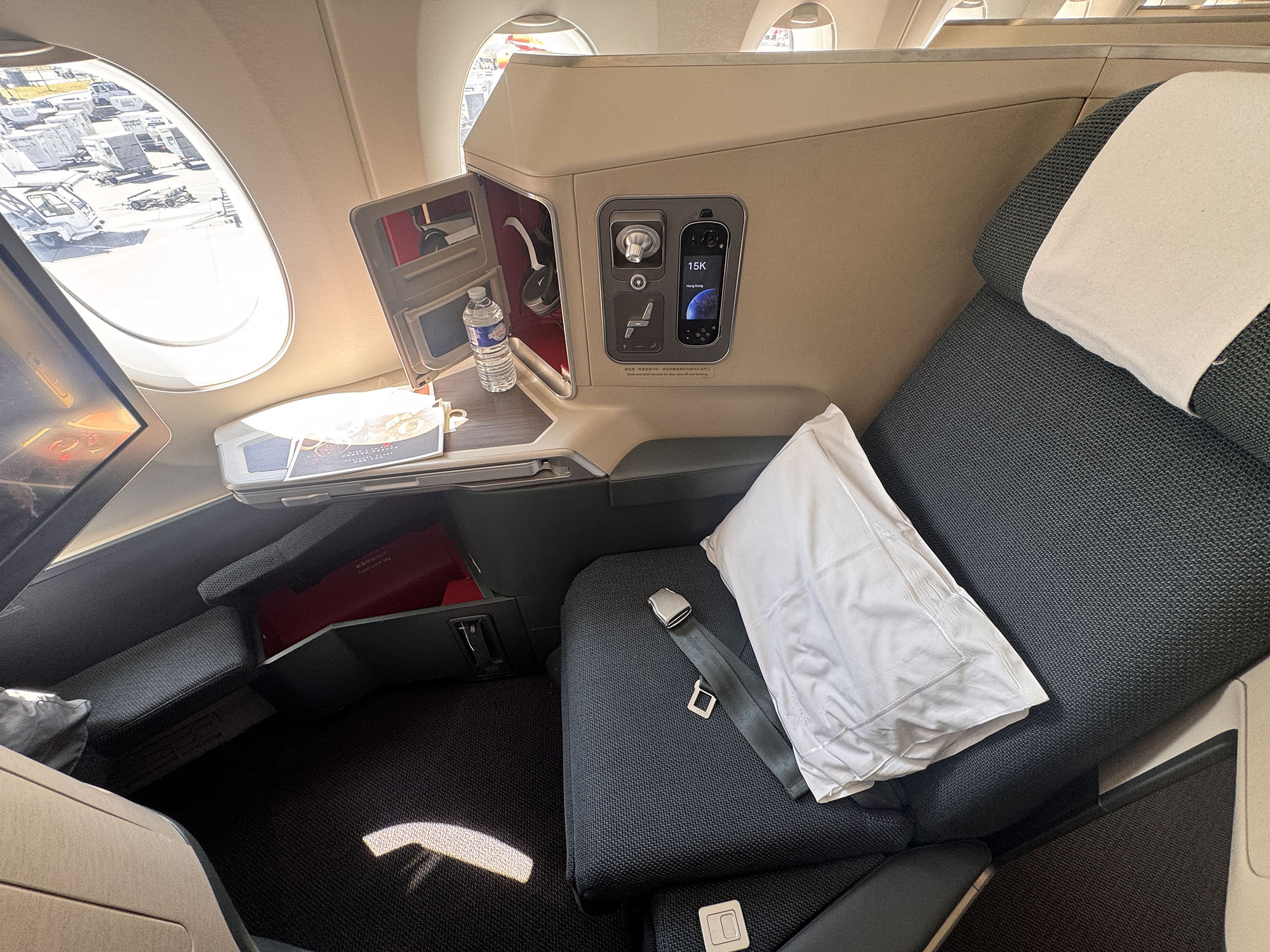
    For the flight today, I was seated in 15K, a window seat on the right side of the cabin, with two windows all to myself.

    Cathay Pacific A350 business cabin
    Cathay Pacific A350 business cabin

    Surprisingly, when I first made my booking, all the centre pairs were already taken. Travelling with a companion, I’d hoped for one of those, but none were available even four months before the flight. Apparently every couple in Europe had the same idea. In fairness, the centre seats are so private that you’d have to lean well forward to chat anyway.

    Travelling as a pair?The centre pairs in Cathay’s A350-1000 business cabin were all gone four months before this flight. If you want to sit together, select seats the moment you book.

    The seat is Cathay’s customised version of the Cirrus reverse herringbone, originally made by Zodiac and now by Safran. Cathay has flown versions of it across its long-haul fleet since 2011, and apart from the newer Aria Suite (which I’ve yet to try), this is still the airline’s main workhorse. It’s one of the roomier reverse herringbones around, especially at the footwell, which doesn’t taper into the usual narrow cubby.

    Cathay Pacific A350 business class seat
    Cathay Pacific A350 business class seat

    Here’s what’s where:

    • Side panel: a touchscreen IFE remote, a reading light, and seat controls with presets for upright and full-flat.
    • Side cabinet: this is where you can find your headphones, a Bamford amenity kit and a bottle of water when you first get to your seat. There is also the AC and USB-A power sockets located in here. The door has a small mirror, handy for checking for vegetables stuck between your teeth, or to make sure you don’t have the odd hair out of place after a nap.
    • Console: a generous side table, with the tray table pivoting out from beneath it, so you can still get in and out with the table deployed.
    • Storage: a lidded compartment beneath the side console, big enough for shoes and small gadgets, and still reachable in bed mode.
    • Overhead: reading lights only, with no personal air nozzles, so dress for the cabin temperature.
    Side console with headphones, amenity kits
    Side console with headphones, amenity kits
    Seat controls, IFE remote control
    Seat controls, IFE remote control

    It’s a very solid business class seat, and still one of my favourites: direct aisle access for everyone, plenty of places to stash things, and a proper view out.

    Amenities

    When I got to my seat, the menus were already waiting, along with a pillow and a bedding kit and slippers tucked into the footwell. Cathay added mattress pads to its business class bedding in 2019, but only for long-haul flights from Hong Kong to Europe, North America and South Pacific.

    Cathay Pacific bedding in a bag, plus bedroom slippers
    Cathay Pacific bedding in a bag, plus bedroom slippers

    The Bamford amenity kit and Cathay’s noise-cancelling headphones live in the side cabinet.

    Cathay’s current partner for its amenity kit is Bamford, which are also the same amenities found in the lounges and bathrooms across its network on the ground.

    Bamford amenity kit
    Bamford amenity kit

    The amenity kit is one of the more substantial ones offered in business class. Packed in a slick pearl-white faux leather pouch, the kit contains an eye mask, dental kit, ear plugs, body gel, and even mouthwash and a pillow mist.

    The bed

    A note about the bed first. The seat reclines into a fully flat bed at the touch of a button, and Cathay adds a bedding set on long-haul flights for better comfort. The bedding was comfy, but the pillow was a little too soft for my liking, with roughly the structural integrity of a German pillow. A second pillow would have helped. While this was a 12-hour red-eye flight, given I was already adapted to European hours, I only managed maybe 3-4 hours of sleep throughout the flight.

    Cathay Pacific business class bedding
    Cathay Pacific business class bedding

    Lunch

    On this flight today, there are two main meal services: lunch served after take-off, and breakfast just before the early morning arrival into Hong Kong.

    While we were still on the ground, the crew came round to take lunch orders.

    The food and wine menus are as follow:

    As you can see from above, the menus were significantly more substantial than the intra-Asia business class service that I take a lot more frequently, both in terms of food choices and beverage options. For lunch alone, there was a whopping five menu options to choose from. Even though two of the options were all-day options, it’s still an impressive selection.

    For lunch today, I went for the octopus salad to start, and the stir-fry prawns with jasmine rice for main, which came with a side of pork rib soup.

    Kudos to the crew: service began within 30 minutes of take-off. First up was a canapé of prawn cocktail in an unnamed sauce, with another glass of champagne.

    Prawn cocktail canape
    Prawn cocktail canape

    The octopus salad arrived ten minutes later on a tray, with a second crew member following with the bread basket. I took a customary piece of baguette, which was cold and hard enough to count as carry-on.

    Octopus salad, sans bread (it came later)
    Octopus salad, sans bread (it came later)

    I’m a fast eater and typically inhale my food in minutes. Most of the time the on-board service speed is able to match my eating pace, but to my dismay today, the main course arrived almost 30 minutes after the starter. The octopus salad turned out to be mere foreplay: there was time for a toilet break before the main event. At least the business class lavatories at the front of the cabin have windows and Bamford toiletries, so the wait came with a view.

    The main course came just as I was starting to turning hangry. The prawns were passable, though the sauce did a much better job with the rice. The glorious winner was the pork rib soup, although I’m not entirely sure that wasn’t homesickness talking. It was so good I asked for seconds, which the crew gladly served.

    Stir-fry prawns with spring onions and ginger in tomato sauce
    Stir-fry prawns with spring onions and ginger in tomato sauce

    For dessert, I asked for both the ice cream and the fruit plate, because holidays. Cathay serves Häagen-Dazs in every cabin, and today’s flavour in business was Belgian chocolate.

    The fruit plate was a delicately arranged plate of four slices of different fruits. Cathay has always had an eclectic fruit selection: the watermelon, orange and dragon fruit were easy to identify, but the pale green crescent had me stumped for the rest of the flight. Back on the ground, forensic analysis of my photos says honeydew melon although I swear it didn’t taste anything like that.

    Fruit plate
    Fruit plate
    Haagen-Dazs ice cream
    Haagen-Dazs ice cream

    And with my double portion of desserts, the entire meal service wrapped up a little over two hours into the flight. I made up the bed myself, then carried on sipping wine in front of a movie.

    Mid-flight snack: the burger

    About four hours after lunch, I was peckish again, perhaps due to it being closer to dinner time in Europe. So I guess it was time to check out the mid-flight offerings. And of course, the Cathay burger caught my eye.

    Cathay’s burger is famous on its long-haul flights, and I was curious whether the fries would survive the journey from galley oven to seat.

    The all-day menu, available on request throughout the flight:

    • Barbecued pork noodle soup
    • Vegetarian lasagne
    • Classic beef burger with cheddar, bacon and pickles on a toasted brioche bun, with fries
    • Galley snacks: Häagen-Dazs ice cream, Garrett caramel popcorn and other sweet and savoury nibbles

    I pressed the call bell, and a crew member appeared pronto.

    “I’d like a cheeseburger, please.”

    “That will take about 20 minutes. Is that okay?”

    “That’s fine. But can I have a glass of champagne first?”

    Priorities. The glass came first, and I took my time nursing it. Like clockwork, the burger arrived shortly after.

    The Cathay cheeseburger
    The Cathay cheeseburger

    The burger came assembled without vegetables, its lettuce leaf and tomato slice waiting on the side like optional extras. The thick-cut fries looked almost too glossy, as though someone had brushed them with oil before serving. The tray also had a knife and fork, and a small glass tub of Heinz ketchup. Bonus points for elegance.

    Time for the verdict. The patty was surprisingly juicy and hit all the right spots. The fries deserve an honourable mention: deep-fried food rarely holds up at 30,000 feet, so I have to applaud Cathay for even trying. I prefer thick-cut fries anyway, so these were still pretty enjoyable with the ketchup.

    Very juicy patty at 30,000 feet
    Very juicy patty at 30,000 feet

    Feeling greedy, and firmly of the view that calories don’t count above 30,000 feet, I asked whether the San Sebastian cheesecake from lunch was still available. Boy, it was, and I inhaled it along with another glass of the Chinese red.

    San Sebastian cheesecake
    San Sebastian cheesecake

    The wine list

    Speaking of wine, Cathay’s list plays it safe on paper: a champagne, then two whites and two reds from French, Australian and American labels. Look closer and there are quiet stars. La Dame de Montrose is the second wine of Château Montrose, a Saint-Estèphe second growth.

    TypeWineRegion
    ChampagneCharles Heidsieck Brut Réserve NVChampagne, France
    WhiteChartron et Trébuchet Chablis 2024Burgundy, France
    WhiteWestmount Pinot Gris 2023Willamette Valley, USA
    RedLa Dame de Montrose 2017Saint-Estèphe, Bordeaux, France
    RedKilikanoon Killerman’s Run Shiraz 2021Clare Valley, Australia
    Dessert wineGraham’s Late Bottled Vintage Port 2020Portugal
    Chinese showcase, redPuchang Vineyard Beichun Limited Edition 2019Turpan Valley, Xinjiang, China
    Chinese showcase, sparklingSilver Heights Bloom Sparkling Wine 2023Ningxia, China

    The list also showcases two Chinese wines: a red from Xinjiang and a sparkling from Ningxia. I’d tried Ningxia reds several years ago and was already intrigued by how decent they were. Piqued, I asked for the Xinjiang red. The wine held up surprisingly well in the air, with enough depth and complexity for altitude. It went down rather well with San Sebastian cheesecake too, a pairing no sommelier will ever sign off on.

    For the teetotallers, the signature drink is the Cathay Delight (kiwi, coconut milk and fresh mint). Coffee is by illy, tea is by JING, and there’s Hong Kong-style milk tea too. Don’t ask me how they tasted, because I hardly consume any non-alcoholic drinks beyond water.

    Breakfast

    Cathay asks business class passengers to pre-order breakfast on a card tucked into the menu. That spares everyone an ordering conversation at 4am Hong Kong time, an hour at which nobody should be making decisions about omelettes.

    Breakfast came round about two hours before landing, with four choices:

    • Wellness breakfast: chia seed pudding with kiwi, Amarena cherries and dried apricots
    • Lighter breakfast: cold cuts with cheese, olives and bread
    • Chinese breakfast: chicken congee with stir-fried egg noodles and mixed vegetables
    • Western breakfast: cheese omelette, pork sausage, cherry tomato ragout and roasted baby potatoes

    While it’s approaching early morning in Hong Kong, my tummy was clearly still in the mood for supper. Hence, I went for the Chinese option.

    To my relief, the set arrived on a tray: a half-filled bowl of chicken congee, a side plate of stir-fried egg noodles and a small bowl of strawberries, blueberries, melon and mandarin. The congee had some flavour to it, although the noodles was pretty much bland with a rubbery texture. Noodles never really quite do well after a long time in storage, considering we were towards the end of the flight.

    Chinese breakfast set
    Chinese breakfast set

    Entertainment and Wi-Fi

    Cathay’s StudioCX entertainment system plays on a large high-definition screen, and it was competent. I’ve always liked Cathay’s selection of Asian films, and this flight was no exception.

    Entertainment screen
    Entertainment screen

    Wifi was complimentary for all first and business class passengers, regardless of whether you are a Cathay member. You can connect one device at a time and switch between devices whenever you like. Having said that, travelling between Europe and Asia is always a bit of a toss-up as far as wifi coverage is concerned, there are pockets of times throughout the flight where wifi was unavailable.

    However, if you are travelling in premium economy or economy, you will need to be either a Cathay member (for premium economy) or Cathay Gold member (for economy) to access free wifi.

    Service

    For those who are familiar with Cathay Pacific, its business class service tends to be efficient rather than effusive, and this crew fit that mould to the point. They were friendly and professional, from boarding through to landing. They greeted by name, and were fairly attentive throughout the flight.

    The small things went well: meal orders were taken on the ground, lunch commenced fairly quickly after take-off, the call bell was answered almost instantly, and a second bowl of soup arrived without a second thought.

    Between meals, the crew kept a low profile while the cabin rested. I generally prefer this than a prowling cabin crew, because if I needed service, I have the bell to use.

    The one real wobble was pacing of the meal service. A near 30-minute wait between starter and main is long for anyone, although this might be a galley process problem. Having said that, the service was still very competent, and by this time I could be picking at bones for a weak spot.

    Arrival

    We touched down in Hong Kong at 05:48, 22 minutes ahead of the 06:10 schedule. It’s the kind of early nobody asks for at dawn, but landing early in Hong Kong does has its perks: a lighter transit security screening load, and also ample time to freshen up in the lounge before our connecting flight to Kuala Lumpur.

    Final thoughts

    Seat & bed8.0
    Food8.0
    Drinks8.0
    Service7.5
    IFE & Wi-Fi7.5
    Value9.0

    Cathay’s A350-1000 business class remains one of the most dependable ways to get between Europe and Asia. The seat is a proven performer, the wifi is free (although not necessarily fast), and menu hits all the right spots, with the burger and pork rib soup being genuine highlights for me.

    The gripes were small but real: a lunch service that needed a stopwatch, and a pillow that needed a backbone. For a cash fare starting in Kuala Lumpur, it’s a solid 8/10. Unfortunately, with the additional fuel surcharge that Cathay Pacific has levied this year due to uncertain fuel prices, one will be hard pressed to find such a good deal in the near term.

  • FLIGHT REVIEW: Qantas A380-800 First Class, Singapore – London Heathrow (SIN-LHR)

    FLIGHT REVIEW: Qantas A380-800 First Class, Singapore – London Heathrow (SIN-LHR)

    Qantas made quite a fair bit of news in Singapore just before Covid-19 with the grand opening of its first class lounge, which sadly shuttered not long after it was officially opened.

    The good news is, the lounge survived the pandemic; it is now reopened and received guests at full force, just as with before.

    I have had the fortune to experience the first class cabin some years back, but it was from Sydney to Singapore. I had such a great time, it created a new bucket list item for me, to try the same product again but on a much longer flight, from Singapore to London or vice versa.

    However, the first class cabin across all airlines is some what of a unicorn in the post-Covid era. Even with a bank full of points, it takes sheer determination and an awful lot of patience to find any kind of award availability.

    And I finally laid my hands on it.

    In this post:
    • Flight today
    • The Qantas A380
    • Checking in
    • Qantas First Lounge
    • Boarding
    • The seat
    • The service
    • Qantas amenity kit & pyjamas
    • In-flight entertainment
    • In-flight lounge
    • Final thoughts

    Flight today

    Qantas QF1
    Singapore (SIN)
    – London Heathrow (LHR)
    20 November 2022
    Depart: 11.55pm
    Arrive: 6.25 am (+1 day)
    Duration: 13 hr 50 min
    Aircraft: Airbus A380-800
    Seat: 4F (First Class)

    The Qantas A380

    The A380 needs no introduction – the famous double decker jumbo is a favourite amongst both airlines and passengers; the latter for the number of passengers it can pack, while it also calls for a stable ride.

    Prior to Covid-19, Qantas launched a refurbishment project for its fleet of 12 A380s. While business class and premium economy got a complete overhaul, the first class cabin saw relatively less major upgrades, including a reupholstering of the seats and a brand new in-flight entertainment screen.

    Through Covid-19, Qantas has grounded all of its aircraft, only to bring it out of storage earlier this year in 2022.

    Sadly, Qantas has retired two of the big birds, with 10 superjumbos left in its fleet. Even with, only five of the aircraft are currently in service with the other half still in storage.

    At the time of writing, Qantas is only operating the A380 on two routes: QF1/2 between Sydney and London via Singapore, and QF11/12 between Sydney and Los Angeles.

    Checking in

    Qantas operates out of Changi Airport Terminal 1, and currently operates out of row 8, sharing the row with its low cost subsidiary Jetstar.

    Check in Row 8, Changi Airport Terminal 1

    The configuration has now changed a little since the pandemic. There is an agent stationed at the front of the kiosks and counters to check that you have all the necessary documents, before leading you to a self check-in kiosk.

    Qantas uses self check-in kiosks for its passengers which peppers the front of the counters, but as a First class passenger feel free to skip ahead and head straight to the counters for assistance.

    By the time I got there, check-in was almost closed and there were hardly anyone there, hence check-in was relatively fast and smooth.

    Note that while check-in for most airlines typically close 45 minutes before the flight, Qantas closes check-in a full hour ahead of all its A380 services, so be sure to arrive ahead of time if you have the habit of cutting it close.

    Qantas First Lounge

    Qantas First Lounge – Singapore

    One of the key highlights of the Qantas First experience is the Qantas First Lounge in Singapore. Unfortunately as I was only able to reach the airport right before check in close, I headed straight to the gate.

    Milelion did a wonderful job of a recent review for the lounge, so you can find out more about it there.

    Boarding

    QF1 begins in Sydney, and makes a quick stop in Singapore before continuing to London. The flight today arrived about 40 minutes late from Sydney. Correspondingly, the scheduled departure was also slightly delayed, and according to the Qantas app, it was scheduled for 12.20am.

    When I got to the gate about 11.20pm, the set of operating crew were still waiting to go onto the aircraft. Eventually they headed on in shortly after.

    Departure from Singapore

    Boarding eventually commenced closer to 11.40pm, 15 minutes away from the scheduled departure time. First class passengers, along with passengers with young children, the elderly as well as oneworld Emerald passengers were invited to board first.

    I got onto the cabin a little later than everyone else, and the First class cabin was already in a furry of action when I stepped on. The moment I got onto my seat, one of the cabin crew, Luke, came over and introduced himself and asked if I’ll like a champagne (the answer is “always”). He also swiftly took my jacket to keep in the closet.

    Minutes later, the cabin service manager Ginny also came by and introduced herself, as well as the names of the entire team, including Luke and Tania, working in First class. She also asked for my size, and quickly brought along a set of pyjamas, bedroom slippers and an amenity kit.

    Luke returned minutes later with a champagne glass and a set of canapes. The champagne on offer today was the Pommery Cuvee Louise 2005, which was poured at my suite.

    Pre-departure champagne and canapes

    Subsequently, when everyone in First was more or less settled down, another crew walked around offering top-ups for whoever who wanted another pour, or five.

    The two canapes on offer today are: caviar tart with crème fraiche, as well as a barbecue pork egg roll dressed in hoisin sauce. It’s rather novel to be served snacks upon boarding, although it may be rather pointless given that most passengers may have fed themselves at the lounge prior to boarding anyway.

    Qantas first class canapes

    The portions are also rather tiny as with all canapes, so if one was famished, this would have only teased one’s appetite in anticipation of something more.

    My only feedback about the canapes was the need to use one’s hands to eat with it. It would have been appropriate to offer a hot towel service, or perhaps a disinfectant wipe if no cutleries were offered.

    Eventually, we pushed back shortly after 1am, more than a full hour later than the scheduled time.

    The seat

    I have earlier done a review of the Qantas First class service from Sydney to Singapore, and the seat product has seen a modest upgrade since then. The cabin remains unchanged with 14 seats in a 1-1-1 configuration, but what has changed is a reupholstered seat, improved seat controls and an upgraded in-flight entertainment screen.

    Qantas first class reupholstered seats (photo: Qantas)
    Qantas first class in-flight 18″ entertainment screen

    To recap, Qantas refer to its 14 First Class products as ‘suites’, which are in fact open seats. Packed in a 1-1-1 configuration, the cabin has 5 seats on each side of the plane (seats A and K), and 4 in the middle (seats F).

    Qantas first class cabin layout (image: SeatGuru)

    Each of the seat is designed to face forward during take off and landing, but while in the air, the seat can be rotated to an angle for you to stretch out and for more privacy. The window seats swings towards the window, while the middle column F seats swings towards the left.

    As the seat swivels, there is a little ottoman underneath the foldable screen, one little known fact is that this allows for a companion in first class to dine together with you by sitting across you.

    For those in the middle seats, there will also be a privacy screen that you can control and put up to avoid the awkward eye contact with anyone walking down the middle aisle, but this screen is modest at best.

    This is why you need a privacy screen

    The screens on my seat (as well as those in front of me, I later realised) couldn’t quite be pulled up all the way, but given that the lights were off most of the flight time, it didn’t bother us.

    Privacy screen on the left of the screen (when put down); ottoman for buddy dining

    The seat comes with a set of controls on the side panel, where you can adjust practically everything in your suite, from lights, seat position as well as the privacy screens. This is also where the call button is located, but in all honesty most of my flight I rarely used it.

    Seat control panel

    For those who constantly require good ventilation, you will be pleased to know that there are at least two air vents at the seat, one in front of you and another at the side.

    Air vent at the top of the seat

    For those who are in need of power sockets, they can be found right in front of you, at the bottom of the seat in front. With the upgrade the socket now comes with a USB charging port also, which is handy when you need to charge your phone while you sleep.

    charging sockets

    Right after meal service, the cabin crew offered to turn the seat into a bed for me. While that was happening, I went up to check out the in-flight lounge at the upper deck during this time (more about this below).

    When I returned, my bed was fully made and ready for a good night’s rest.

    Qantas A380 bed

    Qantas uses bedding and quilts from Sheridan, which includes a thick memory-foam sheepskin mattress as well as a fluffy duvet to line the fully flat seat. You also get two pillows, one bigger one and a smaller, firmer one. There is also a pillow menu on board, so feel free to request for something else such as a memory foam pillow. For someone who usually can’t sleep on board, this heavenly setup also meant that I managed to pull about 6 hours of uninterrupted sleep on the flight.

    Meal service

    On this overnight flight to London, Qantas offers a supper and breakfast service.

    Prior to take off, as we were still on the ground, one of the crew, Tania, came around taking meal orders for supper, which was to be served right after take off.

    We ended up departing at about 1 am. With that, service only commenced at almost an hour later at 2 am Singapore time.

    Supper service

    The supper service was not exactly the most elaborate; you have a three course meal: a starter, a main course, and a dessert.

    The options are below:

    First class menu – Supper
    First class menu – supper & breakfast
    First class menu – beverages

    For my first course, I went with the signature steak sandwich. Having had it a couple of years back, I was craving for it so I chose it.

    I recalled the bread to a baguette and rather tough to bite, but this time round it was soft and fluffy, which was surprising. The beef was essentially a medium steak, and went very well with the chilli relish.

    Neil Perry’s signature steak sandwich

    Shortly after the starter, my plate was promptly cleared and my main course was served almost immediately after.

    My choice for the main was the seared grouper with soy, ginger and shallot, bok choy and brown rice. The rice came rather dry rather than fluffy.

    Main course – grouper filet

    This was where the menu and actual product differed quite a bit; the fish came deep fried (rather than pan seared as I thought it was going to be). The problem with deep fried items is that they generally do not keep well, and tend to be tougher on the bite after prolonged storage. However, it was drenched in a watery sauce, so that helped to make it a little easier to bite through. Even at 30,000 feet, the sauce was a tad too sweet.

    As for dessert, I was stuffed and sleepy, so I decided to go with a fruit plate, comprising a tad of everything you can find in Singapore: a slice of dragonfruit, papaya, pineapple, watermelon, plum and a whole strawberry. I had a glass of desert wine along with it.

    Fruit plate

    The meal service ended with 40 minutes, which was well and good for those who are considering going to bed quickly. My strategy however was to stay awake, so I continued on with more wine.

    Those who are familiar with what some other airlines offer may be a little shocked at how scanty the menu is for first class. I spoke with the cabin crew, who said that this is a deliberate design given that most of the customers would have fuelled up in the lounge, so this is a pared down service. I was also told that the dining philosophy for first class is that passengers will never go hungry, as they strive to make everything on the menu available throughout the flight, effectively making it a dine-on-demand service.

    Having said that, I don’t find the menu particularly exciting, so halfway through the flight, I did go up to the business class lounge and asked for a small snack.

    There were two choices of snacks in business class, a Vietnamese chicken meatballs which I went for, and another which I didn’t quite remember.

    Business class mid-flight refreshments

    This was probably halfway through the flight, when I was working on this report in the in-flight lounge. As mentioned earlier, the service was excellent, as each and every single crew who past by checked in if I needed something else.

    Let’s talk about the wine list. Qantas offers a printed wine list in first class, and here’s the menu for the day:

    First class wine list

    As you can see, one of the white wines was replaced with another, so that’s the downside of a printed wine list. You will also notice from earlier in this post that the champagne offered was different from what is printed here, and again, this was because they didn’t carry the Piper Heidsieck on this flight, but instead offered the slightly lower rated Pommery Cuvee Louise 2005.

    Champagne Pommery Cuvee Louise 2005

    Travellers familiar with Qantas service will know that the airline serves almost exclusively Aussie wines. Not exactly the top of the shelf items even in first class, but these are well considered to be excellent. My personal favourite was the Penfolds RWT, which I thought was exceptionally buttery and yet doesn’t leave a tannic aftertaste.

    The breakfast meal service was towards the end of the flight. With two hours left on the clock, breakfast commenced. Breakfast once again comprised a multi-course offering, with a choice of fruit, cereal and yoghurt to start off, as well as baked options from the bakery. After which, a full breakfast main course was offered as well, accompanied by your choice of morning beverages.

    To start off, I had a bircher museli, which I’m a personal fan of. The museli portion was a tad tiny, but good enough to start the meal going. I was also offered some bakery options, which I politely declined.

    Breakfast – Neil’s healthy Bircher muesli

    For my main, I went for the healthy bowl of kale, brown rice (again), pickled mushrooms and sesame dressing with a poached egg.

    I have to say that I was pretty much blown away by the freshly cooked eggs on board. While frying was not possible, the team was able to offer a choice of either freshly poached eggs or scrambled eggs (available with the English breakfast option).

    Breakfast – Healthy bowl of kale, brown rice, mushrooms with poached eggs

    The bowl surprised me; it packed some really good flavours, and left me sufficiently satisfied and yet not overly salted. I was pleasantly surprised at how delicious the bowl was, with perfectly made poached eggs that oozed.

    To accompany my meal, I went for a cold pressed juice of honeydew, cucmber, green apple and kale, as well as a flat white. Yes, espresso coffee is available in the premium cabins, as expected of an Australian airline!

    First class amenity kit & pyjamas

    Qantas offers a first class amenity kit and a set of pyjamas to all premium cabin passengers in both business and first class. The first class kits and pjyamas have been designed by Australian designer Martin Grant since quite a while ago, but the latest versions have been refreshed along with the cabin refresh back in 2019.

    First class Martin Grant amenity kit and pyjamas

    The kit comes in two colours: a dark navy blue version for the gents and a red one for ladies. The amenity kit is not particularly exciting, but contains quality skincare products from LaGaia, another Australian brand that Qantas signed in recent years.

    Some other handy items within the kit include a dental kit, ear plugs, an eye shade and a pair of socks for those who need the extra warmth.

    Martin Grant amenity kit and contents

    Qantas also offers pyjamas for both business and first class cabins for overnight flights, such as the the Singapore-London service. The added perk for first class is the pair of bedroom slippers, which are incredibly comfy to don for the times you need to leave your suite.

    Note that if you are taking a day flight out of Australia to Asia, PJs and the slippers will not be offered; if you ask, sometimes they do have a set or two lying around, but your mileage will vary.

    In-flight entertainment

    Let’s address the elephant on the jumbo first: Qantas does not offer any form of wifi access for all its international flights. Despite introducing high speed wifi domestically in Australia since 2017, it has not made any progress on this front for its international network, meaning that it is now becoming one of the few major airlines to not offer connectivity on board.

    If this is a major deal breaker, you may wish to consider other optios.

    In terms of in-flight entertainment, Qantas offers a 17″ screen for its first class passengers, the largest across any cabin. This has been upgraded to a high definition, touch-screen version in the most recent aircraft refresh, which is significantly better than its predecessor.

    17″ entertainment screen

    Content wise, Qantas has several notable offerings in place, including original content from Stan and HBO. The airline also offers ‘box sets’, which are essentially entire seasons of popular TV series.

    The touchscreen is a little useless given the distance between the seat and the screen, but you can always use a handheld control that can be found at the side of the seat.

    Entertainment handheld contol

    Noise cancelling earphones are also offered, which I unfortunately didn’t take a photo of.

    Beyond TV shows and movies, the in-flight entertainment system also offers a variety of (simple) games, as well as an audio library.

    In-flight lounge

    The Qantas A380 offers an in-flight lounge on the upper deck of the aircraft, at the nose of the aircraft. Both business class and first class passengers can access this space, which can comfortably seat 10 people at least.

    Before you have in mind the glorious Emirates A380 bar, this is merely a little seating space on both sides of the stairways between the two decks. Facing the front of the aircraft, on the right is two booth-like seating space, while the space on the left is a single long couch with a small coffee table good for drinks.

    In-flight lounge
    In-flight lounge

    The space is particularly versatile in a few ways, I have seen families with children coming out to hang around a table playing card games, and I personally used the space to hammer away on my laptop. This is also a perfect space for some reading if you are concerned that your reading light may be too bright for your neighbours at your seat.

    Unpictured is a small self-service bar beside the long couch, where wines, water, snacks and fruit are stocked for passengers to help themselves. I probably spent about 2-3 hours in the lounge, during which I saw quite a number of business class passengers coming out to help themselves with snacks, rather than drinks.

    Final thoughts

    The Qantas first class cabin is definitely a significant level of luxury up from its business cabin. Despite not offering a fully enclosed suite, I felt the seat was still private enough for both work and leisure.

    A special mention for the bedding: it’s probably one of the best I have had in the sky, with an extra thick and firm mattress and a sufficiently thick duvet cover.

    The suite design, despite being a decade-old product, works well. The attention to little details, such as sufficient storage space for little knick-knacks were available where you need them, whether in bed or seat mode. The upgrade was a good mid-point recovery, with the previous seats looking worn and discoloured and also badly in need of a new screen.

    The service was excellent, not overly attentive, but timely whenever I need someone or something. Case in point: when I was in the upper deck lounge working away at my laptop with a glass of champagne from first class, the crew proactively came up to the upper deck to refill my champagne. If that’s not mindfulness, I’m not sure what do you call that.

    For an extended overnight service, the food and beverage service was sufficient, although considerably scaled back from pre-pandemic days.

    However, if you compare its offerings with what other competitors, including Singapore Airlines are offering, I tend to agree that Qantas’ menu is the weakest of all, both in terms of quality and options.

    Having said that, the A380 is still an incredible aircraft to travel on for comfort.

    This is not the end of the line for the first class product; Qantas has unveiled a new first class suite concept to be fitted onto its ultra long-haul aircraft, the A350-1000ULR.

    Comprising an enclosed suite that comes with a separate seat and bed, this will be definitely top of the line compared to many other major carriers when it starts flying in late 2025.

  • FLIGHT REVIEW: Qantas A330-300 Business Class, Singapore – Sydney (SIN-SYD)

    FLIGHT REVIEW: Qantas A330-300 Business Class, Singapore – Sydney (SIN-SYD)

    In November 2022, Qantas resumed flights between Singapore and Australia, after a 20-month hiatus since Australia closed its borders in March 2020.

    With Australia allowing Singapore citizens into the country since November last year as a pilot before reopening the borders, I thought I’d take a trip Down Under in February this year to see a couple of friends that I have not met for years.

    I had a good experience with Qantas several years ago, and was excited to see if the experience remained the same.

    In this post:
    • Flight today
    • Pre-trip planning
    • Checking in
    • The seat
    • The service
    • Food & drinks
    • Qantas amenity kit
    • Final thoughts

    Flight today

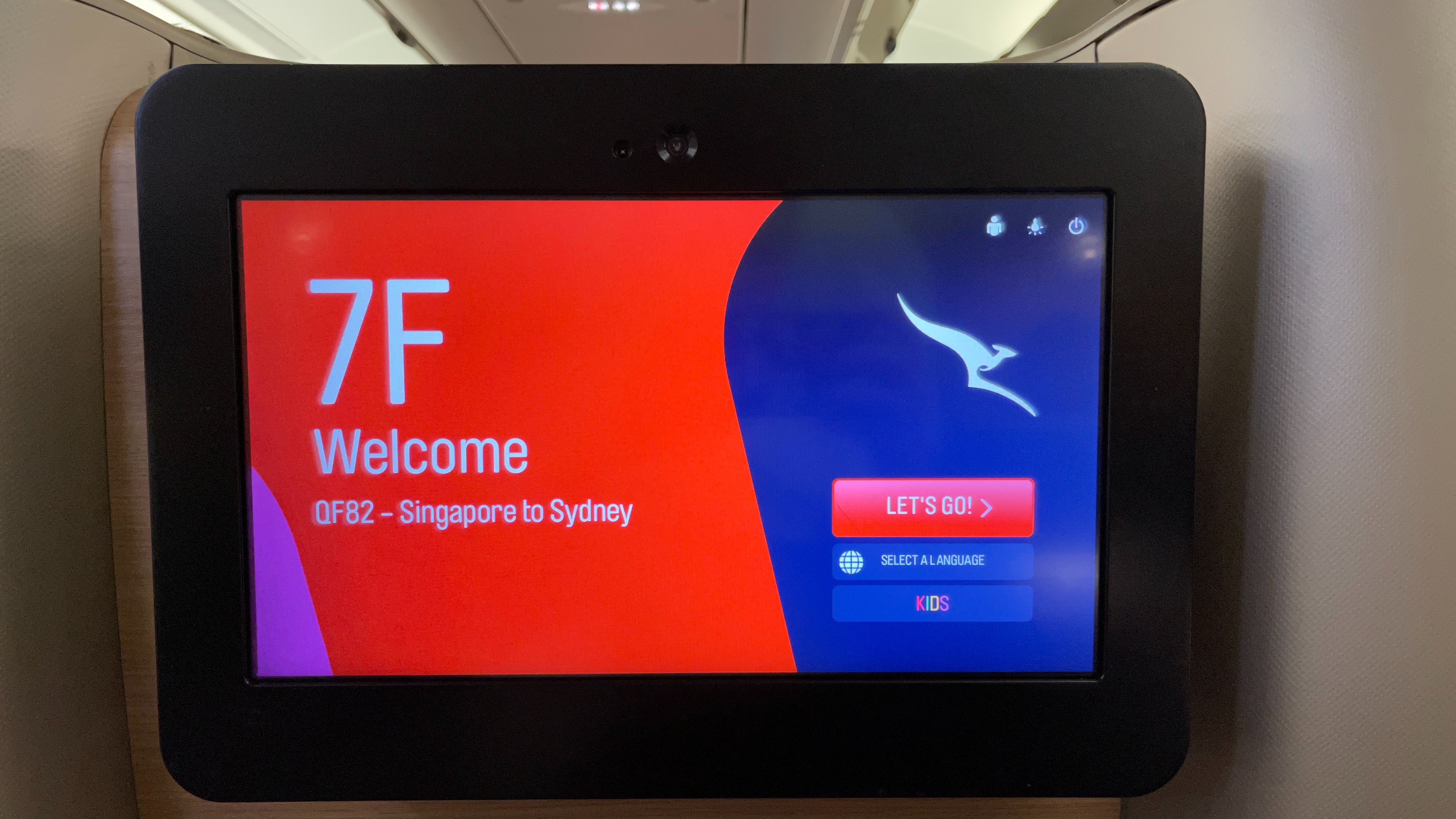
    Qantas QF82
    Singapore (SIN)
    – Sydney (SYD)
    16 February 2022
    Depart: 9:00PM
    Arrive: 7:20PM (+1 day)
    Duration: 7 hr 20 min
    Aircraft: Airbus A330-300
    Seat: 7F (Business Class)

    Pre-trip planning

    Visa

    Most visitors to Australia will require an Electronic Travel Authority (ETA) or a visa to enter, including Singapore citizens.

    Citizens of over 33 countries, including Singapore, Malaysia, Brunei, Hong Kong and Japan can apply for the ETA through the Australia ETA app. Each ETA is valid for 12 months and costs A$20.

    This is incredibly important and I cannot emphasise how many Singaporeans have always forgotten to apply for an ETA until they get to the airport. In the past, airlines were able to do this ETA for you at the airport for a hefty fee, but this is no longer the case as Australia Departure of Home Affairs has now restricted applications to be done solely through the app.

    If you have an APEC Business Travel Card, that also forms a valid visa and you will not have to apply for an ETA for your visit, even if it’s for leisure.

    Covid tests

    At the point of time when I travelled, Australia required a pre-departure test using either a PCR at most 3 days before the flight, or an ART 24 hours before the departure time.

    Australia will drop all pre-departure testing requirements from 18 Apr 2022, so you are only subject to an on-arrival test which in most cases are a self-administered ART within 24 hours of arrival.

    Checking in

    Qantas operates out of Changi Airport Terminal 1, and currently operates out of row 8, sharing the row with its low cost subsidiary Jetstar.

    Check in Row 8

    The configuration has now changed a little since the pandemic. There is an agent stationed at the front of the kiosks and counters to check that you have all the necessary documents, before leading you to a self check-in kiosk.

    After you retrieved your boarding pass and bag tags, you can then proceed to the baggage counters to drop off your bags. Note that your boarding passes printed from the kiosks should be seen and stamped by an agent. Mine wasn’t stamped, and I was turned back at the pre-immigration point to get my boarding pass stamped.

    The seat

    Qantas uses the Thompson Aerospace seat product across its entire wide-body fleet. The product is now almost 10 years old, and fans of Qantas would be familiar with the hard product. 

    Qantas A330-300 business class seat

    With the phase-out of the older business class products that used to be on the A330-200s, Qantas now only has a single seat product on all its long-haul widebody aircraft, making it easier for travellers, so you don’t have to figure out what seat you are travelling in.

    Given that I have reviewed this product before, you can read more about the seat here.

    The service

    QF82 is a red-eye flight to Sydney, with a total flight time of 7 hours and 20 minutes.

    Boarding commenced 45 minutes before the scheduled take off time. I went to the boarding gate at about 30 minutes before, only to find an incredibly long queue for the security screening. Lucky for me there’s a separate queue for business class passengers, which was considerably shorter than the economy one.

    Gatehold room

    Within 10 minutes I was done with security and was on my way straight to the aircraft. The business cabin was surprisingly full today, with all but two seats occupied in the 28-seat section.

    Promptly I took my seat at 7F. The mattress topper, along with the comforter, was wrapped in plastic and placed on the seat along with an unwrapped pillow.

    On the side console was a pair of menus, one for the supper service, and a separate breakfast card for me to check off the items I wanted before landing. This card was collected even before the aircraft took off, so that’s some mighty efficiency there.

    Menu cards

    A cabin crew came around to offer a pre-departure drink of either water, juice or champagne, along with a set of the famed Qantas pyjamas. It was pretty refreshing to be offered a drink while the plane was still on the ground, given that some other airlines took the chance to do away with it.

    Soon we were on the way, with the push back of the aircraft happening about 15 minutes after the scheduled departure time of 8.30pm.

    Food & drinks

    Right after take-off, dinner service commenced at about 9.45pm. The crew pushed a trolley through the cabin, setting up the table setting along with a first choice of drink. Instead of a table cloth, the setting was all done on a pre-set tray: a side salad, a bread plate and the glassware. I took one slice of bread, and went with a glass of red wine.

    Dinner setup

    The supper menu was rather simple: a choice of main course, followed by dessert. There were four main courses to choose from, and a good selection of post-meal sweets or cheeses.

    Business class dinner menu

    For my main course tonight, I chose the prawn wanton dumplings (a misnomer, given that wantons are dumplings). Unfortunately, the main course took another 20 minutes before it got to me.

    Prawn wanton dumpling soup

    The wantons were served with a serving of springy egg noodles, as well as a side of Asian greens, spring onions and green vinegared chillis. Overall it was a pretty hearty supper, and I liked that it was served not too hot. The greens looked like they are out for too long, but otherwise everything else was excellent.

    The only other problem is that this dish didn’t exactly go with a slice of bread and a side salad, but I’ll let that pass.

    After I was done with dinner, the tray was promptly cleared. The dessert came around in a form of a trolley, which I chose an ice cream from (10.30pm). Out of Singapore, Qantas carries a selection of Haagen Daz ice cream, and the flavour of the day was strawberry.

    Dessert and wine

    Soon after, I set out my own mattress topper on the seat, reclined the bed into bed mode and fell into snooze land.

    Given that breakfast was ordered at the beginning of the flight, this means that the crew didn’t have to wake passengers up too early for breakfast. The breakfast card offered three options: a full breakfast served 90 minutes before landing, an ‘express breakfast’ served 60 minutes before landing, or no breakfast at all.

    Breakfast card

    A full breakfast meant any number of items on the menu, while an express breakfast was a choice of one food item and one drink. I picked two drinks – a juice and a coffee – and a savoury item for breakfast, and I was woken up only about 40 minutes before landing, so I guess you could get away with two drinks for an express breakfast.

    Express business class breakfast – Brioche roll with bacon and egg

    Breakfast was a brioche roll with bacon and egg, which was delicious. The bacon was over cooked and incredibly salty even at 35,000 feet, so I took out most of it. I also chose a cold pressed juice and a white coffee. The crew was too busy to offer a second round of coffee, so when I finally managed to get the attention of a crew for a review, the captain asked to prepare the cabin for landing. This meant that my review had to come in a paper cup, given that all crockery would have to be stowed for landing by that time.

    Qantas amenity kit

    You might be wondering about the amenity kit. Qantas usually offers an amenity kit on the flight, but as there were not enough on this flight, the kits were only available on demand. I learnt about this only when I requested for an eye shade, and the crew discreetly explained why they didn’t hand them out to all the passengers.

    The amenity kit this season was designed in commemoration of Qantas’ centenary in 2020, with a range of designs in a nod to its colourful history. The kit itself was a throwback to the 1960s era, decked in pastel blue.

    Qantas amenity kit (credit: Qantas)

    Within the kit was an eye shade in the same design as the kit, a dental kit, ear plugs and also a mini-kit of amenities from Australian wellness brand Li-Tya, comprising lip balm, face cream and hand cream. Qantas has also chose the eco-friendly route of packing these items in paper (rather than plastic), in a nod to their sustainability efforts.

    Qantas amenity kit

    Qantas also offers pyjamas in its business cabin for overnight flights. On this flight, the PJs were handed out on the ground, right after the pre-departure drinks were served. Note that if you are taking a day flight out of Australia to Asia, PJs will not be offered; if you ask, sometimes they do have a set or two lying around that they can offer you with.

    Qantas business class pyjamas

    One thing to note: Qantas business class cabins have a dearth of lavatories, so there is almost always a line of people waiting to wash up and change out. To avoid that and to maximise sleep, I usually wear my own sweatpants and change into the pyjamas top only, and change out only after I arrive and get out of the airplane.

    Final thoughts

    It was an incredibly enjoyable flight, partly accentuated by the fact that I was visiting Australia for the first time after a three-year gap. It was encouraging to see that the flight was relatively packed in both cabins, and that will only continue to grow as international travel relaxes further with time.

    The cabin service also remained fairly consistent from before. While all airlines have been reeling from a drastic drop in revenue over the last two years, I’m also glad that Qantas has stuck out and not further reduced cabin service. In contrast, Singapore Airlines have now reduced meal service on Australian flights to just a single meal service, which in my opinion is way too little.

    Overall I’m relieved and happy that the Qantas experienced remained more or less similar to its pre-Covid days. While the schedule is not as favourable given it only operates only a single overnight flight out of Singapore, it is still nonetheless a very comfortable flight to be on.

  • Review: Courtyard by Marriott Cologne, Twin Guest Room

    Review: Courtyard by Marriott Cologne, Twin Guest Room

    Courtyard by Marriott is no Ritz Carlton, but it’s functional and usually well located. So here’s a functional review.

    We don’t always need a fancy hotel when we travel. Comfort, yes, but the bells and whistles, sometimes. There is good value in having a top-grade hotel sometimes, but in some cities, a reliable, trusted property is all you need.

    On this trip, Cologne is one such city, and Courtyard by Marriott served that purpose: no-frills, comfortable, fairly decent location and great value for money.

    For those who are not familiar with the Courtyard brand, they are typically mid-tier properties offering a less frills experience as compared to the mother brand. These properties still have the necessary amenities as a full service hotel, but without the premium frills such as a spa or a pool. Think of it as like a full service economy class air ticket (probably a 3 or 4 star airline), rather than a low cost carrier.

    The brand is predominantly found in US, with a small splattering of presence in other continents. In Europe, it has 77 properties across 20 countries, with the largest network here in Germany with 16 Courtyard properties.

    Asia has 97 Courtyard properties, where China account for about half of them and India for another quarter.

    In this post:
    • Location
    • About the hotel
    • Checking in
    • The room
    • Restaurant – The Bistro
    • Facilities & amenities
    • Final thoughts

    Location

    A little orientation of Köln or Cologne: The heart of the city is split by the Rhine river into east and west. Most of the tourist attractions and where visitors will want to be is on the west side.

    Cologne map

    Cologne has two key train stations: the first being Köln Hauftpbanhof, or the Cologne Central Station, and another one further out called Messe/Deutz Banhof, which is located on the east bank of the Rhine.

    Courtyard by Marriott Cologne is located in the city centre amid the famous Eigelstein neighborhood, within a reasonable walking distance to several key landmarks, including the famous Cologne Cathedral (Kölner Dom), as well as a plethora of restaurants and shopping.

    The hotel is about 1km away from Cologne Central Station. If you are arriving by train from another city, you are likely to be arriving at Messe/Deutz, which will require a change of trains to reach Central Station. Alternatively you can take the S-Bahn to Hansaring, and then weave through the smaller streets to reach the hotel, although I would strongly discourage you from doing so if you are carrying heavy bags.

    The hotel

    At this property in Cologne, the hotel has 236 rooms housed within its six-storey building. Rooms are laid across floors 1-5.

    Courtyard by Marriott Cologne

    The hotel only has 4 room types:

    • King Guest Room
    • Twin Guest Room
    • Larger King Guest Room
    • Corner King Guest Room

    Courtyard by Marriott properties typically have a fairly standardised set of room types, as they are designed for business travellers who simply need a no-frills, full service hotels. The standardised rooms allow for the hotel to focus on a consistent set of experience without the need to go over the top in both service and product for top-end rooms and suites.

    This works out well for leisure travellers as well who value price and location over the bells and whistles that the hotel may offer, as there’s also a sizeable group of travellers who minimise their time spent in the room.

    Checking in

    The lobby is modest, which works well for properties like these. With only three check-in counters, There were hardly anyone else when we arrived just after mid day, around the usual check in hours, so we were attended to almost immediately.

    Hotel lobby

    The receptionist checked our documents and more importantly, our vaccination records, before speedily processing the rest of our check in. In less than 5 minutes, we were on our way to our rooms, located on the second floor.

    The room

    For this stay we booked a Twin room. The room measures 22 square metres in size, which is fairly spacious by European standards. The corner rooms are slightly bigger at 29 square metres, but similar to the regular rooms in both form and function.

    Twin Guest Room

    In the twin configured room, both twin beds are standard singles, and each comes with its own bedside table, reading light and set of power sockets.

    Work desk

    On the far side of the room, there is also a glass work desk with an office chair, which is suitable for working in room although i wouldn’t recommend sitting in that chair for too long. There’s also a table lamp that is oddly positioned, with its stem awkwardly sticking out of the bedside table. I get that lamps need an electrical source but this arrangement is simply aesthetically off.

    Across from the bed is a wall mounted flat screen television, above a simple console tabletop where the complimentary coffee and tea are placed.

    Wall mounted TV, console

    The room comes with a simple wardrobe near the windows, in which you will find the in-room safe, ironing board and iron as well as the hairdryer.

    Wardrobe

    During the time of Covid, housekeeping is only offered every third night, but you can always call up the front desk to request for daily clean up if you need it.

    In another aspect of its functionality, Courtyard by Marriott Cologne offers a simple bathroom, with a walk-in shower, single vanity and sink and a toilet.

    Bathroom

    The hotel provides bath amenities which are branded Nirvae, which is found exclusively in the hotel industry. The amenities itself is nothing too exciting, but good enough for you to use without much concerns.

    Note that the toilet does not come with a bidet or washing hose, so if that’s a concern, you may have to look elsewhere.

    Restaurant – Bistro

    In another aspect that reinforces its chain operations, the hotel’s restaurant name is also standardised across the brand: the Bistro. Opened for breakfast daily and dinner Mondays to Saturdays, the Bistro offers a good range of meals and drinks for guests.

    Bistro
    Day of weekOperating hours
    Mondays to Fridays6.30am to 10.30am
    3pm to 11pm
    Saturdays7am to 12pm
    3pm to 11pm
    Sundays & Public Holidays7am to 12pm
    Bistro operating hours

    Breakfast is charged at €18 per person and is served between 6.30am and 10.30am on weekdays, and 7am to 12pm on weekends. Marriott Bonvoy Platinum elite members and above enjoy complimentary breakfast, regardless whether their room rates include them.

    While I didn’t have breakfast at the hotel, the restaurant staff kindly offered complimentary coffee in the morning when I had to get some work done. A quick glance at the breakfast spread saw a mostly continental spread, with some hot items including bacon and eggs. At EUR18, you will be better off walking out to grab breakfast, such as from this lovely little Italian place near the hotel.

    Bistro breakfast

    The lunch and dinner menus looked a little more promising, although not a large menu. Most food items are reasonably priced: for instance, expect to pay €5- €11 for snacks and starters, €10,5-€13,5 for sandwiches, and up to €21 for main dishes.

    Drinks wise, beer is your go-to option, with Happy Hour happening every Friday and Saturday, 5 to 7pm where you can get a glass of Kölsch for €2,50, with a free bite to go along. For the uninitiated, Cologne is home to the Kölsch, the local’s favourite brew and default choice for a beer.

    Cocktails and wines are generally more expensive in Germany, but the Bistro prices them similar to many other restaurants. Expect to pay about €12,50 for a mixed drink, while a glass of wine goes upwards of €7,50.

    Facilities & Amenities

    FacilityOperating HoursLocation
    Fitness Centre 24 hoursLevel 5
    Business Centre 24 hoursGround floor
    Convenience Store 24 hoursGround floor

    Fitness and recreation

    Courtyard by Marriott Cologne only has a fitness centre located on the top floor. Accessible 24/7, the gym has an array of equipment, including cardio machines such as treadmills and ellipticals, as well as a rack of dumbbells and two benches.

    Fitness Centre

    Unfortunately, the hotel does not have a swimming pool, nor does it offer access to any swimming pools nearby.

    Business Centre

    The hotel does not have a business centre, but on the ground floor you can find a little business corner further in from the front desks, equipped with two Macs.

    Business Centre

    In the same corner you will also find an ATM (comes with a fee, on top of what your bank may charge you), as well as a cigarette vending machine.

    The business centre comes with a printer, so it will be handy for printing the extra documents you may need.

    Business Centre

    Convenience Store

    The Market

    Another distinct feature of Courtyard properties are the in-house convenience store, which they named the Market. I have seen this before in the US properties as well, which usually carry a variety of items from food, drinks, alcohol to other consumables such as laundry power, soap, dental care items and more.

    The full price list is as follow:

    The Market – Price List

    Final thoughts

    Like I mentioned at the beginning of the review, travelling doesn’t always have to include a fancy hotel. There are several fundamental criteria such as comfort, safety, and location, all of which Courtyard by Marriott Cologne has met during my stay and I’m pleased with it.

    If there’s only one thing to pick: the hotel doesn’t have a lively bar, and perhaps that’s the point. There are some nights where you just want a quiet glass of wine after a long day out, instead of a boisterous beerhaus, so the hotel fits the bill just for that.

  • REVIEW: Gekko House – A Tribute Portfolio Collection, Superior Room

    REVIEW: Gekko House – A Tribute Portfolio Collection, Superior Room

    The final stop of my German run, this hotel is the first Tribute Portfolio hotel I’ve ever stayed in. While it didn’t take my breath away, the property ranks pretty high on design, and is good value for money especially for solo travellers.

    In this post:
    • What are Tribute Portfolio Hotels?
    • About the hotel
    • Location
    • Checking in
    • The room – Superior Room
    • The facilities
    • Restaurant – Chicago Williams
    • Breakfast
    • Final thoughts

    What are Tribute Portfolio Hotels?

    A network of about 50 individual boutique hotels, this soft brand (as the industry calls it) is a collection of independent boutique hotels that each has its own unique styles and operating models. The Tribute Portfolio brand embraces quirky and personable properties for guests seeking unique and diverse experiences, which can be a breather for some who wish to experience smaller, quirkier hotels when they want something different that the larger chains offer.

    Tribute Portfolio was first introduced by Starwood Hotels and Resorts back in 2015, and it’s kind of an answer to Marriott’s very own Autograph Collection, also another mid-tier collection of boutique hotels.

    Naturally, when Marriott acquired Starwood, the mammoth group took over these properties as well in the following years. Some observers may have gambled on that Tribute Portfolio will be folded into Autograph Collection, but even up to today Marriott held true to its promise that it will keep the two separate.

    Marriott has a distinct brand positioning for both soft brands: Autograph Collection Hotels are selected for their rich design and immersive stories; while Tribute Portfolio brings together characterful hotels with vibrant social scenes that create a sense of belonging for guests and locals.

    Today, the portfolio remained fairly small with only about 50 boutique hotels globally, with most of them found mainly in Europe where it first began.

    About the hotel

    The Gekko House opened only in January 2020 – right before Covid-19 ravished the world – as part of Germany’s Gekko Group, a hospitality outfit (not to be confused with Accor’s french subsidiary Gekko Group).

    Gekko House

    Gekko House is the group’s first house branded hotel. Gekko Group’s founders, Micky Rosen and Alex Urseanu, are veterans to design-led hotels, with a portfolio that includes celebrated properties like Roomers, The Pure and Gerbermühle, with a total of eight properties across Germany. The Roomers hotels in Berlin, Munich and Baden-Baden, are also Design Hotels (also a Marriott brand).

    The hotel stands at 8 storeys high and comprises 128 rooms, which is fairly sizeable given the small plot of land it occupies.

    The ground floor is taken up mainly by the restaurant (more on that later), while rooms decked out floors 1 through 7. The rooftop is on the eighth floor, and serves as a rooftop bar only during summer months, although you can still access it year-round.

    The hotel offers seven room types:

    • Superior
    • Superior Comfort
    • Premium
    • Premium Comfort
    • Premium Comfort Twin
    • Select King
    • Junior Suite

    The key difference between Superior and Premium rooms are the size of the beds: Superior rooms offer a 160cm wide Queen bed, while Premium rooms come with a 180cm wide King sized bed.

    If you want twin beds, your only option is the Premium Comfort Twin, which cost about €30 more expensive than the base rooms.

    If you need some fresh air in your room, the Select rooms are the only ones in the house with a balcony.

    At the top end of the range is the Junior Suite, which is the only room type in the hotel that offers a bathtub. However, the industrial-looking tub is in the room itself right under the TV, so depending on your personal preference, you might want to choose another hotel if the tub matters a lot.

    Junior Suite (photo: Marriott)

    Location

    The hotel is located in the Gallus district in Frankfurt Am Main. While somewhat near to Frankfurt Hauptbanhof, but it’s not exactly that near: two trams stops or 800m away to be exact.

    Gekko House is located some 800m away from the Hauptbahnhof

    Don’t let the map fool you – while it seems like it’s somewhat near the tracks and main station, the walking distance from the entrance of the station is a good 15 minutes to the hotel, or longer depending on the amount of bags you have.

    Take trams 11, 14 and 21 from stops right outside the main station for two stops, and you will only be a short walk away from the hotel. Even with a single trip ticket, you are allowed a free transfer from the trains to the trams.

    Checking in

    Once you walk into the hotel, you will be greeted by the restaurant. The cash desk at the restaurant currently doubles up as the lobby, where all check in formalities are currently being done.

    Gekko House restaurant Chicago Williams & check-in desk (photo: Marriott)

    With the current Covid-19 restrictions in place, Germany imposes a 2G+ requirement for hotels. Guests who are staying for leisure are required to show proof of vaccination, plus either a booster or a valid ART test taken within the last 24 hours.

    Previously, check in was supposed to be done at a separate lobby which is pocket-sized, decked out with cherry wood panelling and tapestries astride deep olive walls.

    Check-in desk; now some service counters of sorts

    The room

    For this stay I have opted for the entry-level room – the Superior room with a queen-sized bed. Once you enter the 17 square metres room, while compact, you won’t feel claustrophobic at all; the room is rather minimalist but yet sufficient for a single person.

    Superior Room

    The room controls are activated by a master key near the door, you will need to insert your keycard into the holder before any of the electricals can work.

    Key holder

    Unfortunately the reverse is also true: the moment you take out your keycard, everything in the room goes dark. I would prefer if they had some kind of a lag of a couple of seconds before that happens.

    The rooms at Gekko House are designed in a grunge industrial fashion with exposed concrete walls and ceilings, in a nod to the area’s industrial character. There are whimsical touches to the room, such as the large hand-blown glass bulb lamp, representing the area’s burgeoning creative vibes.

    Superior Room

    The queen bed is backed on a velvet bedframe, a porcelain stool on one side and a wooden stool on the other side, both doubling up as beside tables. There are also wall sockets on both sides of the bed, providing that touch of convenience that is not lost despite it being a minimalist design.

    There is also a small cupboard by the side, which houses a small safe within, as well as a nespresso coffee machine atop along with several glassware.

    Amenity table with drinkware, coffee machine
    Safe and laundry bag

    Facing the bed was a wall-mounted television, with a wall-mounted television console as well as a Marshall speaker, which I appreciate for a tinkle of late night music when I wind down.

    TV and speaker

    The bathroom is pretty simple in its design and function as well. Standard sized standing shower, single vanity and a toilet bowl take up most of the room in the bathroom. The sink has an extended area for your own stuff, and if you need more, feel free to place them on the ledge on top.

    Superior Room bathroom

    Gekko House uses Grown Alchemist amenities – surprise, surprise: from Australia! – in the bathrooms. Founded by Australian brothers Keston and Jeremy Muijs in 2008, the Melbourne-based beauty brand is a skincare line that focuses on sustainable and organic ingredients.

    Grown Alchemist bath amenities

    The hotel uses handpump bottles fixed to the wall, so as to reduce single-use amenities that tend to get thrown away each time the room is refreshed.

    Note that the hotel does not provide any other bath amenities, including dental kits or shaving kits. If you need any of those, you will have to purchase them from the Spati on the ground floor (more on this later).

    You might notice that there isn’t a mini-bar in the room, nor are there additional amenities such as toothbrush or combs in the room. Fortunately or unfortunately, this is the hotel’s ethos: by reducing these items in the room, they can keep rates low as well, and anything you need can be bought from vending machines which they lovingly call “Spati” at the lobby.

    Spati

    Prices at the Spati is by no means cheap. Forgot your dental kit? That’s €3. If you like the Grown Alchemist amenities and want to bring home a pump bottle, that’s €25 each.

    Need some bottled water in the room? That’s €3,50 each. Beers at €4, and if you are in a mood for some bubblies, a 20cl bottle of Moet & Chandon Brut Imperial goes for a cool €22.

    At these prices, you are better off picking up some of these items at the local supermarket.

    There’s a small tablet that is tucked away on the lower shelf of the TV console, which serves as your handy guide to the hotel. You will find information about the hotel, including a list of the items and prices at the Spati.

    In-room tablet with all you need to know

    The facilities

    Gekko House is kind of a bare bones hotel, with no facilities on site.

    Apart from the Spati that serves as a self-service convenience corner at the hotel, there are only a small handful of common areas within the hotel for use.

    The first is this small little corner near the front of the hotel, which can also be a waiting area if there’s a line for check in.

    Lobby waiting area

    There is also a rooftop accessible via the lifts. On the warmer months this serve as a rooftop bar, but since I visited in winter, there was nothing going on at the moment.

    Rooftop
    Rooftop bar area

    Restaurant – Chicago Williams

    The signature bar and restaurant, Chicago Williams, is located at the first floor of the hotel, and is also the centrepiece of the property.

    Chicago Williams restaurant

    Specialising in American barbecue, Chicago Williams offers a rather simple menu where you can order grilled meats mostly by weight, except chicken where it comes either in half or full bird.

    The full menu is below:

    Food menu

    Drinks wise, the restaurant specialises in highballs, with a selection of either standard or premium highballs to choose from. My observation is that mixed drinks in Germany tend to be relatively more expensive than beer (of course) and wine.

    Drinks menu

    The experience starts when you first step into the restaurant. Right at the front of house is a huge pot of corn chowder, and the staff will scoop out a complimentary bowl serve it to you as they bring you to your table.

    Corn chowder

    I ordered a half chicken and cauliflower, as well as mac and cheese on the side. I got a glass of rose along with the meal, which turned out to be a pretty good choice.

    Half chicken
    Mac n cheese
    Grilled cauliflower

    The cauliflower blew my mind a little, as I wasn’t expecting to be so flavourful. The cauliflower is both smoked and sauteed, dressed with parsley pesto and walnut oil before being topped with some spring onions.

    Breakfast

    As I wasn’t a Marriott Bonvoy Platinum Elite member, my room didn’t come with a complimentary breakfast. Breakfast can be added for €19 per person per day, so I didn’t book breakfast.

    Breakfast Hours –
    Mondays to Fridays: 6.30am to 10.30am
    Saturdays & Sundays: 6.30am to 12pm

    However, the hotel is happy to provide complimentary coffee if you head down to ask. Coffee is dispensed from a one-touch machine.

    When I was collecting coffee one morning, I managed to snap a few photos of the breakfast offering. It seemed to be a continental offering, with no hot food in sight.

    Breakfast – Cereal, bread and jams
    Breakfast – pastries
    Breakfast – cold cuts, salad bar
    Breakfast – Fruit, juice and water

    Final thoughts

    Gekko House may be styled as a Tribute Portfolio independently-managed hotel with some character, but in reality it probably felt more like an upscale ‘hostel’ with individual rooms. The lack of amenities can be bothersome, but if you are on a leisure stay you really shouldn’t be staying in the hotel all that much.

    While the lack of in-room amenities may bother some people, I’m pretty cool with it: I’m all for providing less in the room, and for guests to either bring their own or request (or even buy) one only if it’s necessary.

    I initially thought I wouldn’t enjoy the hotel, but I soon realised it was sufficient for a solo traveller, with a good price point at well under €100 per night. The restaurant serves a great American barbecue dinner, but I’d advise against buying breakfast there, as you can get way better value for €19.