On-arrival tests changed from PCR to ART; travel history requirements shortened to 7 days
Singapore earlier this week announced a slew of changes to the way it manages its Covid-19 restrictions in Singapore, and along with it made some key changes to travel requirements as well.
These changes are largely in a positive direction, including using cheaper testing requirements, and simplification of how it categorises source countries.
Cheaper ART test for VTL on-arrivaltesting
From 22 Feb 2022, VTL and Category I travellers will no longer need to perform an on-arrival PCR test. Instead, they will have up to 24 hours from their entry into Singapore to take a supervised self-swab ART at one of the testing centres (Combined Test Centres (CTCs) or Quick Test Centres (QTCs)) located across Singapore.
Supervised testing centre
In addition, the current enhanced testing regime requiring VTL travellers to take self-administered Antigen Rapid Test (ART) from Day 2 to Day 7 will also cease.
This change will see travellers save at least S$110 on testing, further lowering the costs of travelling into Singapore.
For those who were originally arriving on or after 22 Feb 2022 and booked a PCR test at Changi Airport through Changi Airport Safe Travel Concierge, you will be given a refund in the coming days, less a S$3 processing fee.
Note that you will be required to self-isolate until you get a negative result on the ART test at the test centre, so it’s best to book early.
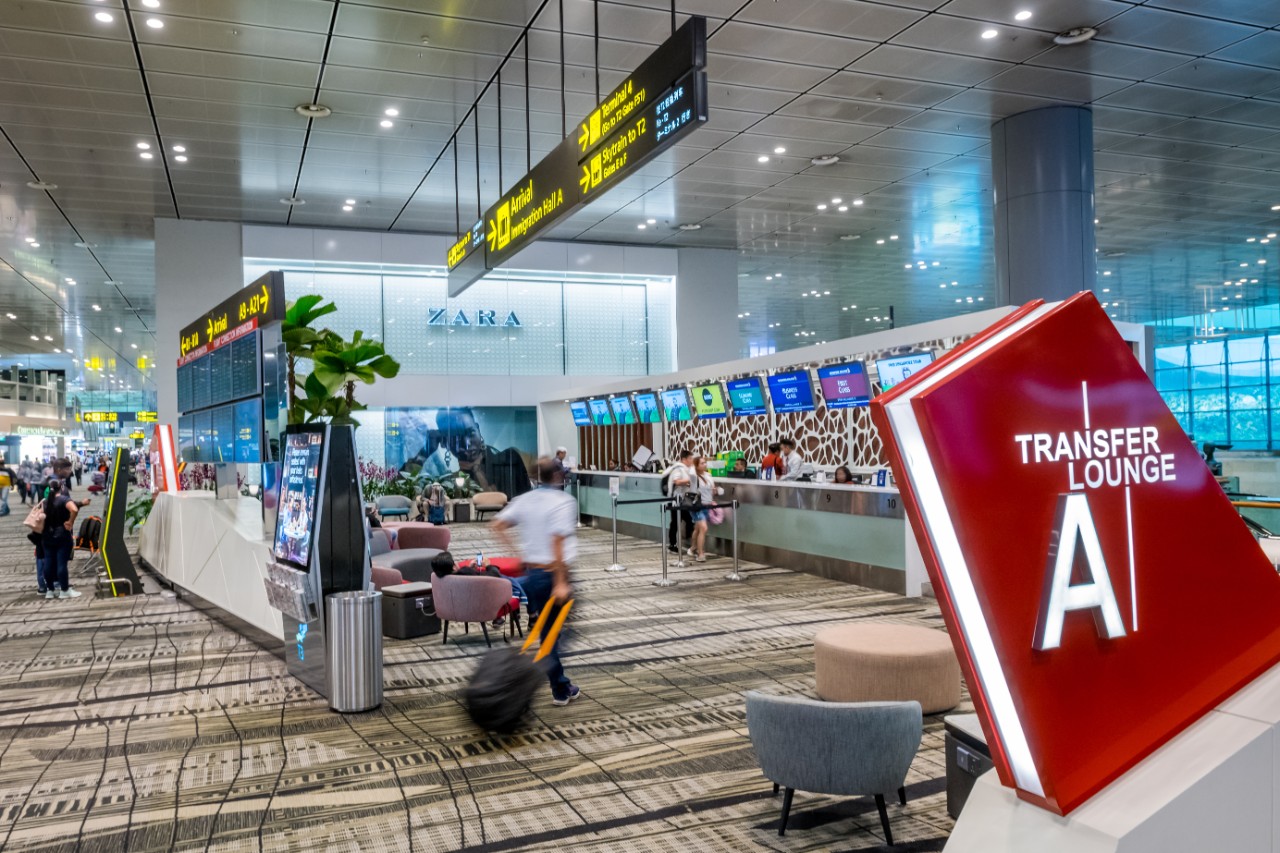
No more testing requirements for transit passengers
In another critical development, transit passengers are also no longer required to take any form of pre-departure tests from 22 Feb 2022 if they are transiting in Singapore.
In tandem with the other adjustments to travel measures, CAAS will also be removing the pre-departure test requirements for all passengers transferring or transiting through Singapore. This will help reduce cost, improve convenience and enhance Singapore’s attractiveness as a transfer/transit hub.
The changes will apply to all flights arriving in Singapore from 21 February 2022, 2359 hours (Singapore Time), regardless whether the flight is a designated VTL flight.
CAAS
Note that this waiver only applies for passengers who are booked on a single ticket through Changi Airport. If passengers self-connect (i.e. booked two separate tickets) and have to pass through immigration, the prevailing rules (whether VTL or non-VTL) will apply, including test and quarantine requirements.
Previously, transit passengers are also required to produce a negative PCR or ART (only for Category I, II and III countries) test taken within two days before their flight. This has posed some challenges for some travellers, given the increasing number of countries – in particular European countries – that have completely done away with pre-departure tests.
With the scrapping of the transit testing requirement from 22 Feb 2022, passengers flying through Changi Airport will no longer need to carry a test result, unless of course their final destination requires it.
Simplification of travel categories
In addition to the changes in testing requirements when travelling to Singapore, the authorities have also simplified how it categorises countries when travelling to Singapore.
The least restrictive Category I will remain as it is, and continue to enjoy quarantine-free entry into Singapore. Category I countries include China, Chinese territory of Macau, and Taiwan. Hong Kong has unfortunately been ‘demoted’ to Category II.
Similar to VTL travellers, travellers from Category I countries will also no longer be required to take a PCR test on arrival, instead they will also be required to take a supervised ART at an approved test centre within 24 hours of arrival.
Categories II, III, and IV will be combined into a single General Travel category. To this end, the SHN period for non-VTL travel from these countries will be standardised to 7 days, and can be taken at either a hotel of choice or a private residence.
A new category, Restricted countries/regions, will be introduced to allow for imposition of stricter measures where necessary.
Final thoughts
These changes are definitely good developments, with travel to become less restrictive and cost prohibitive.
The switch to post-arrival ART test from the current PCR testing regime is probably the most celebrated change; this alone will result in a S$110 savings, significant when travelling from a nearby country.
However, one key hassle in this new arrangement is the requirement to visit a test centre after arrival, as well as the need to isolate until you have received your negative result.
The simplification of the country categorisation, along with the shortening of travel history consideration (from 14 to 7 days) and the standardisation of SHN period is also another positive move. Travel today has been made complex, so any consolidation is always good news and easier to navigate.
Regardless, these moves are another step to the reopening of Singapore as a travel hub, and opened up even more travel opportunities and options for Singapore residents, even as we continue to inch towards a semblance of normalcy for international travel once more.
Germany was never a top-of-mind destination personally. Despite having a good time in Berlin some years back, spending an extended period of time in the land of good beers and Christmas markets in the heart of winter wasn’t exactly my idea of fun.
So how did I ended up spending close to three weeks in Germany? This trip was fraught with many twists and turns. Originally meant to be a part-Italy and part-Germany trip, the entire plan was thrown out of the window when Italy closed its doors to travellers planning to land directly from Singapore.
Cologne
There were some workaround ways possible, such as landing in a third country in EU and then travelling into Italy, but that proved too risky, so we decided to stay put in Germany fully.
Even a full two weeks in Germany was not as easy as it seemed. Germany, like many other countries, have both federal and state governments, both of them responsible for different set of Covid-19 rules. One of the cities we were intending to visit, Dresden, was in the state of Saxony, which banned any form of tourism in late 2021. We only found out about this when the hotel wrote to us a week before the trip, asking that we cancel the reservation if we were planning to visit for holidays.
Ich verstehe nur Bahnhof. At this stage, it was clear to me that I was faitgued with trip planning, and all I’m reading was yet another set of (complicated) regulations.
Needless to say, Saxony was off the books, and once again, we are back to the drawing board.
Eventually, we landed on a (almost) round Germany trip, kicking off with Cologne, before spending the second week in Bavaria down south, with the last couple of days back in Frankfurt.
Flight planning
Right from the onset, the intent was to burn the long-accumulated miles on flights. After all, availability was aplenty, wasn’t it?
Alas, the availability wasn’t as plenty as one would thought. Getting out of Singapore was easy; coming back on a VTL flight was like searching for a needle in a haystack. With the last-minute change in plans, the search became frantic: I ended up looking in another direction, and landed myself a seat on Finnair, via Helsinki.
Not a bad thing, I thought, given that I have not tried the Finnair product before.
Flight Reviews
Singapore Airlines B777-300ER, Business Class, Singapore – Frankfurt
Finnair A320, Business Class, Frankfurt – Helsinki
What happened to my return leg on Singapore Airlines then? This was one helluva excursion to Singapore Airlines “world-class” service centre at Ion Orchard. Because of the change in plans, I personally spent about three mornings at Singapore Airlines’ service centre to get my tickets amended.
While Singapore Airlines offers unlimited free change for tickets to entice people to book with them, the change experience was far from ideal. Reports from the ground was a three-hour wait time for its customer service hotline, while the queue time at the Ion service centre was not any better: anything between 4-6 hours. What complicated matter was the suspension of VTL flight tickets announced on 22 Dec for a month, leading to a surge in last-minute bookings and change request.
Five star for branding, zero for customer service.
Hotels
A two-week journey means countless hotels. You will notice most of these hotels are Marriott properties, this is mostly planned to chalk up as many nights as possible in the new membership year in my pursuit for Platinum.
The hotels we chose for this trip will be a mix of budget-friendly and mid-tier hotels, with nothing too outrageous given the travel budget constraints of the group.
While it’s always fun to review awesome hotels, the intent is also to build and provide a little more insights to hotel options that are great value for money for those who may be starved of points and need to pay cash for accommodation.
Moxy Hotel is Marriott’s relatively new, budget-friendly hotel brand, with over 60 properties across North America, Europe and Asia. The hotel has come upfront to say that its rooms are tiny, but all properties also include social spaces, clearly targeting the younger travel crowd who may be budget conscious. Moxy has a cheeky vibe to it, so it will be interesting to see what the hotel can offer beyond a room.
Courtyard by Marriott, Cologne
Courtyard by Marriott, Cologne
To be completely honest, I wasn’t looking forward to this property at all. This is your typically business hotel, catered for your one-night business travellers, so that also means no-frills, no-personality. In short, Courtyard doesn’t scream anything at all, so spending four nights at this property wasn’t exactly going to appeal.
But what gives? Location and price. It was in the Old Town, minutes away from the epicentre of where the attractions are, and incredibly affordable. So four nights, here we go.
Sheraton Carlton Hotel Nuremberg
Nuremberg was meant to be a pit stop to fill up some time before we head to Garmisch-Partenkirchen, where we had a confirmed, unchangeable hotel reservation for three nights.
This also means the hotel here is purely perfunctory, which means location and price are both prized above everything else.
While the Sheraton brand is arguably strong in Asia with its luxe touches and premier hospitality, the same can’t be said of its counterparts in other parts of the world. How will this stay pan out? We shall see.
Aloft Munich
Aloft Munich
Aloft needs no introduction; with a tagline “A Vision of W”, you will know it’s kind of like a lesser cousin to that flashy boy who’s everyone’s favourite.
Aloft is a select-service brand, and the Munich branch is excellently located: right across from the Munich Hauptbahnhof station. This makes the property a hot favourite for those who values location over everything else; there’s a direct train line to the airport, Marienplatz is just two S-Bahn stops away and if you are looking to do day trips, they all depart from near here.
The best part? The hotel was offering a deal, so this only went at slightly under €100 per room, per night.
Hilton, Frankfurt Airport
Hilton Frankfurt Airport
Having stayed at Moxy the first time round, we decided that we should try a property that’s at least located within walking distance from the airport itself, and settled on the Hilton Frankfurt Airport.
The hotel is located atop the long distance train station, within The Squaire mall right across the skywalk (bridge) from Frankfurt Airport Terminal 1.
As a diamond member, there were also some perks that came pretty convenient even as I book entry level rooms, such as free breakfast even for the second room I booked.
The Gekko House, Frankfurt
Gekko House
This Tribute Portfolio property was the second Frankfurt hotel I chose to stay in, when I had a couple of last days alone in Frankfurt. Travelling alone at this stage also means twice the price for hotel stays, so I looked at value-for-money options without breaking the bank and Gekko House came up.
Looks fun, so here we go.
Bonus: Reindl Partenkirchen Hof
Reindl Partenkirchen
Reindl Partenkirchen Hof is a family-run inn in the ski resort town of Garmisch-Partenkirchen. The hotel is decked out in classic Bavarian traditional fittings, so it’s probably the closest you will get to a historic feel of what a Bavarian house feels like.
Let the humble look of the place fool you not, this place often books out way in advance and also requires a multiple-night stay during the peak ski season. We had a chance at a booking, so let’s see how this turns out.
Covid-19 test requirements
All travellers to Germany over the age of 6 must be fully vaccinated to qualify for quarantine-free travel. Germany also does not require any pre-departure tests nor on-arrival tests for fully vaccinated travellers.
However, rules within each German state may vary. All establishments within the country largely operate under one of these three rules:
3G: vaccinated (German: geimpft), recovered (genesen) or tested (getestet)
2G: vaccinated or recovered
2G+: 2G, plus either a booster or a valid current test
Depending on the state you are in, most establishments currently (February 2022) have a 2G+ requirement before you may enter, including restaurants, bars, and even leisure stays in hotels.
However, Germany is set to further relax restrictions in March, with restaurants and bars becoming 3G on 4 Mar, and subsequently dropping all restrictions from 20 Mar.
Regardless, as with all travel, research before you go.
Returning to Singapore, VTL travellers will now only require a pre-departure ART test taken within 2 days of departure day, as well as a supervised ART at an approved test location within 24 hours of arrival into Singapore.
Germany has many free rapid test centres around in the city, and the results will be sent to you via email within 30 minutes of your test. These tests are valid for travel to Singapore, as long as there’s a corresponding identifier such as your passport number or date of birth on the test results along with your name.
Free testing centre in Munich
Final thoughts
This trip is the first extended holiday I’ll be taking. While the itinerary as far as flights and hotels are concerned are not as fancy as I would want it to be, but this is probably a more realistic itinerary and choice for the average traveller, so it will provide a good perspective on mid-tier and budget-friendly options you might consider.
The actual reviews will come in a while, so this page will be updated as and when the reviews are completed.
Some good news for travellers: Singapore has relaxed some inbound travel requirements, including a relaxed post-arrival testing regime, as well as exemptions for recently recovered travellers.
Singapore health authorities have made two significant tweaks to its border health measures last week, which should make travelling slightly easier. This includes a relaxation of the post-arrival testing regime from today (24 January 2022) for travellers entering the country via the Vaccinated Travel Lane (VTL) programme, as well as some important exemptions for travellers who have recovered from Covid-19 within the last 90 days.
Relaxed self-testing regimefrom 24 January 2022
The daily testing regime, in place since Omicron first hit Singapore in November last year, will now be replaced by self-administered antigen rapid tests (ARTs) on days travellers need to leave their accommodation. This is a significant improvement from the previous rules, including a daily swab plus two supervised tests on Days 3 and 7.
No more supervised swabs at Quick Test Centres
Travellers arriving on VTL flights and entering Singapore will only be required to complete an on-arrival PCR test (S$125) at Changi Airport (no change), followed by ARTs on days 2 to 7. The actual policy communication is as follow:
“[VTL travellers] will only be required to do unsupervised self-administered ARTs from Day 2 to Day 7 of their arrivals if they need to leave their place of residence or accommodation.”
In addition, results from your self-administered ARTs will no longer need to be reported to MOH via the self-reporting system.
Note that the ART kits are not provided, travellers will need to purchase and use their own kits. If you are travelling or returning to Singapore, note that you are not supposed to go out to purchase them during your self-isolation period as you wait for your PCR test results. Otherwise, these ART kits are available at most pharmacies in Singapore, or available for purchase online from marketplaces such as Shopee or Lazada.
What if I test positive when I do my own ART?
If you test positive from a self-swab and have minimal or no symptoms, the good news is that you can self-isolate at home and no longer need to get a PCR confirmatory test.
Stop going to work and cancel your social activities to protect others from possibly being infected with Covid-19.
Self-isolate for 72 hours at home or in your accommodation. This will allow you to safely recover, monitor your health and avoid spreading the virus further.
At the end of 72 hours, you should perform a self-administered ART.
You can stop self-isolation and resume normal activities when you get a negative result.
If you continue to test positive, continue to self-isolate and self-test daily until you obtain a negative result, or until 12pm on Day 10 for vaccinated individuals, whichever comes earlier.
Test and quarantine exemptions for recently recovered travellers
One other key development are for travellers who have recently recovered from Covid-19.
Travellers who have recovered from the virus within 90 days of their last infection will be exempted from all testing and stay-home notice requirements. This includes any required Stay-Home Notices (SHN), pre-departure tests or on-arrival tests.
Travellers will need to furnish the following, which must be in English or accompanied with an English translation:
A positive Covid-19 PCR test or professionally-administered ART result 7-90 days (for fully vaccinated travellers) or 14-90 days (for partially or unvaccinated travellers) before the date of departure for Singapore.
A discharge memo that states the traveller’s name, and at least one other personal identifier such as the date of birth or passport number corresponding exactly with the information in the passport used for entry into Singapore. It should also state the date of infection or the discharge date, which must be within 7-90 days (for fully vaccinated travellers) or 14-90 days (for partially or unvaccinated travellers) before the date of departure for Singapore. The memo must also be issued by a relevant state authority or licensed medical professional.
This is great news because it will allow those who have recently recovered from Covid-19 to travel or return to Singapore after only 7 days, instead of the current 14 days.
Recently recovered travellers can also return earlier than 7 days
For people who have unfortunately contracted Covid-19 just before returning or travelling to Singapore, they may be permitted to depart for Singapore if they test negative for Covid-19 via a PCR test or professionally administered ART at least 72 hours after their initial positive diagnosis, even if it’s within the 7-day period for fully vaccinated travellers or 14-day period for partially or unvaccinated travellers.
However, the full testing and any quarantine requirements will still apply should this group of travellers decide to return earlier.
In any case, our recommendation is still to wait till the 7-day (or 14 days for partly or unvaccinated travellers) before travelling to Singapore.
Final thoughts
This turn of events is an affirmation as to how Singapore has understood Omicron and its management plans within the community.
Health Minister Ong Ye Kung has come out to say in no uncertain terms that he expect another big wave of Omicron cases to come in the weeks ahead. Despite that, the current travel posture and the most recent changes reflects Singapore’s commitment to keep its borders open as we try to achieve an endemic state.
The biggest news are for those who have recently recovered from Covid-19, with the waivers of all tests and quarantine requirements. This means that there is a lot more flexibility in planning for travel, as well as for those recently infected while overseas and wishing to come back to Singapore as soon as possible.
Comfy rooms, fantastic location, excellent service; this brand new Hilton in Melbourne may just change your mind about the brand.
Hilton properties are incredibly ubiquitous; you will find it in virtually every city in the world. However, the brand was conspicuously missing from Australia’s most fashionable city: Melbourne, or at least until earlier this year.
Hilton existed in Melbourne for more than four decades since the 1970s, until it decided to pull out of the city in 2014, leaving the city only with a DoubleTree property. That unfortunately has the effect of a mistaken identity, where DoubleTree Melbourne on Flinders St is being dubbed as the “Hilton”, leaving many locals confused when a new, bone fide Hilton popped up earlier this year in the heart of the city.
The 244-room property opened its doors in March 2021, after a bit of a delay no thanks to Covid-19.
Hilton Melbourne Little Queen Street
The hotel stands at the former Equity Trustees building (which, by the way, still exists today but in a different location). Designed by tenant architects Oakley and Parkes and built by 1931, Equity Chambers is a late addition to the exotic commercial styles prevalent in the late 1920’s and said at the time to be Romanesque but displaying Byzantine characterisation.
While the frontage retains its façade from its former glory, the back has been extended with a six-level wing as well as a new 16-story tower, designed by architecture and design studio Bates Smart.
Hilton Melbourne comprises 239 guest rooms and only five suites across nine room types:
King/Twin Guest Room (27 sqm)
King Superior Room (27 sqm)
King Deluxe Room with City View (27 sqm)
King Premier Room with City View (27 sqm)
King Premier Corner Room (33 sqm)
King Junior Suite (43 sqm)
King Premium Suite (55 sqm)
King Master Suite (55 sqm)
As you can see above, if you need a twin room, you only have a single option. For those who are staying alone or don’t mind sharing a bed with your travel companion, you have more options to choose from, with upgrades sometimes available for Hilton Honors elite members.
The first four room types are essentially the same room, difference being the view and the type of windows in your room. Unfortunately, the twin rooms, along with the entry-level King Guest Room, are located on the poorer side of the hotel, with practically no view.
Those facing Bourke Street Mall will be in for a treat, with full-length windows overlooking the city. The larger rooms come with a separate seating/lounging area, which may be ideal for couples with a child or two in tow.
At the top end there’s the King Master Suite. While it’s the same size as the Premium Suite, the premium is in the finishing: think oak-cladded walls, high ceilings, rustic feels. The room boasts of restored heritage features, preserving the charm of the original architecture, while mixing in modern comfort. The suites come with a separate living area with enough sofa space for a party.
Hilton Melbourne – Master Suite (photo: Hilton)
Note that bathtubs are only available for the King Premier Corner Room and above; all lower category rooms come only with a standing shower.
Location
Hilton Melbourne Little Queen Street is located in the heart of Melbourne CBD, just a 5-minute downhill walk away from the Bourke Street Mall.
Hilton Melbourne location (not to scale)
If you are walking from the hotel to the Mall, you will also pass by Hardware Lane, a quaint little street lined with restaurants and pubs famous for alfresco dining.
Everywhere within Melbourne CBD is walkable from the hotel, but if you are feeling lazy there’s always the tram, which you can take for free within the CBD.
If you are arriving at the hotel by Uber or driving yourself, be sure to turn into Little Queen Street to access the hotel lobby on the inclined slope. Once at the entrance, A colourful large-scale mural by local graffiti artist Kitt Bennett, part of the Juddy Roller collective, along with an array of angled bronze panels will greet you at the hobby’s entrance.
Driveway
You could also pull your luggage through the entrance along Bourke Street, but that means that you will have to traverse through the restaurant and take the lift up to the Mezzanine level where the lobby is, which is probably not the best idea.
Parking
There are two parking options available: valet-parking with your vehicle stored on-site at AUD 65 per day, or self-parking at a car park along Hardware Lane for AUD 25 a day.
If you wish to park at the off-site car park, the entrance is via Bourke St. The carpark entrance is indeed by Hardware Lane, so it may seem like you are driving onto the pavement, but keep cool and follow the signs to turn into the car park.
Just following the signs and yes, drive on the pavement!
For those who choose the self-parking option, be sure to validate your parking ticket at the front desk before collecting the car. There is no limit to the number of times you can enter and exit the car park each day, but you will need to validate your coupon each time you want to drive out, otherwise you are subject to the prevailing parking rates which are sky-high even by Australian standards.
Checking in
The lobby is perched on the slope of Little Queen Street, which will greet you once you enter the understated door.
The lobby is located on a mezzanine level, halfway between the restaurant floor and the first floor where the meeting rooms are located. On the same floor you will find the concierge desk, as well as some sofa seating in case you have to wait around for a bit.
Hilton Melbourne lobby
Australian hotels tend to have a later check-in time and earlier check-out time than hotels in Asia, so you might want to factor that as part of your planning. As a norm, most Australian hotels require either an 11am or 12pm check-out, with check-in time at 3pm or later.
We checked in at about 12pm, and the hotel had no issues giving us access to the room earlier than the stipulated check-in time.
While elite members should get a (non-guaranteed) late check-out, this is largely dependent on the hotel’s discretion. On the last day, we requested for a 12pm check-out, which was promptly granted for us. If you need the room till much later in the day, you are unlikely to get a much extended late check out, but instead will be encourage to dump your bags at the concierge so you can head out to town.
The Room
For this stay, we booked ourselves into a Deluxe Twin Room. Note that this is the only room type with twin beds available, so if you are looking for a larger room, you are out of luck. What this also means is that Hilton elite members will certainly not be upgraded, given that there are no higher room categories that has two beds.
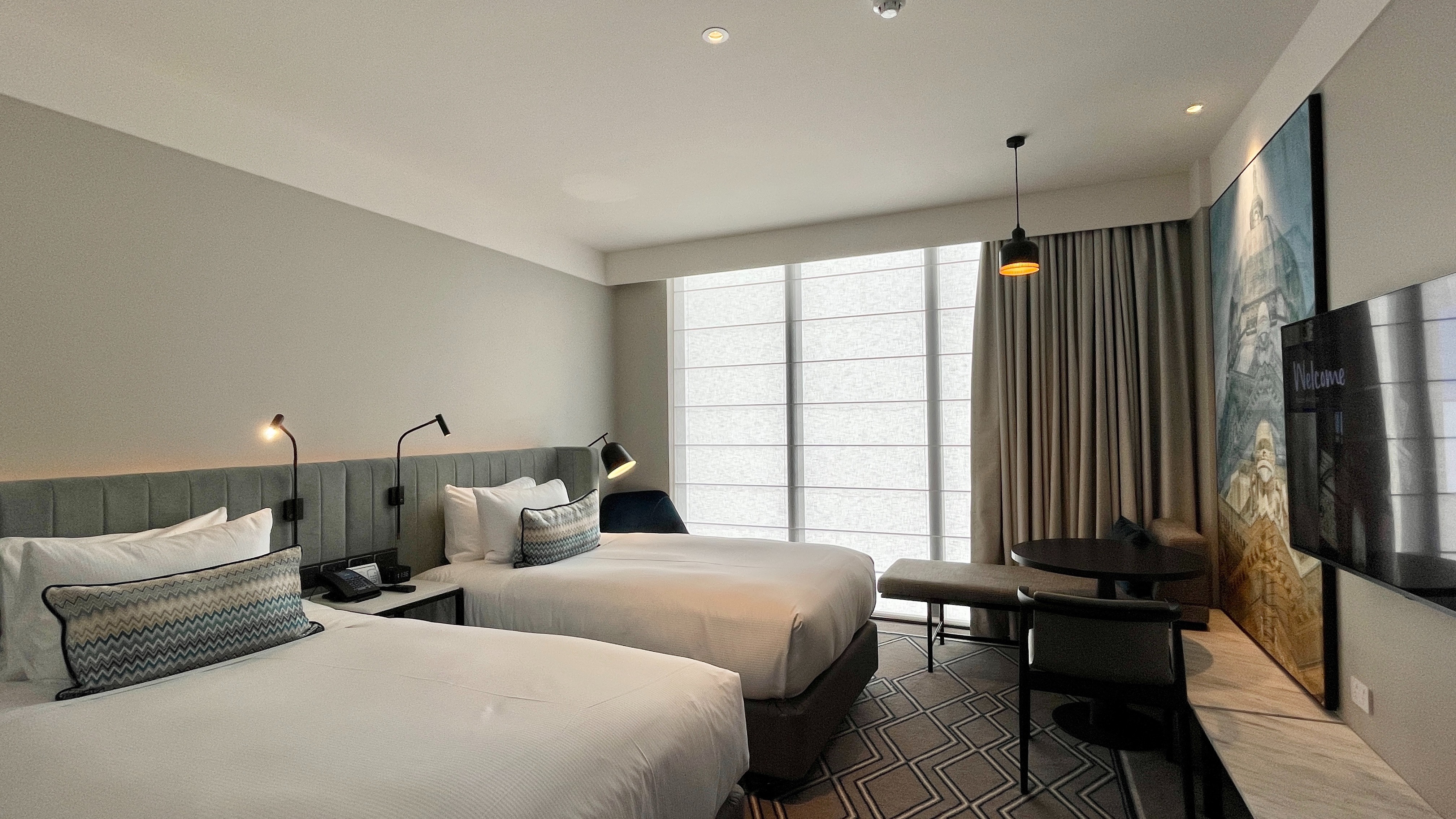
Hilton Melbourne – Twin Guest Room
The room is what I call functional chic: the décor is rather simple with elegant modern touches that make it work. The twin beds, each larger than a standard single-sized bed, is backed by a fabric headboard that brackets them nicely, complete with a small table in between.
Each bed has a reading lamp above it, and both beds share a set of power sockets located just above the bedside table.
Hilton Melbourne – Twin Guest RoomBedside power sockets
What I love is also the alarm clock: it comes with both a wireless charging pod and built-in cables for charging, which is a nice thought if you forgot your cables, or are simply lazy to unpack it.
Alarm clock with charging cables and wireless charging pod
Near the window is an armchair which we ended up using as a storage area.
On the other side of the room, there was a little ledge that runs from the window to underneath the television, providing extra holding space when you need to unpack your suitcase while not taking up precious floor space. The television is wall-mounted and flushed into the wall, which saves considerable space given that modern hotel rooms are compact.
In the corner of the room, there’s also a day bed of sorts flanking the window, with a round small dining table next to it. There is also a small armchair, so the entire setup is sufficient for in-room dining for two also.
Daybed
Near the door was the wardrobe, where you will be able to find in-room amenities including bathrobes, iron, ironing board and laundry bags. There is also an open rack next to the wardrobe where you can hang more clothes (or anything for that matter). Underneath it is where you will find a drawer containing the in-room safe.
Wardrobe – Bathrobes, ironing kit and more
For in-room refreshments, the hotel has emptied out the minibar, but there’s a menu that you can order from.
The room also comes with a kettle and some teabags and filtered coffee bags that you can enjoy. The one-cup drip coffee bags are from Dukes Coffee, which also supplies the hotel restaurant’s coffee.
Complimentary coffee and tea
The bathroom is fairly spacious. The vanity counter top is a simple marble-like surface affixed on a black metal frame, with a large rounded rectangular mirror that runs the entire length of the vanity.
Twin Guest Room – Bathroom
Bathtub lovers should note that most rooms come only with a standing shower, with bathtubs being found only in the higher room categories.
Hunter Lab amenities
Hilton Melbourne uses Hunter Labs amenities, in the form of pump bottles affixed to the walls. Hunter Labs is a fairly new Australian home-grown skincare brand founded initially for men but later on garnered enough appeal to become unisex. The scent is decidedly a little more botanical with a hint of citrus, which has a generally wide appeal.
Disposable amenities
Notwithstanding Covid-19 which saw hotels returning to using one-off disposable amenities, pump bottles are increasingly common as hotels move towards sustainability options, including common-use pump bottles in the bathrooms, so as to reduce single-use plastic bottles.
Wifi
Australian hotels typically charge for Wifi even though mobile data is pretty ubiquitous today; Hilton Melbourne is no different. Wifi access costs A$19.95 per day, but this is complimentary for Hilton Honors Gold & Diamond members.
Evening cocktails
Despite being a Hilton property, Hilton Melbourne does not have a club lounge, and also does not offer club-level rooms for booking.
What this means for Diamond members – where lounge access is complimentary – is an in-room evening cocktail experience.
The hotel serves up two bottles of wines (a red and a white), as well as two bottles of beers, along with some canepes to the room each evening between 5pm and 7pm, prepared by the hotel restaurant Luci. While no non-alcoholic options were provided at the time of service, there’s no harm in checking with the front desk if you prefer to have non-alcoholic drinks.
In-room evening cocktails for Diamond members
While this is a daily allotment, note that the provision of your beverages is on a replenishment basis – if you have an unopened bottle in the room, they will not provide a new bottle the next day unless you specifically ask for it.
The canepes do rotate daily, but they are nary a meal in itself, so don’t expect it to be a dinner replacement.
Breakfast – Luci
Breakfast is served at the hotel’s sole restaurant Luci, located on the ground floor of the hotel. Available between 6.30am and 10am on weekdays and 7am to 10am on weekends, breakfast is served as a buffet.
Luci
As a Hilton Honors Gold or Diamond member, breakfast is included in your room rate.
During our stay, the hotel offered an a la carte continental breakfast menu, right up to the last morning when they changed it to a buffet breakfast instead.
A la carte breakfast
For our breakfast, we were allowed to order up to three items and two sides. The menu was fairly simple, but the servings were reasonable and ample. Strangely enough, coffee was not included as part of breakfast (what nonsense, isn’t it?), while tea and juices are.
Unfortunately, the a la carte breakfast service is a temporary fixture. A check with the hotel also confirmed that it has permanently switched to a buffet breakfast service, which we didn’t try on the last morning as we were headed elsewhere for breakfast instead. Based on the little visual survey we took on the last day, it seems like the spread includes items already on the menu: toast, pastries, cereal, yoghurt, fruit, a made-to-order egg station, as well as some other hot entrees such as chipolata sausages and bacon.
Hilton Melbourne buffet breakfast spread, available daily
If you didn’t have breakfast as part of your room rate, Luci offers an a la carte menu for breakfast as well, which I presume will be similar to what I was given during my stay. Regular breakfast fare such as eggs, toast, yoghurt, bircher muesli are all available, with prices ranging between AUD6 for a slice of toast with condiments to AUD24 for eggs benedict. While the quality is good, you might find better value elsewhere outside of the hotel.
Outside of breakfast service, Luci also opens for dinner on Wednesdays to Saturdays, serving up contemporary Italian-inspired fare for dinners.
The facilities
Despite its size, Hilton Melbourne does not boast of a wide array of facilities. Apart from the food and beverage offerings by Luci and Douglas Club, the hotel pales in comparison in terms of recreational facilities, with only a fitness centre nested on the first floor and no spa nor swimming pool.
Fitness centre
The fitness centre is located on the first floor of the hotel, and is accessible 24/7 with your room key.
Taking up about the size slightly larger than a guestroom, the gym is compact yet sufficient for a quick workout without leaving the hotel. There’s a good rack of dumbbells available with two adjustable benches, as well as a cable machine tucked at the corner.
For your cardio options, there are three treadmills available for use, as well as an elliptical, a rowing machine and a stationary bike as alternatives.
For a serious workout, there are plenty of commercial gyms and workout studios within CBD that you can check out as well, particularly if you have access to Classpass.
Final thoughts
The stay was a surprisingly comfortable one, even though the size of the hotel doesn’t exactly scream “Hilton”. For those familiar with the brand, Hilton is not particularly an exciting property to be staying in. In many cities, Hilton evokes the image of a large, business travel-centric decades-old hotel, with dated rooms complete with fittings that are long due to be replaced. Business travellers continue to stick with the brand mainly because of familiarity and location, and many of these mature properties are also full service ones, with plenty of restaurants, bars, large gyms and even spas available for guests to use without having to step out of the hotel.
This quaint brand-new property in Melbourne changed all of that image, and proved that Hilton has not lost its touch; it is still capable of modernising itself in terms of how it presents its rooms, joining the league of chic hotels.
The hotel has also possibly cut away some frills such as a spa and swimming pool, thereby allowing itself with work with smaller footprints and focusing on core offerings without compromising on standards. In markets such as Australia, on-site swimming pools are sometimes quite useless as they would usually be tiny and have to be closed half the year due to weather.
What needs to be polished is in the area of service.
During my stay, never once did we see the Concierge desk being manned, leaving me to wonder if the hotel even offers a concierge service which is rather precious for time-strapped business travellers.
The servicing of the rooms were also a little inconsistent, such as having housekeeping leaving a bottle of cleaning agent (by accident I hope) in our bathroom one day. Our request for additional items at night also took an incredibly long time to come, leaving us to wonder if the hotel had overnight staff.
Having said that, the front office manager, Resh, was incredible. There had been some hiccups during our stay due to a reservation oversight, but she was fast to identify and rectify the problem and did an amazing job in service recovery.
This will not be the only Hilton property you will find; Hilton is expected to open another Hilton-branded property in Melbourne Square come 2024.
New partnership between Qantas and Accor lets you double-dip by earning points in both programmes for a single flight or stay
In a partnership between Qantas and Accor that goes live today, Qantas Frequent Flyers and some Accor ALL members can now earn points in both programmes when they stay and spend at Accor hotels, or by taking a Qantas flight, under a new partnership between the airline and hospitality group.
The partnership was first announced in November 2020, but the details are only made known today as the partnership takes off.
First and foremost, members must sign up for an account (if they don’t already have one) with both Qantas Frequent Flyer (QFF) and Accor ALL, and link them, before they can double-dip on the points.
All Qantas Frequent Flyer members can earn Qantas points on Accor hotel stays
All QFF members, regardless of status, will earn 3 Qantas points per Australian dollar spent at Accor properties across Asia Pacific, including properties in Singapore. This is on top of what you will earn as an Accor ALL member.
For instance, if you spend S$1,200 (about A$1,210) on a night’s stay at Raffles Hotel, that will rake in 3,630 Qantas points, on top of your usual Accor points based on your status.
Earn Qantas points for your stays in Accor properties across Asia Pacific
Eligible spend at the hotel includes all other expenses incurred during your stay, including restaurant meals, spa services, internet (where there’s a fee), room service and more.
Note that the rate of earning is regardless of your status with both QFF and Accor ALL, the earn rate remains the same at 3 Qantas points per A$1 spent, without any status bonus.
Select Accor ALL members and QFF members can also earn Accor points on Qantas flights
However, earning Accor points for flights is only limited to elite members of both programmes. Eligible members are:
Qantas Platinum and Platinum One members, or
Accor ALL Gold, Platinum and Diamond status members
For every A$10 eligible spend on a Qantas flight, all the above-mentioned members will earn 2 Accor points, with the exception of Accor ALL Gold members who will earn 1 Accor point. Again, this is on top of the usual Qantas points and status credits you will earn.
ALL Platinum (and above) members will earn 2 ALL points per A$10 spent on eligible flights
One very specific requirement in order to receive your Accor ALL points is that the flight must be marketed (carries a QF flight number) and operated by Qantas. So if you are flying Jetstar with a QF flight number, you are out of luck.
Qantas defines eligible spend as “the price paid for the seat including fare and carrier charges, but excluding government imposed taxes or optional fees such as seats, bags, upgrades”.
If you recall, Accor points are essentially a flat-rate rebate, every 2,000 points will net you 40 Euros that you can use to offset your hotel spend. As such, each Accor point is worth 2 Euro cent, or about 3 Singapore (or Australian) cents. This translate to an effective rebate of 0.3% for Accor Gold members or 0.6% for Qantas Platinum, Platinum One and Accor Platinum and Diamond members.
Fast-track to Accor ALL Silver
For QFF Gold or higher members who do not hold any status with Accor ALL, Accor is also offering a fast-track to its Silver tier for Qantas Frequent Flyers holding Gold status or above with just one stay.
Accor ALL Silver is the first elite tier in its programme, with only some nominal perks. The only noteworthy benefits are a ‘priority welcome’ at select hotels, as well as a welcome drink and late checkout where available.
Note that Accor ALL Silver is also given with the Accor Plus membership, so this fast track is not particularly attractive. Moreover, there are no additional fast-track for higher tiers, including Accor ALL Gold or Platinum.
Of course, you must be members of both programmes in order to link them, but if you don’t have a membership with either, there will be a link to sign up along the way.
Process flow to link accounts
Final thoughts
This partnership moves in the right direction for its members, by allowing an official double dipping in both programmes for either a stay or a flight. What this also does is to further encourage loyalty to both programmes, given that all other rival programmes now only allow you to credit points into a single programme at any point in time.
Accor Pacific CEO Simon McGrath said this was a major milestone for the travel industry, enabling greater benefits for loyalty members across more than 1,200 Accor hotels, apartments and resorts in the Asia Pacific region.
“We are joining forces to reward our customers, delivering exceptional travel benefits and unrivalled service for people who enjoy our two much-loved brands,” Mr McGrath said.
“Our partnership with Accor launches at an ideal time, with domestic and international borders reopening and frequent flyers starting to plan and book their next getaway,” said Qantas Loyalty CEO Olivia Wirth.
While Qantas points are not as highly valued as some other frequent flyer programmes, this added bonus of earning Accor ALL points may drive up the value by a little more, especially if one travels a lot within the region. The only downside is the definition of ‘eligible flights’ for the earning of Accor ALL points on Qantas flights – for Singapore-based travellers, it would be an added incentive if Jetstar flights are also included in the programme.