Singapore Airlines announced earlier this week that it will finally be refreshing all of its lounges at Singapore Changi Airport Terminal 3.
The suite of lounges – including the Private Room, the SilverKris lounge, and the Krisflyer Gold lounge – will progressively undergo refurbishment from August 2019 and will be completed by mid-2021.
The new lounges, to be designed by international hospitality design firm Hirsch Bedner Associates, is touted by SIA to “inject a fresh look and feel to each lounge that is modern yet homely, while inspiring a sense of timeless elegance”.
SilverKris Business Class Lounge
The Changi Airport Terminal 3 SilverKris Lounge will be the first to be renovated, commencing August 2019. The lounge will be expanded finally, making way for more customers and easing off the late evening crowds.
Artist’s impression of new business class lounge
The new Business Lounge will be styled into four zones:
A relaxed cafe zone for short transits
A dining hall featuring a full selection of Asian and international cuisine
A full service bar (which is previously only available in the first class section), which also doubles up as a breakfast bar in the mornings
A productivity and rest area, decked with productivity pods for your business needs and chaise chairs for a quick nap before your flight
Krisflyer Gold Lounge
For all the Star Alliance Gold members out there who are constantly frustrated with how lacklustre this lounge is, the upgrade will boost the current footprint of the lounge to twice the current size.
Most importantly, SIA is finally putting in restrooms and showers into the Krisflyer Gold Lounge. That’s a piece of development that’s deeply welcomed, and also a long overdue addition.
SilverKris First Class Lounge & The Private Room
The first class lounge will be refreshed, offering “carefully designed luxurious and intimate seating spaces suitable for both work and rest”.
Artist’s impression of The Private Room
SIA didn’t add many other details, except that it will still have its own flagship bar. My view is that if it’s now available in both the first and business class, it really isn’t much of a flagship anymore, isn’t it?
I’m not sure about you, but I’m really not sure how ‘careful’ a luxury design might look like. Intricately-designed embroidered armchairs? Hand-painted crockeries? High-tech booth seating that reads your mind on what you’ll like to eat and have them served in five minutes? I’m curious.
Interim arrangements
To facilitate lounge access during the upgrading works, it seems like SIA will be making use of the existing Krisflyer Gold Lounge for its SilverKris lounge users. The current Krisflyer Gold Lounge will be closed from 31 July 2019 all through to 2021, when the upgrading works are completed.
Eligible customers of Krisflyer Gold Lounge will be directed to a ‘temporary Krisflyer Gold Lounge’ on the other side of the terminal.
Final thoughts
If SIA’s latest SilverKris lounge refreshes in Bangkok and Hong Kong are anything to go by, I’m pretty much excited by how the new lounge will present itself.
SIA has an impeccable record for treating its topmost tier customers right: the Private Room is one such testimony and I expect this to continue to be the headliner. But as you go down one cabin, the long-time business class travellers will tell you that the treatment is no longer special. Today, when you head into any SIA SilverKris lounge, a common refrain you will hear is that the lounge is well worn, and the softer offerings are also pretty much mediocre as compared to what other airlines offer.
Closer ties will see both airlines expand codeshare arrangements, enhancements on frequent flyer programmes as well as maintenance, repairs and overhaul (MRO) services.
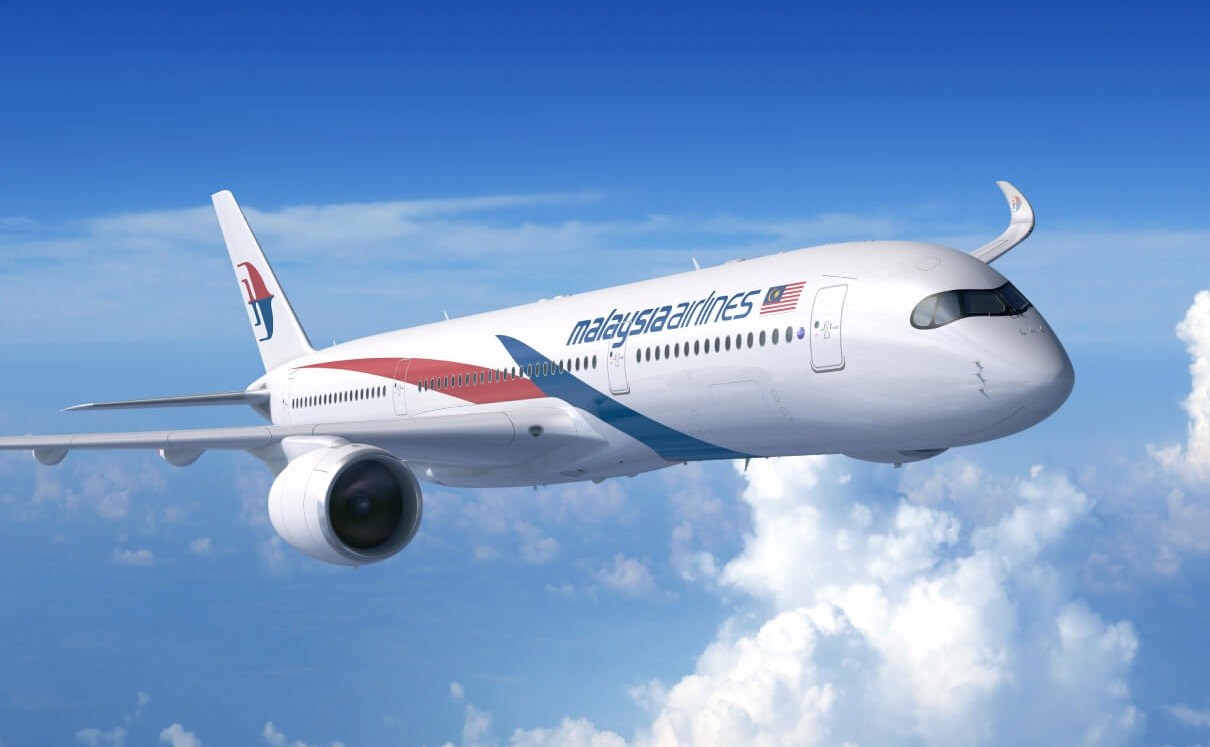
Singapore Airlines signed a Memorandum of Understanding with Malaysia Airlines earlier this week (27 June 2019) to ‘significantly step up cooperative ties’.
While the media release did not specify anything concrete (as with most MOUs), it broadly mentioned three areas of collaboration:
Expanding codeshare arrangements beyond the current Singapore-Malaysia services;
Enhancing both airlines’ frequent flyer programmes
Cargo
MRO services
All of the above are subject to government and regulatory approvals, and more details will be announced down the road when a proper agreement is signed.
Coming full circle?
If you are somewhat an avid fan of Singapore Airlines, you will know that the carrier has its roots in Malaysia-Singapore Airlines, or MSA. The joint airline was formed in 1966 as a collaboration between both Singapore and Malaysia governments after the independence of Singapore.
Regretfully (or perhaps fortunately to some), the partnership didn’t last very long before they went separate ways in 1972 owing to bilateral tensions as well as differing visions on the airline by both governments.
This partnership may seem like long time coming for many observers, but it’s highly unlikely that it will return to the MSA days in the near future.
Malaysia Airlines for one, has gone through a pretty rough patch in recent history. After suffering two fuselage losses within the same year (MH370 and MH17), the airline has been struggling to get back on its feet.
Despite numerous attempts and the change in several chief executives, Malaysia Airlines never did recover and is still loss-making. Today, it is largely funded by the Malaysian government. Most recently, Malaysian prime minister Dr Mahathir did suggest that it was studying whether it could “shut, sell or refinance” the airline.
So what’s next for customers?
For starters, Singapore Airlines’ customers can expect to see more codeshare services on Malaysia Airlines, particularly those out of Kuala Lumpur. As Singapore Airlines Group service practically all of Malaysia Airlines’ destinations, this shouldn’t be much of an issue for most Singapore-based customers.
The more critical piece is probably the frequent flyer piece. Singapore Airlines’ Krisflyer programme and Malaysia Airlines’ Enrich have fundamentally very different mechanisms for both earning and burning miles, so a collaboration will take some time to work out in order to ensure equity.
Both Singapore Airlines and Malaysia Airlines are also currently in different alliances, which limits the extent of earning miles on each others’ programmes. We will be looking out for developments on this front.
Singapore Airlines / 22 Apr 19 / B787-10 / SQ983 BKK-SIN / Business class / 14A
I was redeeming my Krisflyer miles for a trip down to Perth, and I remembered that I could add on a leg within Southeast Asia for an additional USD100. As I had a trip to Bangkok some time earlier in the year, I decided to add on a Bangkok-Singapore flight to make the full use of my miles.
Bangkok Survarnabhumi airport is a massive animal, but Singapore Airlines almost always depart from D gates. Singapore Airlines also operate a SilverKris lounge at the airport, right across from gate D7.
Singapore Airlines Boeing 787-10 business class
The aircraft
The Boeing 787-10 is the new generation aircraft that Singapore Airlines have decided on for its short and medium haul flights. At the time of writing, the aircraft type is progressing replacing the A330-300s on several routes, including to Osaka, Taipei and Perth.
The aircraft has a two-class configuration: business and economy class, with 36 and 301 seats respectively, for a total of 337 seats. In business class, the seat that Singapore Airlines have chosen is the STELIA Symphony, a brand new design that Singapore Airlines have decided on and announced with much fanfare back in 2018.
In a departure from its previous regional configuration on the A330-300, Singapore Airlines have gone with a 1-2-1 seat layout, forgoing the wide seats its famous for and gone for the alternating pattern with a side console. This layout is similar to what other airlines such as Qantas have on their widebody aircraft.
The seat
The Boeing 787-10 I travelled on has 36 business class seats across 9 rows in a 1-2-1 configuration, which means that all seats have direct aisle access. At the time of booking, all the window seats with the side console dividing the seat from the aisle have been taken up, which was rather surprising.
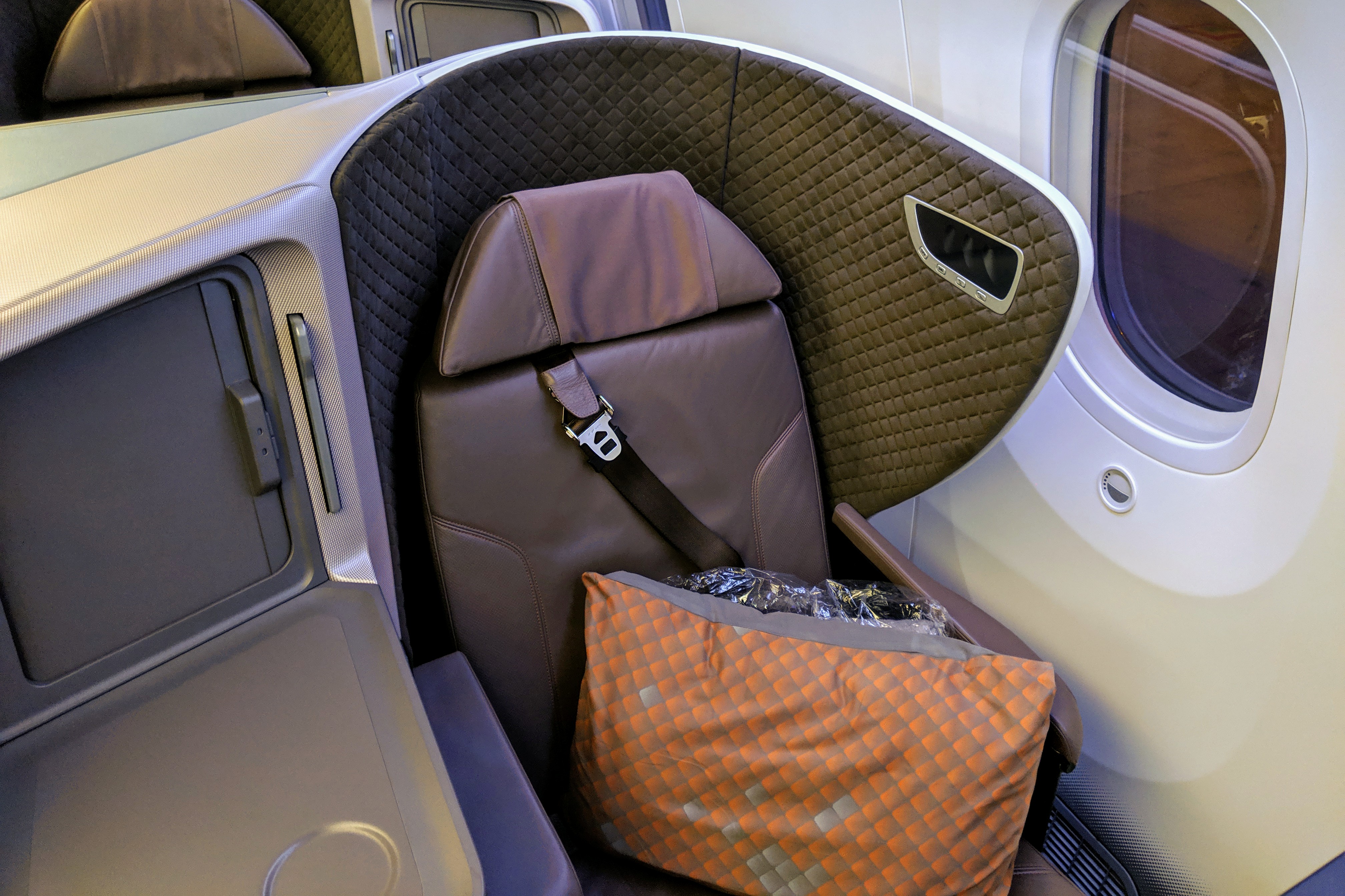
The 2018 regional business class seat
At first seating, the seat feels a little tight. The seat comes with adjustable armrests on both sides, which one can leave up or push it down to level with the seat for a more spacious seating.
Unlike the Qantas layout, Singapore Airlines have aligned the seats in the such a way that in alternate rows, couples travelling together can choose a pair of middle seats that is right next to each other.
Alternating couple and aisle-siding seats for the middle section
You will also notice there’s a sort of privacy divider between each seat and the aisle, making the seat feel really private as you will be avoiding any kind of awkward eye contact with your neighbours across the aisle if you happen to be just looking around from your seat.
Privacy divider on every seat
The controls on the seat have been very much updated from previous iterations of the Singapore Airlines business class seat. Loyalists will know that the previous iterations of the business class seats – especially the long haul seats – are built to be manually turned into beds upon request.
Seat controls and entertainment handset
For the Boeing 787-10, Singapore Airlines have adopted an electronically-controlled system. The seat controls are located on the side of the table-console. At a touch of the button, you will be able to recline the seat into a fully flat bed.
On the side console was also a small compartment which contained the headphones, and also contained the power socket and charging ports. For take off and landings, the compartment needs to be closed, so effectively you won’t be able to charge anything during this time.
Storage compartment on the side console
One thing to note is that the foot well is rather small. When I tried it, the only comfortable position is when you sleep facing upwards. If you are a side sleeper like me, you will be more comfortable curling up your legs, rather than try to slot them into the foot well. If you are very tall, good luck to you.
Tiny footwell
The tray table is stowed under the in-flight entertainment screen in front of you. There is a button to eject the tray, which you then unfold into a larger table.
For an extra perk, the two front row window seats – 11A & 11K – both contain an extra storage space that also serves as a bassinet space. If you manage to get those seats, the space is very handy to keep your bags within reach during flight.
Bassinet space at seat 11A
The service
The flight time today was just under 2 hours, and a full meal was served.
As usual, as the economy class is still boarding, the cabin crew came around with a choice of pre-departure drinks. As always, I’ve gone with a glass of champagne. The choice of bubbly today was the Charles Heidsieck, the choice of champagne that Singapore Airlines go for its business class.
Shortly after take off, dinner was served rather quickly. The menu for the day read as below:
Appetiser: Marinated fried tofu and cashew nut salad with thai chili sauce
Main course: Seared kurobuta pork loin with bourbon sauce Deep fried sesame coated chicken with asian green, carrot, fried noodles and oyster sauce Hor Mok Pla, or thai style minced fish with coconut cream and spices, sauteed vegetables and fried rice
Dessert: Raspberry choux
Assorted bread rolls and gourmet breads
Coffee and tea
Given the short flight time, the meal was served on a single tray, rather than through a multi course presentation.
Single tray service for short haul flights
The only real choice you get on short haul flights are a choice of main course. For flights out of Bangkok, note that there’s also no Book The Cook options so you are pretty much limited to the menu choices.
I decided to go with the pork loin, which I thought was the least bad options based on the choices available. At first bite, I was pleasantly surprised at how tasty it was. The pork was tender and the texture was in fact closer to chicken, rather than pork.
The jus was pretty good as well, although I’m sure that would have been laden with sodium.
The star of the meal was in fact the dessert. The cake was balanced in its sourness and sweetness, making it a perfect end to the meal.
Along with the meal, there was also the usual choice of four wines, two whites and two reds. I went with the french red bordeaux (as opposed to the italian red), which wasn’t particularly memorable, although it wasn’t bad.
Champagne barely half-filled
I was done with my meal pretty quickly and soon enough the cabin crew came around to clear my tray. I then asked for another glass of champagne, which was promptly brought to me. I was rather amused at the serving though: it was barely one-third filled. I understand that service guidelines typically require most beverages to be filled to roughly about half, or two-thirds of the glass to minimise spillage, but one-third of a small, tall glass is kind of ridiculous.
Needless to say, I had to ask for a second serving.
Final thoughts
It’s great that Singapore Airlines has finally moved to a 1-2-1 configuration for its regional business class seats, which is a much needed upgrade from the previous 2-2-2 cabin which I unfortunately had to experience when I went to Beijing.
Having tried the seat for the first time, while sleek, I personally felt that the seat was rather tight. Even though it seemed like there was a lot of space, but in reality the seat width didn’t feel spacious, especially when the armrests are up.
Fully flat bed at a touch of a button
The screen also seemed like it was right in my face, although one may argue that’s not too bad a thing actually as I could actually touch the screen without stretching.
The design of the seat could also use some tweaking. Realistically speaking, the compartment next to the seat which had a sliding door wasn’t much of a use. If I have placed some small articles in it, I had to shut the door in order to prevent the items from falling out in case of turbulence. A container-style compartment would have worked much better.
In-flight entertainment
The seat controls next to the seat was also often accidentally triggered by my resting arm when my armrest is down, which was rather annoying.
On the service front, as usual it was impeccable, and a tray service even in business class is pretty standard for a short flight like this. However, I would really appreciate if there was a semblance of option, even for something as simple as desserts where some things such as ice cream are easy to uplift.
After launching the UOB Krisflyer account with some flak and tweaks down the road, UOB has most recently launched yet another co-brand card: the UOB Krisflyer credit card.
Now, UOB is only the second financial institution to launch a Krisflyer-branded card, after American Express.
The short list
Income requirement: S$30,000 p.a. for Singaporeans, S$40,000 p.a. for foreigners.
Annual fee: S$192.60, waived for first year
Renewal gift: 10,000 miles when annual fee is paid
Sign up bonus
The sign-up bonus is essentially in two tiers, one for all customers who apply for the card, and one for new-to-UOB customers.
For all applicants, if your card application is approved by 30 June 2019, you will receive 5,000 bonus Krisflyer miles if you spend at least $5 within the first 60 days of getting your card.
For this bonus, you will first receive 3,000 miles in your Krisflyer account within the next month after the first spend, while the remaining 2,000 miles will be posted by 31 October 2019.
If you are new to UOB (i.e. this is your first UOB credit card), you will get an additional 7,000 Krisflyer miles, or a return ticket to Bangkok, Lombok or Penang if you spend at least S$2,000 in the first 60 days of getting your card. This is on top of the 5,000 miles for all. Note that you will need to register for this promotion via SMS.
The earn rates
UOB has advertised the following earn rates:
3 Krisflyer miles per dollar spent (mpd) on Singapore Airlines, SilkAir, Scoot and KrisShop purchases
Up to 3 mpd on everyday spend, with a minimum of S$500 annual spend on Singapore Airlines Group purchases
Of course, given that this is a co-brand card, there are no transfer fees involved to convert your UOB points to Krisflyer miles.
You will receive KrisFlyer Elite Silver status when you spend a minimum of S$5,000 on Singapore Airlines Group.
There’s also the twice-a-year $15 credit that you can use for Grab rides, as well as a twice-a-year $15 credit for wifi routers you rent from Changi Recommends.
Scoot privileges
If you book Scoot tickets through the dedicated link, you and your travelling party will receive the following perks:
Priority check-in and boarding with Scoot
Additional 5kg check-in baggage allowance, if you have purchased any check-in bags
Standard seat selection for you only
S$10 booking fee waiver for you only
One-time change waiver
This may be a good deal if you travel frequently on Scoot, either for leisure or (sadly) for work.
The fine print
Now for the headline that appears on about every other article published so far: you will get the bonus miles only a year later. Specifically, for the 3 miles per dollar spent on everyday spend, you will first receive base 1.2 mpd in your monthly statement. The remaining 1.8 mpd will only be awarded two months after your card anniversary, if you fulfill the minimum S$500 spend on Singapore Airlines Group.
No way to earn your bonus miles faster. In the terms and conditions, it is also explicitly stated that “Expedite of fulfillment of Award is not allowed”. If you cancel your card within the first year, tough luck — you forfeit all bonus miles.
UOB takes a broad definition of ‘everyday spend’. Everyday spend include dining (eating places, restaurants, bars and fast food restaurants), online food delivery (GrabFood, foodpanda, honestbee), online shopping, online travel and all transport cards.
All miles will be automatically credited at the end of each month to the nominated Krisflyer account. There is no conversion fee, yippee!
As with all other UOB cards, miles are earn in blocks of S$5 spend. You get the same number of miles whether you spend $5.20 or $9.80. And if you spend $4.80 in a single transaction, you don’t get a single mile.
Now the assessment
3 mpd on everyday spend is not the highest in the market, but it definitely is an attractive alternative for those who are lazy to carry multiple cards or be scrutinous on what cards to use for which transaction types.
UOB has also fortunately taken a very broad approach to the categories of merchants for each spending type, hence you do not need to worry about whether a particular you will get the full 3 mpd. For instance, under ‘dining’, bars and cafes are all included, on top of restaurants.
Some of the fringe perks, including the $15 Grab credits and $15 Changi Recommends credits for wifi routers are pretty decent.
The airline perks on the other hand is rather… lame.
First, Krisflyer Elite Silver Fast Track: if you have to spend $5,000 to get Silver, this is really nothing to be excited about. You will get 25% bonus miles, priority waitlist and standby, and some discounted service fees. Honestly, if you are like me and end up buying the cheapest economy class fare all the time which attracts 50% of mileage flown, 25% of 50% is just an additional 12.5% miles. That’s it. And also, there’s no lounge access for silver, not even a one-use pass.
$20 KrisShop rebate: I don’t get why you can only use this once a year.
$10 convenience fee waiver for Scoot bookings: While this seems pretty good, but note that they only waive it for the cardholder (i.e. you) when making a group booking. Factor in the fact that Scoot charges a $20 credit card fee (as opposed to $5 fee for AXS payments), you are effectively pay for any miles you get out of using your UOB Krisflyer card.
Final thoughts
It seems like Singapore Airlines is reserving the best perks for itself, and instead provided its partners with a range of ‘cheap perks’ in the form of Scoot privileges and discounts.
Also remember: in order to accrue miles on Krisflyer, you will also need to purchase the Perks Plus bundle so the costs eventually adds up.
What disturbs me the most is the fact that you have to wait an entire year to get your bonus miles on top of the base 1.2 mpd. I know this is probably so that UOB can calculate how much you did spend on SIA Group in order to qualify for the bonus, but this is pretty easy to overcome by requiring cardholders to spend the minimum upfront to unlock the higher earn rates.
All in all, when you look at the kind of perks they offer (i.e. mostly on Scoot) as well as some of the other perks, such as Grab vouchers in lieu of limo services, it’s very clear that this is targeted at a low- to mid-budget travellers, rather than high travel spenders.
I think there is an opportunity for UOB to launch a premium travel card to hit a segment that it has routinely missed, and given its relationship with Singapore Airlines, this might just be its perfect opportunity.
Book by 30 April to enjoy 30% off usual redemption rates for travel between 1-31 May 2019 to destinations including Bangkok, Jakarta, Seoul, Beijing and Shanghai.
Singapore Airlines has unveiled its list of redemption offers for the May edition of the Spontaneous Escapes. A total of 34 destinations are up for grabs (some one-way) this month, but unfortunately some destinations such as Australia and New Zealand are not available at all this month.
Some notable mentions:
Southeast Asia
Bangkok: Economy class for 8,750 miles; Business class for 15,050 miles
North Asia
Hong Kong: Economy class for 10,050 miles; Business class for 21,350 miles
Shanghai, Beijing: Economy class for 14,000 miles; Business class for 27,300 miles
Osaka, Tokyo, Nagoya, Fukuoka (one-way from Singapore only): Economy class for 17,500 miles
Seoul: Economy class for 17,500 miles; Business class for 32,900 miles
Europe (one-way from Europe to Singapore only)
From Paris, London: Economy class from 26,600 miles
Some blackout dates and restrictions on specific flights do apply, so remember to check the list before booking. Also, remember that the deadline to book is 30 April 2019 for travel between 1 to 31 May 2019.