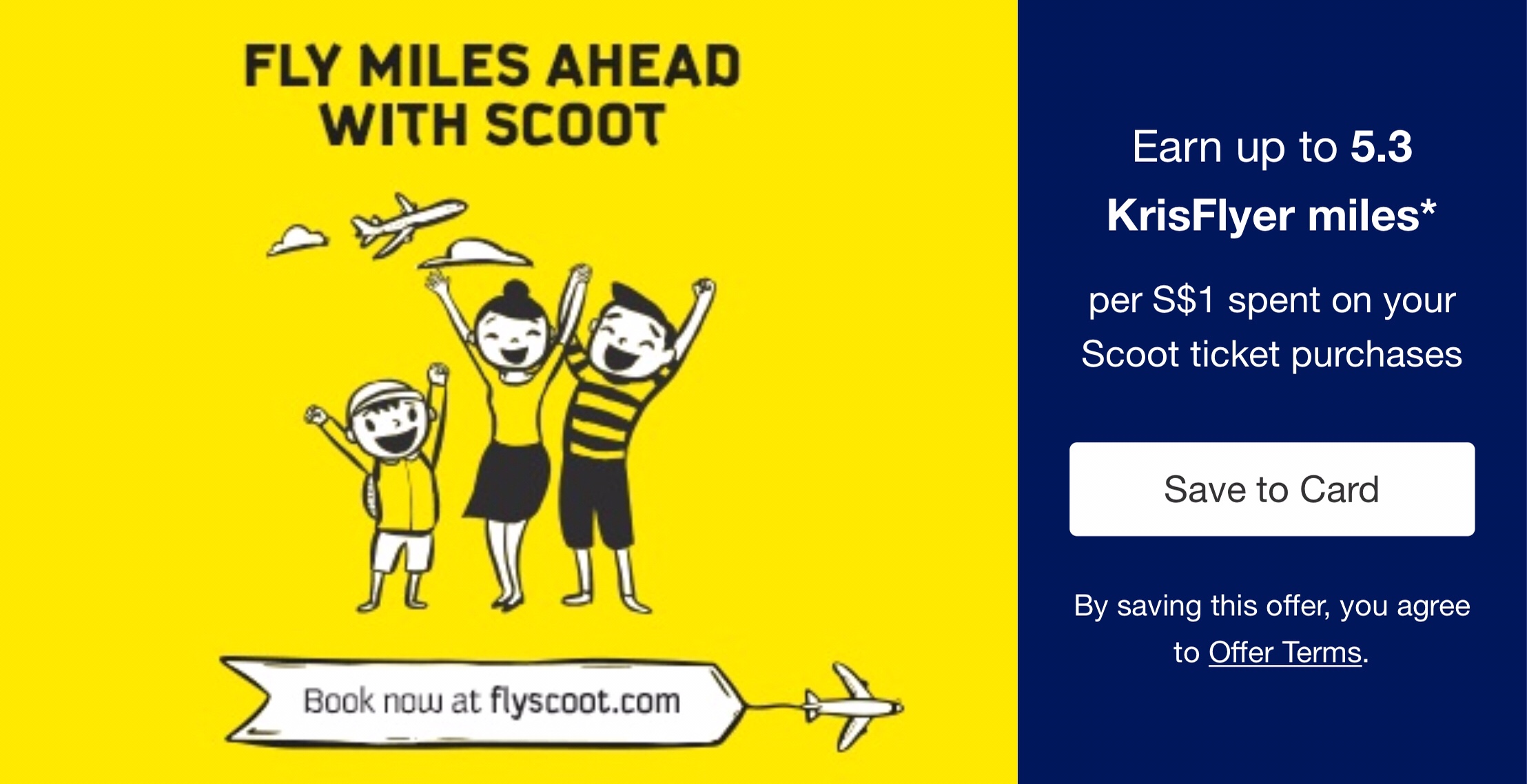
From now until 18 June 2019, earn an extra 4 miles per dollar spent on Scoot, when using the Singapore Airlines branded American Express cards.
The bonus miles is on top of the base earn rates (i.e. 1.3 mpd for the PPS branded cards, 1.2 mpd for the Ascend and 1.1 mpd for the blue Krisflyer card), so that means you will earn up to 5.3 miles per dollar spent.
The maximum number of bonus miles you can earn is capped at 1,200 miles, i.e. S$300 spend. That’s not a difficult one to hit. There’s also no restrictions on where you need to begin your trip in, so that makes planning really flexible.
To qualify for this offer, you must either have received an email from Amex, or log into your Amex app to check if you are served the offer. The offer is limited to the first 10,000 registrations although I have not heard of anyone who was rejected.
Singapore
Airlines will be increasing the redemption rates for all award tickets, as well
as upgrades, from 24 January 2019. This increase will see Krisflyer members
forking out anything from 2,000 miles to 15,000 miles more for their premium
economy, business or first class ticket.
For those
who have longer term memories, the last revision was in March 2017 (yes we are
in 2019, guys), where SQ famously removed its 15% online redemption discount,
in return for absorbing fuel surcharges on its tickets.
This time round it’s mostly grim. Economy class rates remained unchanged, but everything else is going up – both saver and advantage rates. We will take a look at the increases at the saver level, because, frankly who redeems at an advantage level unless you really need to travel?
One great news for those who usually upgrade with their miles: SQ will now allow a two-class upgrade from Economy to Business for aircraft with the premium economy product. Previously this will not be possible.
Premium Economy
Premium
Economy saver rates have gone up between 2,000 and 5,000 miles per way. If you
are travelling from Southeast Asia to anywhere in Asia Pacific, you are likely
to have to fork out an additional 2,000 miles each way.
For ultra-long
journeys, expect to pay 5,000 miles more. See below for some examples:
Singapore to
Premium Economy saver, each
way (‘000 miles)
Old
New
Change
Hong Kong, Taiwan
22.5
24.5
+2 (8.8%)
Japan, South Korea
32.5
34.5
+2 (6.1%)
South Asia
30
32
+2 (6.6%)
Australia (excl Perth, Darwin)
45
47
+2 (4.4%)
Europe
62.5
64.5
+2 (3.2%)
USA (West Coast)
65
68
+3 (4.6%)
USA (East Coast, Houston)
70
73
+3 (4.3%)
Business
This is
where the shit gets real. Business Saver rates have gone up between 1,500 and
11,000 miles each way. To show that inflation spares no one, every single city
pair have gone up, including Zone 1 to Zone 2 fares, i.e. Singapore-Jakarta
& Singapore-Kuala Lumpur flights.
For very
long flights like Australia to Europe services, travellers will now have to
fork out about 22,000 miles more for a business class return flight. Under the
old rules that would have given you a Singapore-Bangkok one-way business
ticket. Ouch.
Singapore to
Business saver, each way (‘000 miles)
Old
New
Change
Indonesia, Malaysia
17.5
19
+1.5 (8.6%)
Thailand, Vietnam
20
21.5
+1.5 (7.5%)
Hong Kong, Taiwan
27.5
30.5
+3 (10.9%)
Japan, South Korea
43
47
+4 (9.3%)
South Asia
35
39
+4 (11.4%)
Australia (excl Perth, Darwin)
58
62
+4 (6.9%)
Europe
85
92
+7 (8.2%)
USA (West Coast)
88
95
+7 (8.0%)
USA (East Coast, Houston)
92
99
+7 (7.6%)
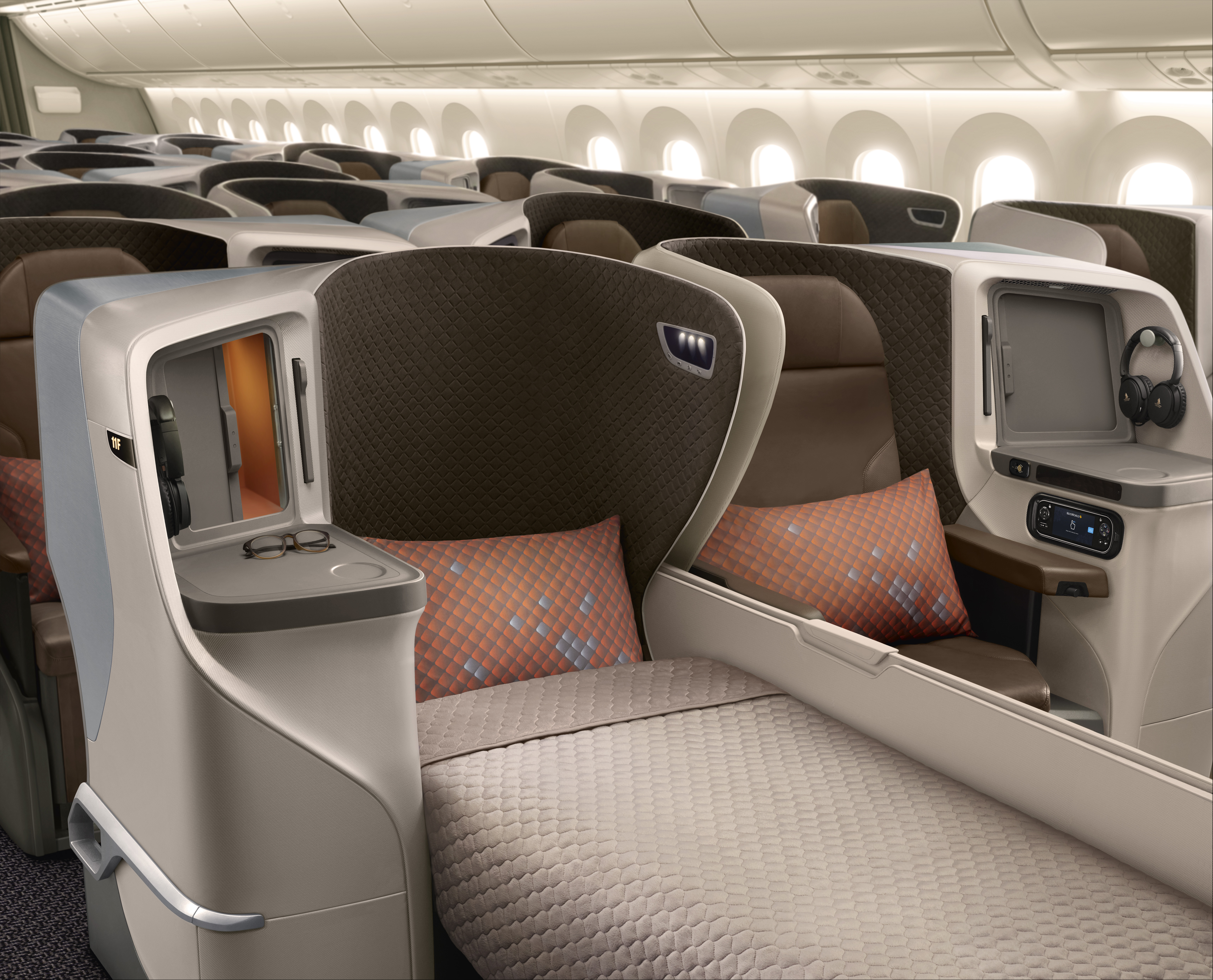
First/Suites
Of course, First
and Suites are not spared, but then again if you have enough miles for
redeeming a first class ticket, the increase really shouldn’t matter that much.
The mileage required for redeeming a first class ticket have gone up between
2,500 and a cool 15,000 miles, depending on your city pair.
Arriving into Frankfurt
The shortest
first class flight you can get is on Singapore-Jakarta for 25,000 27,500 miles which
will let you have a taste of their famous Private Room at Changi Airport
Terminal 3 before you head off south.
If you are
like me who like to save your miles for very long haul trips, be prepared to
save even more miles now. The famous SQ11/12 Singapore-Frankfurt-New York
service will now cost you a cool 132,000 miles each way, up from 120,000 miles.
This is a far cry from the time when there was a 15% online discount, which
will only set you back by 102,000 miles back before 2017.
Here’s a
look at some of the changes:
Singapore to
First saver, each way (‘000 miles)
Old
New
Change
Indonesia
25
27.5
+2.5 (10%)
China (Beijing, Shanghai)
50
53
+3 (6%)
Japan, South Korea
65
70
+5 (7.7%)
Australia (excl Perth, Darwin), New Zealand
80
85
+5 (6.3%)
Europe
115
125
+10 (8.7%)
USA (East Coast, Houston)
120
132
+12 (10%)
Upgrade awards
I don’t
normally encourage people to use miles for upgrades since you will usually have
to purchase fairly expensive fares to be able to upgrade.
There are
however exceptions to this, for instance, if you are travelling for work and
your company policy allows you to upgrade with your own miles.
So what have gone up for upgrade awards? Generally, short haul flights are unaffected, the changes impact mid (anything further than Singapore-Hong Kong) and long haul flights. Increases are generally modest (1,000 to 2,000 miles each way) and tops off at 6,000 miles increase for Australia-USA flights, for a economy to business class upgrade award.
The one good news that came out of it is that customers can now do an economy-to-business upgrade on flights with premium economy. This was previously not possible and customers wishing to upgrade to business would have to purchase a premium economy fare, to the dismay of many.
No more waitlist within 14 days of travel
Another good news that came out of today’s announcement was the confirmation of waitlisted flights 14 days before your flight. Previously there have been harrowing accounts of how flights were confirmed only a day or two before, but this will not longer be the case as SQ will no longer allow redemptions waitlisting within 14 days of departure.
Final thoughts
We didn’t see this coming. This increase certainly came very shortly after the last round, and the increases are a sign of things to come with Singapore Airlines’ transformation. While the increases are not dramatic, but the creeping and somewhat frequent changes should let you reconsider whether to stick to a single mileage programme, or hedge it with another.
Bottomline is: don’t hoard your points. The longer you keep, the more value you lose.
Of course, there are some bright spots, such as how Singapore Airlines have decided to make the Spontaneous Escapes a permanent feature, meaning you can enjoy last-minute redemption deals at 30% discount. Of course, this will heavily depend on what is unsold, almost akin to a bakery’s end-of-day discount sale.
For the full changes and new award charts, see SQ’s website here.
The November Spontaneous Escapes promotion list is now out!
For the penultimate edition of the year, KrisFlyer is offering 30% off the usual mileage required for Economy & Business on SQ to destinations across Asia and Australia only, for travel in December 2018.
For SilkAir, the destination list is slightly more generous, with 15 destinations as far as Hiroshima, Japan and Darwin, Australia.
Also included in the promotion this month is January travel to USA. If you recall, Singapore Airlines came out to say earlier this month that the premium economy cabin is not selling like hot cakes on the non-stop services to USA, so I guess naturally these will come at a discount too. The price? 45,500 miles each way to Los Angeles and San Francisco, plus taxes, for travel between 1-13 January 2019.
All redemptions must be made by 30 November 2018.
You can find the full list on KrisFlyer’s website, but here’s what I think its most value for money:
Denpasar-Bali: 12,250 miles each way in Business – good to try the new B787-10 regional business class product
Sydney: 40,600 miles each way in Business – good to try the new A380 business product
Singapore Airlines Boeing 787-10 on Bali flights
What is KrisFlyer Spontaneous Escapes?
Singapore Airlines releases a list of discounted KrisFlyer redemption Saver awards, in both Economy and Business, to select destinations every month, at 30% off the usual redemption rates.
The deals are usually available for a very short time, and travel is also limited to the following month, making this perfect if you have unused leave or you are in need of a spontaneous holiday.
The list varies from month to month, sometimes including destinations as far as Düsseldorf, so be sure to check back each month!
American Express is the latest card to jump on the mobile payment promotion bandwagon, with an offer launched on 15 August 2018 for Singapore Airlines co-branded credit card holders.
For every S$1 spent, Amex will give you 4 bonus miles, on top of the usual mileage. That means PPS Club branded cards can earn up 5.3 miles per dollar, Ascend can earn up to 5.2 miles per dollar and the blue Krisflyer card earns 5.1 miles per dollar.
Earn up to 5.3 miles, the promotional flyer says
There’s a very big BUT
However, the promotion is capped at a grand total of… 1,200 bonus miles. That’s right, that’s a pathetic S$300 spend.
Also, foreign spend will not count towards the promotion too.
This offer is obviously not as generous as what Citibank did with their insane up to 8 miles per dollar spend, but still a relatively easy way to scoop up some miles if you are already holding the card.
How to sign up?
Because this promotion is not available on their website, I assume that only those targeted for this promotion (i.e. received the promotional email) will be eligible to sign up.
So, if you have the email, make sure you click on the “Save to Card” link in that email to register for the promotion first. Only the first 20,000 cardholders who register for the promotion will be eligible for the promotion.
Then, proceed to spend S$300 on your Amex KrisFlyer card between 15 August and 15 November 2018, and wait for the 1,200 bonus miles to be credited.
One caveat though: for any reason if you are holding multiple Amex KrisFlyer cards (I cannot imagine why you will do that), every card is eligible as long as you receive an email for it.
tl;dr: don’t ever, ever convert your Krisflyer miles to KrisPay miles. EVER.
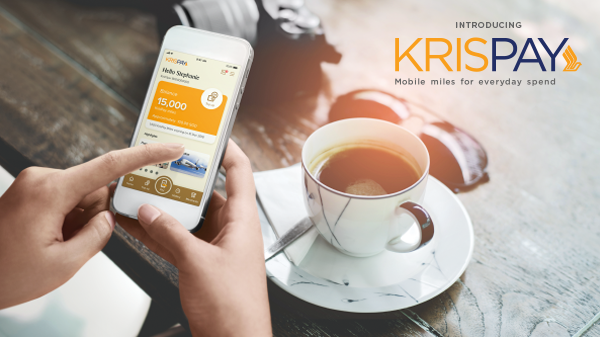
Singapore Airlines introduced KrisPay yesterday, where Krisflyer members can use their miles to offset cash payments at a range of merchants in Singapore (lucky you, rest of the world).
This is how the marketing email sells it:
KrisPay is the new digital wallet that turns your KrisFlyer miles into instant purchases – right from your mobile phone, starting from as little as 15 miles. You can now use KrisPay for everyday spend such as your petrol purchases at selected Esso service stations^, M1, Challenger and many more participating merchants.
How bad is it?
It is… really bad. From the mechanism, to the conversion rate, to the redemption levels. Let’s look at them one by one.
The mechanism
First you will have to download the KrisPay app (I’ve downloaded it, so you don’t). The first bugger that annoyed the hell out of me was that the app can only be installed on iOS 11.0 or later. So if you are like me and detest updating iOSes unless absolutely necessary, this is already a sign of things to come.
Once you have successfully downloaded the app, you have to sign in with your KrisFlyer account.
To use KrisPay, you will need to first convert your KrisFlyer miles to KrisPay miles. This conversion is irreversible so please do not try it.
For the added touch of insult, the KrisPay miles are only valid for six months, as compared to three years for KrisFlyer miles. I suppose this is a feeble attempt for you to use up your soon-to-expire KrisFlyer miles if you are not intending to travel.
And once there, you pay by scanning a special QR code at the merchants, similar to how you will use GrabPay.
The conversion rate
The rate is absolutely dismal, where you can use 150 miles to offset S$1. That’s 0.67 cents per mile, which is an absolute waste of your miles even if you have too much.
Let me put this in context: a return business class ticket to Tokyo (saver award) will cost you 86,000 miles. What else can you do with 86,000 miles?
If you decide to buy Singapore Airlines tickets and pay with your Krisflyer miles in part, 86,000 miles will offset about S$877.55.
If you decide that your miles are not worth spending on SQ tickets (gasp!) and decide to use them on Krisshop, you can get S$688 in value.
But, if you decide to go crazy and use that on KrisPay, you will get… S$573.33.
What would you prefer, a return business class ticket to Tokyo or S$573.33?
The list of merchants
KrisPay launched with a list of 18 merchants spanning retail, food and beverages, beauty services and petrol. The upside is that they have got some pretty big names, such as Cedele, Esso and Gong Cha.
The bad side? Roll out is pretty patchy right now. For instance, KrisPay is only accepted at 23 out of 62 Esso stations, and a very tiny three out of 11 TWG outlets.
Also confusing are the specific terms and confusions conditions for each merchant. For instance, Esso only allows KrisPay for fuel payment, M1 doesn’t allow you to use them for prepaid cards, etc. To add salt to the wound, payment by KrisPay will render you ineligible for other promotions and discounts. So for Singapore-based customers who are so used to 10-14% discounts at Esso, you can kiss that goodbye.
If you want the full list of merchants, click here.
So why KrisPay?
The loyalty proposition in Singapore has definitely heated up over the past couple of years and even airline loyalty is not spared.
While airlines traditionally built their loyalty programme around cultivating repeat customers and rewarding their repeated patronage with free flights, the landscape has evolved to the point today where it has gotten too easy to earn miles (or points).
This creates an increased uptake in redemptions, particularly on very lucrative routes, that will result in loss of revenue. Therefore it is in SQ’s interest to burn these points at the cheapest possible way while still retaining the overall attractiveness of the programme without having to slap on restrictive rules such as short lifetime of miles.
It will be interesting to see what’s the uptake on KrisPay and the actual number of miles being used. I suspect the number will not be that low after all.