Tag: Kuala Lumpur

  • REVIEW: Hilton Kuala Lumpur, Executive Plus King Room

    REVIEW: Hilton Kuala Lumpur, Executive Plus King Room

    Hilton fans in Singapore will definitely be familiar with Hilton Kuala Lumpur. Located adjacent to KL’s main transport node KL Sentral, the hotel is a well-appointed property suited for both business and leisure needs.

    Hilton Kuala Lumpur (credit: Agoda)

    In this post:
    • The hotel
    • Checking in
    • The room
    • Executive lounge
    • Breakfast at Vasco’s
    • Other facilities
    • Final thoughts

    The hotel

    Located conveniently at KL Sentral, Hilton Kuala Lumpur is literally next door to the train station and offers more than 500 rooms in its giant 35-storey building. The hotel also has 14 meeting rooms capable of holding business events for up to 1,500 people.

    Hilton Kuala Lumpur lobby

    While the hotel opened its doors back in 2004, it was last refurbished in 2013. At first glance, the hotel still looks pretty swanky to the extent of being a little glitzy; a big welcoming lobby, tall ceilings and a modern-looking cafe and bar at the lobby adds to the glamour of the property.

    The hotel is part of a joint development with Le Meridien hotel located next door, which has been owned by Japanese billionaire Katsumi Tada since it opened its doors in 2004. Just a couple of years back in 2017, Tada has sold the hotel to the owners of Le Meridien next door, Daito Trust Construction Co, another Japanese entity.

    Check-in

    I tried checking in early at about 11.30am. Hilton KL is pretty good with its upgrades for elite members. As a Hilton Honors Diamond member, I originally booked myself into a Deluxe room, but I saw in my Hilton app that I was given an Executive Plus room.

    As I checked in way too early, the front desk offered me a choice of either an Executive standard room if I wanted the room now, or a Executive Plus room if I could come back later in the afternoon. I chose the latter as I wanted to head out for lunch.

    One thing to note if you are a diamond member, the priority check-in desk for Hilton Honors members is not located at the same place as the check-in desks. There is a small little signage just before you hit the desks that will point you to the right direction. If you need help, just ask the concierge and they will be happy to point you in the right direction.

    Priority check in area for Diamond, Gold members

    The room

    I originally booked myself into the cheapest room type, but as a Diamond member I was upgraded to an Executive Plus room, which was one of the corner rooms on each floor.

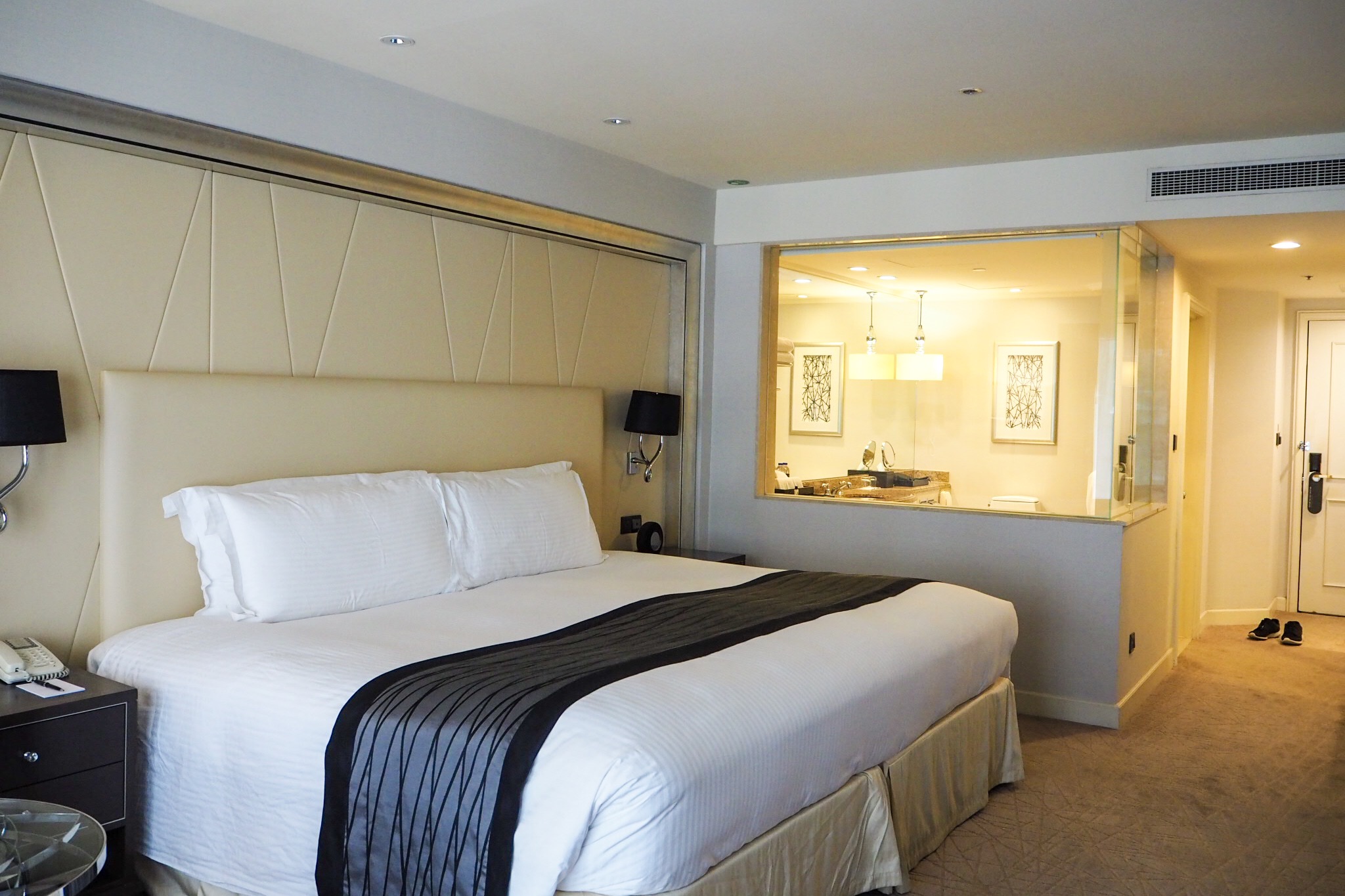
    Executive Plus room

    While the room was not a junior suite, it boasted of a very generously sized bedroom, as well as an equally generous bathroom. The room comfortably fitted a King sized bed, as well as a couch right by the window which served us well as a daybed.

    Work desk (right) and TV

    There was also a full sized work desk if working in the room is what you need.

    The bathroom had a generous bath tub, big enough for two people. As with all other Hilton properties, there are separate shower and toilet stalls, each with their own door. There was only a single vanity however, but this is often not an issue for me.

    Bathroom vanity and bathtub

    The amenities Hilton Kuala Lumpur uses is Crabtree and Evelyn, consistent with the other Hilton brands in this part of the world.

    Crabtree & Evelyn amenities

    One interesting offering by Hilton KL is a bath preparation service, with a complete menu of different scented baths that staff can prepare for you for RM58 nett. There are four options to choose from, including a jetsetter’s Boost Bath, which is a “refreshing blend of tangerine and lemongrass to sooth, relieve and revitalise the body.”

    For couples on a getaway, there’s also a “Pure Romance Bath” for RM180 nett, which comes with two glasses of sparkling wine, not too bad a deal considering that a glass of wine costs at least RM50 in a hotel.

    It might sound rather extravagant, but I can see how this is useful for couples on a romantic getaway, or even perhaps for parents who will want to delight their kids.

    If you want something even more luxurious, there’s always an in-room massage service offered by the hotel’s spa, but I was shocked at the price tag which was something to the tune of over RM400 for an hour of bliss.

    Bedside table – telephone, mini hotel guide

    The room also comes with a Nespresso machine, as well as four bottles of complimentary bottled water. I am quite a water guzzler, so the first thing when I got to the room was to request for even more bottled water, which the hotel gladly acceded to.

    Nespresso machine and bottled water

    As with most hotels there’s also a fully stocked in-room mini bar right under the counter, which will be replenished daily and charged to your account if you consume any of it (you shouldn’t).

    The only downside to the corner room is the fact that the room is not completely blacked out in the morning. The doors to the bathroom are a pair of translucent sliding doors facing the bed, and there are no curtains within the bathroom. Go figure.

    Executive Lounge

    Hilton Kuala Lumpur’s executive lounge is located on the 33rd floor. All guests staying in executive rooms and suites, as well as Hilton Honors Diamond members can access the lounge during their stay.

    Hilton KL Executive Lounge

    The lounge is open from 6am to 11pm daily, and serves up daily breakfast, as well as afternoon tea and evening cocktails.

    The lounge runs on two sides of the corridor, a bigger lounge on the right side where the food and drinks are located, and a smaller lounge on the left side with the reception desk. Both rooms feature high ceilings and full length windows offering a view of the city.

    View from the executive lounge
    The other side of the excutive lounge

    I managed to check out the afternoon tea (2.30pm to 4.30pm) shortly after returning to the hotel and getting my keys. Hilton KL’s afternoon tea serves an assortment of light savoury and sweet bites, along with coffee, tea and soft drinks. The bites of the day included tempeh sandwiches, chicken sandwiches, beef wraps and scones.

    Sandwiches and scones served during afternoon tea

    The sandwiches were delicious and right sized so despite being full from lunch, I went back for seconds. I was rather suspicious of the scones at first, but they turned out tasting better than they looked.

    Evening cocktails ran from 6pm to 8pm. I tend to go up and find a choice spot just before evening cocktails begin, and even when I got there at 5.45pm, about half the lounge was already occupied. Right at 6pm, more people came in and practically every single table was taken up.

    Evening cocktails refreshments, including salads, dips and hot food

    Hilton Kuala Lumpur offers a good spread of hot and cold foods during the evening cocktail hours. There were some interesting bites, such as a savoury profiteroles with mackerel mousse, and also a rather amazing pasta seafood salad with generous servings of mussels. The sweets were slightly less appealing although there was still a rather good assortment.

    Evening cocktail refreshments

    A worthy mention here will be the level of service offered at the lounge, despite the crowd. Team members went table to table taking drink orders and served them rather promptly. The staff was also very proactive in going around the tables to top up wines during the two-hour window, and offering incredibly generous pours.

    The very generous wine pours

    What I didn’t like about the lounge was the fact that large families could bring young children into the lounge. A kid was screaming and running around the lounge for the good part of an hour, which I thought was a safety hazard. Personally I would very much prefer if Hilton could run their lounge like some other hotels where children were not allowed into the lounge during even cocktail hours.

    Breakfast at Vasco’s

    As a diamond member, I could choose to have my breakfast either at the main restaurant Vasco’s in the lobby, or at the executive lounge. Whenever I’m in Asia, I generally prefer to dine in the main restaurant as the spread tends to be a lot more generous and hearty than what you will get in the lounge.

    Vasco’s – Hilton KL breakfast restaurant

    The downside of having breakfast in the main restaurant is that it usually gets pretty crowded. On a Sunday morning at about 9am, there was a short queue into the restaurant, although I didn’t have to wait for long. With ample capacity to hold more than 100 guests, the restaurant was still packed and I didn’t get much choice as to where I wanted to sit.

    Vasco’s – Hilton KL breakfast restaurant
    Seats by the window

    Hilton Kuala Lumpur serves up a solid breakfast buffet. Apart from the usual American breakfast offerings, there was also a substantial Asian selection, including local breakfast choices of nasi lemak and roti canai, as well as Japanese and Indian fares. Each of these sections is a selection from one of the hotel’s wide range of restaurants, so I figure it’s also good marketing for each of these restaurants.

    Roti canai

    My choice of breakfast in Malysian hotels is always nasi lemak, and Hilton’s rendition didn’t fail to deliver. The curry chicken complements the fragrant steamed coconut rice, with the sambal chilli hitting all the right spots as well.

    Oh, and if you are into noodles, don’t forget to try the curry noodles from the noodle station!

    If there’s one thing I’d complain about, it’s probably the coffee. Not worth wasting your caffeine consumption on it.

    For those who don’t have breakfast included in your room rate or as part of your Hilton Honors perks, the walk-in rate for breakfast is RM88 nett per person, so it pays to book a room with breakfast if hotel breakfast is your thing.

    Outside breakfast hours, Vasco’s serve as an international buffet restaurant for lunch and dinner, with themes from month to month. If you fancy something else, there are four other restaurants on-site for you to choose from: Chambers Grill for your grill favourites, GRAZE which serves modern European cuisine, Chynna dishing out Cantonese favourites and Iketeru, a Japanese restaurant.

    Other facilities

    Hilton Kuala Lumpur is a full service hotel, complete with an array of facilities for any visit.

    On the recreational front, the hotel boasts of a massive gym with a good range of equipment. Apart from the usual cardio machines, the gym is well invested, with a squat rack and also a good range of free weights for serious trainers. Within a gym also lies a group exercise room, complete with scheduled gym classes every day of the week.

    Note that the gym and spa serves both Hilton and the adjacent Le Meridien hotel, so it can get rather crowded. The gym also offers public memberships for non-hotel guests.

    Apart from the gym there’s also a full spa service, including in-room massage services if you are too lazy to even walk down to the spa. The spa shares the same changing rooms with the gym, and is fully equipped with a sauna, hot tub and steam room for those who like a good soak after their workout.

    Outside the gym, there’s also a picturesque swimming pool and a pool bar. The swimming pool is not ideal for serious swimmers, but good enough for a lap or two or if you want to get some sun.

    For event organisers looking to hold events at Hilton KL, this is probably one of the best options you can find in town. There are 14 meeting rooms in varying configurations, capable of holding up to 1,500 people.

    Final thoughts

    Hilton Kuala Lumpur is undoubtedly one of my most favourite hotels in the city, for good reasons. An excellent five star hotel, armed with a wide range of excellent facilities, dining options and an incredibly convenient location, the property is usually my first choice in the city and it takes a lot of consideration for me to stay anywhere else.

    While some may content that the service is not as personalised as what you’d get at higher end hotels such as St Regis, I contend that this is sufficient for me. I typically get a little suffocated with overly attentive service, so this works just fine for me.

    If there’s anything I might pick on, it’s probably just that the hotel is starting to show signs of age. Fading furnishing, tired looking facilities, but these are really minor details. After all, a good hotel is a balance of service and hardware, and as far as Hilton Kuala Lumpur is concerned, it’s pretty much there.

    Hilton is definitely increasing its footprint in Kuala Lumpur, with a leap in the number of properties in the last few years. Just in the last two years alone, Hilton chose KL as the city for its first three Hilton Garden Inn properties in Malaysia: two in Chow Kit and one in Puchong. Just a little further down south, Hilton’s DoubleTree will also open its doors in Putrajaya later this year.

    In the pipeline is also Canopy and Conrad KL, which I’ll definitely be looking forward to check out when they open over the next few years.

  • FLIGHT REVIEW: Malaysia Airlines Boeing 737-800 Business Class, Kuala Lumpur – Singapore

    FLIGHT REVIEW: Malaysia Airlines Boeing 737-800 Business Class, Kuala Lumpur – Singapore

    Continuing my journey from Ho Chi Minh City, the flight for the day is a short business class ride from Kuala Lumpur to Singapore with Malaysia Airlines.

    The Kuala Lumpur to Singapore hop is an incredibly short one, typically the aircraft only cruises for less than thirty minutes before descending.

    My ride today is on a Boeing 737-800, which Malaysia Airlines have plenty of. Between Singapore and all the Malaysian destinations it flies to, Malaysia Airlines only use the Boeing 737-800.

    The aircraft

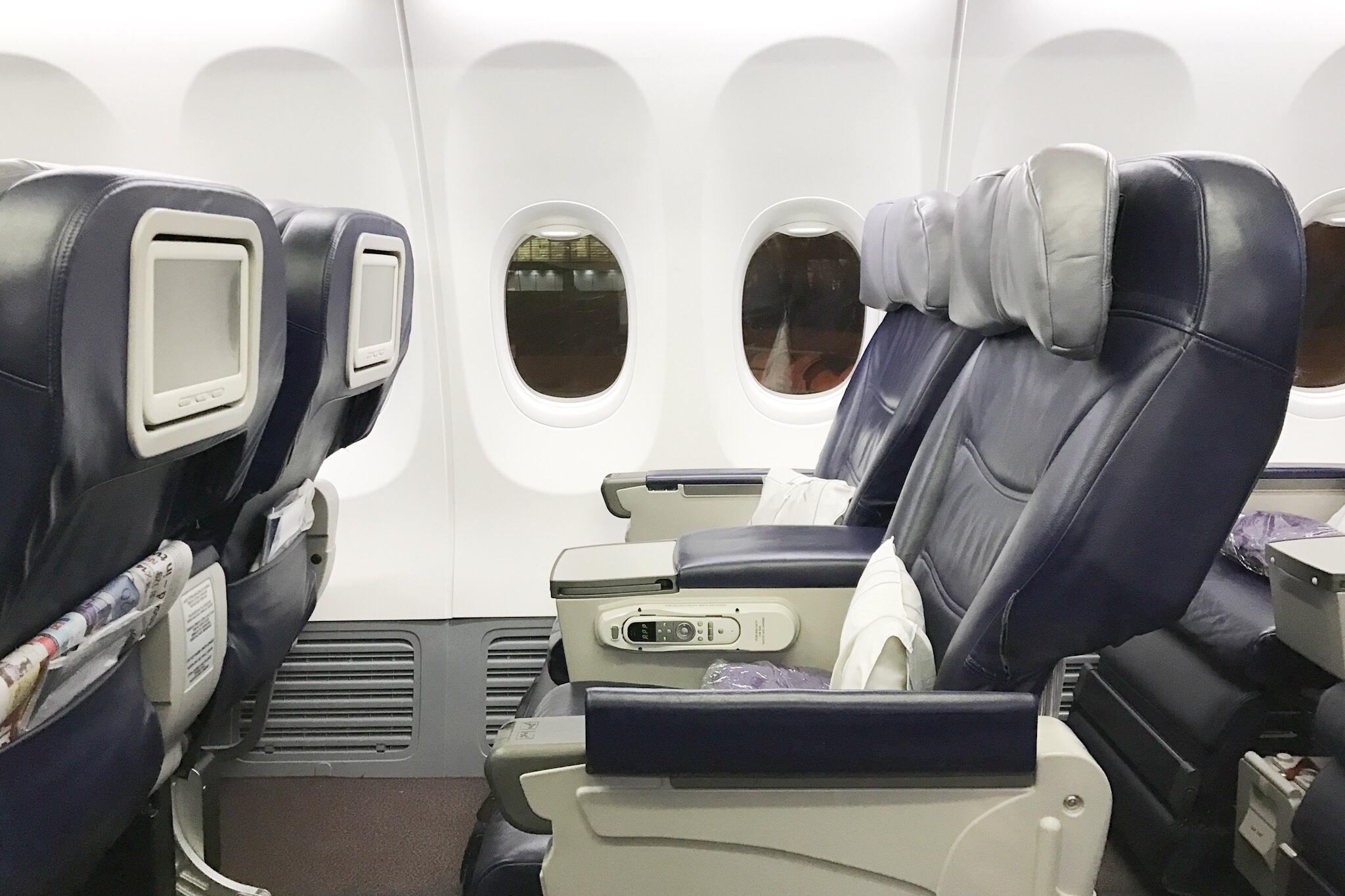
    Malaysia Airlines’ Boeing 737-800 features 16 business class seats, laid out in a 2-2 configuration across four rows. In economy class, there are 144 seats, laid out 3-3 across 24 rows.

    Malaysia Airlines B737-800 business class

    The business class seats are recliners, which is perfectly fine for ridiculously short haul routes like mine. What you need to be aware of is that Malaysia Airlines also uses these narrowbody aircraft on some mid-haul route, including the Shanghai Pudong — Kuala Lumpur red eye service that I took some time ago, and also sometimes to Perth. So, always check the aircraft before you book.

    I’ve pretty much covered most of the seat in my review from Ho Chi Minh City to Kuala Lumpur, so there really isn’t much to add.

    The service

    Given that this was a ridiculously short flight with under an hour flying, one should not expect anything much.

    The business cabin was only half full when the aircraft door was closed. Only when the economy class passengers were all boarded and the aircraft door was closed then a cabin crew came around to offer a pre-departure drink of either apple, orange or guava juice.

    Pre-departure drink: orange juice

    One thing to note in case you don’t already know this: Malaysia Airlines have taken off alcoholic beverages from all flights under three hours for a few years now, that effectively means all domestic service, as well as most of the regional services within Southeast Asia, no longer carry booze.

    Shortly after I picked up the orange juice, the crew came around with a cold towel. Being pretty grossed out by the state of the cleanliness on my last flight, I used it to clean the armrests again.

    Soon we were on our way. The moment we are at cruising height, the cabin crew around to offer a snack: a choice between a tuna sandwich, or a curry puff. I decided to go with the sandwich, which was quickly brought to me on a tray, with a piece of Beryl’s chocolate.

    Spicy tuna sandwich

    It was… alright. I also asked for a glass of sparkling water, which was promptly brought to me, along with the rest of the bottle.

    After I was done with the sandwich and my drink, the cabin crew came around offering a choice of hot beverage, which I was pleasantly surprised at, given the short length of the flight. I opted for a green tea, which again, was brought to me rather quickly. I had at least another 15 minutes with the tea before it was being kept for landing.

    Final thoughts

    Given that this is an incredibly short flight, there really isn’t much to expect out of a flight like this. It’s ridiculous to expect anything to eat on a flight like this, and you are better off filling yourself up with food before or after your flight.

    The cabin crew is extremely efficient, which isn’t hard to achieve with only half the business seats filled.

    Spritzer sparkling water

    The aircraft is incredibly old, but good enough for a short hop from Kuala Lumpur to Singapore. I generally have no issues with old aircraft, but what really bugs me is the state of cleanliness of the aircraft. Fortunately, this aircraft was a lot cleaner than the previous one I took from Ho Chi Minh City to Kuala Lumpur.

    At the time of writing, a return business class ticket between Singapore and Malaysia is about S$700 from Singapore, or RM2,200 from Kuala Lumpur. If you are redeeming miles, that will set you back by at least 32,000 miles. No one should really be spending that kind of money or miles for a journey like this, and the only reason why you should fly this is if you are connecting on to somewhere else.

  • REVIEW: InterContinental Kuala Lumpur, Grand Premier Room with Club access

    REVIEW: InterContinental Kuala Lumpur, Grand Premier Room with Club access

    In a frantic attempt to complete the IHG Accelerate challenge by 31 July 2018, the end of the promotion period, I had to clock two nights at any InterContinental properties across Asia Pacific or the Middle East.

    Given that I’m not going to hop on a seven-hour flight to the Middle East for a stay, I began scouring this region. The cheapest InterContinental property in Asia Pacific turned out to be right next door: Kuala Lumpur.

    I booked myself into the entry level room for two nights at the InterContinental Kuala Lumpur for a total of just under RM1,100 over two nights. The property has also offered a e-Upgrade option where you can opt for certain payable upgrades, which will be confirmed at check-in.

    For this stay, apart from offering a paid room upgrade opportunity, the hotel also offered Club InterContinental access for RM150++ per person per day. Since I was going to stay alone, this is much more worth it than paying RM230++ for an upgrade to a Club InterContinental Room.

    The Hotel

    InterContinental Kuala Lumpur is located in the heart of Kuala Lumpur near Ampang Park, or a stone’s throw away from KLCC. The hotel is easily accessible from KL Sentral via the LRT, so travelling from the airport to the hotel is relatively fuss-free on public transport.

    AB59C9E4-2F13-4944-8C90-55DFB1D44578
    InterContinental Kuala Lumpur, formerly Hotel Nikko

    The 473-room property took on the InterContinental brand only in February 2011. Previously Hotel Nikko, the hotel was built in 1997, which explains the design of the hotel: a large front lawn lined up with flag poles and a large driveway; a voluminous lobby adorned with a giant and rather gaudy chandelier. Having said that, the hotel was renovated when InterContinental took over in 2011.

    While this is touted as a five star hotel, the hotel had only rather standard amenities. Apart from meetings and conference venues, the hotel only had a 24-hour gym and a swimming pool for recreation. There’s an on-site spa, but beyond offering treatments, the spa did not have any relaxation facilities such as a jacuzzi or sauna.

    E8B5BAAB-A07A-4496-BA35-3D3E0D51218F
    Fairly good sized swimming pool

    The Room

    Checking in was a breeze considering I arrived in the middle of the day. The check-in staff did acknowledge my IHG Rewards Club membership, and proactively offered an upgrade to the Grand Premier Room.

    55597FA4-E922-4A28-B530-EF1D9CFC4464
    InterContinental Ambassador dedicated check-in counters

    Of course, while that sounded awesome, a closer look at the website showed that the first three room types – Deluxe, Premier and Grand Premier – were all of the same size, and offered the same amenities. And Kuala Lumpur is not a city with a great cityscape, so view is definitely not worth any premium.

    8CBA8490-6CE2-4B37-A739-1D38FFFB5EDD
    Entrance to the Grand Premier Room

    At 42 square metres, InterContinental Kuala Lumpur offers up a generous room size, consistent with other hotels built around the same time. The Grand Premier Room, later I found out, was more recently renovated than some of the lower tier rooms.

    The room featured a rather standard layout, with an oversized King bed backed upon a beige soft panel against one side and the TV on the other. I believe the bed could take up to an entire family of two adults with two very small children.

    7A52D65F-0F4D-4307-AD1E-A7EBD7F67CAF
    Grand Premier Room, InterContinental Kuala Lumpur

    The bed was rather firm to my liking, but the pillows were rather lacking in support. Both mornings I woke up with a slight neckache, which was a pity given that excellent bed.

    The bathroom now has a see-through glass wall that looks into the room, a feature that I don’t quite understand especially for larger rooms like these. In smaller, newer hotel rooms, hotels often do this to make the room more spacious. But in this case, I don’t see any particular function for this except if you’ll like to watch TV while standing up in the bathtub.

    70E508A2-4A30-4A3B-A652-5265319E28D0
    Spacious bathroom

    Having said that, I appreciated the large bathroom. Arguably one of the better designed toilets, with the details put in sensibly. When else will you need a phone unless you run out of toilet paper while you are on the toilet?

    The toiletries were from Agraria as well, similar to what is provided to all InterContinental properties around the world. The American brand markets itself as an aromatherapy brand, but I’m not too big a fan of their bath gels and shampoos as they feel rather watery and I ended up using half the bottle each time.

    Club InterContinental

    On level 26, certainly not as huge and definitely not as wonderfully designed as the Club InterContinental in Singapore. The decor is a little strange in my opinion, with large gaudy marble table tops and matching ugly chairs. The carpet was incredibly worn out too while the armchairs looked like they needed reupholstering.

    9969485D-ACC2-4F31-A87D-FC462352E21E
    Club InterContinental Lounge on Level 26

    The centrepiece of the lounge was a full marble countertop where food and drinks were placed throughout the day. Hanging above was an array of lights hung from an equally unappealing reflective metal piece. All in all, they looked like they were designed on a budget in the 1980s and never got refreshed.

    As with other Club InterContinental, the lounge offers all-day refreshments, with a la carte breakfast, high tea and evening cocktails for guests to enjoy.

    42F50E47-DA08-4EC3-8940-E2C9A931D69F
    Afternoon tea at Club InterContinental KL

    Right after checking in, I went to the lounge for the afternoon tea. The afternoon tea is available daily between 2.30pm to 4.30pm. Similar to InterContinental Singapore, there’s a three-tier afternoon tea set that’s served up, but you can also pick and choose from items if you are feeling peckish but don’t quite feel like a glutton.

    Scones were delightful but a little too starchy, clotted cream was on point. The rest of the items were passable, but nowhere near memorable by KL standards, given that you could get incredibly delicious food anywhere.

    A70F3944-01BB-4A1F-BD07-C96481222E57
    Afternoon tea at Club InterContinental KL

    I asked for a flat white to go with the high tea, but disappointingly what came was more like a cafe au lait.

    This is when I start to find the service a little awkward. The staff were all incredibly polite and attentive, but the presentation of food and beverage is pretty much awkward. The coffee I requested for came filled to the brim of the cup, which also means that the wait staff struggled not to spill anything while bringing it to me. The sparkling water that I asked for came at room temperature and a single ice cube, again filled right to the brim and I found myself trying not to spill any while lifting it off the table to bringing it to my lips.

    In the evening, cocktail hours was from 5.30pm to 7.30pm. Similar to the other InterContinental hotels, the Club lounge serve up a selection of hot hor d’oeuvres, along with a light buffet spread of canapés, cut fruits and cakes.

    2DB5C102-5C66-4518-B456-7E69B054C1E9
    Evening cocktails canapés 

    I got there at a little over 6pm, and the lounge was well attended, but not filled to the brim. I ended up at one of the high benches as most of the choice tables were taken up.

    What I thought was good effort on the hotel’s part was to have a theme each day. The first evening I was there, the food were essentially French, with a seafood skewer, some random beef cube and a mushroom tart. This was great, so I had a couple of servings through the evening along with the canapés and desserts.

    8B89B2F5-B427-44B6-9B3E-CD6A34549454
    Hot hor d’oeuvres, French themed

    The second evening was Japanese, with a trio of karaage items for the hot food, and other appetising selections such as spinach in sesame sauce, unagi with seaweed, cucumber and ponzu sauce as well as an assortment of sushi (it was just California maki and inari sushi). Even the desserts were Japanese themed, featuring mochi, azuki cakes and azuki matcha creme.

    Having said that, the quality of food was acceptable. It wasn’t mind blowing, but palatable enough for you to waste a bit of calories. Be sure to leave space to venture out and get yourself a wonderful Malaysian dinner.

    Breakfast

    As a Club InterContinental guest, you get a choice of breakfast either at Serena Brasserie at the lobby, or at the Club InterContinental lounge.

    I checked out Serena on the first day. Even before 9am, the restaurant was filled to the brim and there was a line outside waiting for tables. Not totally unexpected, given the size of the hotel. I was seated rather quickly given I was alone and the groups ahead of me were waiting for larger tables.

    277CE6D6-81C3-4D69-8ECA-F3F0DA698D8E
    Breakfast at Serena Brasserie

    I usually have rather high expectations of Malaysian hotel breakfast buffets. In my opinion, they are always much better than the Singapore hotels. For instance, the made-to-order roti canai at Eastern & Oriental Hotel in Penang still lingers in my mind (and its imaginary tastebuds).

    The variety of food at Serena Brasserie was pretty reasonable, with a splattering of offerings such as western options, to your local dishes such as congee with condiments, live cooking noodle station, dim sum and Indian curries. However, the quality was pretty dismal: while there’s a staff making roti canai, they were not cooked to order. It was more of a showroom, where he makes it, cuts it into smaller pieces and brings it out to one of the buffet tray.

    78BE95F7-120E-4850-A6C9-03CDF8486350
    Roti canai & dim sum, Serena Brasserie

    The noodles were also incredibly underwhelming, lacking flavour in the soup base. The ingredients were pretty dubious too, and I had no idea what the balls were.

    Above all, given the volume of guests, the trays often empty out quickly and the staff were slow in replenishing the food. I was staring at the empty tray of nasi lemak, with some remnants of rice left atop a banana leaf base, wondering if I should scrape the bottom of the tray.

    The only thing worth eating in that place? The chicken siew mais. I probably had six.

    The morning of the day I left, I decided to head up to the club lounge for my breakfast instead. As with other Club InterContinental lounges, it features a part buffet, part a la carte menu.

    CCA204BD-B0C3-4BD9-AFA7-3481004A89F8
    Breakfast at Club InterContinental KL

    While the menu wasn’t extensive, it had a bit of everything: some local options, along with the usual western eggs and even lighter options.

    Unsure of the portions, I decided to go for eggs first, done over easy. The single egg arrived slightly burnt, with two oily small tomatoes and some asparagus on the side.

    9A3B47C2-7895-4423-A263-F7D4EB8F1F9E
    Pancakes with berries

    Obviously a single egg is not going to fill me up. So after I was done with the egg, I ordered the pancakes. The serving was small, but totally unappetizing. For some reason, the pancakes came slightly cold and almost tasteless on its own. I gave up after one pancake.

    The buffet spread was slightly better, especially the nonya kuehs. That kind of was the saving grace for me.

    Final words

    Overall the hotel is pretty underwhelming for an InterContinental property. The rooms are decent, but the quality of food and service is pretty much lacking. For a foodie city, the quality of food, both in the lounge and at the breakfast restaurant, has to go up several notches to attract people to want to spend time in the hotel, although one can argue that you shouldn’t be spending time in any hotel in KL.

    F93EAF07-F0DB-4746-BF96-D730FCF44D1E
    InterContinental Kuala Lumpur

    Don’t get me wrong, it’s not that the service is bad. What is lacking is the refinement in the service, particularly of the wait staff in the lounges. The staff were friendly, but when it comes to plating food, serving drinks, you could tell that they needed a lot more training.

    While InterContinental Kuala Lumpur has got pretty good rooms and plenty of space to work with, the hotel will be hard pressed to compete with other properties in the city, especially if it wants to be a hotel of choice for business and premium leisure travellers alike.

  • FLIGHT REVIEW: Malaysia Airlines Boeing 737-800 Business Class, Shanghai Pudong – Kuala Lumpur

    FLIGHT REVIEW: Malaysia Airlines Boeing 737-800 Business Class, Shanghai Pudong – Kuala Lumpur

    Malaysia Airlines / 30 April 18 / B737-800 / MH PVG-KUL / Business Class

    Tl;dr – It’s not too bad, but avoid red-eye flights under six hours at all costs. Product is dated but still acceptable, timing of the flight is absolutely horrendous. Also, catering out of Shanghai airports generally suck.

    Malaysia Airlines B737-800 Business Class seats

    In another one of my crazy business trips up to Shanghai, I made the mistake of planning to travel back to Singapore via Hong Kong during the Easter weekend when half the territory is going on holiday. True enough, I didn’t manage to get any seats out of Hong Kong, so I ended up booking myself on Malaysia Airlines via Kuala Lumpur and the only option available was a red-eye departure.

    The flight departs from Shanghai Pudong airport at an ungodly hour of 2.30am, scheduled to arrive into Kuala Lumpur at a little over 8am.

    Now, for those who are unacquainted with Shanghai airport, this is one of the worst hub airports I’ve ever been to. The astounding lack of good quality restaurants, lounges and shopping is even more stark now as compared to what’s available in town. The lack of customer service at almost all travel touchpoints – from check-in, security, immigration – coupled with standard long wait times makes this airport an undesirable one for me.

    I left my hotel at about 12.30am for the 40-minute cab ride to the airport, and got to the kerb at about 1.15am. When I arrived at Terminal 2 – where Malaysia Airlines operated out of – the terminal was completely dark with only a handful of people within. You could have thought that the airport was closed, except that it’s not (it is technically a 24-hour airport).

    Airport experience

    Only three check-in counters were opened, and there were nobody in line when I got there. When I was checking in, the check-in agent was multitasking – checking me in while playing his mobile game. I let it go given that it’s really late at night and I know how tough is it to stay awake with nothing to do.

    One of the best things about travelling during such zombie hours is the lack of queues. I swept through immigration and security checks in less than five minutes altogether, a new record for me in Pudong, so much so I had some time to check out the lounge.

    The aircraft

    I made my way to the gate at about 2am, half hour before departure. The gate was still not ready for boarding when I got there, and as usual lines has already formed up. A glance at all the tired faces, you could tell that everyone was waiting to get in their seats so they could sleep.

    The choice of aircraft for this red-eye service was a Boeing 737-800, a narrowbody which holds 16 in business class and 144 in economy. Malaysia Airlines ply Kuala Lumpur-Shanghai twice daily, and uses an A330-300 on the day flight and this smaller aircraft on the overnight flight, a decision which baffles me.

    16 business class seats in a 2-2 across configuration

    Now a little bit about MH’s 737s. Malaysia Airlines has a relatively large fleet of about 52 of these birds, which they use primarily for domestic and regional services, and Shanghai was one of the furthest destinations they have for this fleet.

    The 16 seat business cabin was laid out in a 2-2 across configuration, and featured recliner seats which was hardly ideal for a red-eye. Each seat measured 21 inch across and had a pitch of 42 inches.

    Obviously there wasn’t any fancy controls to handle, apart from some mechanical buttons to control the seat back and leg rest.

    The service

    Given that this is a red-eye service that departs at a god-forsaken hour, I was bracing myself for grumpy cabin crew. Who wants to work through the night?

    Fortunately for me there was no such thing. The crew was friendly, albeit a little quiet, but still very professional in the truly Malaysian hospitality.

    Pre-departure drink, no alcohol served

    In the front, there were two cabin crew including the inflight supervisor, who worked the business class while the rest were at the rear. When we first boarded, they quickly offered earphones and a choice of welcome drink of juice or water for pre-departure drinks. Consistent with other flight reports, no alcohol was offered on ground.

    I noticed there was no newspapers distributed or offered to passengers when I was boarding and was wondering if that’s normal. When I got to my seat, I realised why – the newspapers were stuffed into the seat back pockets at random. I had a copy of The Star, while my neighbour had a copy of the New Straits Times. Given this was 2.30am I decided that it was a bad idea to be difficult and request for a Chinese newspaper for the sake of it.

    Complimentary Malaysian newspaper

    As a narrowbody, this means that while premium passengers get to board first and relax in their seats, they also end up being exhibits while the economy class passengers file through from the front door. Awkwardly that means your every move, whether you start getting comfortable and all covered up in your blanket, or having your pre-departure drink, is being observed by all 100 over passengers as they move pass you.

    Soon enough, as the plane pushed back and took off on the 5-hour journey down south to Kuala Lumpur, the lights never came on and most of the cabin went to sleep.

    I went up to the crew and asked for a glass of champagne, which they obliged. I supposed they were a little taken aback given that most passengers went straight to sleep, while this alcoholic (me) wanted some bubbly at an unearthly hour.

    Feeling bad for having to open that bottle, I had a second round, before finally retiring for the night.

    About 90 minutes before landing, the lights were turned on and breakfast service commenced. The sky was starting to light up as it was about 6.30am in the morning.

    To start off breakfast, there was a side of fruits, yogurt and a choice of hot bread. I went for the croissant, which was surprisingly light and fluffy.

    Signature Malaysian breakfast – nasi lemak

    For mains, there was three options in Business – a western breakfast, an oriental option of dim sum, or the classic Malaysian choice of nasi lemak. Instinctively I went for the last choice, given my love for the dish. Unfortunately the rice was a little too moist and mushy for my liking, and lacking the distinct coconut aroma, but otherwise the curry chicken was good.

    Overall the flight service was very acceptable, despite the choice of timing and aircraft. Understandably, given the economics of routes in and out of Malaysia, one can understand why Malaysia Airlines operates the B737 on many of its routes given the weak demand on many of the routes especially after 2014, despite very good prices.

    Poor Malaysia Airlines’ reputation had taken a tremendous beating since the twin tragedy in 2014 and ticket prices have been consistently low since.

    In what seem to be an uplift, it has most recently taken delivery of the A350 which has promised to offer a much better experience, including in-flight wifi, and will also start moving away from the A380 to better manage its commercial performance. Given the slow and steady shifts in the business I do look forward to much improvements in the product and the classic Malaysian hospitality that it has always strived to offer.