Cathay Pacific’s Asia Miles is currently offering a bonus for credit card points converted in Asia Miles. The offer runs from now until the end of January 2020.
The offer
From now until 31 January 2020, Asia Miles members who convert credit card points into Asia Miles will receive 10% bonus points.
While this year’s promotion is lightly less than last year’s 15% bonus, the upside this time round is that there is no cap to the number of miles you can transfer. In 2019, there was a 10,000 miles cap on the number of bonus miles you can receive.
How to sign up
To qualify for the bonus, first you will need to register through this link.
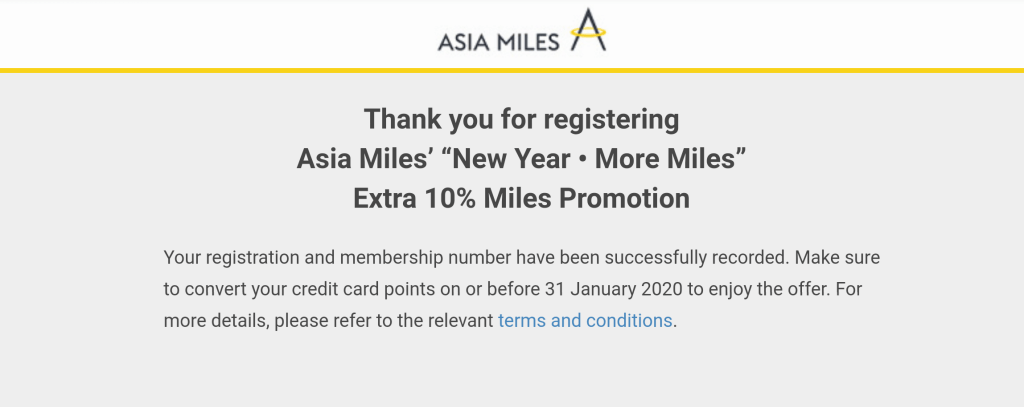
You should see a confirmation page once you have registered.
Next, go on to make the transfer from your credit card points to Asia Miles. For those based in Singapore, you can transfer from the following banks or card issuers into Asia Miles:
American Express
Bank of China
Citibank
DBS
HSBC
Maybank
UOB
Note that the 10% bonus miles will only credit 6 to 8 weeks after January, so don’t count on it if you need the miles urgently.
Asia Miles has confirmed that as long as the transfer request is initiated before 31 January 2020, the bonus miles will be awarded.
In any event if you do not see the bonus miles come in, be sure to contact Asia Miles by 31 May 2020, after which they will not entertain any further claims.
As part of my mattress run in Shanghai, I took out one night at DoubleTree Shanghai Jing’an, a relatively new property in Shanghai.
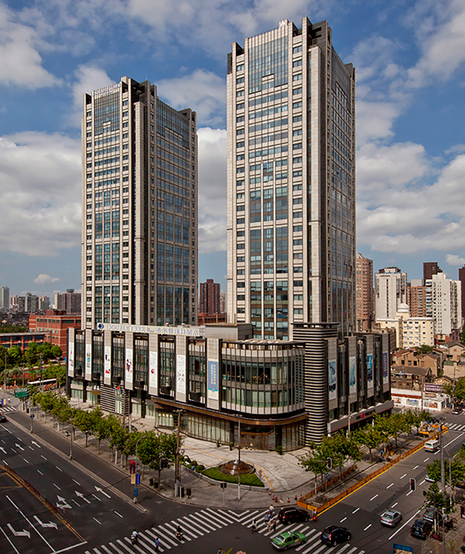
Located on the west side of the Huangpu river, the hotel is centrally located near to some of the commercial districts, in the Jing’an district. At the time of my stay, the hotel is only about four months old, having opened only in July 2019.
The 307-room property is the second DoubleTree branded property in Shanghai, with the first one located in the Pudong new district.
Rooms at the hotel run in two towers, up to 28 floor each. At the time of my stay, it seems like all the guests were funneled to only one of the towers, with the other one cordoned off.
This property is located about 15 minutes north of Shanghai’s famed Xintiandi area. The actual distance is not that far, but the traffic in Puxi area leaves much to be desired pretty much throughout the day, no thanks to the many traffic lights.
There is a subway station (Line 8) about 10 minutes walk away, so that is always an option in the cooler months, and you may be surprised it might be faster than taking a car ride at certain times of the day.
As for the distance to the airport, the hotel is about a 30 minutes drive from Hongqiao airport, and 45 minutes away from Shanghai Pudong International Airport.
The room
As a Hilton Honors gold member, I was once again upgraded, this time to an executive room. However, I didn’t have the chance to check out the executive lounge on this trip, as I was out of the hotel most of the time.
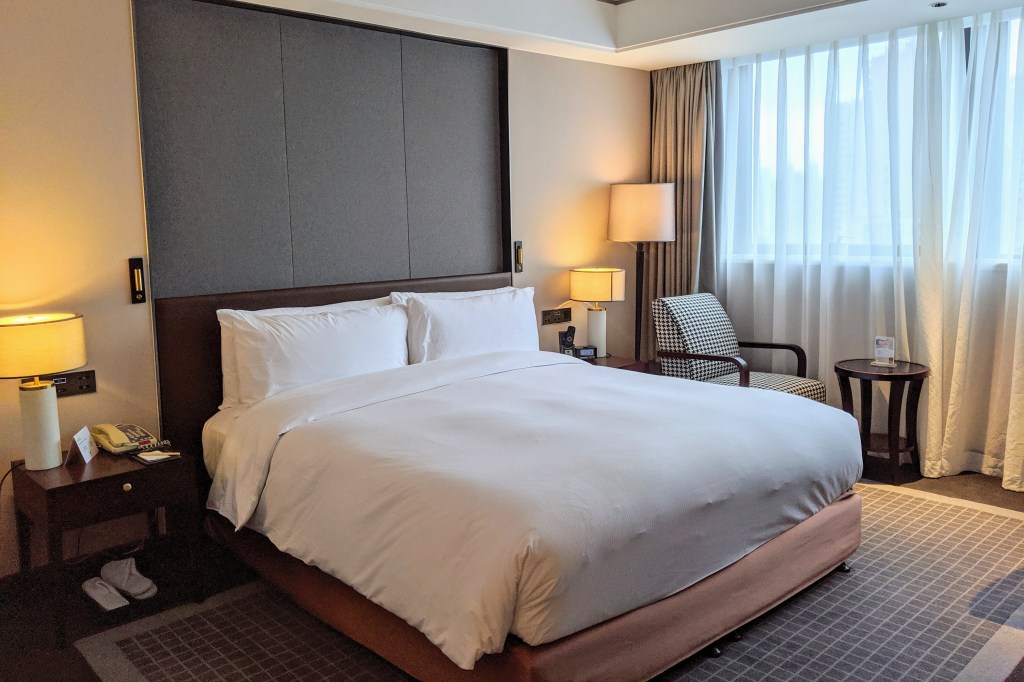
DoubleTree Shanghai Jing’an, King Room
The room itself was pretty much a standard King room, which was fairly small based on the past rooms in China I’ve stayed in before. The room was decked out in modern dark wood finishing, which thankfully was accompanied by pretty decent lighting.
The king bed was generous in space and fairly comfortable, unfortunately the choice of pillows left me with a neckache the morning after as all the pillows are too soft. If you a side sleeper, you may want to use the extra pillow in the closet, or request for even more pillows.
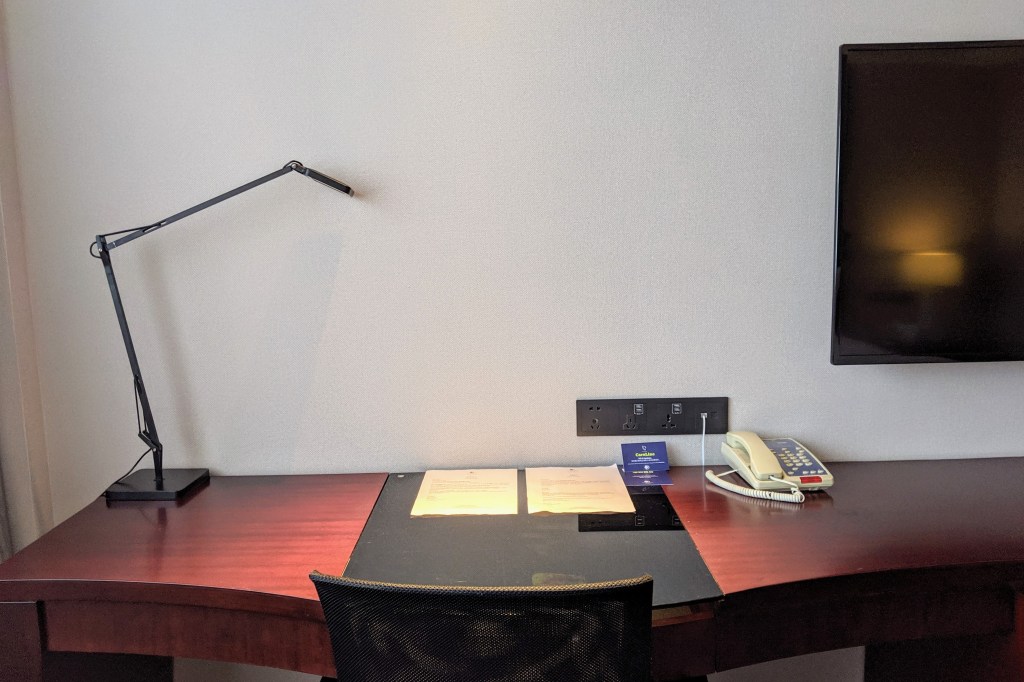
There was also a sizeable work desk, making this a decent hotel to use for business trips.
Working desk in room
The electrical fittings were also pretty well thought out, with an assortment of international sockets available at the work desk, as well as USB charging ports by the bedside. This to me is one of the small but meaningful details hotels can do to make big differences in the experience.
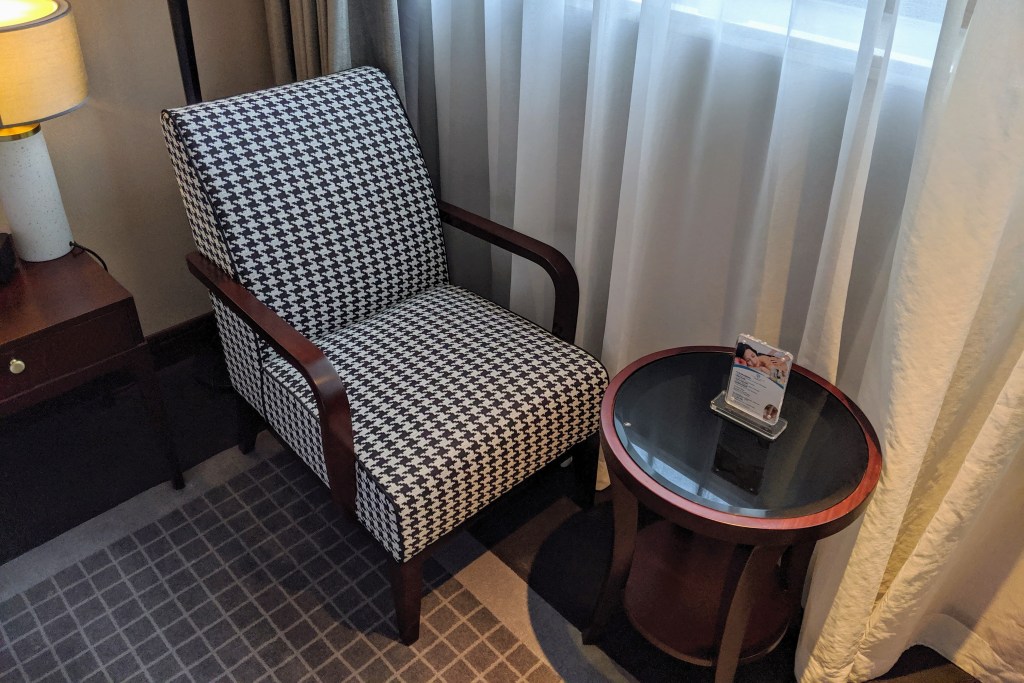
There was also a little armchair and coffee table by the window, which I thought was pretty unnecessary. The chair was stiff as hell so I don’t really lounge there.
Armchair and coffee table that I didn’t use
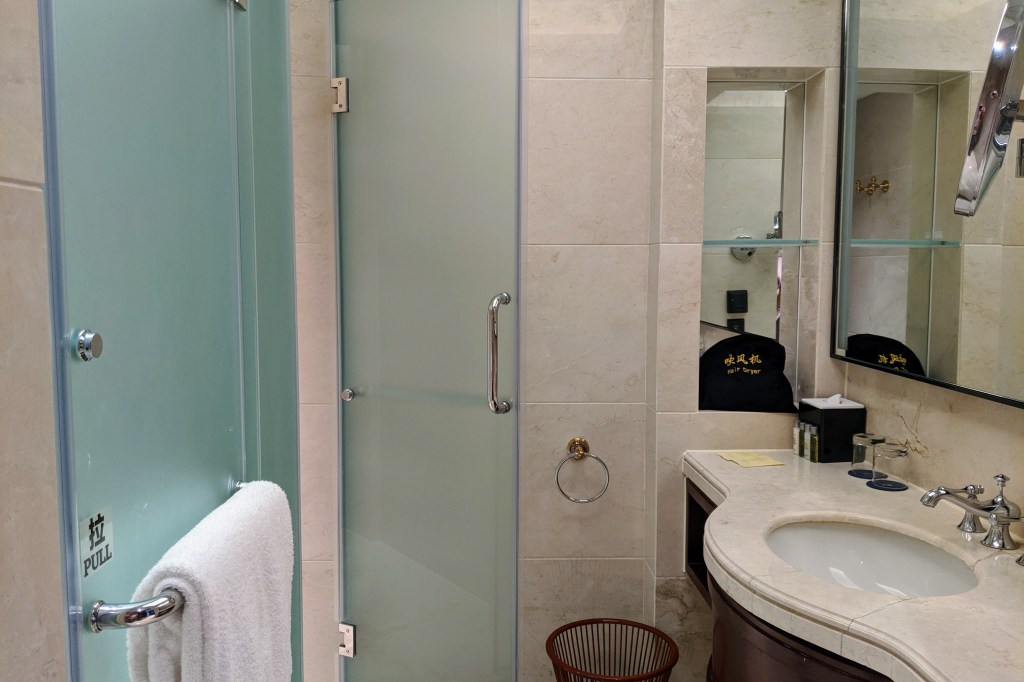
The bathroom was also pretty compact. There were separate toilet and shower cubicles, each with their own doors.
Bathroom with separate bath and toilet cubicles
I typically prefer this arrangement if I’m travelling with a companion, so that we could both use the bathroom at the same time if necessary. There was also a bathtub next to the shower, which was a rarity in newer DoubleTree properties.
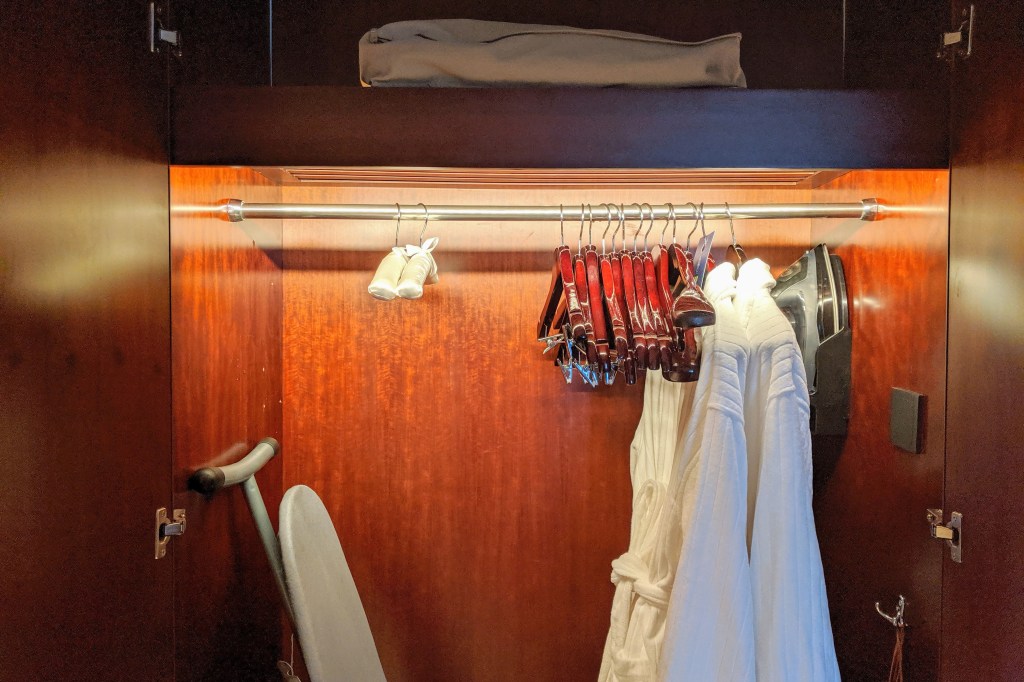
You will be able to find the other standard amenities such as a bathrobe, bedroom slippers, ironing board and iron, hairdryer, all either in the bathroom or in the wardrobe.
Wardrobe situation
Unlike the DoubleTree by Hilton Pudong, the minibar is not filled up. Instead, there was an order chit from which you can order, and the items will be sent up to your room. I personally prefer this model, so I can use the minibar for my personal items.
The facilities
As I had a pretty short stay there, I didn’t have much time to fully check out the hotel.
There is an executive lounge on the 27th floor, which opens from 10.30am daily. Do note that if you have executive lounge benefits either as part of your room or your Diamond status, there is no breakfast served in the lounge so all guests will have to head to the level 2 restaurant for breakfast.
The lounge also serves up afternoon tea as well as evening cocktails daily, but do check with the reception on the exact hours.
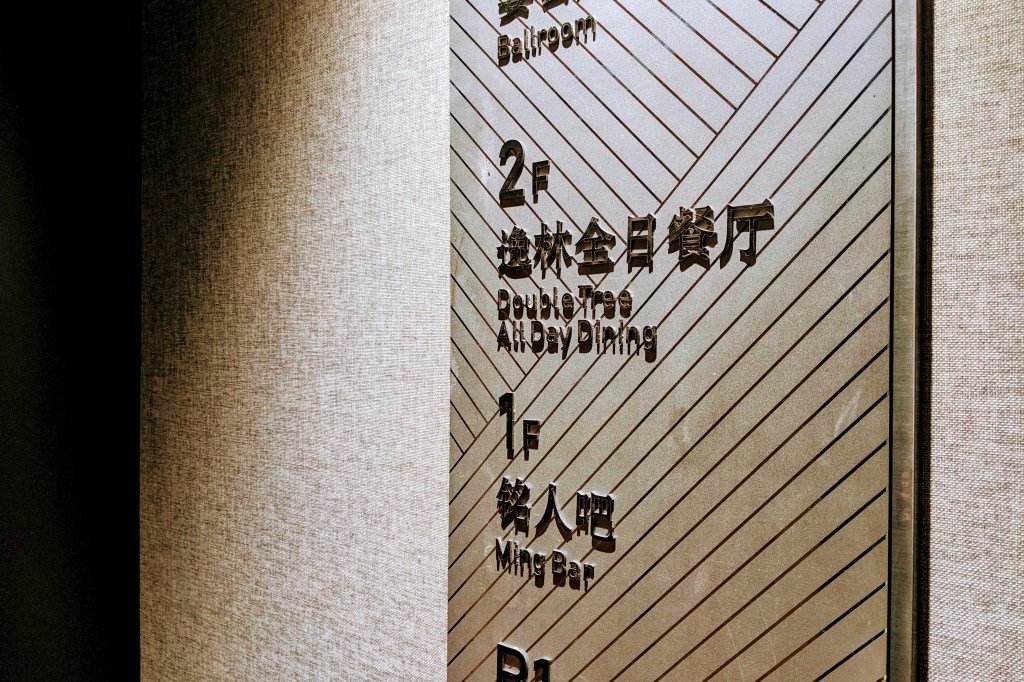
All-day dining restaurant on 2nd floor
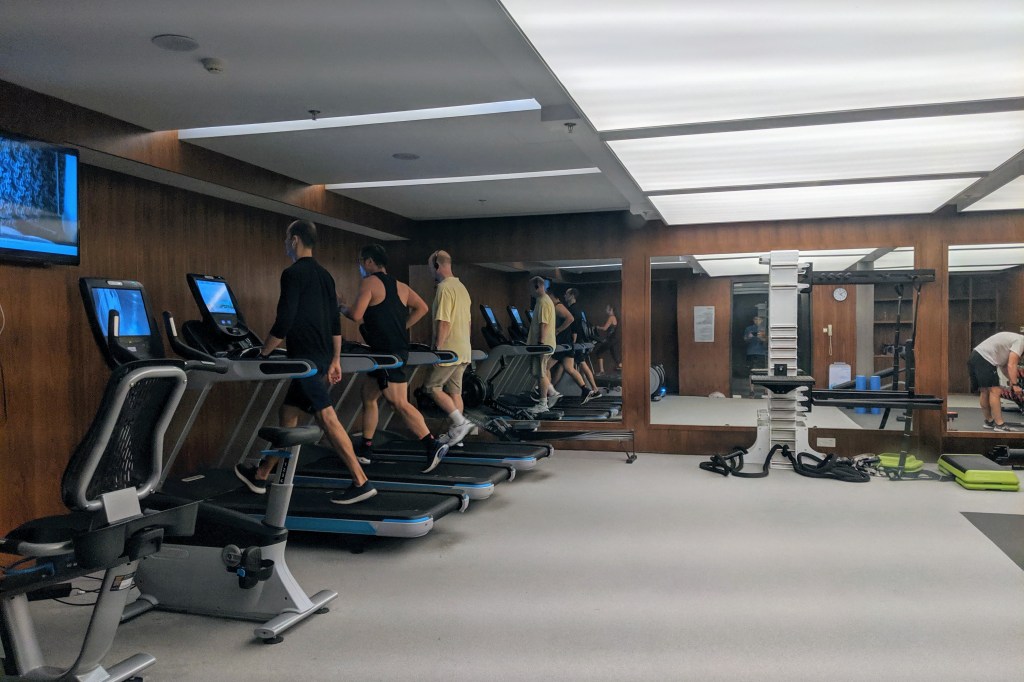
As for recreational facilities, DoubleTree by Hilton Shanghai Jing’an has a fitness centre in the basement. While I didn’t use it, I went to take a look and found it pretty well equipped.
Fitness centre in the basement
The strange thing about this hotel is: I’m not clear if there was a swimming pool. Based on earlier news reports about the property, there seems to be one. However, it was not mentioned on the hotel official website, neither was it mentioned in the information booklet or any of the signs when I was in the hotel.
Also, there are no spa services or facilities, so in this respect the hotel is pretty no-frills.
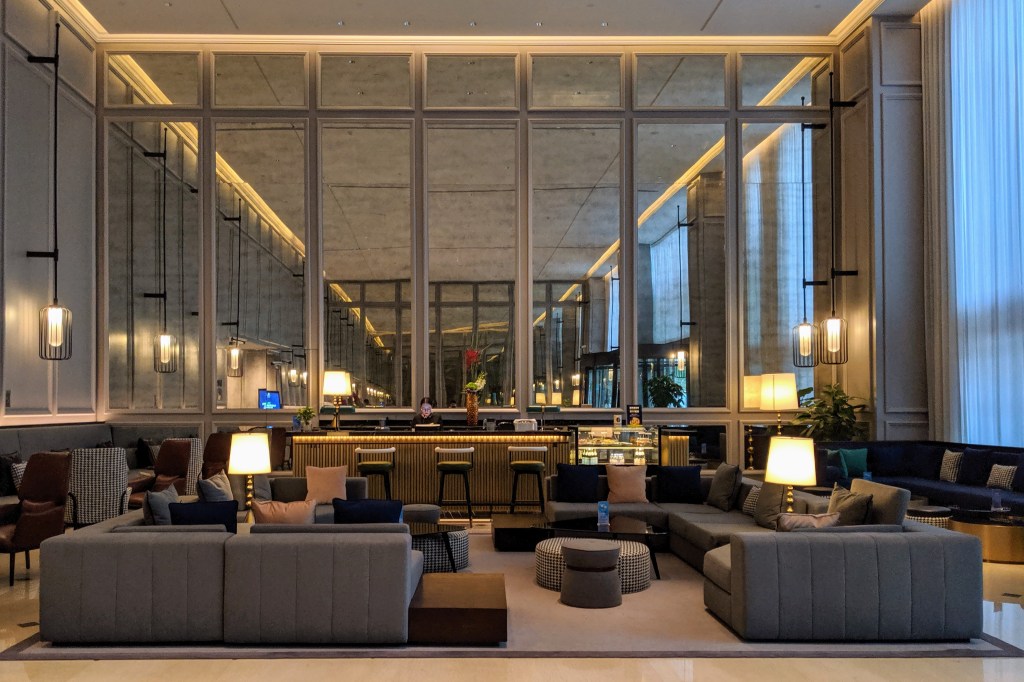
Lobby bar
There is a lobby bar on the ground floor for your evening tipple and a Starbucks within the same building accessible from the lobby, even though it is technically not part of the hotel.
Breakfast
Breakfast was served at the all-day dining restaurant located on level two of the hotel.
When I went down for breakfast, I was a little lost. My room number was taken by a staff at the door of the restaurant, but the staff signaled for me to head into the restaurant and look for a table by myself.
DoubleTree by Hilton Shanghai Jing’an breakfast restaurant
I don’t usually like to do that at a hotel breakfast restaurant, as many people are usually walking around taking food, and I certainly didn’t want to accidentally sit at a table that someone else had taken.
Also, at first glance, some of the tables had incomplete settings, so all the more I wasn’t sure if those tables were taken. Eventually, I found a huge booth (ample seats for six people) which wasn’t taken, and I awkwardly took up the table.
A little about the space within the restaurant. The restaurant was huge, but lacking in natural light. There were also not many tables, and while I liked space, I felt this restaurant had too much space.
Plenty of space in this restaurant, but a little too much space
Food selection was terrible. There was a lot of food, but nothing particularly stood out. Some of the food on offer included one entire section of steamed goods, but it turned out to be all root vegetables (potatoes, lotus roots, tapioca). There was also a tray of fried dough items that was present in a pretty haphazard and unappetising manner.
Tray of deep fried dough and spring rolls, anyone?
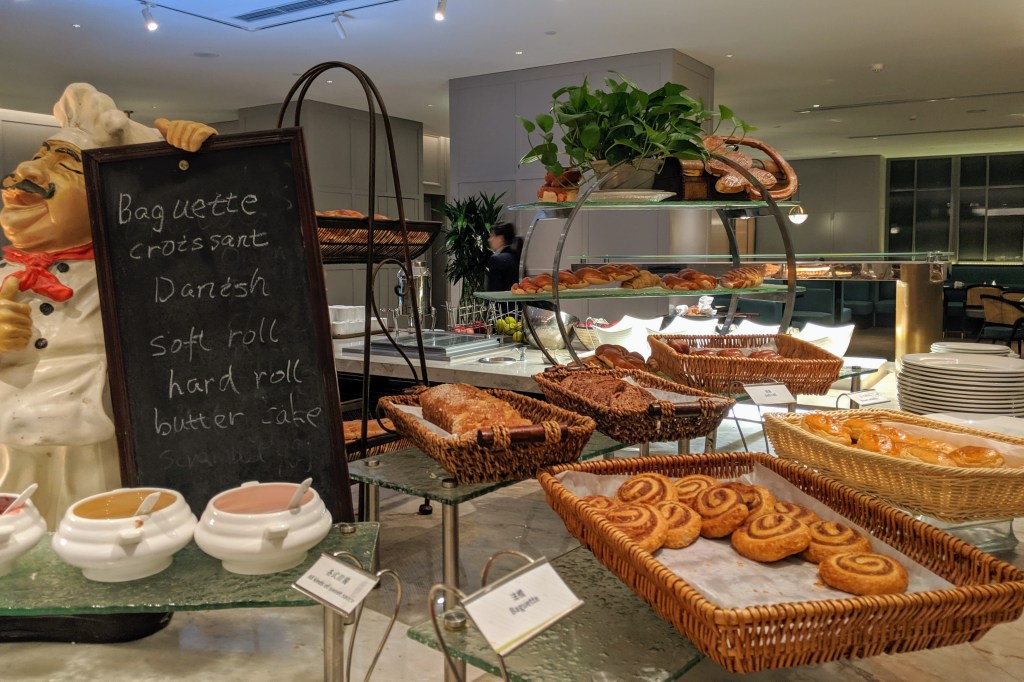
There was also the usual western breakfast offering, including an egg station, bacon, sausages and bakery items, but none of them looked appetising.
Bakery items
As such, I simply took a croissant and a fried egg to fill myself up a little, before skipping the restaurant and head out for a much better breakfast.
Final thoughts
As with all newly built hotels, the finishing for the hotel is gorgeous. I loved the spacious lobby,
Unfortunately, this strength of the hotel is also its weakness. In my opinion, there was a poor use of space. There was so much more potential in what the hotel could use the abundant space in lobby for, such as a cafe (or two) or perhaps even a bistro.
The rooms on the other hand, are fairly efficient in terms of space to a fault as well. I would have preferred slightly more space to move around within the rooms, particularly the bathroom.
In my previous trips to Shanghai I’ve always stayed at the now-gone Hilton Jing’an, which has always been excellent. Having not visited Shanghai in a while, I was horrified to find out that Hilton Jing’an, a well-known landmark having been around for over four decades, have been sold off and is now rebranded as Kunlun Jing’an Hotel. So now if you are looking for a Hilton-branded property in the Jing’an area, the DoubleTree by Hilton Shanghai Jing’an is your only option.
Ever since SPG and Ritz Carlton Rewards were folded into Marriott to become the Bonvoy monster that it is today, status has never been tougher to get.
With Platinum requiring 50 nights to get, one of the lesser known nifty trick was to book a meeting with Marriott. For the first meeting or event held at a Marriott property in 2019 and before, you will get 10 free elite nights credit.
On top of that, you also get:
One elite night for every 20 eligible room nights you book, up to to 20 elite nights per event
Two points per USD spent on qualifying event charges, up to 60,000 points per event. Elite bonuses will stack on top of these points.
The meetings booking is a rather value-for-money way to earn 10 elite night credits, as meetings can go for as cheap as S$500 or under for a half-day meeting package in Singapore.
No more 10 elite nights for first meeting from 2020
Starting 2020, the 10 night credit will be removed. The other perks remain, so you will still get the points based on your spend, as well as the elite night credit for every 20 room nights booked.
So for those who are chasing to keep their platinum status, this is definitely a bad development. That also means that they will continue to have to earn the nights the good ol’ way of actually booking rooms.
Although I’m based in Singapore, personally I’m more of a fan of Oneworld airlines rather than Star Alliance (and by extension, Singapore Airlines). As a matter of habit, I find myself booking on Oneworld carriers more than on Singapore Airlines, given the relative higher price of the latter out of Singapore.
Back in 2018, I paid good money to be part of Marco Polo Club (which is separate from the Asia Miles programme) and managed to get myself to silver after making several trips. The perks at this Oneworld Ruby level is pretty decent: while I’m flying Cathay Pacific or Cathay Dragon, I’ll get lounge access.
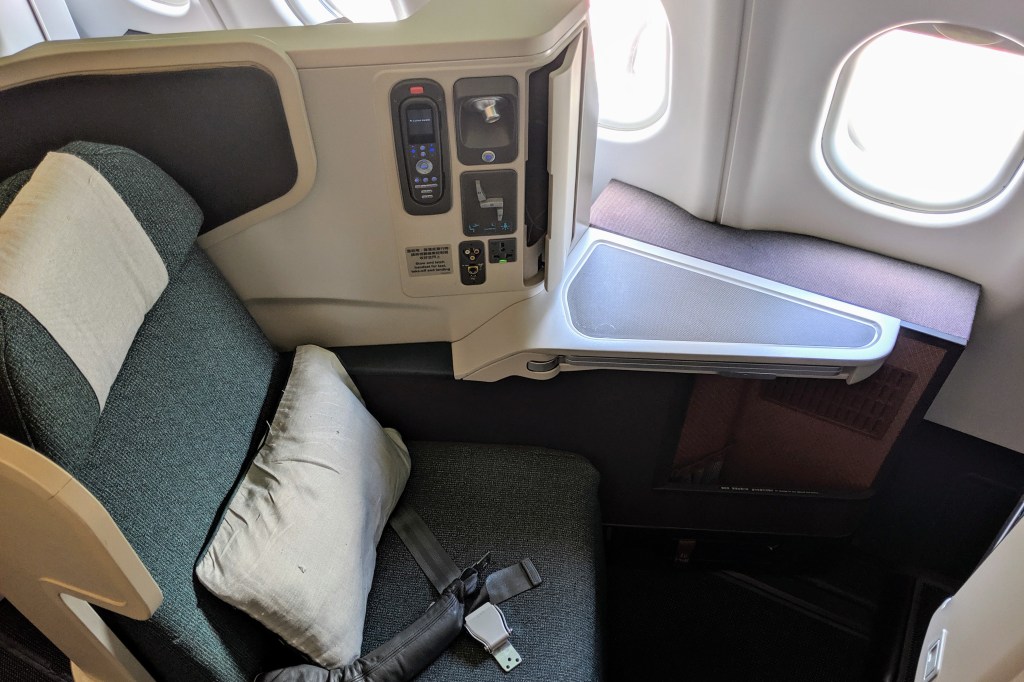
Cathay Pacific A330 business class seat
So after having a year of Marco Polo Club Silver and enjoying its pretty good perks, I thought I’ll try out Qantas Frequent Flyer and see how far I will get. I knew I was going to fly more in 2019 so I wanted to see if I will be able to fly enough to qualify for Gold, which will offer me more perks.
For a start, joining Qantas Frequent Flyer is free (note that if you reside in Australia or New Zealand, there’s a joining fee). This is in contrast with the USD100 I had to pay to join Marco Polo Club.
Qantas Frequent Flyer Gold benefits
For the uninitiated, Qantas Frequent Flyer (QFF) belongs to the Oneworld Sapphire tier, which is equivalent to Cathay Pacific Marco Polo Club Gold, or British Airways Executive Club Silver.
As a summary, this is what you get at QFF Gold, which is also what you get as a Oneworld Sapphire elite status holder:
Oneworld business class lounge access when travelling on Oneworld airlines
75% bonus Qantas points when travelling on Qantas, Jetstar, Emirates and American Airlines
Additional baggage allowances when travelling on Oneworld airlines
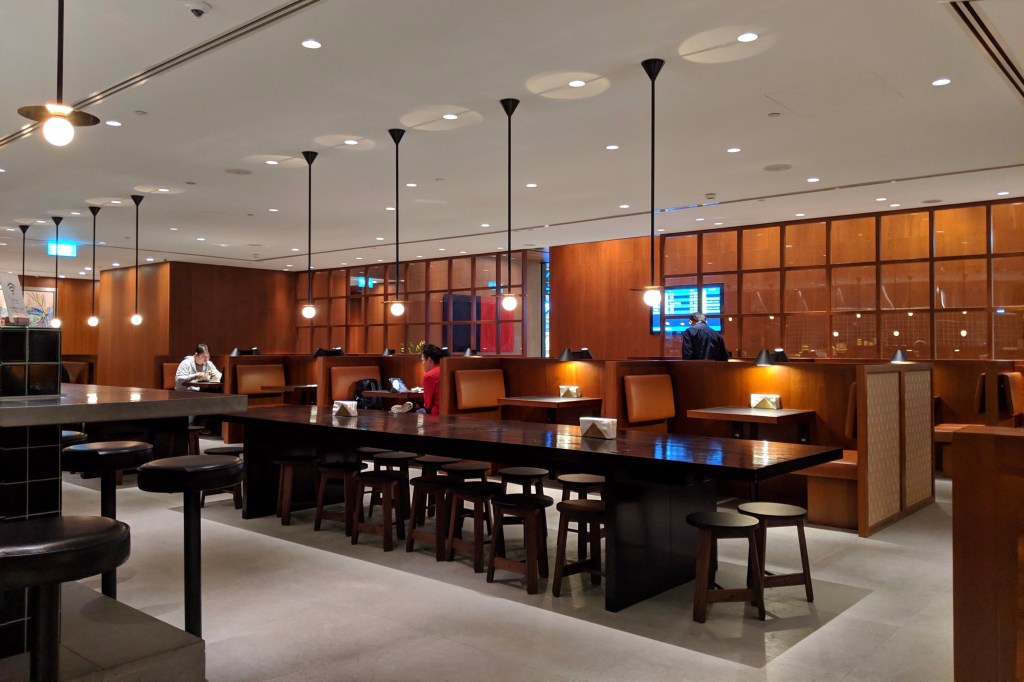
Oneworld Sapphire gives you business lounge access, such as this Cathay Pacific lounge at Changi Airport Terminal 4
Beyond the above, QFF offers some pretty unique perks, including:
Lounge access when travelling on Jetstar and Emirates
Access to Emirates lounges when travelling with Qantas
Additional baggage allowance
If you need detailed information on what QFF Gold offers, check out Qantas’ website here.
Lifetime Gold
More importantly, I have a chance to gun for lifetime Gold status at some point, when I hit 14,000 status credits (that’s another story for another day… maybe 20 years later).
Marco Polo Club has ceased their lifetime membership a while back so if I want to keep my status, I have to keep flying and accumulating 600 club points every single year.
How I did it
To qualify for QFF Gold, I’ll need to rack up 700 status credits in a year. To keep it in subsequent years, I only have to earn 600 credits each year.
This is a summary of the flights I took and the number of status credits I earned from each flight:
Flights
Trip Type
Qantas Points
Status Credits
Cathay Pacific business class Singapore to Okinawa (via HKG)
Return
7,750
280
Malaysia Airlines business class Singapore to Bangkok (via KUL)
Return
2,150
120
Qantas economy class Singapore to Perth
Return
4,050
50
Jetstar Max bundle Perth to Singapore
One way
4,050
50
Jetstar Max bundle Singapore to Ho Chi Minh Ctiy
Return
3,150
60
Jetstar Max bundle Singapore to Taipei
Return
4,400
80
Jetstar Max bundle Singapore to Bangkok
Return
3,150
60
Total:
28,700
700
So in total, I scored exactly 700 status credits and 28,700 Qantas points, enough for me to get QFF Gold.
Some people may argue that going to BKK via KUL is an absolute waste of time, which technically was not wrong. After all, why spend 5 hours travelling when you could spend just two?
However, this route is one of the best value to rake in status credits: at SGD600+ in business class for a roundtrip between Singapore and Bangkok, you get 120 status credits, working out to about a little above SGD5 per status credit.
As a point of reference, 28,700 Qantas points is enough for me to redeem a one-way economy class ticket to Sydney on Qantas, or a one-way economy class ticket to Japan.
One way Economy class ticket from Singapore to Sydney on Qantas: 25,200 points + $123.30One way Economy class ticket from Singapore to Tokyo-Haneda on Japan Airlines: 24,500 points + $106.90
How does this compare if I were to credit the points to Cathay Pacific Marco Polo Club or British Airways Executive Club?
For a start, over a third of my status credits came from Jetstar flights, so we are naturally comparing apples to oranges.
To recap, to reach the equivalent of QFF Gold, I’ll need either:
600 tier points for British Airways Executive Club + 4 segments on BA
600 club points for Marco Polo Club
Even if I swapped the Jetstar flights out for Malaysia Airlines or Cathay Pacific flights, this will be how my earnings will look like on BAEC and Marco Polo Club:
Flights
Trip Type / Fare Class
BAEC Avios
BAEC Tier Points
Asia Miles
MPC Club Points
Cathay Pacific business class Singapore to Okinawa (via HKG)
Return
6,222
160
10,000
120
Malaysia Airlines business class Singapore to Bangkok (via KUL)
Return
2,390
160
2,358
80
Qantas economy class Singapore to Perth
Return O class
1,214
40
0
0
Qantas economy class* Perth to Singapore
One way O class
607
20
0
0
Malaysia Airlines economy class* Singapore to Ho Chi Minh Ctiy
Return V class
422
20
0
0
Cathay Pacific economy class* Singapore to Taipei
Return Q class
1,056
20
2,660
30
Cathay Pacific economy class Singapore to Bangkok*
Return Q class
448
10
2,000
20
Total:
12,359
440
17,018
250
*substituted with the best matched Oneworld carrier routing
As you can see, the number of tier points and club points don’t quite get me to Marco Polo Club Gold nor British Airways Executive Club Silver, or even anywhere near.
In terms of the number of miles earned, 12,300 Avios is hardly enough to get you anywhere, while 17,000 Asia Miles can get you a one way ticket to Hong Kong, or even Shanghai, albeit in economy.
tl;dr – both Marco Polo Club and BAEC are solid programmes, but this will not help leisure traveller me get to the Oneworld Sapphire level as easily as with Qantas Frequent Flyer.
Jetstar Asia is a key advantage
The ability to earn Qantas points and status credits on Jetstar is also another huge plus for QFF. As I’m based in Singapore, taking Jetstar flights was easy, given it’s the home for Jetstar Asia.
To get points and status credits with Jetstar, you will need to purchase either the Starter Plus or Starter Max bundle. I usually go with the Max bundle, so that gives me 30kg check-in baggage allowance, a complimentary meal, seat selection on any seat in the aircraft, as well as a decent amount of Qantas points and status credits.
For instance, for an extra SGD180 (the price of the Starter Max bundles on a roundtrip) on a roundtrip between Singapore and Taipei, you get a whopping 80 status credits and 4,400 points on the fare (my total fare including the bundle was about SGD520). This is a very good value if you ask me, as I usually will purchase check-in bags and food on board anyway.
The best part is that if you travel with Jetstar, the flights count towards the four Qantas/Jetstar flight per year requirement in order to get Silver or higher status, which makes it really easy for Singapore-based travellers.
Maintaining QFF Gold in 2020
Will I strive for Gold in 2020? Definitely. I have a couple of trips on Qantas coming up in 2020, including one in Premium Economy that I’m dying to review.
Hoping to score the new Qantas A380 when I’m doing the premium economy cabin later this year (photo: Qantas)
On top of the Qantas flights, I also have a couple of weekend trips planned, and can easily take Jetstar on those trips to clock up status credits and maintain my Gold status.
Having said that, the caveat is this: QFF is a solid programme if you care about getting elite status that gives you perks such as extra baggage allowance and lounge access when you travel, rather than having cheap redemption options for award tickets.
It’s not that QFF does not allow you to redeem, but rather, Qantas still has an opaque “additional fees and surcharges” that comes with the redemption tickets, that may make the programme very unattractive. For instance, a one-way redemption in business class from Singapore to Sydney will set you back by over 68,000 points, and another $250 in fees and taxes.
All in all, I still find it very good value to go with Qantas Frequent Flyer, given that my total investment to get gold was slightly over SGD4,000, or about SGD5.70 per status credit, which is pretty economical.
And the perk of getting into a good quality (read: non pay-per-use lounge) lounge all the time? Very much worth the chase.
For my final leg home from Shanghai on a weekend trip, I took advantage of Singapore Airlines’ Spontaneous Escapes offer last month and redeemed a one-way business class seat from Shanghai to Singapore at 27,300 miles.
The usual redemption rate is 39,000 miles each way in business class for PVG-SIN, so this was pretty good value.
I’ve not tried Singapore Airlines’ latest business seat product that was launched in 2017, so I was looking forward to reviewing this seat.
For those who are familiar with SIA’s Spontaneous Escapes, this is a monthly offer which offer select cabins on certain routes at a 30% discount for travel in the following month. SIA’s China services, including Beijing and Shanghai, tend to always be on offer.
SQ operates out of Terminal 2 at Shanghai Pudong International Airport, along with most other Star Alliance carriers including Air China, Thai Airways and United Airlines. Check-in was relatively fuss free, with three dedicated business class check-in counters, so there was hardly any queue.
While there is not a dedicated immigration lane for business class passengers, there was one for security screening right after immigration. The immigration lines can get pretty backed up, so arrive early.
Singapore Airlines does not have its own lounge in Pudong, so guests are directed to the Air China business class lounge.
Singapore Airlines premium cabin customers use the Air China lounge at Shanghai Pudong airport
The flight was scheduled to depart at 1625, and boarding commenced about half an hour earlier. As usual, passengers in suites and business class, as well as PPS members, were invited to board first.
The aircraft
Singapore Airlines deploy an assortment of aircraft on the four times daily Singapore-Shanghai service, including the Boeing 777-300ER, A380 and A330. The service frequency and aircraft type also varies during different times of the year depending on demand.
For the A380, Singapore Airlines is currently undergoing a fleet refurbishment process to install their newest seats and suites. As such, SQ has three different variants at the moment for the A380, given it’s taking time to refurbish the fleet.
Luckily for me, the A380 I was on today was the type with the latest seat products, including the new suites.
On this configuration of A380, there are 6 suites, 78 business class seats, 44 premium economy and 343 economy class seats. The suites and business cabins are on the upper deck, while the premium economy and economy class seats are located on the lower main deck.
The load today was pretty light. Out of 78 seats, the cabin was less than half full with about 34 passengers in business class. My choice of seat for the day was all the way at the rear, at seat 91D.
Singapore Airlines introduced this seat along with the new suites when they refurbished the aircraft in 2017, 10 years after taking in their first A380. In this new configuration, the business class seats and suites are located on the upper deck, with the six suites in front, and the 78 business class seats taking the rest of the upper deck.
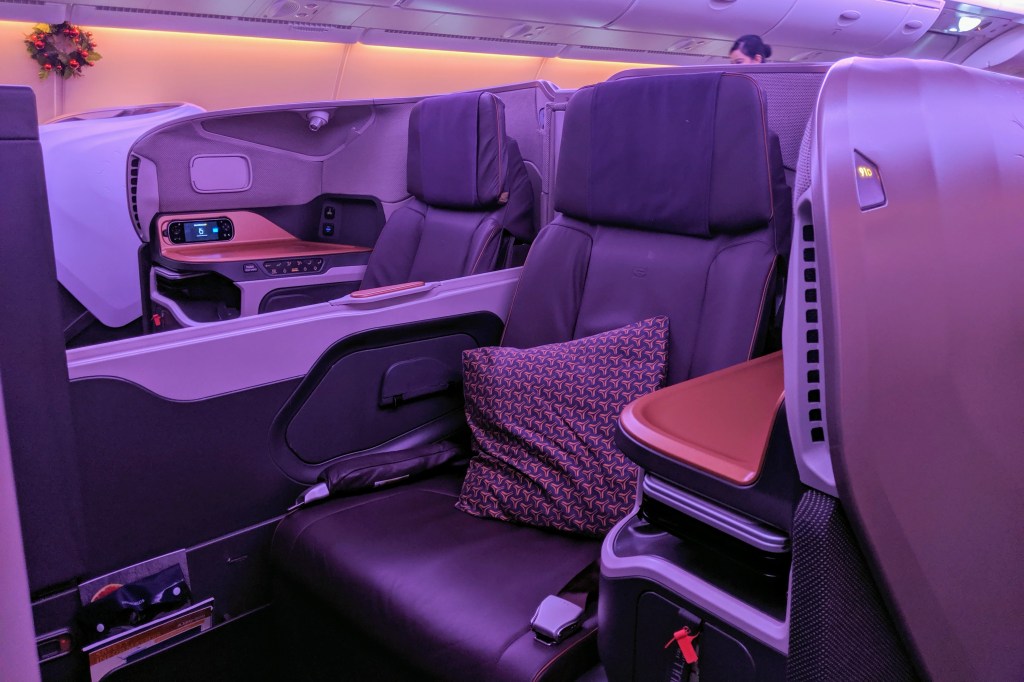
Singapore Airlines 2017 business class seat
The good thing with it is that they can actually do concurrent boarding and disembarking of both decks, although that some passengers in premium cabins may not like that idea, given after all, they love the priority.
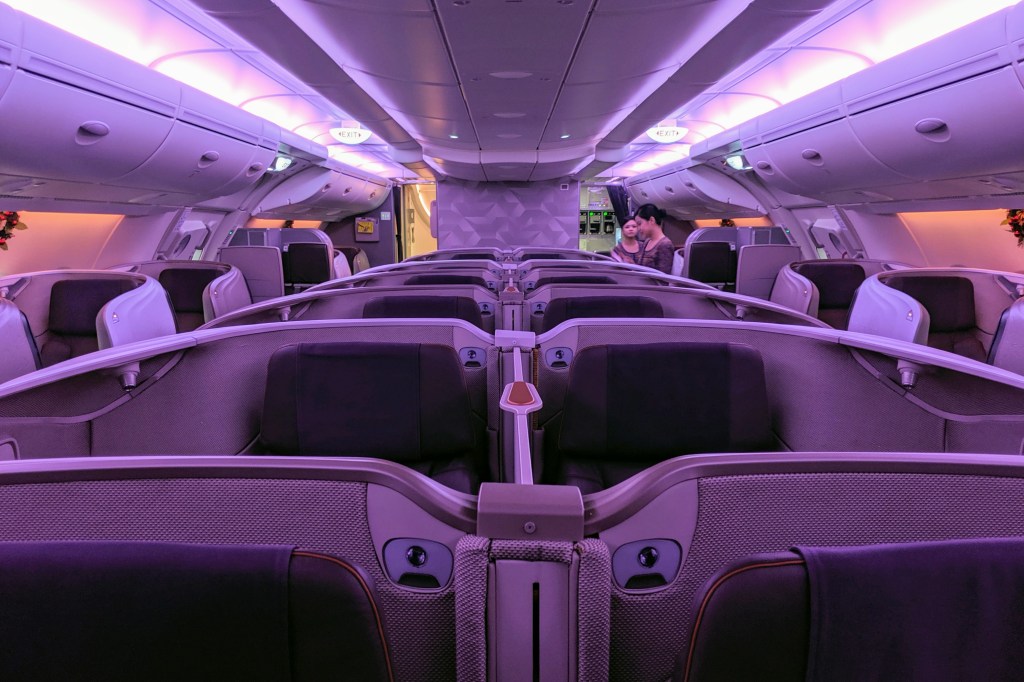
The 78 business class seats are spread across three main cabins on the seat map, although in reality the rear two cabins are visually just one. The ‘mini cabin’
Most passengers will like to be at the front of the cabin, but I figured that the rear will be rather empty given the light load. True enough, upon boarding, the cabin crew told me that there was only six passengers in the rear cabin, and I was free to change my seats if I so wanted to.
My middle seat
Now, the seat. The Singapore Airlines 2017 Business Class seats (2017J) measures 25 inches across, and can be fully reclined into a flat bed. In the bed mode, the bed runs about 78 inches head to toe.
The seat also features a larger privacy shell so that you get more privacy from the aisle.
Seats are pretty private, you won’t see your neighbours if you really don’t want to.
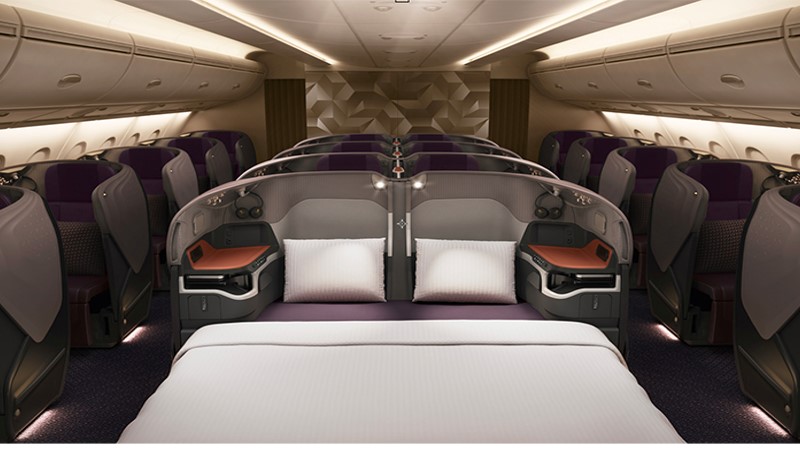
At the time of its launch, Singapore Airlines also mischievously marketed the business class seats as best in class for couples travelling together, featuring a ‘double bed’ in the new business class configuration, as exemplified by this marketing imagery:
Singapore Airlines A380 business class double bed (source: Singapore Airlines)
However, the reality is that there are only three such pairs of seats available on each flight, which are seats D & G (middle seats) on the bulkhead rows of 11, 91 and 96.
The only reason why they can be formed into a ‘double bed’ is because these are the only seats that has a full-width footrest area. The other seats all have a side cubbyhole, so when the seat is fully reclined into a bed, the footrest angles away from the middle.
Ample legrest area in the bulkhead seats (Pictured: Seat 91D)Non-bulkhead seats have smaller legrests (Pictured: seat 92D)
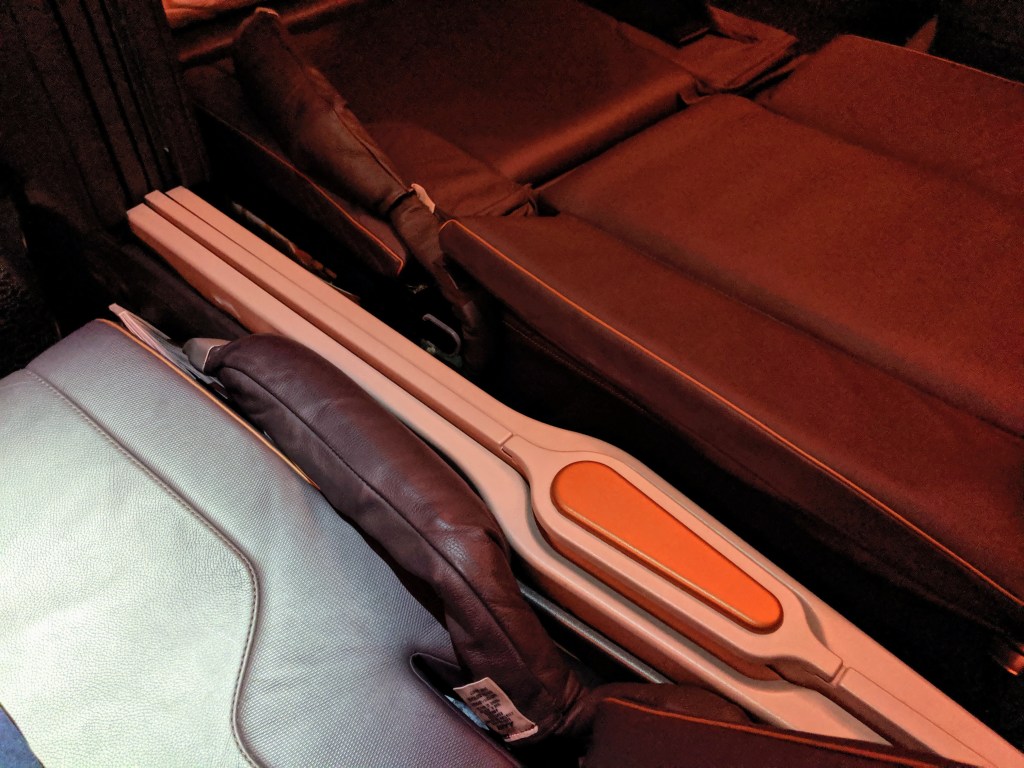
Even for three ‘double beds’, note that there is still a hard divider that can be drawn all the way down to bed-level when both are reclined into bed positions. However, the mattress topper will not be able to fully cushion the gap, you will still be able to feel it if you lie across it.
Seat divider
Note that seats 91D & G are bassinet positions, so they can’t be reserved in advance until 48 hours before the flight. Even then there is a chance you might be moved, if there’s a infant that pops up last minute.
All of the seats have a side table that separates the seat from the aisle. While that means that the middle pair of seats are side by side, there is a retractable divider that you can put up if you are travelling alone.
Side table
Storage wise, the seat does have several spaces for you to store personal items around the seat. There is some space under the seat in front of you for a small suitcase or a backpack, so for most travellers there no need to use the overhead compartments.
As for overhead storage, note that there are no overhead storage compartments for the middle seats, so if you need to stow something, it has to be above the window seats.
There are no overhead storage space for middle seats
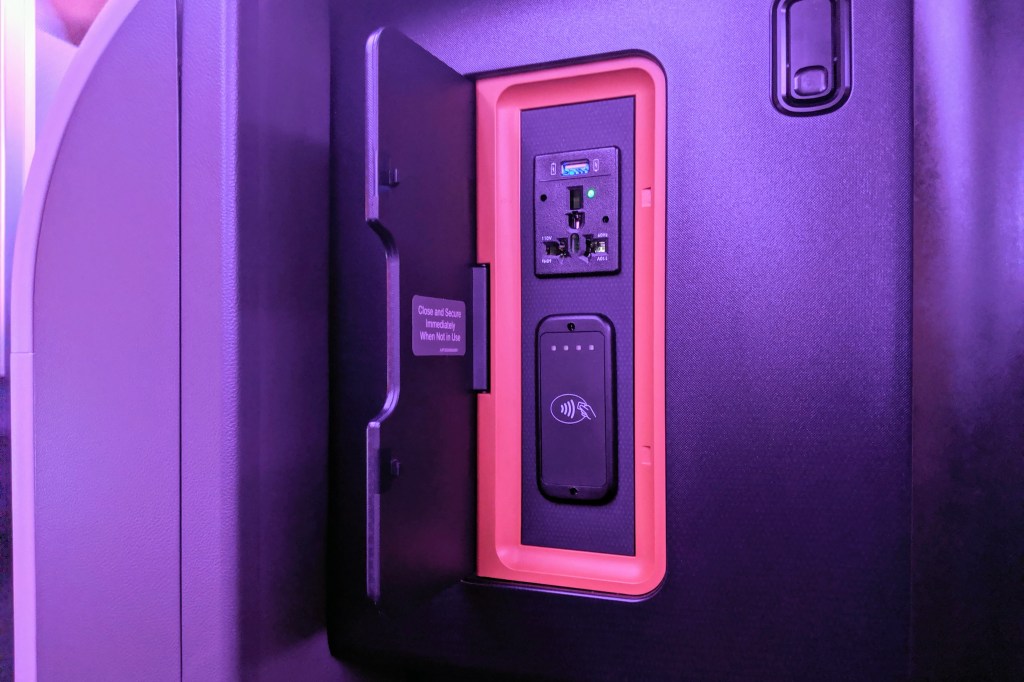
At the back of the side table, there is a small compartment for storing personal , which is also equipped with a USB charging socket. If you need a power socket, it’s available in front of you just below or beside the IFE screen.
Power socket for your use
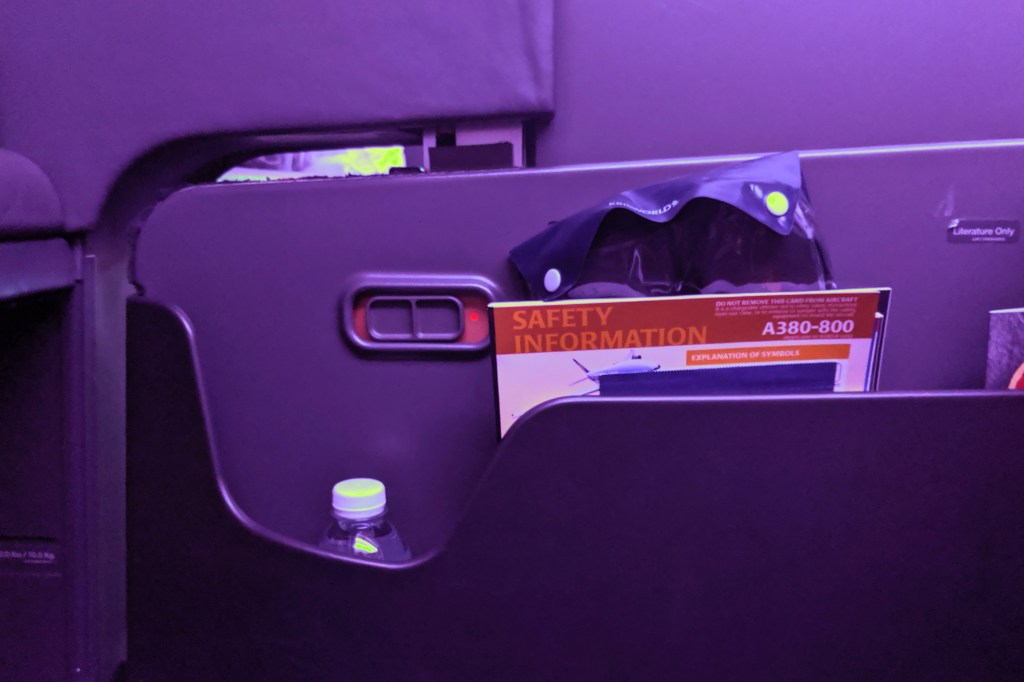
At the side of seat near the foot area is also a magazine rack, along with a bottle holder. There’s enough space to also stow a slim laptop if you wish.
Magazine rack and bottle holder
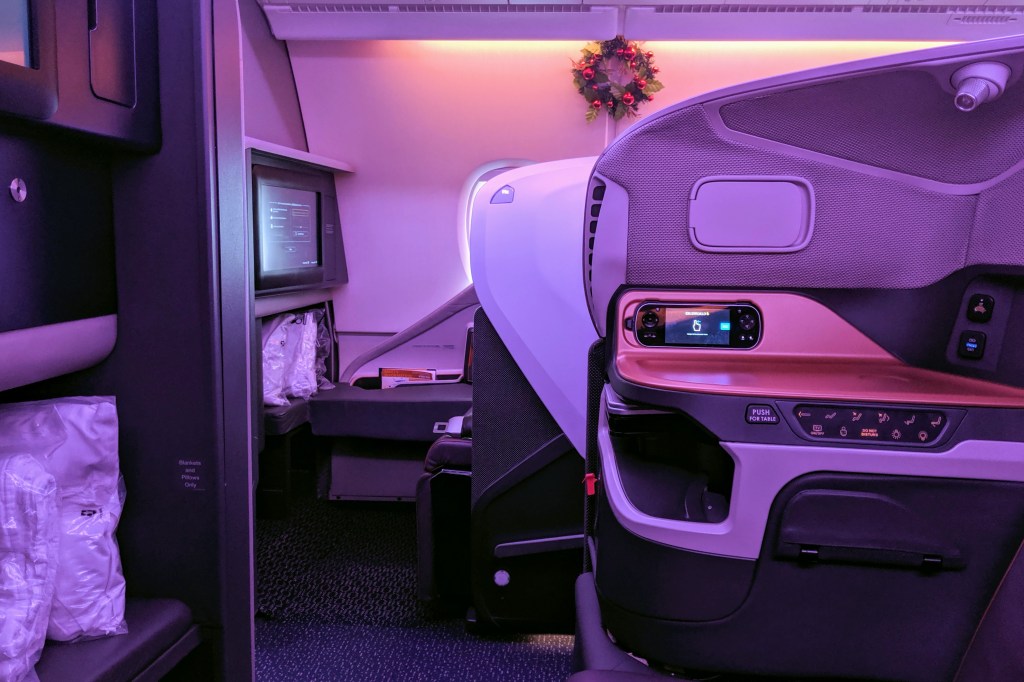
At the side of the seat just below the side table is a control panel for the seat. Unlike previous versions of SIA business class seats, the 2017 version is now fully control by electronics. The seat can be fully converted to a bed at a touch of button, although you can still trouble a cabin crew to do it for you if you prefer that personal touch.
Electronic controls
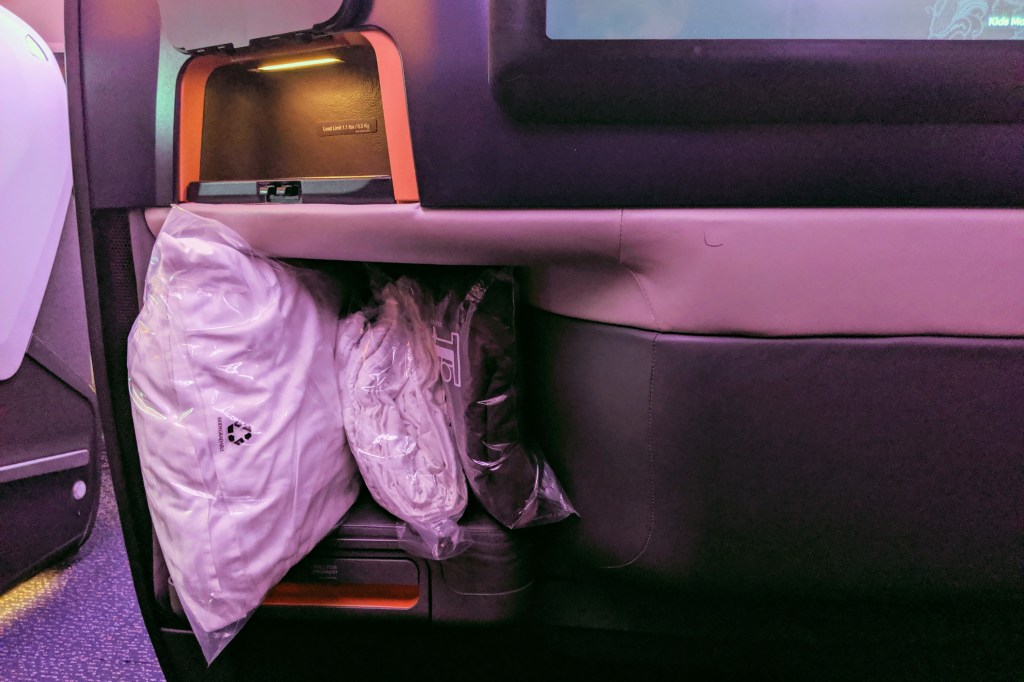
There is also a thin mattress topper and a blanket, although they are all rather thin, so that means that you will be sleeping on a firm bed.
The service
The service was rather attentive today, as the cabin was pretty empty. I was greeted by name, and the cabin crew also knew my preferences after I stated it once.
When I boarded, the cabin crew quickly came around offering a pre-departure drink. Unfortunately they didn’t offer any champagne, so I settled for a sparkling water.
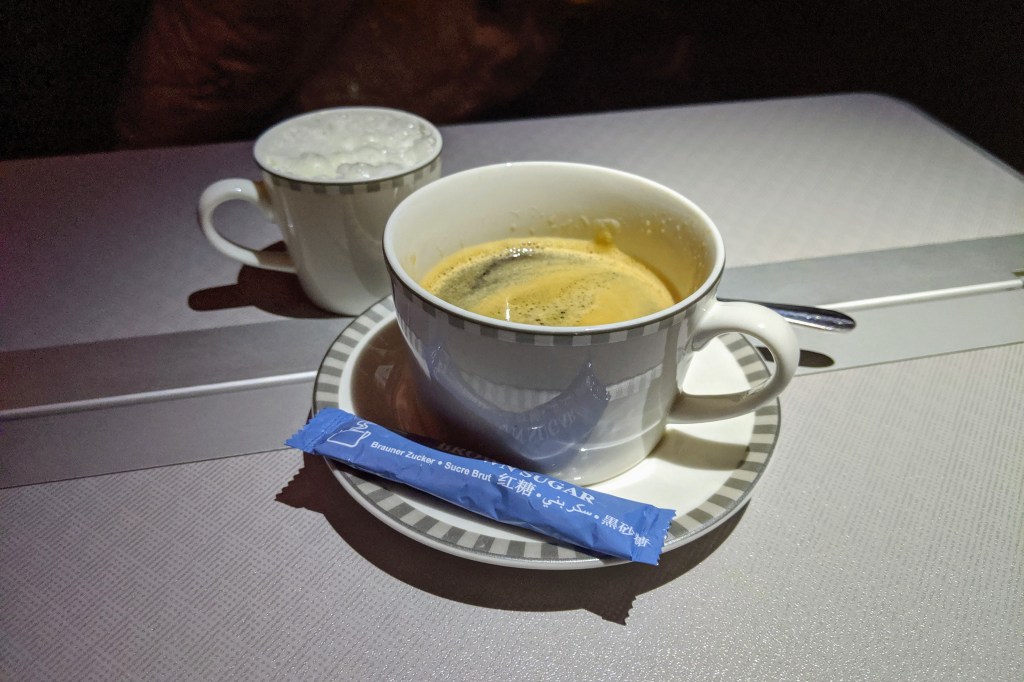
After doors have closed, another cabin crew came around to take orders for a pre-meal drink. I opted for some decaf coffee given it was relatively late in the day, which was promptly brought to me right after take off.
Post-take off drink: decaf coffee
Shortly after that, they brought around the famed Singapore Airlines canapes of lamb and chicken satay, which I thought signaled the start of the meal service.
Canapes of satay
Surprisingly, I was asked by the cabin crew at that point if I will like to have dinner at 6pm or 6.30pm, given it was rather early in the evening. I thought this was a very nice touch, rather than just assume that everyone wanted to eat right at the beginning of the flight.
Dining
Given the flight duration of five hours, there was only going to be a meal service for the flight. Soon enough, 6.30pm rolled by and the cabin crew came around to lay out the tablecloth and cutlery in preparation for dinner. I was offered a drink once again to go with my meal, and I decided on a red wine, the Chianti.
The SIA business class menu
Now a bit about SIA’s menu: on their China-bound flights, there is one special menu available, Shi Quan Wei Mei, a special Chinese feast designed by a celebrity chef.
According to the in-flight menu, each dish is made using locally sourced ingredients that are in season.
The menu for Shi Quan Wei Mei reads as follow:
Side Dish: Marinated Cucumber and Shimeiji Mushrooms
Cold Appetiser: Red Pepper Pork Roll and Watercress Pine Nuts in Bean Skin
Main Course: Prawns in Pickled Chilli Sauce with stir fried kai lan and purple sweet potato rice
Dessert: Warm Soy Bean Milk with Tofu Skin and Pigeon Egg
If Chinese food is not your style, there’s also the regular menu for your perusal:
Canape: Singapore Chicken and Lamb Satay
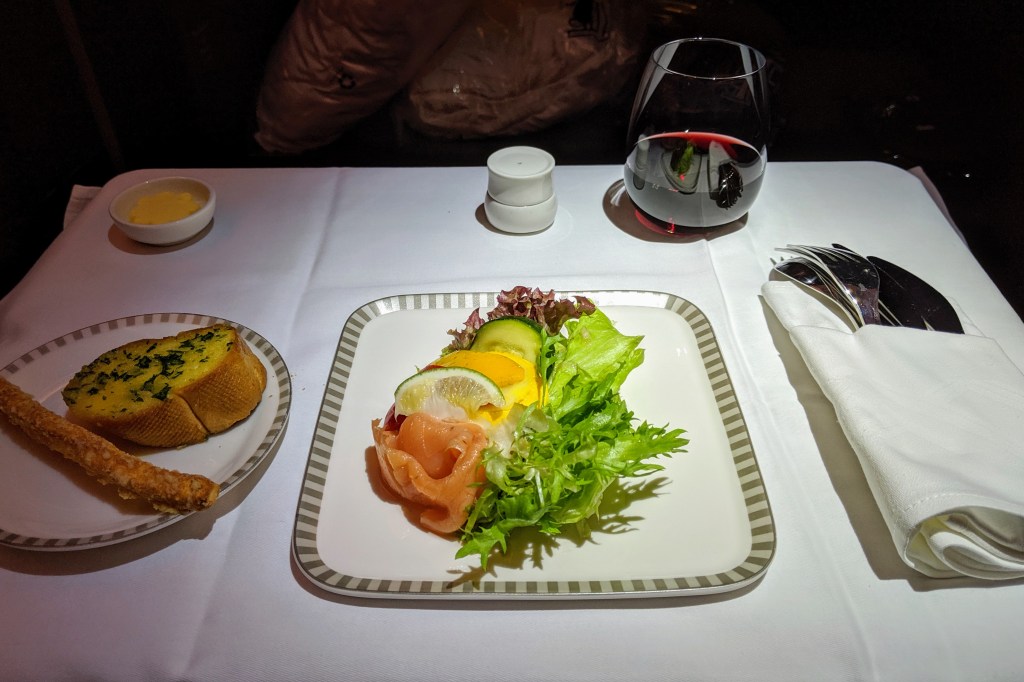
Appetiser: Salad of Smoked Salmon with grilled vegetables and herb vinaigrette
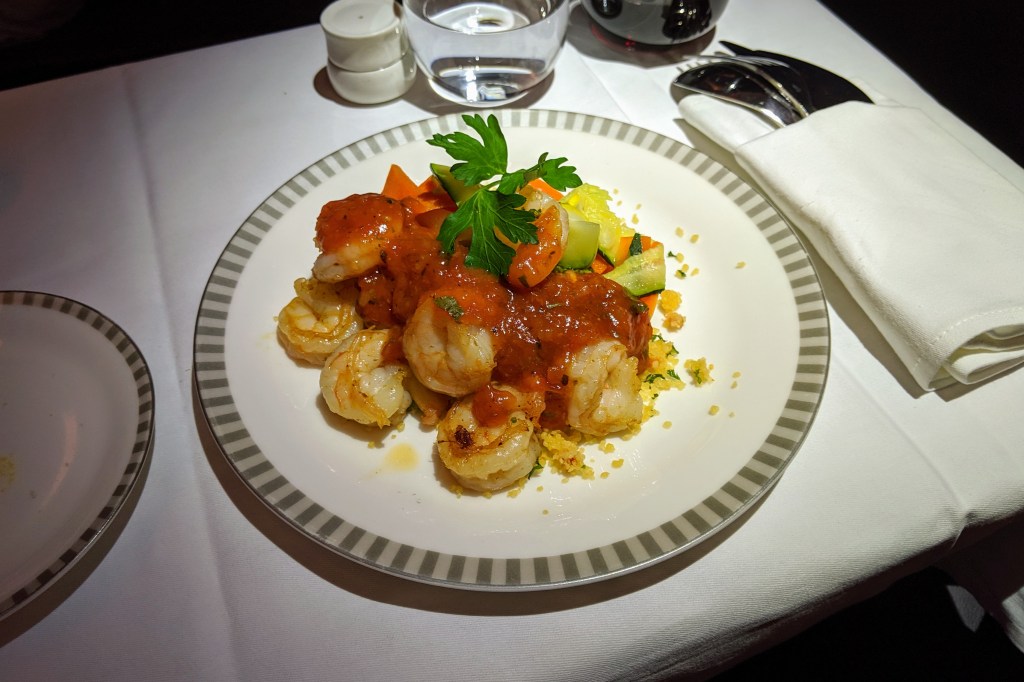
Main Course: choice of Grilled Cumin Spiced Lamb Ribs with Lemon Thyme Sauce Sauteed Prawn in Tomato Coriander Sauce Wok Fried Chicken with bamboo shoots and chives, Chinese greens and fried noodles
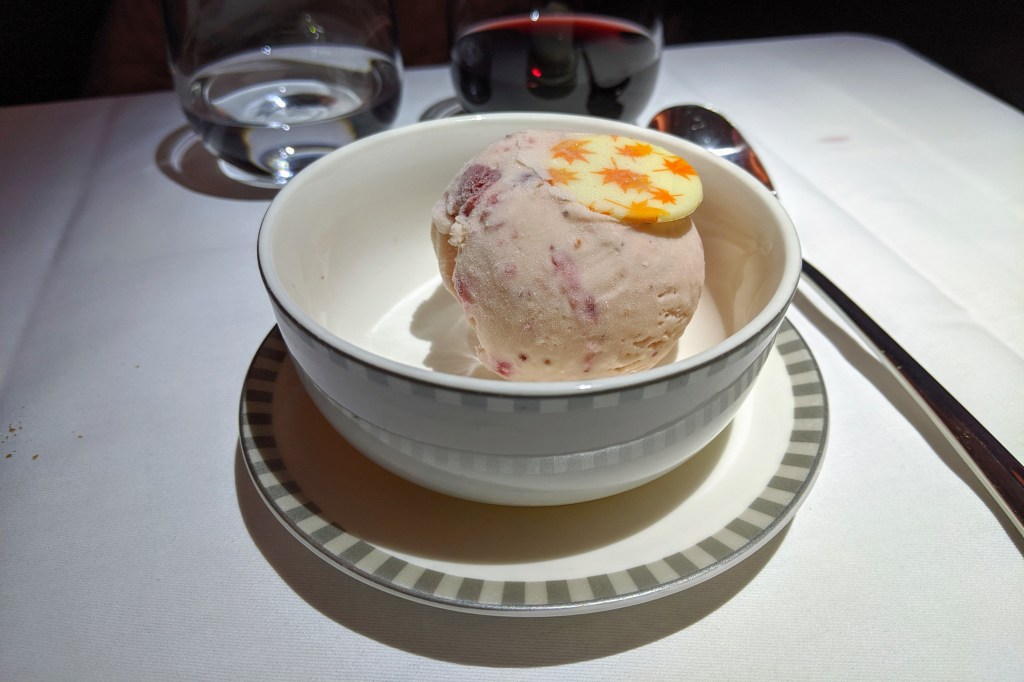
Dessert: Haagen Dazs Strawberry Ice Cream
Selection of Cheese
Fruit from the Basket
Assorted Bread Rolls and Gourmet Breads
Fine Pralines
Coffee and Tea
The appetiser was served up pretty swiftly. The smoked salmon wasn’t memorable, but I really enjoyed the grilled vegetables as they were pretty crunchy yet juicy. Not a fan of the leafy bits so I left those alone.
And of course, the garlic bread is always such a treat.
Salad of smoked salmon
As I wasn’t particularly hungry, I went for the prawn for my main course. Usually I’m pretty skeptical of prawns as a main dish, given that sometimes that can mean only one single prawn, as mentioned in the menu.
Sauteed Prawn in Tomato Coriander Sauce
However, I was pleasantly surprised with the portions this time round. There was a hearty serving of de-shelled prawns, with a side of vegetables and couscous. The prawns were well flavoured and it’s still pretty substantial, despite being labeled as a low carb option.
My empty plate was removed not too long after I was done, and I was again offered a refill of my wine, which I gladly accepted. The dessert of ice cream (one of my favourites) was also brought to me at this time.
Haagen Dazs ice cream
Unlike Cathay Pacific who serves the ice-cream in its original single-serve tub, Singapore Airlines scoops the ice cream into a bowl, and often garnish it with either biscuit crumbs or some sauce. Personally I actually prefer it to be in the tub, because for some reason when it is scooped out it tends to melt faster.
In-flight entertainment and Wi-Fi
Singapore Airlines equips the 2017 business class seat with an 18-inch Panasonic screen. As I was sitting at a bassinet-available seat, the screen was significantly higher than my eye level when I’m seated to cater space for the bassinet. If people behind me were to stand up, they will be able to see what I’m watching!
My screen is clearly visible even from five rows back
The KrisWorld IFE is pretty world-class, containing a good array of international selection. Note that Singapore Airlines have two IFE systems running through its entire aircraft fleet, and fortunately the A380s have the newer Panasonic ones with a far larger library, inluding over 300 movies and 700 TV shows.
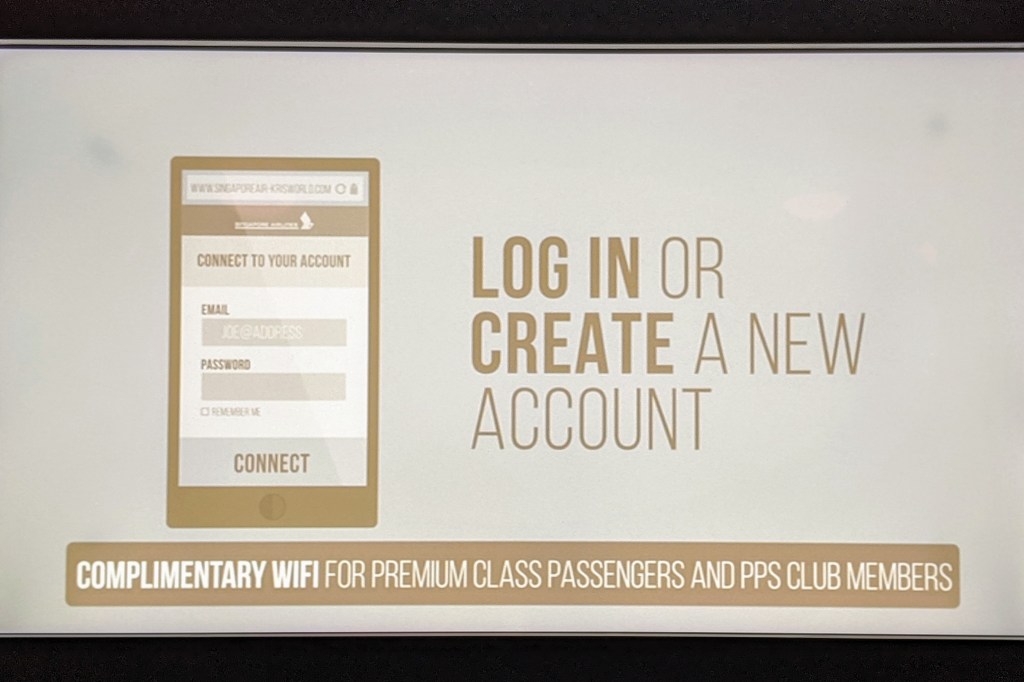
In terms of Wifi, Singapore Airlines offers them on the A350 and A380 fleets as well as select 777-300ER aircraft. In case you haven’t heard, Singapore Airlines now offers unlimited free wifi for its suites and first class passengers, and a reasonable 100MB allowance for passengers in business class, as well as its PPS members.
Complimentary 100MB wifi for business class passengers
If you need more than the 100MB given to you, you can purchase additional data limit at the following prices:
30MB – USD3.99
100MB – USD9.99
200MB – USD15.99
The prices are definitely not cheap, and SIA no longer offers time-based wifi access.
I barely touched the in-flight wifi, as I usually prefer to stay disconnected when I’m flying. Having said that, this is a good consideration if you prefer to work on your flight, and 100MB is sufficient for basic email exchanges, or for your basic messaging apps.
Final thoughts
I must say I really enjoyed this flight and the seat was more than comfortable for this five-hour journey back home.
The seat pretty much works for me. I personally prefer seats with electronic mechanisms, so that I can operate the seat myself without troubling a member of the crew. On previous versions of the business class seats that require manual handling, I often find myself waiting a tad too long for my seat to be converted into a bed.
Fully reclined business class seat, all done by myself!
While some critics may feel that the seat is a distinct departure from the generous width that SIA had in its previous generations of business class seats, I think they are sufficient and pretty within standards of many other airlines’ business class seats.
If there’s one thing that’s lacking, it’s with the amenity kits. SIA is one of the few airlines that doesn’t provide an amenity kit for their business class passengers, although everything you need in the kit is either provided to you at your seat (e.g. eye shades and slippers), or available in the lavatories (e.g. toothbrush).
The service was very attentive, given the relatively light load for the evening. The meal service was again impeccable, but the quality of food is a far cry from what it used to be, if you ask me. For instance, there are practically no choice for appetisers, dessert, or even the famous satay (what if I don’t eat mutton?).
While I was initially a little hesitant in choosing a seat closer to the back of the plane, but I really liked how empty the cabin was. Even though this means you are one of the last few business class passengers to disembark when you arrive at your destination, but the privacy and attentiveness of the crew more than make up for it.
















 Shanescape