Book by 30 April to enjoy 30% off usual redemption rates for travel between 1-31 May 2019 to destinations including Bangkok, Jakarta, Seoul, Beijing and Shanghai.
Singapore Airlines has unveiled its list of redemption offers for the May edition of the Spontaneous Escapes. A total of 34 destinations are up for grabs (some one-way) this month, but unfortunately some destinations such as Australia and New Zealand are not available at all this month.
Some notable mentions:
Southeast Asia
Bangkok: Economy class for 8,750 miles; Business class for 15,050 miles
North Asia
Hong Kong: Economy class for 10,050 miles; Business class for 21,350 miles
Shanghai, Beijing: Economy class for 14,000 miles; Business class for 27,300 miles
Osaka, Tokyo, Nagoya, Fukuoka (one-way from Singapore only): Economy class for 17,500 miles
Seoul: Economy class for 17,500 miles; Business class for 32,900 miles
Europe (one-way from Europe to Singapore only)
From Paris, London: Economy class from 26,600 miles
Some blackout dates and restrictions on specific flights do apply, so remember to check the list before booking. Also, remember that the deadline to book is 30 April 2019 for travel between 1 to 31 May 2019.
Continuing my journey from Ho Chi Minh City, the flight for the day is a short business class ride from Kuala Lumpur to Singapore with Malaysia Airlines.
The Kuala Lumpur to Singapore hop is an incredibly short one, typically the aircraft only cruises for less than thirty minutes before descending.
My ride today is on a Boeing 737-800, which Malaysia Airlines have plenty of. Between Singapore and all the Malaysian destinations it flies to, Malaysia Airlines only use the Boeing 737-800.
The aircraft
Malaysia Airlines’ Boeing 737-800 features 16 business class seats, laid out in a 2-2 configuration across four rows. In economy class, there are 144 seats, laid out 3-3 across 24 rows.
Malaysia Airlines B737-800 business class
The business class seats are recliners, which is perfectly fine for ridiculously short haul routes like mine. What you need to be aware of is that Malaysia Airlines also uses these narrowbody aircraft on some mid-haul route, including the Shanghai Pudong — Kuala Lumpur red eye service that I took some time ago, and also sometimes to Perth. So, always check the aircraft before you book.
Given that this was a ridiculously short flight with under an hour flying, one should not expect anything much.
The business cabin was only half full when the aircraft door was closed. Only when the economy class passengers were all boarded and the aircraft door was closed then a cabin crew came around to offer a pre-departure drink of either apple, orange or guava juice.
Pre-departure drink: orange juice
One thing to note in case you don’t already know this: Malaysia Airlines have taken off alcoholic beverages from all flights under three hours for a few years now, that effectively means all domestic service, as well as most of the regional services within Southeast Asia, no longer carry booze.
Shortly after I picked up the orange juice, the crew came around with a cold towel. Being pretty grossed out by the state of the cleanliness on my last flight, I used it to clean the armrests again.
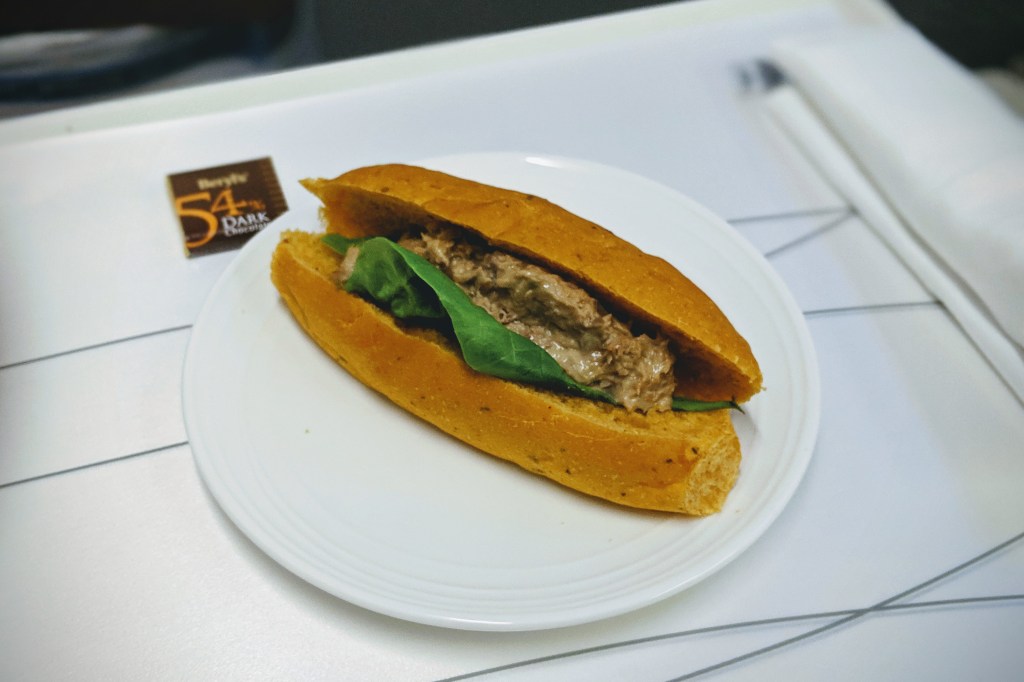
Soon we were on our way. The moment we are at cruising height, the cabin crew around to offer a snack: a choice between a tuna sandwich, or a curry puff. I decided to go with the sandwich, which was quickly brought to me on a tray, with a piece of Beryl’s chocolate.
Spicy tuna sandwich
It was… alright. I also asked for a glass of sparkling water, which was promptly brought to me, along with the rest of the bottle.
After I was done with the sandwich and my drink, the cabin crew came around offering a choice of hot beverage, which I was pleasantly surprised at, given the short length of the flight. I opted for a green tea, which again, was brought to me rather quickly. I had at least another 15 minutes with the tea before it was being kept for landing.
Final thoughts
Given that this is an incredibly short flight, there really isn’t much to expect out of a flight like this. It’s ridiculous to expect anything to eat on a flight like this, and you are better off filling yourself up with food before or after your flight.
The cabin crew is extremely efficient, which isn’t hard to achieve with only half the business seats filled.
Spritzer sparkling water
The aircraft is incredibly old, but good enough for a short hop from Kuala Lumpur to Singapore. I generally have no issues with old aircraft, but what really bugs me is the state of cleanliness of the aircraft. Fortunately, this aircraft was a lot cleaner than the previous one I took from Ho Chi Minh City to Kuala Lumpur.
At the time of writing, a return business class ticket between Singapore and Malaysia is about S$700 from Singapore, or RM2,200 from Kuala Lumpur. If you are redeeming miles, that will set you back by at least 32,000 miles. No one should really be spending that kind of money or miles for a journey like this, and the only reason why you should fly this is if you are connecting on to somewhere else.
Amex is not my top choice of card when it comes to earning miles – their base earn rates are pretty crap at 1.2 mile per dollar spent (mpd).
But with the regular promotions that Amex is running, this may not be the case, although you have to keep a tight watch over how much you are raking up with your Amex cards given that the caps are pretty low.
(1) Daily Essentials promo – Earn up to 3.3 mpd
Earn up to 3.3 KrisFlyer miles per S$1 spent with your Amex Singapore Airlines-branded cards, on what Amex term as “daily essentials”, which are the following merchants:
Starbucks
Coffee Bean & Tea Leaf
MacDonalds
Subway (except stores in hospitals and schools)
Deliveroo
Foodpanda
Unity (except outlets in FairPrice)
Watsons
Sistic
There’s a cap of S$200 spend per month. That’s enough to cover 1 Starbucks drink or a MacDonalds meal a day, so drink away and earn up to 660 miles per month along the way.
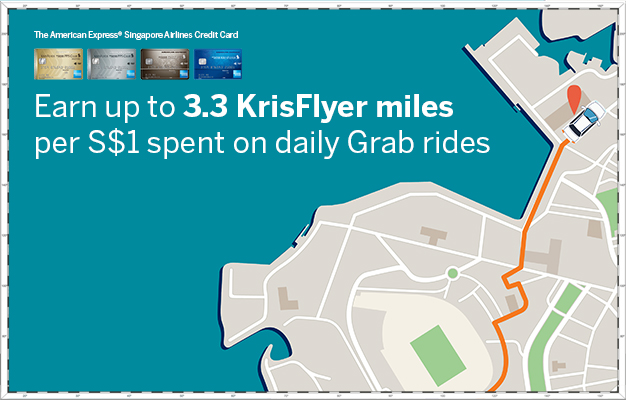
(2) Grab rides and GrabPay topups – Earn up to 3.3. mpd
Use your Amex Singapore Airlines-branded card on your Grab rides and earn an additional 2 mpd, on top of the base rate for your card.
The best part of this promotion is that GrabPay topup transactions are also eligible for the bonus miles, unlike many other credit cards that have started to exclude mobile wallet top-ups.
This promotion is only valid for Grab transactions in Singapore, and up to a maximum of $200 each month. No registration required.
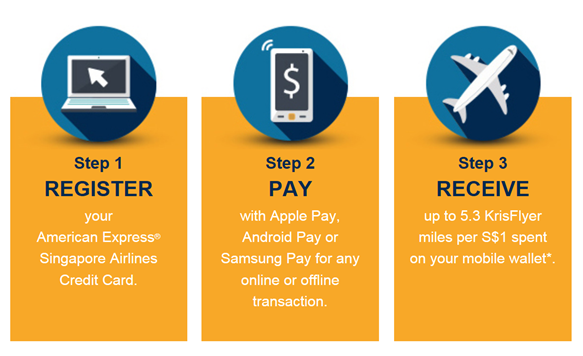
(3) Mobile payments – Earn up to 5.3 mpd
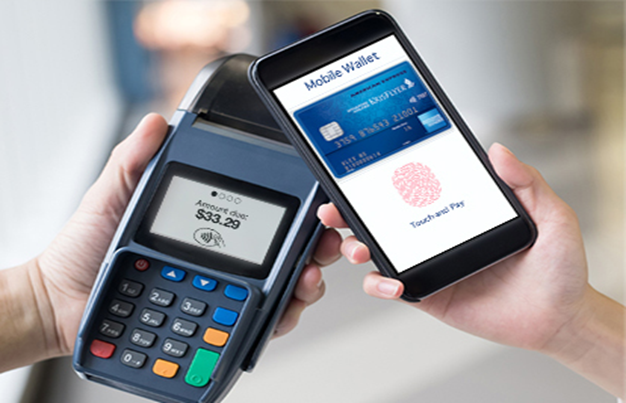
From now until 15 June 2019, Amex Singapore Airlines cardholders will earn an extra 4 Krisflyer miles per dollar spent when you use your mobile payment wallets, such as Apple Pay, Google Pay or Samsung Pay.
This promo requires registration and is limited to the first 15,000 cards. Also, you are limited to a maximum of 1,200 bonus miles, translating to a maximum of $300 spend during the promotional period. To register, log into your Amex account online or through the Amex app, and view under “Offers”.
I was travelling from Ho Chi Minh City back home to Singapore, so decided to do a mileage run with a oneworld carrier given that I was trying to keep my frequent flyer status on Qantas for another year.
Having done some research, I realised that Malaysia Airlines was my best bet given that it goes via KL, as that gives me two sectors and a lot more points and status credits with Qantas Frequent Flyer than travelling on a direct flight.
Standby at airport: Go shows
I showed up way too early at Tan Sohn Nat International Airport for my 7.10pm flight, and wanted to check if I could standby for an earlier ticket. I had done it pretty often with Qantas in Australia, or to some extent with airlines in US as well, so I thought I could try.
While I tried to check in, I was told by the agent that the fare class for my ticket was ineligible for what they called ‘go shows’, and asked that I wait around to 4pm before my flight opens for check in. Obviously I wasn’t going to wait around for 2 hours to check my bag, so I asked to speak to the airport manager.
When I later spoke to the airport manager, he explained that their customer management system has recently been changed and they are no longer allowed to put people on a different flight from what was booked.
In summary, any sale tickets – whether in Business or Economy – will not allow you to show up for an earlier flight. From some online research the only exception seem to be out of Singapore.
Having said that, the airport manager made an exception to allow me to do an early check-in (they do not offer ECI at SGN), and invited me to head to the lounge early.
Security, immigration, lounge
Note that the airport only offers dedicated immigration counters for Sky Priority members, a Skyteam initiative, as Vietnam Airlines is an alliance members. Unfortunately that also means that all other airlines customers, including premium passengers, will have to join the general line. If you are an ASEAN passport holder, fortunately the dedicated counter queue tends to be shorter.
Once you have passed through immigration, you will see that there’s a dedicated business and first class security lane so feel free to use that.
The lounge that Malaysia Airlines uses at Tan Sohn Nat International Airport was the Saigonnais Lounge, a third-party lounge operated by Sasco, the airport operator. In fact, all the lounges at the international terminal are operated by Sasco.
Saigonnais Lounge, Tan Sohn Nat Airport International Terminal
The aircraft
After spending about three hours at the lounge, I finally head to the aircraft to start my journey.
My ride today is on a Boeing 737-800, which Malaysia Airlines have plenty of – 48 to be exact. MH typically uses the 737-800s for its domestic and regional services, some as far as Taipei, Shanghai and Perth.
Malaysia Airlines Boineg 737-800 Business class
MH was expecting to bring in some MAX 8 and MAX 10 from this year onwards, but given the recent incidents around the MAX variants it remains to be seen if that will still happen. At the time of writing, MH has yet to make any changes to their order.
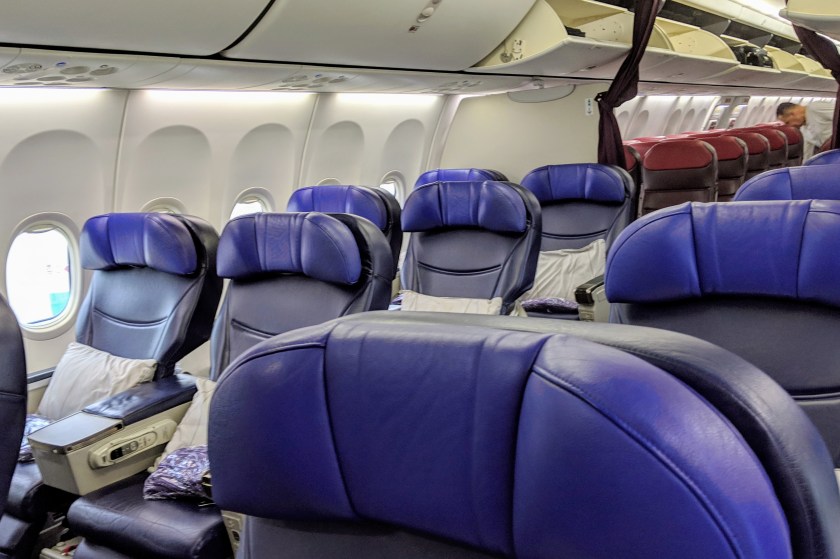
Malaysia Airlines’ Boeing 737-800 features 16 business class seats, laid out in a 2-2 configuration across four rows. In economy class, there are 144 seats, laid out 3-3 across 24 rows.
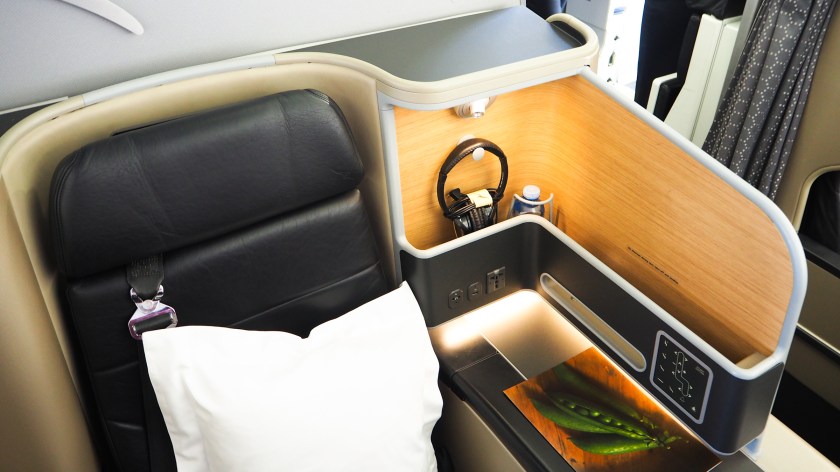
The business class seats are recliners, which is perfectly fine for short haul routes. The seats come with 42 inches of pitch, offering plenty of legroom. The seat measures 21 inches across, wide enough for even a fairly big sized person.
Malaysia Airlines Boeing 737-800 business cabin with 16 seats
Be careful though, Malaysia Airlines also uses these narrowbody aircraft on some mid haul route, including the Shanghai Pudong — Kuala Lumpur red eye service that I took some time ago. So if you want to have a good rest, either avoid overnight services altogether on MH, or check the aircraft before you book.
The seat
The seat has got simple mechanical controls: one button to control the seat back recline, another one for the legrest. Both of these have to be set to the default position for take off and landing. Note that this is a recliner seat, while it has a considerable recline, these are not flat beds – don’t expect to sleep well on them.
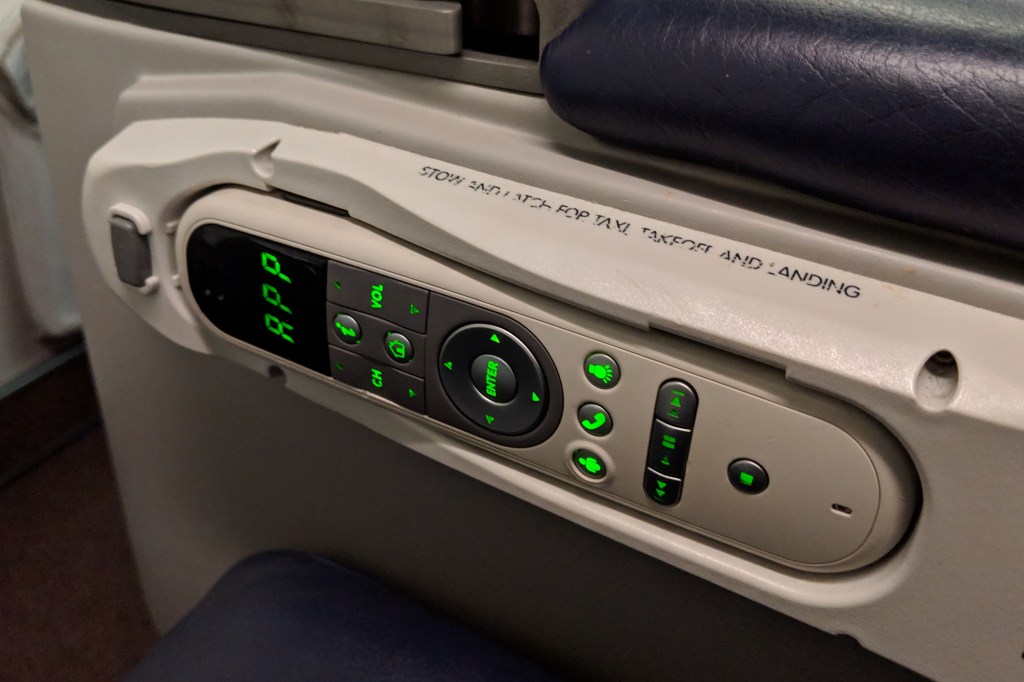
The tray table is stowed in one of your armrest. In the middle armrest between each pair of seats, you will find the controller for your in-flight entertainment system.
Controller for in-flight entertainment system
As I was seated in row 1, the in-flight entertainment screen is also stowed under the middle of the pair of seats. To take out the screen, you will have to push it in first before it pops out. There was no instructions so I had to look around and fiddle with the screen before I could get it to come out, which was pretty frustrating.
The service
The cabin today was only about half full, so there was only about one person for every two seats. In the business cabin, there was two cabin crew, so the passenger to crew ratio was very good.
There was also a variety of newspapers being put in every magazine holder in front of the seat: you don’t really get a choice, but every seat seem to get a different newspaper so you can always swap with your seat neighbour if you wanted something else.
Pre-departure drink – no alcohol served
As a pre-departure service, I was offered a couple of guava, orange or apple juice. I went with the pink guava (I may have gotten this wrong) and was pleasantly surprised at how tasty it was. I was then offered a cold towel to refresh myself.
One thing to note: Malaysia Airlines have stopped serving alcoholic beverages on its flights under three hours for a couple of years now, so there was none available on this flight.
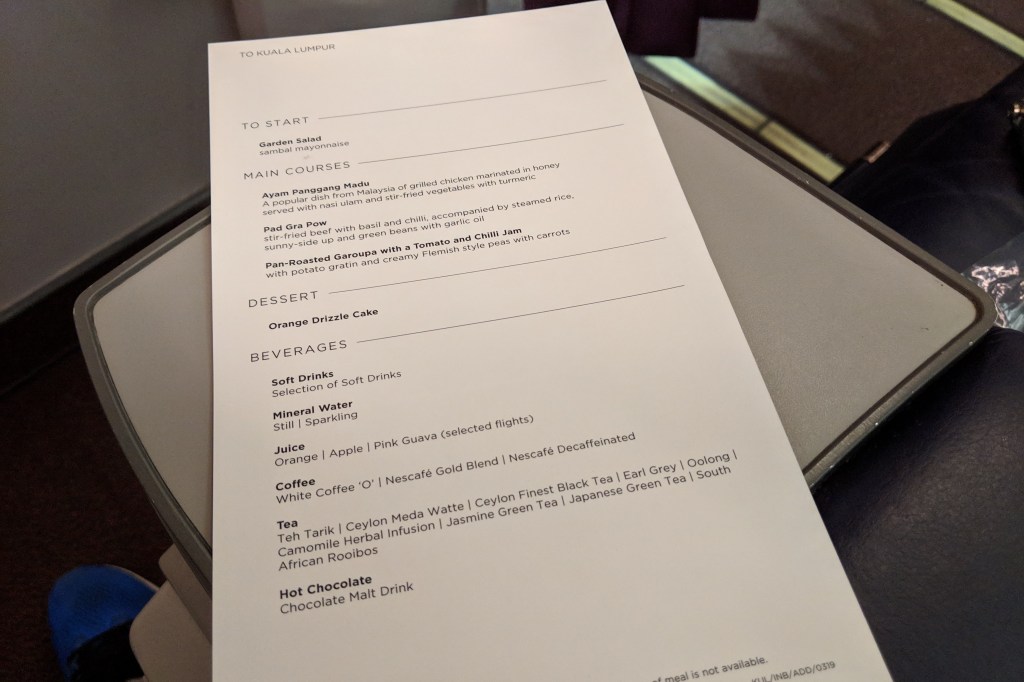
Soon we were on our way, and the cabin crew came around handing out menu cards.
Business Class menu cards
There was a simple dinner service on this short two-hour ride. Despite the short ride, there was three options available for the main course:
Ayam Panggang Madu (Grilled honey chicken)
Pad Gra Pow (Thai-style stir fried beef with rice)
Pan-Roasted Garoupa with Tomato and Chilli Jam
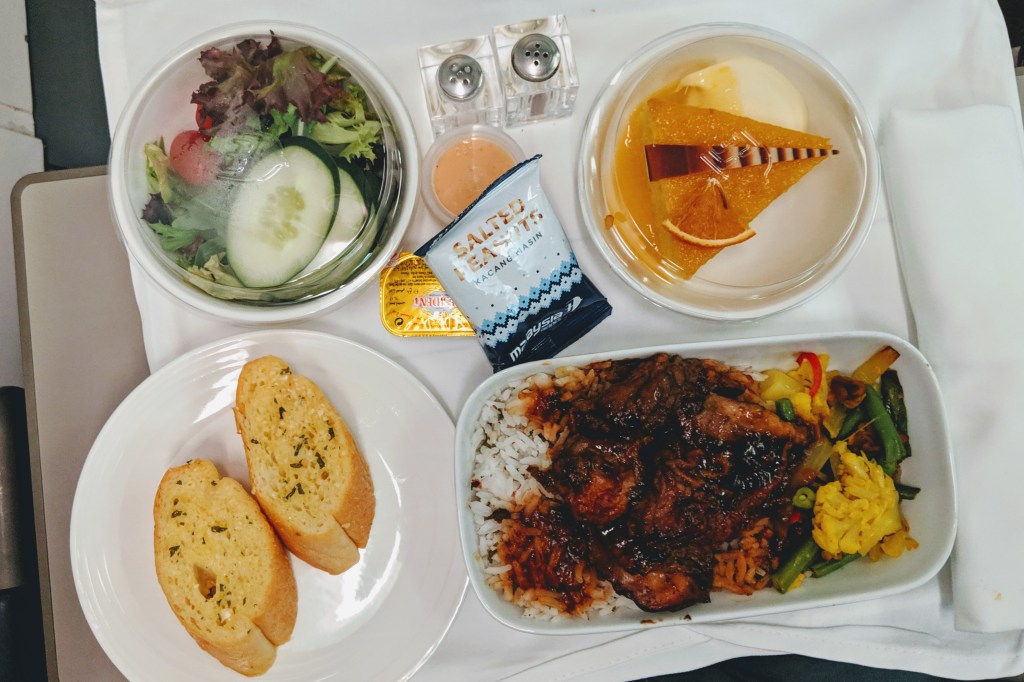
I went for the Ayam Panggang Madu, and everything was served on a single tray, including a side salad to start with, and an orange cake for dessert. One of the cabin crew also came around with a selection of breads. I decided to go with garlic bread which, to my disappointment, was cold.
Dinner service – Ayam Panggang Madu
While the meal didn’t exactly look very palatable, the surprise was in the cake: it was so delicious, and not too sweet, so I finished it all.
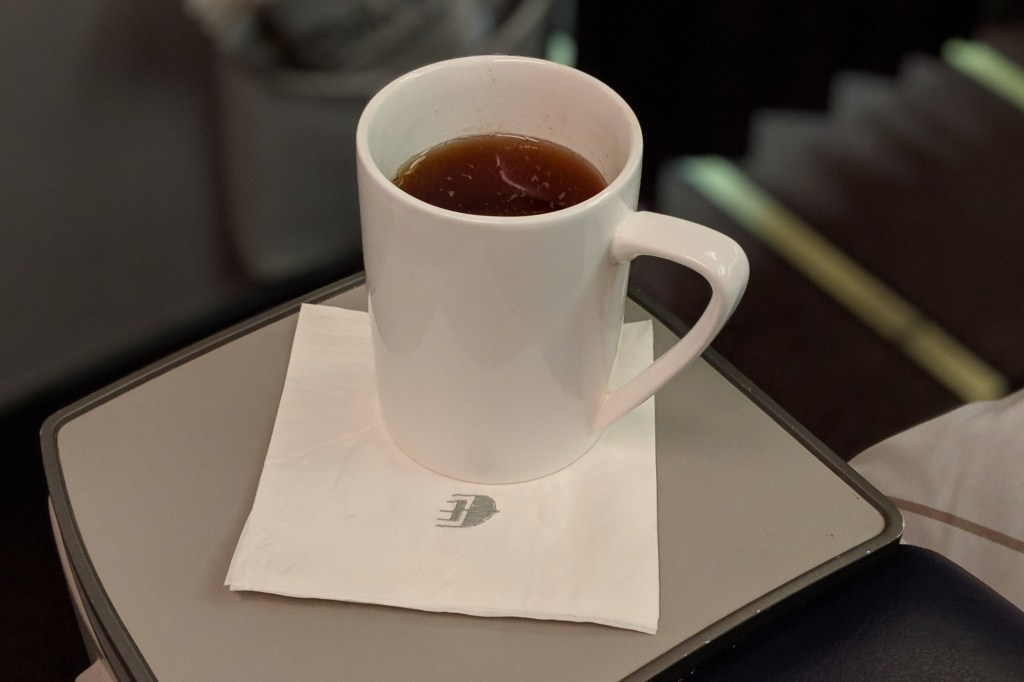
After the meal service, my tray was promptly cleared and I was offered a hot drink. Checking the menu, I decided on a Rooibos tea, which took a while to come. However, the tea was pretty heartening and in my opinion a good way to end off the flight in absence of a glass of wine.
Red Rooibos tea
In-flight entertainment
As I was in the bulkhead seat, the in-flight entertainment seat was stowed at the side of the seat. With no instructions on how to get it out, I struggled with the screen for a good while before figuring out to use it.
The screen is a touch screen, but for the germaphobes, there’s also a remote control stowed at the side of the seat.
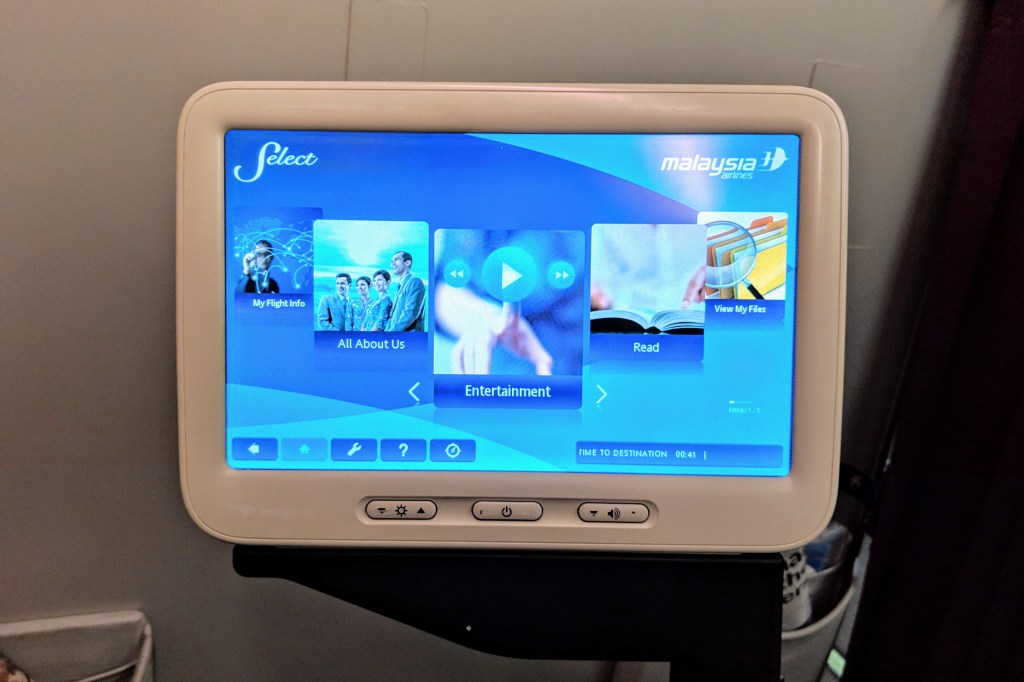
In-flight entertainment screen needs to be upgraded
Given it was a short flight, I didn’t bother watching any shows. I scrolled through the selection, which wasn’t huge but pretty current. The screen was quite small for a business class cabin, and the resolution of the screen was quite bad as well. There was a pair of headphones that was dished out at the beginning of the flight, but again, it looked like they have been in use for the last decade.
Final thoughts
Malaysia Airlines has a fairly large fleet of Boeing 737-800s, so if you ever need a hop in Southeast Asia, there’s a good chance you will have to ride one of these.
Let’s face it: the business class product is not stellar on any Boeing 737s, including SilkAir’s (not until they get the flat beds). The other major issue with MH’s planes are the state of the cleanliness. While airplanes are rarely the cleanest place on earth, it’s really something else to have armrests as dirty as theirs.
On the service end, MH obviously fared much better. The Malaysian hospitality is warm, the food tasted good, and everyone was pretty attentive and proactive.
What I’m really unsure of is the removal of alcohol beverages on journeys under three hours.
DBS has quietly added Qantas as a frequent flyer redemption partner last week, making it only the fourth partner one can transfer DBS points to.
The exchange rate is 1 DBS point to 2 Qantas points, at a rate similar to Krisflyer miles and Asia Miles. Redemption has to be made in blocks of 5,000 DBS points to 10,000 Qantas points. Each transfer will incur an administrative cost of $26.75.
What can I use my Qantas Points for?
Apart for redeeming for Qantas flights, you can also use Qantas points for oneworld partner flights. You can also use your Qantas points for Jetstar flights (PSA: don’t do it) and more importantly, for Emirates flights.
Comparable rates to Krisflyer miles for redemptions
For a while now, Qantas has been known to have very generous earn rates, but terrible redemption rates and availability when compared to competitors flying on the same route, or even across oneworld frequent flyer programmes.
Ever since Singapore Airlines has devalued its Krisflyer programme (once in 2017, and a second time in 2019), the redemption rates are now pretty comparable.
For flights from Singapore to Australia, it is slightly cheaper to fly Qantas in Premium Economy and Business, as compared to Singapore Airlines:
Miles/points required for one-way redemption from Singapore to Sydney, Melbourne or Brisbane
Class
Singapore Airlines Krisflyer (in ‘000 miles)
Qantas Frequent Flyer (in ‘000 points)
Economy
28
28
Premium Economy
47
45
Business
62
60
First
85
90
Northbound, you save about 8,000 miles when you fly with Qantas in Business, although I will suggest you wait until the A380 are refurbished end of the year:
Miles/points required for one-way redemption from Singapore to London
Class
Singapore Airlines Krisflyer (in ‘000 miles)
Qantas Frequent Flyer (in ‘000 points)
Economy
38
40
Premium Economy
64.5
63
Business
92
84
First
125
126
How does Qantas Frequent Flyer compare to other oneworld programmes?
Compared to other oneworld programmes most commonly used in this part of the world, Qantas is slightly on the more expensive side requiring more points for a similar redemption when compared to other oneworld programmes:
Miles/points required for one-way redemption from Singapore to Sydney, Melbourne or Brisbane
Qantas Frequent Flyer (in ‘000 points)
Asia Miles (in ‘000 miles)
BA Executive Club (in ‘000 Avios)
JAL Mileage Bank (in ‘000 miles)
Economy
28
25
24.5
25
Premium Economy
45
35
40
N.A.
Business
60
50
60
48
First
90
75
80
72
Miles/points required for one-way redemption from Singapore to London
Qantas Frequent Flyer (in ‘000 points)
Asia Miles (in ‘000 miles)
BA Executive Club (in ‘000 Avios)
JAL Mileage Bank (in ‘000 miles)
Economy
40
35
35
40
Premium Economy
63
45
70
N.A.
Business
84
70
105
80
First
126
110
140
100
As you can see from the above, JAL Mileage Bank probably offers the lowest redemption rates, but it’s also notoriously difficult to accrue them unless you fly exclusively with them, or in premium classes on oneworld carriers.
Otherwise, Qantas still offers very good earn rates when flying with oneworld carriers (e.g. for SIN-MEL in Premium Economy, you’ll earn 5,200 points on Qantas Frequent Flyer, as compared to 4,125 on Asia Miles, or 2,625 on JAL Mileage Bank), so it may not be a bad idea given that you will have more to spend.







 Shanescape