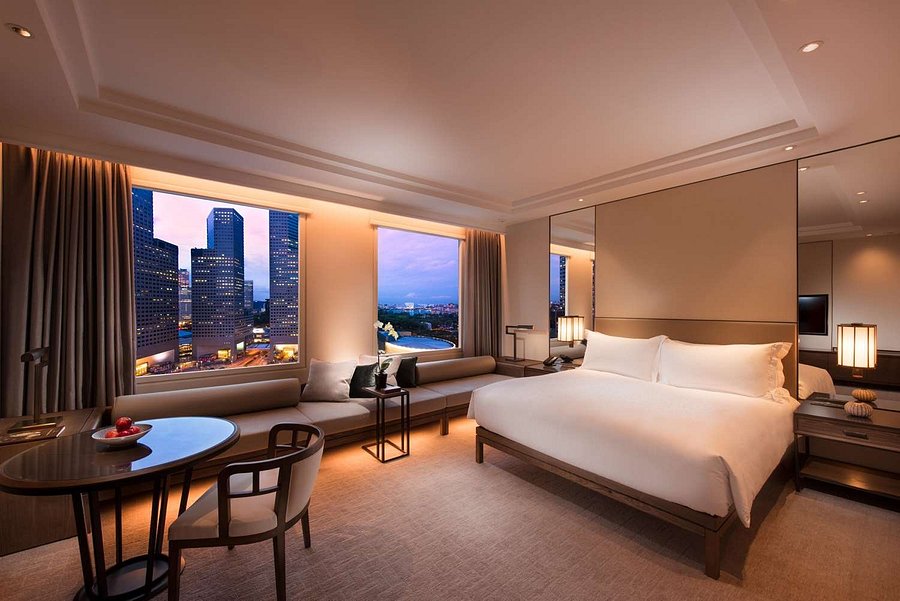
Hilton has launched the “Hilton Dream” sale; Hilton Singapore rooms are also available from $201 nett
Conrad Centennial has joined the long list of hotels approved to receive leisure guests. From 16 Dec 2020, the hotel in the Marina area will reopen its doors to leisure guests once again after being shut for nearly three quarters of the year.
Changes to lounge operations
While the hotel will welcome guests, Executive Room guests and Hilton Honors Diamond Elite members will have to contend with some changes to operations, according to the hotel.
Conrad Centennial will only operate one lounge at Level 31 when it reopens on 16 Dec. The poolside lounge at level 4 will be closed until further notice.
The Level 31 lounge will be opened from 3pm to 10pm daily, serving both afternoon tea and evening cocktails at the following hours:
Afternoon tea: 3pm to 5pm
Evening cocktails: 6pm to 8pm
According to the hotel, afternoon tea will be consist of sandwiches and cakes served to the table on a stand, with coffee, tea and other non-alcoholic beverages available. In the evening, complimentary evening drinks will be served with hors d’oeuvres.
As with Hilton Singapore, prior reservation is required to visit the lounges during both sessions. You will be able to reserve a one-hour slot for each session.
The lounge will not be serving breakfast, so guests will have to head to Oscars for breakfast from 7am to 10.30am (weekdays) or 11am (weekends).
Facilities
The hotel is expected to reopen all facilities, including the fitness centre, swimming pool and on-property restaurants and bars, but do expect that capacity controls will be in place.
At the same time, Hilton is running a global sale from now. The ‘Big Dream, Big Savings’ sale differs slightly from region to region, but for Asia Pacific (including Singapore) the sale runs from now until 7 Dec 2020, for stays between 26 Nov 2020 and 30 Jun 2021.
For this sale, the rates will be up to 25% off the property’s Best Available Rate (BAR), with an additional 5% for Hilton Honors members. Unlike most of the booking terms for rooms this year, the sale will be non-refundable, but changeable up to three days before arrival.
Conrad Centennial – From S$224++
A quick search for stays in December see good availability at Conrad Centennial from S$224++ for weekday stays, and from S$273++ for stays on Fridays to Sundays.
Prices in January 2021 goes down a little, starting at S$203++:
Hilton Singapore – from $171++
Hilton Singapore has been fairly active in its promotions since it reopened in September, especially with its Foodie Staycation deals that comes with a night’s stay and a gourmet meal for two at Opus Bar & Grill or Il Cielo.
Under the Big Dream sale, rates begin at S$203++ for stays in December:
If you can wait until January, the rates for Hilton Singapore goes down to S$171++ for a weekday stay, an unbeatable price:
Final thoughts
Hilton Honors members have long awaited for Conrad Centennial Singapore to reopen since the middle of this year. Arguably the best Hilton property in Singapore, the news of the hotel reopening in time for Christmas is greatly welcomed.
So if you are planning to start clocking stays in 2021 to requalify for status in 2022, it might be a good time to start planning your stays with a couple of these deals now!
The travel bubble bursts for now, bubble slated for re-start on 6 Dec 2020
Travellers hoping to catch the Singapore-Hong Kong air travel bubble (ATB) will now have to wait another two weeks for it to begin, as Hong Kong is facing a possible ‘fourth wave’ in Covid-19 cases.
The ATB was originally slated to commence today (22 Nov), but a decision was made on Saturday afternoon to postpone it by two weeks given the unstable situation in Hong Kong.
Hong Kong
On Saturday (21 Nov 2020), Hong Kong saw a total of 13 unlinked cases, bringing the seven day average of unlinked cases to 3.86. While this did not reach the mutually agreed threshold of 5, both countries agreed that it would be unwise to commence the ATB at this point.
Given the evolving situation in Hong Kong, Secretary Edward Yau and I discussed further this afternoon, and decided that it would be better to defer the launch of the ATB, by two weeks. We will review within two weeks on the new launch date and update again.
Singapore Transport Minister Ong Ye Kung
While the initial deferment is for two weeks, both governments are said to announce details of the new launch dates in ‘early December’.
Hours earlier: new on-arrival test requirement in Singapore
Just a day before the postponement was announced, Singapore has installed a new testing requirement for travellers from Hong Kong as the latest measure. Passengers travelling on ATB flights from Hong Kong to Singapore previously only needed to take a test before departing Hong Kong.
This brings the total number of tests for a round-trip journey to four: one before departure from each point, and one upon arrival at each airport.
Under the original arrangements of the ATB, there were only three tests required:
Pre-departure test from Singapore to Hong Kong (between S$160 to S$200)
On-arrival test taken upon arrival in Hong Kong (HKD499, or S$83)
Pre-departure test from Hong Kong to Singapore (between HKD750 to HKD2000, or S$120 to S$325)
There was previously no requirement to take a test upon arrival in Singapore. With the new requirement, the new requirement adds another S$196 to the costs of tests, bringing the total for a round-trip journey to at least S$600.
The exception will be for those who have spent less than 72 hours in either city, given the pre-departure test is no longer required if the arrival test was taken less than 72 hours before the return flight.
Children under the age of 12 are not required to take the pre-departure Covid-19 PCR test when travelling from Hong Kong to Singapore (both pre-departure and upon arrival), but is required to do so when travelling from Singapore to Hong Kong.
It’s unclear at this moment if this fourth test will continue to be required when the ATB launches on 6 Dec 2020.
Singapore Airlines, Cathay Pacific offer refunds
Given such late notice of the postponement of the flights, both airlines have offered free refunds or rebooking of the flights for those hoping to travel between 22 Nov and 5 Dec.
Singapore Airlines customers who no longer wish to travel on the ATB flights can request for a refund, or rebook their flights through SIA’s Assistance Request form. Any refunds will be accorded to the passengers’ original mode of payment.
For Cathay Pacific customers, they may request for full refund, exchange the value of the ticket towards Cathay Credits, or rebook the flights free of charge. Affected customers will be preliminarily rebooked on non-ATB flights, so be sure to check your email or contact your travel agent for next steps.
Seats availability very low from 6 Dec
With the bubble deferred for two weeks, passengers who were originally planning to travel between 22 Nov and 5 Dec will be scrambling to rebook flights.
Unfortunately, seats are scarce. On Singapore Airlines, there are no longer any seats available for booking on the ATB-designated daily flights SQ890 and SQ891 from the entire month of December. This is more likely to be a pre-emptive measure on SIA’s part, to accommodate affected customers who wish to rebook their flights.
For Cathay Pacific, there are barely a few seats available on select days in December, but these are expected to be fully taken up with the rebookings for the coming days. However, economy class fares have breached the S$1,000 mark, with round-trip tickets for the week of 7 Dec going at about S$1,200.
Final thoughts
Many people have probably joked about how the bubble will burst even before it begins at one point or another, no thanks to the term ‘bubble’.
The unfortunate thing has indeed happen, tragically hours before the first flight was slated to take off.
With the whole world keeping an eye on how the ATB will work out, it is indeed unfortunate that the arrangement has to be postponed as a result of a potential fresh outbreak. As Singapore Transport Minister Ong Ye Kung puts it: “it is a sobering reminder that the virus is still with us”.
Even as details of the new launch dates come up in the weeks ahead, how Hong Kong manages its cases will also be very critical. If the situation doesn’t come under control, it’s likely that the ATB will be further delayed, perhaps till 2021.
For those who have transferred credit card points to Qantas Frequent Flyer points before, you should have received an email for this promotion.
Simply transfer points from your credit card rewards points to Qantas between 1 Nov and 30 Nov 9pm Singapore Time (12am AEDT), and the airline will add the bonus points after.
The bonus comes at two tiers:
Under 299,999 Qantas points – 15% bonus
300,000 Qantas points & above – 25% bonus
The bonus points will be credited up to 15 days after the end of the promo period, i.e. by 15 December. All partial bonus points will be rounded up to the nearest whole point.
In addition, Qantas is also offering status credits for transfer of points. For every 5,000 points transferred, members will receive 1 status credit, up to a maximum of 150 status credits (i.e. 750,000 points transferred).
Note that this earning ratio is before factoring in the bonus points, so for instance if you are transferring 250,000 Citi ThankYou points to 100,000 Qantas points, you will only receive 15,000 bonus Qantas points and 20 status credits (not 23 status credits).
This is one of the rare times where you can actually earn status credits without having to fly. While the status credits earned this way don’t count towards any loyalty bonuses, they still count towards lifetime status credits.
According to Qantas, the points must be credited to QFF within the promotional period to qualify for the bonuses and status credits, so it’s best to transfer early if you want to take advantage of this promotion.
Note: According to the terms and conditions, this is supposed to be a targeted promotion, so your mileage may vary.
Which banks transfer to QFF?
There are only four banks in Singapore that transfer to Qantas Frequent Flyer:
Bank
Transfer Ratio
American Express*
450 MR points to 250 Qantas Points
Citibank
25,000 ThankYou points to 10,000 Qantas Points 10,000 Citi Miles to 10,000 Qantas Points
DBS
5,000 DBS points to 10,000 Qantas Points
Standard Chartered
2.5 360° Rewards Points to 1 Qantas Point (min 2,500 360° Rewards Points)
*excluding Singapore Airlines-branded cards
Is this a good promo?
Not really. Qantas has previously offered higher bonuses of up to 40% bonus for points transferred to QFF. Standard Chartered ran a limited offer that ended just last month, giving out 1,400 Qantas points for every 2,500 360° Rewards Points transferred.
Another major problem with Qantas Frequent Flyer programme is the relative less appealing award rates and high surcharges for redemptions.
For instance, these are the miles, fees and charges for redeeming a ticket for a one-way business class seat from Singapore to Sydney on various airlines & programmes:
Programme
Operating Airline
Miles required
Surcharge
Taxes
Total
Qantas Frequent Flyer
Qantas
68,400
S$128.20
S$73.10
S$201.30
Asia Miles
Qantas
61,000
~S$145
~S$73
S$228
British Airways Executive Club
Qantas
62,000
N.A.
N.A.
S$103.40
British Airways Executive Club
British Airways
50,000 (off-peak)
N.A.
N.A.
S$331.63
Singapore Airlines
Singapore Airlines
62,000
N.A.
S$77.30
S$77.30
As you can see, Qantas charges the most number of points required on top of quite a hefty surcharge & taxes. While British Airways charges significantly less number of Avios required, the fees did stack up significantly, eroding any savings from using less miles. You get the best value out of Singapore Airlines in this instance, assuming if you already have the miles to begin with.
Even with the transfer promotion, the savings is hardly worth the additional cash you have to dole out in fees. While you effectively save between 9,000-13,600 points (about 13% or 20% depending on how much bonus you received) for a Singapore-Sydney business class redemption, you will in return have to fork out an additionl $120+ if you compare it to a Singapore Airlines redemption.
Taxes and fees for a Classic Rewards business class ticket on Qantas, Singapore to Sydney (one-way)
One of the few upsides to having Qantas points is their use on Emirates. Emirates has most recent announced that it will no longer make its first class inventory available to most partners, reserving it for Emirates Skywards members only and the most strategic partners. Following that announcement, Qantas confirmed that the Emirates first class award tickets are still available to Qantas Frequent Flyer members, so this is where Qantas points are somewhat still relevant.
Final thoughts
This is one promotion that we think you shouldn’t lose sleep over. Since Qantas Frequent Flyer began expanding its transfer partners locally, there has always been some kind of promotion that offer bonus points on top of the base transfer ratios.
In addition, Qantas points are only valuable in very specific circumstances. Qantas has culled most international flights until at leaast March 2021, so transferring them pre-emptively may also not be the best choice for now.
Details of the Singapore-Hong Kong ‘Air Travel Bubble’ has been announced. Here’s what you need to know from testing to flights, landing arrangements and more.
As promised, the Singapore authorities today shed more light on the details of the first Air Travel Bubble (ATB) arrangements between Singapore and Hong Kong.
From 22 Nov, there will be one flight a day with an initial quota of 200 passengers. This increases to 2 flights a day from 7 December, with a total of 400 visitors to be carried each day.
The story so far…
When the bilateral ATB was first announced back in October 2020 by Hong Kong Chief Executive Carrie Lam and Singapore’s Transport Minister Ong Ye Kung, it was met with much excitement by residents on both ends. The excitement arose from the fact that this is the first true leisure travel arrangement, with no restrictions on the type of travel and, more importantly, no quarantine required at either end of the journey.
These are some of the facts that were put out for those who wanted to travel via the ATB:
Travellers must have stayed in Singapore or Hong Kong wholly for the preceding 14 days before travel. This excludes select groups of foreign workers (Holders of Work Permits or S Passes working in the construction, marine shipyard and process sectors), as requested by the Hong Kong government.
Travellers must take mutually recognised COVID-19 polymerase chain reaction (PCR) tests and will need to have negative test results.
Travellers will not be subject to any quarantine or Stay-Home Notice requirements, or a controlled itinerary.
Travellers must travel on dedicated flights for this ATB, i.e. these flights will only fly point-to-point between Singapore and Hong Kong and carry only ATB travellers. No transit passengers nor non-ATB travellers (e.g. travellers on business green lane arrangements) will be allowed on board.
New details
With the announcement today, the ATB will set to begin from 22 November 2020, starting with one daily flight dedicated to the ATB. A maximum of 200 passengers will be allowed on the flight.
If this goes well, the number of flights will go up to two a day, with no change to the maximum number of passengers on the flight. This effectively doubles the number of passengers to be carried.
Cathay Pacific business class
The air travel bubble will be suspended for two weeks if the seven-day moving average of the daily number of unlinked COVID-19 cases is more than five in either Singapore or Hong Kong.
Both governments have been very careful since the first announcement of the ATB to point out that the initial numbers will be deliberately kept very small, with the ability to scale up or down, depending on the Covid-19 situation in both countries.
Testing requirements
There will be a total of three tests required: two when you are departing Singapore to Hong Kong, but only one when you are departing Hong Kong travelling to Singapore.
From Singapore
Travellers will need to take a PCR test within 72 hours before the departure time. Those departing from Singapore must apply for approval to take their PCR test at least seven days before departure, and will need a confirmed flight ticket to Hong Kong to do so.
The PCR test will be from a sample obtained through a nasal swab, and currently priced at about S$200 per test.
Upon arrival in Hong Kong, you will need to take another test at the airport, and wait at the airport for test results before you can leave. The test will cost HK$499 (S$90).
From Hong Kong
Travellers will be required to take a PCR nucleic acid test in the city at most 72 hours before departure with test results available before flight. This can be done at any of the government-approved clinics and laboratories, or at the community testing facilities. Depending on where you go, the test can be a nasal swab or a deep throat saliva sample.
At the time of writing, the cost of taking a test at a private facility is between HK$700 to HK$2000 (S$122 to S$350), while the community testing facility is estimated to be HK$240 (S$42). At the time of writing, it’s unclear whether visitors to Hong Kong can use the community testing facility.
Note: Regardless of which city you are departing from, if your return flight is less than 72 hours from the time you last took a Covid-19 test, you will not be required to take the second pre-departure test.
E.g. If you arrive in Hong Kong from Singapore on 10 Dec at 1900H and took the arrival Covid-19 test at 2000H. If you are scheduled to return to Singapore on 13 Dec at 0910H, you will not be required to take the pre-departure test out of Hong Kong.
Flights for ATB
Both Singapore Airlines and Cathay Pacific have announced flights under the ATB, as follow:
Singapore Airlines (using an Airbus A350-900 Regional)
Sector
Flight No.
Departure
Arrival
Days Operating (22 Nov – 6 Dec)
Days Operating (From 7 Dec)
SIN-HKG
SQ890
1000
1400
22 Nov (Sun)
SQ890
0800
1145
23 Nov (Mon)
SQ890
0735
1120
25, 27, 29, 30 Nov 2, 4 Dec
Daily
HKG-SIN
SQ891
1255
1655
23 Nov (Mon)
SQ891
1230
1630
25, 27, 29, 30 Nov 2, 4 Dec
Daily
Cathay Pacific (using an Airbus A350-900)
Sector
Flight No.
Departure
Arrival
Days Operating (22 Nov – 6 Dec)
Days Operating (From 7 Dec)
SIN-HKG
CX734
1500
1900
24, 26, 28 Nov 1, 3, 5, 6 Dec
Daily
HKG-SIN
CX759
0910
1300
22, 24, 26, 28 Nov 1, 3, 5, 6 Dec
Daily
For the first two weeks from 22 Nov, Singapore Airlines and Cathay Pacific will both operate the first outbound ATB service from their respective countries, and then proceed to alternate days in a week to operate the once-daily ATB flight, with Singapore Airlines taking Mondays, Wednesdays and Fridays, and Cathay Pacific taking Tuesdays, Thursdays and Saturdays.
For the first two Sundays, SIA will operate ATB service on 29 Nov, Sunday, while Cathay will operate the ATB service on 6 December, Sunday.
Both airlines will increase to a daily service from 7 December, when the quota increases to two flights a day.
With those services serving the ATB facility, the following flights will continue to serve non-ATB passengers, including transit passengers and RGL visitors. Passengers previously booked on Singapore Airlines for non ATB purposes will be transferred to Scoot.
Airline
Sector
Flight No.
Departure
Arrival
Days of Ops
Aircraft
Singapore Airlines
SIN-HKG
SQ872
1450
1850
Wed, Thu, Sat
B787-10
HKG-SIN
SQ871
1955
2355
Wed, Thu, Sat
B787-10
Scoot
SIN-HKG
TR980
1415
1815
Tue, Fri, Sun
B787-9
HKG-SIN
TR981
1915
2320
Tue, Fri, Sun
B787-9
Award tickets and fares
When in-principle agreement for the ATB was first announced last month, flight searches jumped 400% and fares rose 40% in response to the news, despite specific ATB flights not yet being confirmed.
There have been previous news reports on how airfares to and from Hong Kong have jumped, despite details of the ATB not being released yet.
For those who are looking to use miles to redeem for tickets on this route, our only advice is to keep your miles back in your wallet.
At the time of writing, there are no longer any award seats available on Singapore Airlines’ services between Singapore and Hong Kong all through end January 2021.
Cathay Pacific have also greyed out all its award availability across all cabins, even right up to the most expensive ‘Choice’ and ‘Tailored’ awards through end of January 2021. You may however place yourself on the waitlist and hope it comes through.
As such, your best bet will be a cash ticket instead.
Cathay Pacific has done up a dedicated page for the ATB, with flights now going on sale. Flights for the ATB are marked with a Travel Bubble label, so you know which ones you can book.
The cheapest fares available for Cathay Pacific seems to be the following:
Cabin Class
Fare Class
All-in fare (S$)
Economy
V
$557
L
$682
M
$787
Premium Economy
E
$1157
R
$1262
Business
I
$1789
P
$2149
D
$2619
C
$3224
Cathay Pacific indicative fares
Singapore Airlines has not released any information on the ATB flights, but based on a quick search on its website, fares begin from $557 round-trip out of Singapore:
Cabin Class
Fare Class
All-in fare (S$)
Economy
W
$558
H
$697
M
$802
E
$872
Business
U
$1961
J
$2729
C
$3334
Singapore Airlines indicative fares
Of course, the lower fare classes have all been snapped up or closed off by now, so be prepared to shell out a premium.
For those who are more price-sensitive, you might want to go with Cathay Pacific. While the return flight is a tad early, the difference in price between both airlines may not be worth the additional time in Hong Kong.
More information
Singapore’s Immigration and Checkpoint Authority has set up a dedicated page with more information on the ATB.
There is a dedicated website set up by Hong Kong Tourism Board on the Air Travel Bubble, which you can refer to for more information.
New destinations include Dhaka, New York JFK and Penang
Singapore Airlines and Silkair has published their schedules up to January 2021, with a published schedule to a total of 43 cities across 28 countries/territories.
There are a handful of new destinations, including Bandar Seri Begawan, Dhaka and Johannesburg, on top of the previously announced non-stop service to New York JFK. All new services will begin in November.
Silkair has some notably decreases in frequencies, such as to Cebu & Medan.
Between Singapore Airlines and Silkair, the two carriers will operate about 1,500 flights in December & January each. Overall, the two airlines are flying at about 16% of its pre-Covid-19 capacity.
Key changes
Some of the key changes include:
South Asia
SIA has commenced two weekly to Dhaka in November, which will increase to four times weekly from November.
Johannesburg services has commenced since November for three times a week.
Southeast Asia
SIA will commence a weekly service to Bandar Seri Begawan. While the flight has an SQ flight number, it will be operated by Silkair.
SIA will commence daily services from Singapore to Bangkok. The return service will also be daily.
Services to and from Manila services will increase from two to five times weekly from December.
Ho Chi Minh City and Hanoi remains one way services to Singapore in December & January, but with increased frequencies.
North Asia
SIA will commence a weekly service to and from Shenzhen
Services to Hong Kong will increase from seven to 10 times weekly.
Services to Osaka will increase from two to five times weekly.
Services to Tokyo-Narita will increase to six times a week in December, and to daily in January 2021.
Seoul will be served six times weekly, up from five.
Southwest Pacific
Brisbane gets two additional services a week as SQ245/SQ256, making it a total of four weekly non-stop service.
Services between Singapore and Melbourne increases from daily to 13 times a week.
Sydney services will increase from seven to 12 times a week, including the SQ288 Singapore-Sydney-Brisbane-Singapore triangular service.
Auckland services begins a sixth weekly service in December, up from five.
Europe
Copenhagen gets an additional service for a total of two flights a week.
Services to and from Amsterdam increases to a daily service from December, up from three times weekly.
Singapore Airlines schedule
The full schedules for Singapore Airlines for December 2020 and January 2021 are as follow:
Silkair will be adding new destinations from November: Penang, Danang, Male and Kathmandu.
The other key changes from December are:
Phnom Penh: increase from two to three services a week
Medan: decrease from three to two services a week
Cebu: decrease from two to one service a week
Sector
Flight No.
Days Operating
Dep
Arr
Duration
Aircraft
Singapore – Chongqing
MI972
Mon
0700 0700
1135 1140
4h 35m 4h 40m
B737-800
Chongqing – Singapore
MI971
Mon
1235 1240
1730 1725
4h 55m 4h 45m
B737-800
Singapore – Kuala Lumpur
MI324
Sat, Sun
0830
0930
1h
B737-800
MI324
Wed, Thu
0920
1020
1h
B737-800
Kuala Lumpur – Singapore
MI323
Sat, Sun
1025
1125
1h
B737-800
MI324
Wed, Thu
1110
1210
1h
B737-800
Singapore – Penang (New!)
MI348
Tue, Sun
1000
1125
1h 25m
B737-800
Penang – Singapore (New!)
MI347
Tue, Sun
1215
1340
1h 25m
B737-800
Singapore – Medan
MI234
Tue
0740
0800
1h 20m
B737-800
MI238
Fri
1900
1920
1h 20m
B737-800
Medan – Singapore
MI233
Tue
0840
1120
1h 40m
B737-800
MI237
Fri
2005
2235
1h 30m
B737-800
Singapore – Cebu
MI560
Sun
0925
1320
3h 55m
B737-800
Cebu – Singapore
MI559
Sun
1425
1830
4h 5m
B737-800
Singapore – Phnom Penh
MI608
Tue, Sat, Sun
1630
1735
2h 5m
B737-800
Phnom Penh – Singapore
MI607
Tue, Sat, Sun
1835
2135
2h
B737-800
Danang – Singapore (New!)
MI631
Sun
1150
1550
3h
B737-800
Singapore – Male (New!)
MI482
Tue
1005
1150
4h 45m
B737-800
MI486
Sat
2035
2210
4h 35m
B737-800
Male – Singapore (New!)
MI481
Tue
1255
2045
4h 50m
B737-800
MI485
Sat
2320
0655(+1)
4h 35m
B737-800
Singapore – Kathmandu (New!)
MI412
Sun
0915
1210
4h 55m
B737-800
Kathmandu – Singapore (New!)
MI411
Sun
1310
2020
5h 10m
B737-800
Final thoughts
The schedules that SIA has put out continue to climb upwards, although this continues to be a slow and steady hike. There are certainly some very interesting developments, including the recommencement of services to Male & Kathmandu, which almost certainly point towards SIA posturing themselves towards capturing as much transit/transfer traffic as they can from across the greater Asia region.
All eyes are on Hong Kong right now, with details of the Air Travel Bubble to be announced soon. It’s likely that SIA made further calibrate its service to Hong Kong, depending on regulatory requirements, as well as demand for Hong Kong services that doesn’t fall within the ATB arrangements.
With no signs of any leisure travel market happening among Asia Pacific countries as of now, a faster pick-up of flight frequencies is unlikely in the coming months. We can only hope that green-lane arrangements are announced soon for leisure travel.