Travellers going to Wellington on Singapore Airlines can now look forward to a new generation aircraft when the airline switches over to the A350-900 long haul version from 31 October 2019.
This switch will see the phasing out of the older regional business class product on this mid-haul service, which has long been a sore point for many travellers on this route.
SIA currently operates the Singapore-Wellington service, via Melbourne, four times a week. From 1 January 2020, SIA will increase it to five times daily. The full schedule is as follow, effective 31 October 2019:
Flight
Route
Depart
Arrive
Day of week
Aircraft
SQ247
SIN-MEL
2005
0630(+1)
Mon, Wed*, Thu, Fri, Sat
A350-900
SQ247
MEL-WLG
0750
1310
Tue, Thu*, Fri, Sat, Sun
A350-900
SQ248
WLG-MEL
1430
1630
Tue, Thu*, Fri, Sat, Sun
A350-900
SQ248
MEL-SIN
1755
2245
Tue, Thu*, Fri, Sat, Sun
A350-900
*from 1 Jan 2020
New aircraft
The 3-class A350 is a vast improvement over the B777-200. In business class, there are four more seats than the existing B777-200. Economy class has 187 seats down from 245, which is supplemented by a 24-seat premium economy cabin.
The new business class seat is the same one currently on the A350-900ULR, as well as the long-haul versions of the A350s Singapore Airlines is currently operating to the likes of South Africa and Europe.
New longhaul business class
Singapore Airlines first operated to Wellington in 2016
Singapore Airlines became the first Asian carrier to establish a direct connection (albeit not non-stop) between Asia and Wellington back in 2016 with a lot of fanfare.
Wellington Airport is limited by its runway length. At 1815m, there’s a severe limit to the types of aircraft that could take off from Wellington and thereby limiting the destinations served from the New Zealand capital.
Before Singapore Airlines came in with the Boeing 777-200, most of the jets used are typically single-aisle aircraft including the Boeing 737 and Airbus 320, serving only as far as Australia east coast and some Pacific islands.
Singapore Airlines commenced its Singapore-Wellington service via Canberra in 2016, then marketed as the ‘Capital Express’. The stop in Canberra was necessary for refuelling on the way back from Wellington, so that the Boeing 777-200 could carry just enough fuel for the trans-Tasman leg and still take off from the airport.
Singapore Airlines have unveiled its offerings for the September edition of Spontaneous Escapes.
Surprisingly for a school holiday month, there seems to be a bumper crop of destinations on offer, although there are also plenty of restrictions.
As again, the promotional mileage is 30% off the usual redemption rates applicable. Bookings must be made by 31 August 2019, for travel between 1 to 30 September 2019, barring blackout dates.
Key offers
Some of the more prominent call outs include:
All of Japan is available in Business class, including Hiroshima on SilkAir. Not the best aircraft, but better than nothing.
After a busy school holiday season, Australia is back on the list, with Adelaide, Canberra, Brisbane available for redemption.
European and US destinations are scarce this month, except in Premium Economy to Dusseldorf, Frankfurt and Los Angeles.
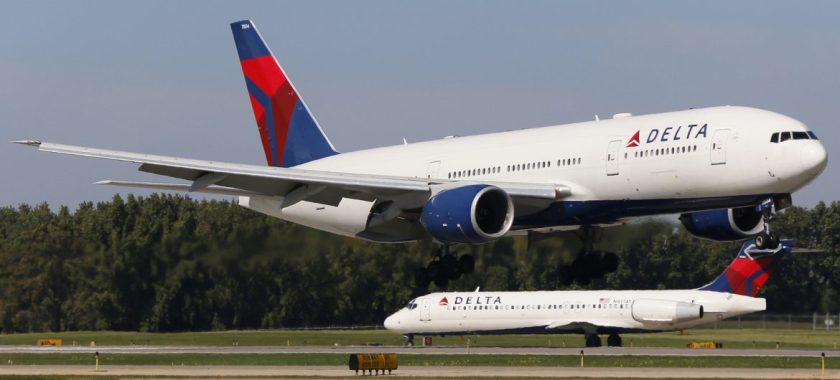
Delta will be terminating its Singapore-Tokyo Narita service from 22 September 2019 onwards, as it rejigs its Asia Pacific network.
This is after several decades of operations by Delta, as well as its predecessor, Northwest Airlines.
In a media release issued by Delta on the enhancements the airline was making to its Tokyo-Haneda operations, it said:
As part of its long-term Asia-Pacific network strategy, Delta will also adjust its network of flights beyond Narita. Effective March 2020, the carrier will suspend its NRT-MNL service and launch new daily ICN-MNL service operated by Delta. Serving Manila through Seoul will offer our customers superior connectivity via our industry-leading trans-Pacific hub in Seoul with our JV partner Korean Air.
While Delta will suspend Narita-Singapore service beginning Sept. 22, 2019, Delta customers can continue to reach Singapore – and more than 80 other destinations throughout Asia – through Seoul-Incheon via the airline’s partnership with Korean Air.
Delta Airlines, 9 August 2019
What led to this?
Delta and its predecessor Northwest Airlines has long used Tokyo-Narita as its Asia Pacific base, as it’s strategically located at the doorstep of Asia from U.S. At its height, Delta served 10 Asia destinations from Tokyo, including Beijing, Taipei, Manila, Bangkok and Singapore.
But in the new era of joint ventures, Delta got left out of the game when United and American Airlines tied up with ANA and JAL respectively, leveraging each other’s extensive networks in their regions to connect Asia to US via Japan.
On top of that, the use of Tokyo-Haneda airport has also been liberated for foreign carriers, albeit to a very limited extent, with four U.S. carriers sharing only six pairs of slots at Haneda. This worked well for the two pairs of U.S.-Japanese airlines joint ventures, because the U.S. carriers could simply work within the limits imposed on them and leave it to the Japanese carriers to fill the rest of the gaps.
With the increasing preference for Tokyo-Haneda over Tokyo-Narita by customers, Delta found it difficult to maintain its traditional hub at the Narita base.
What is Delta’s Asia Pacific strategy?
With Delta left out of a JV partner in Japan, it has gone over to South Korea and hooked up with Korean Air, a long-time Skyteam alliance partner. With the Singapore-Tokyo Narita service canned, Delta customers will now rely on Korean Air’s services to bring them to Incheon, before continuing their journey to the U.S. on Delta.
Tokyo-Haneda airport will also be giving more slots for U.S. carriers from next March onwards. In total, U.S. airlines will be able to operate up to 18 daily round trips to and from Haneda Airport, up from six today. Delta has will be taking up seven out of the 18 available pairs, to be the largest U.S. carrier operating to Tokyo-Haneda, and allowing it to shift all of its flights between Tokyo and the U.S. to Haneda Airport and ceasing all services to Narita.
Henceforth, Delta will be relying on its fairly new joint venture partnership with Korean Air to serve the Asian market, effectively moving its Asian hub to Incheon. This will allow Delta to focus on flying from U.S. to key north Asian cities, while letting Korean Air bring its customers onwards to other Asian destinations.
Singapore Airlines / 4 August 19 / B787-10 / SQ215 SIN-PER / Business class / 12K
Earlier this year I was planning for a National Day long weekend getaway with some friends, so I decided to dump some of my miles into a Bangkok-Singapore-Perth redemption for 32,500 miles (one-way) just before the devaluation of the Krisflyer miles kicked in.
Singapore Airlines had started operating its B787-10 on select services to Perth since earlier this year, so I thought it was prime time to check out the latest seats and service in business class.
Singapore Airlines new generation regional business class seat
Singapore Airlines operate 4 services between Singapore and Perth daily. Out of Singapore, two of the services are in the morning, one was in the evening and one was overnight. On the return leg from Perth to Singapore, there is one service each in the morning, afternoon, evening and overnight.
For my SQ215 service today, departure was at 6.45pm and scheduled to arrive into Perth at 11.55pm. All Singapore Airlines Australia-bound services depart out of Terminal 3 at Changi Airport.
Singapore Airlines business class check-in counters
Check-in was a relative breeze with many check-in rows for customers to proceed to. As a default, business class passengers can proceed to row 6 for a traditional check-in by an agent, but they can also head to row 4 to drop their bags if they have already completed their online check-in earlier.
The lounge
At the time of writing, Singapore Airlines has already announced a phased refurbishment of its lounges in Terminal 3. On the day of my flight, the Krisflyer Gold lounge has moved to Murhaba Lounge, but the SilverKris lounge for business class passengers was still in operation (see my earlier review here).
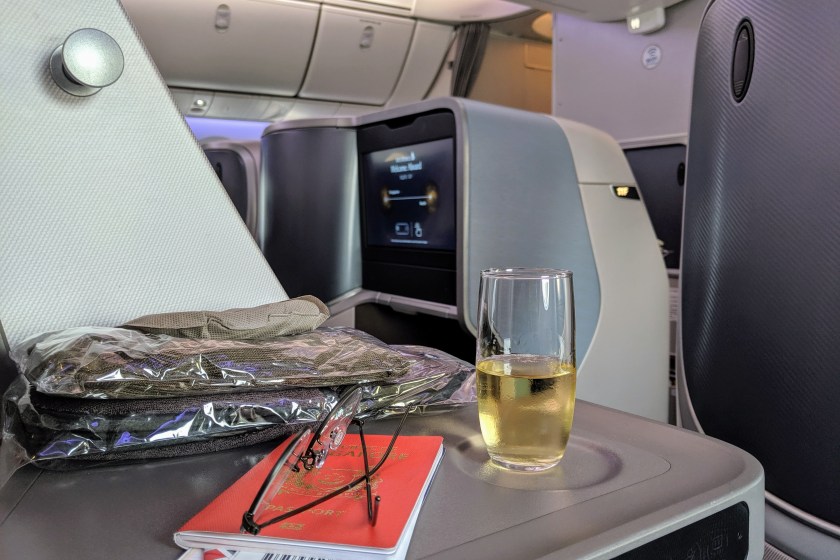
I went in for a quick glass of champagne before making my way to the gate.
The aircraft
SQ215 was operated by a Boeing 787-10 today. The Singapore-Perth route is operated by a mix of the regional A350-1000s, B787-10s as well as some old A330s. Singapore Airlines has most recently announced that from October onwards, the A330 will no longer be on the Perth services, so all premium cabin passengers will enjoy a lie-flat new regional business class product.
For those following Singapore Airlines’ fleet renewal closely, you will know that SIA has now 12 Boeing 787-10 in its ranks, with another three birds joining the fleet by the end of year.
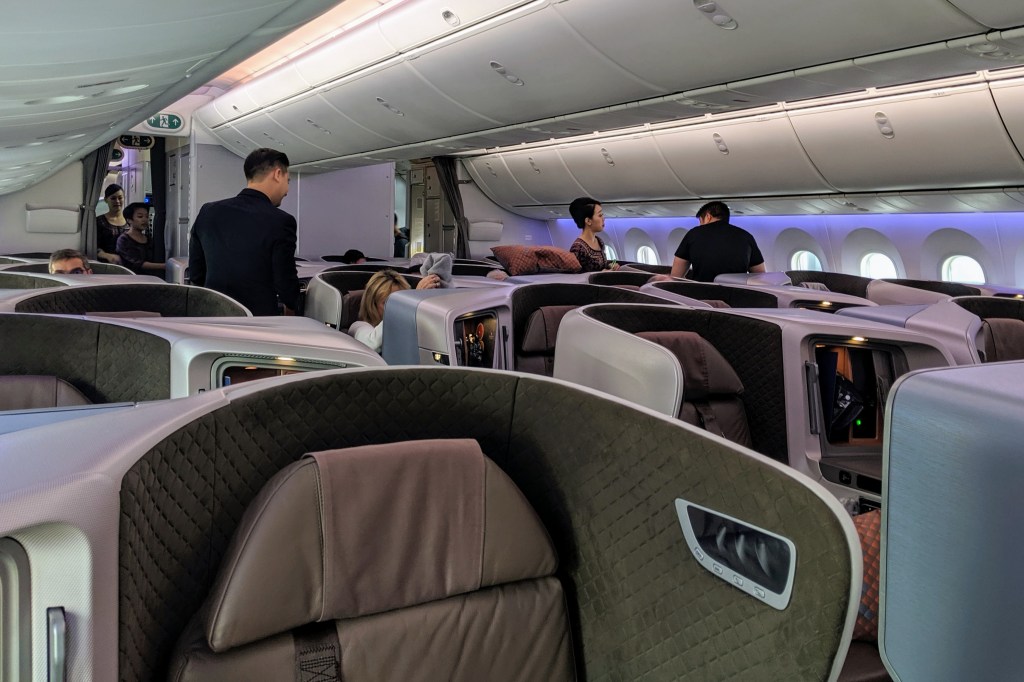
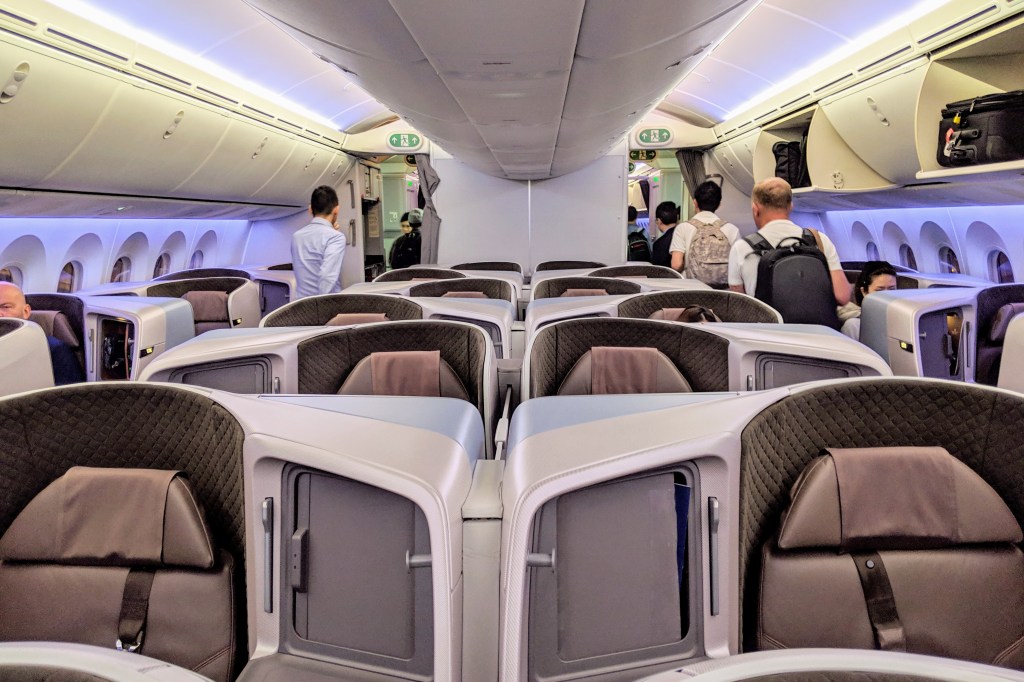
Singapore Airlines B787-10 business cabin
All of Singapore Airlines’ Boeing 787-10 are used for regional services, hence they only have two classes: business and economy. In business cabin, there are 36 seats over nine rows, with four across each row. In business class, the seat that Singapore Airlines have chosen is the STELIA Symphony, a brand new design that Singapore Airlines have decided on and announced with much fanfare back in 2018.
All seats have direct aisle access, an upgrade from the previous 2-2-2 regional products found on the A330.
The seat
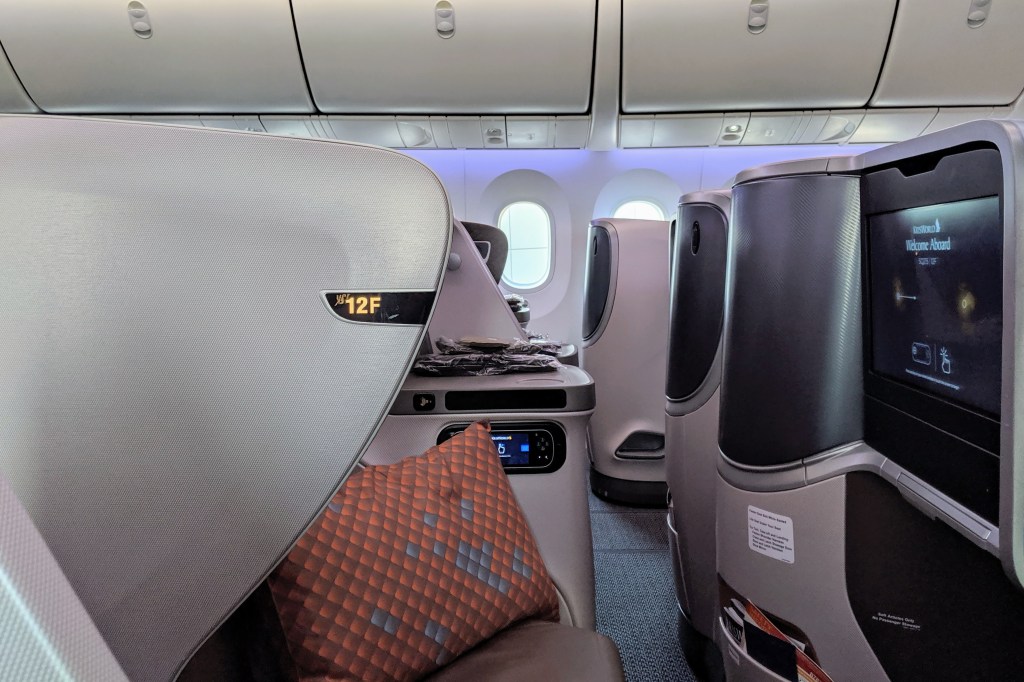
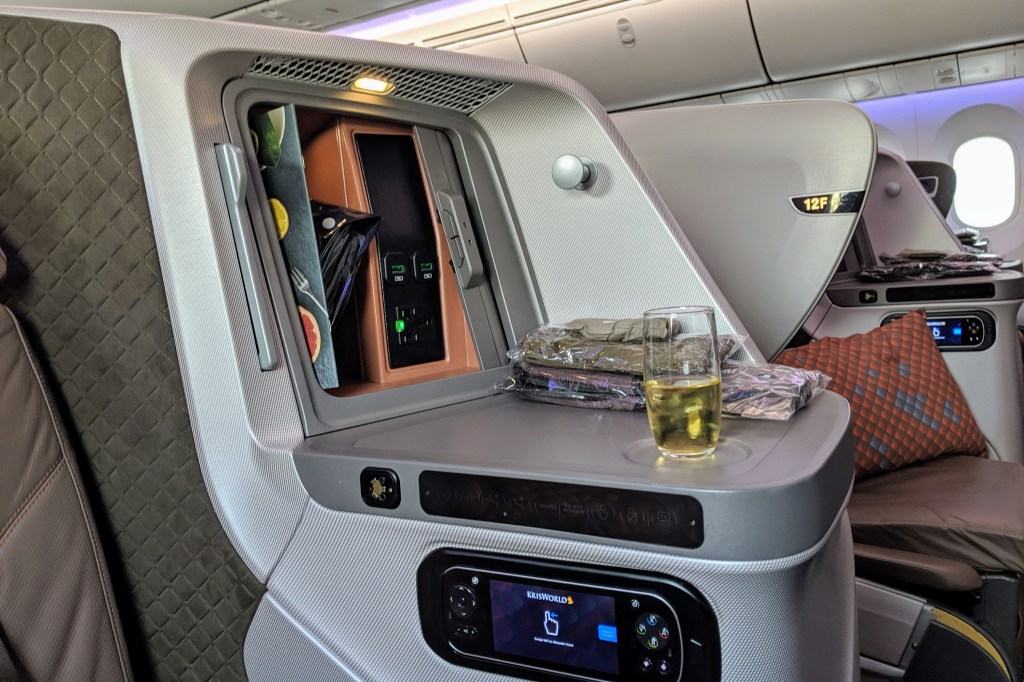
I have done a review of this seat for my Bangkok-Singapore flight earlier this year. This time round, I had the chance to book a seat with the seat next to the window, and have the console separate my seat from the aisle. If you ask me, this is a much better option as it offers a lot more privacy.
Seat 12F across the aisle
Even though this is my second time on this aircraft, I still maintain that the seat feels a little tight, although arguably much less than the JAL seats. The seat comes with adjustable armrests on both sides, which one can leave up or push it down to level with the seat for a more spacious seating.
Singapore Airlines have aligned the seats in such a way that in alternate rows, couples travelling together can choose a pair of middle seats with their seats right next to each other.
Alternating seats for the middle pairs – choose wisely!
As previously mentioned, the seat controls have been upgraded significantly from previous iterations of the Singapore Airlines business class seat. Loyalists will know that the previous iterations of the business class seats – especially the long haul seats – are built to be manually turned into beds upon request.
For the Boeing 787-10, Singapore Airlines have adopted an electronically-controlled system. The seat controls are located on the side of the table-console. At a touch of the button, you will be able to recline the seat into a fully flat bed.
Electronic controls for the seat (above the handset)
On the side console was also a small compartment which contained the headphones, and also contained the power socket and charging ports. For take off and landings, the compartment needs to be closed, so effectively you won’t be able to charge anything during this time.
The tray table is stowed under the in-flight entertainment screen in front of you. There is a button to eject the tray, which you then unfold into a larger table.
The service
Flight time today is about 4.5 hours, which is a relatively short flight. Unlike short-haul services around Southeast Asia, Singapore Airlines do provide some amenities for business class passengers, including slippers, eye masks and socks.
From top left, clockwise: eye shades, slippers, socks
Customarily, the cabin crew came around to offer a pre-departure drink of either champagne, juice or water. Champagne is always my choice of drink, unless it’s way too early in the day. For the uninitiated, Singapore Airlines serve Charles Hensieck champagne in business. Hot towels were also dished out during this time, as the cabin crew collected another round of drink orders for after take-off.
Just after doors are closed and the aircraft is on its way to the runway, the cabin crew came around and swiftly retrieved all the glassware.
Soon we are on our way. As there was only one meal service, there was no rush to serve. The cabin crew came around with the drinks that we ordered before take-off. This was when I experienced a little lapse. I had initially ordered a Shiraz, but a white wine was brought to me instead. After clarifying my order, the wine took a while to come again because the cabin crew forgot to bring it out for me. It was a relatively small matter, but for an airline who had set the bar so high with regard to service, this was a little annoying. I got an extra pour of the Shiraz (which turned out to be pretty decent) from a very apologetic leading stewardess, so I guess I’ll let this slide.
Dinner service commenced about an hour into the flight, so if you are the sort who needs an early dinner, you’re better off grabbing a bite in the lounge first.
As I have previewed the on-board menu earlier through Manage My Booking and wasn’t impressed with the selections, I have went ahead with a Book the Cook selection of Nasi Lemak, which the cabin crew came around to confirm just before the meal service.
For those who are interested, the menu for the evening read as below:
Canape: Singapore Chicken and Beef Satay
Appetiser: Parma Ham and Mozzarella Cheese Caprese
Main Course:choice of Seared Salmon Trout with Campagne Vinaigrette Singapore Roti Prata Wok-fried Beef in Black Peppercorn Sauce Sous Vide Pork Tenderloin with Light Tarragon Sauce
Dessert: choice of Haagen Dazs Strawberry Ice Cream Tiramisu
Selection of Cheese
Fruit from the Basket
Assorted Bread Rolls and Gourmet Breads
Fine Pralines
Coffee and Tea
It’s a full meal service, and in my opinion with a little more choices than what was available on my Singapore-Beijing service.
Having said that, Singapore-Australia flights tend to be competitive given the relatively high yields out of the Australian market, so I’m certain that Singapore Airlines will pull no stops to impressing customers with the service quality on the Australian services.
The famed Singapore Airlines satay was served about an hour into the flight. What always amuses me is how the satay is served before they dress your table for dinner. If you don’t take either chicken or beef, you can always request for more of the other meat you prefer. On some flights, they also serve lamb satay instead of beef.
Chicken and beef satay canapes
Dinner begins proper once I was done with the satay. The cabin crew came around to lay out the table cloth, before dishing out the tray with the appetiser and offering yet another drink. Another crew followed closely behind, offering a choice of bread rolls and garlic bread.
Appetizer: Parma Ham and Mozzarella Cheese Caprese
After the appetiser was completed, the stewardess came around to clear the plate and shortly my Book the Cook meal of Nasi Lemak was in front of me.
For those who had not tried the dish before, it comes with sambal prawns, a slice of otah, omelette and a fried chicken drumstick. The coconut-infused rice was on point, complemented by a sweet and spicy sambal chilli. The accompaniments were pretty rich as well, making the dish a perfect one. My only complaint was the chicken, my personal preference would have been a chicken fillet rather than a chicken drumstick, so that it’s easier to manage.
Book the Cook: Nasi Lemak
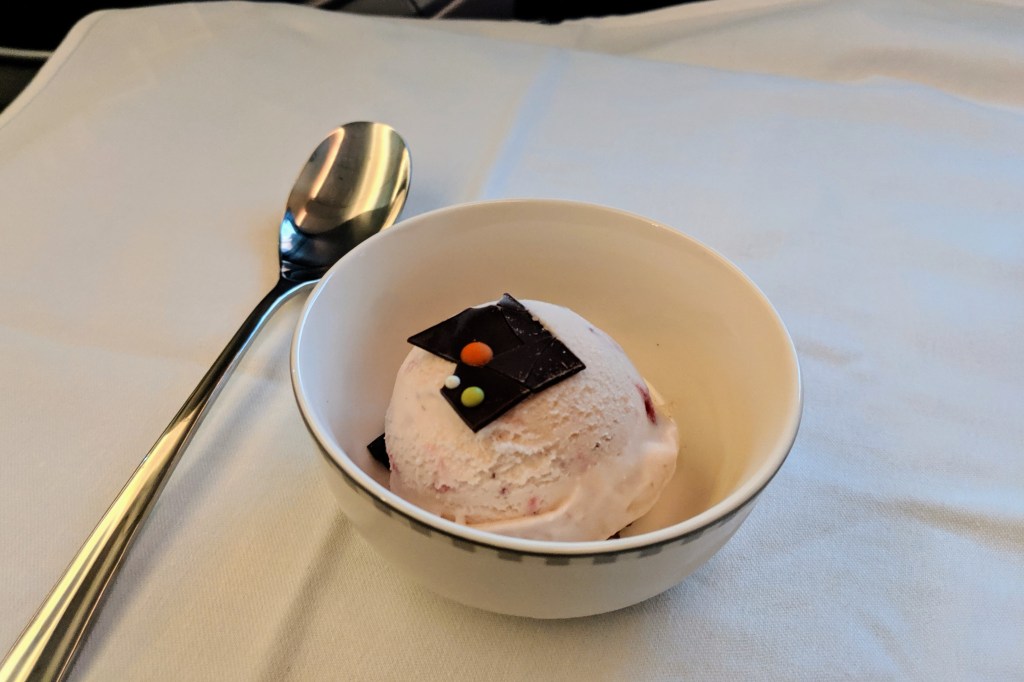
For dessert, there was a choice between the ice cream and a tiramisu. If you have followed me long enough, you will know that I will almost always go for the ice cream. My previous experience with SIA business class desserts have always been disappointing as they tend to ‘overdo’ it, for example adding toppings to the ice cream. However, the ice cream this time round turns out pretty perfect if you ask me: a simple scoop of strawberry ice cream, topped with just a simple wedge of chocolate.
Haagen Dazs ice cream
I also ordered a cup of decaf coffee, which was promptly served after dessert along with a choice of pralines personally offered by the in-flight manager.
The entire dinner service was completed in about an hour, by which time we were about half way into the flight to Perth. I rounded off the flight with another glass of Shiraz.
Final thoughts
The Boeing 787-10 aircraft is a boost to the Singapore-Perth services, which used to be serviced by the A330s using a regional 2-2-2 configuration in the business cabin.
The new seats, with all seats having direct aisle access, was a much needed upgrade, given that the only other competitor on this route, Qantas, has a similar seat type on the A330 they operate. Having said this, Singapore Airlines will be moving to a full new generation business class layout, featuring the latest regional business class product on all of its Perth flights from October 2019 onwards, operated by either the B787-10 or the A350 regional configuration aircraft.
Sunset on flight
Having said this, my comments about the seat comfort still stands. The in-flight entertainment screen was a little too close to my face for my liking, and the side console makes the passage between the aisle and the seat a little tight.
This time round, as I have chosen a window seat with the seat right next to the window (as opposed to having the console next to the window), the seat felt a lot more private than my Bangkok-Singapore sector experience. These seats tend to be very popular for solo travellers, so be sure to book them as soon as you can.
As I have mentioned earlier, the service quality of the Australia-bound services tend to be better as compared to other mid-haul destinations, and this is no exception for my flight today. So if you are ever planning a trip Down Under, you will have every reason to expect a tip-top service in SIA business class.
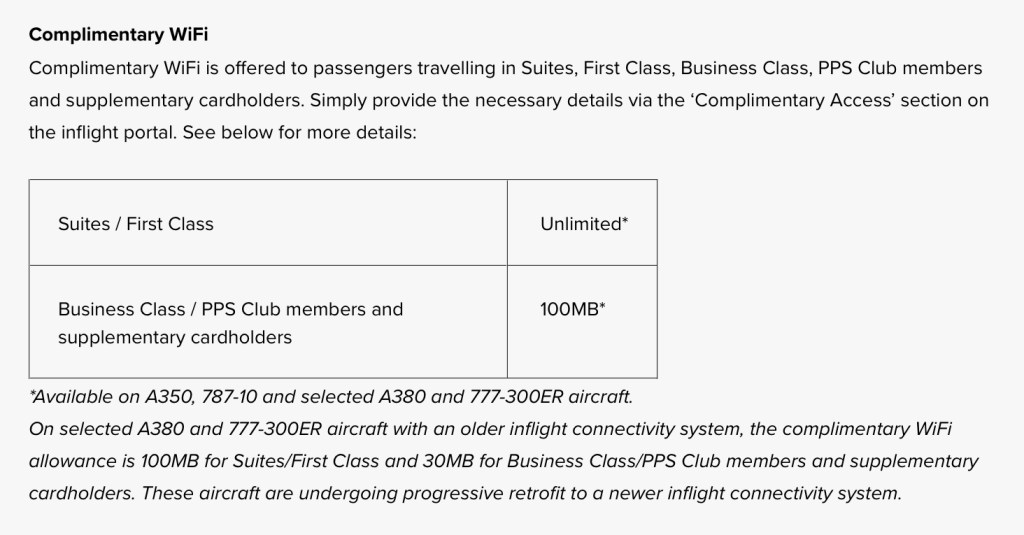
If you are travelling in first class or suites on Singapore Airlines anytime soon, you will now enjoy free unlimited in-flight wifi. Business class passengers and PPS club members will enjoy 100MB, up from the 30MB.
There is a big catch though: it depends on the type of aircraft you are flying on. The limitation is due to the type of in-flight connectivity system used.
You will enjoy the upsized amount if you are flying on the A350 or B787-10 aircraft. But if you are flying on the A380 or the B777-300ER, it will depend on the specific aircraft you are flying on. The fleet is progressively being upgraded so it’s best to check on the flight.
Fret not, even if you are still on an aircraft with the older system, you will still get the previous allowances of 100MB and 30MB for first and business class passengers respectively.
Singapore Airlines first rolled out complimentary wifi for its premium passengers back in February 2018, but up to a nominal limit. Business class passengers and PPS Club members in economy and premium economy were given 30MB, while first and suites passengers were offered 100MB.
Wifi is not available on some aircraft
Note that Singapore Airlines does not have wifi on all its aircraft. The following aircraft types do not have wifi:
A330-300
B777-200
B777-200ER
B777-300
Paying for wifi
Singapore Airlines had previously run a pretty confusing in-flight wifi pricing plan, which saw numerous prices and options depending on the aircraft type you were flying on.
The airline has since moved towards a standardised pricing plan, which unfortunately are now all data-based rather than time-based:








 Shanescape