Qantas still operating minimum essential international links; seems to suggest opening up New Zealand travel first
Qantas today announced a further extension flight cancellations on most international services in June and July. Flights between Australia and New Zealand will however be cancelled up to end-June for now.
Before this, practically all flights up to end-May were cancelled, except for a handful of services to four international hubs for the most essential travel.
Domestic travel within Australia has also be scaled back to a bare minimum, as many states have imposed travel restrictions and isolation requirements. These reductions are also extended till at least end-June.
Qantas however has caveat that “some capacity can be added back in if domestic and Trans-Tasman restrictions ease in coming weeks”.
What does it mean for customers
Assuming you still have a booking for June and July (not sure why you are still holding on to hope for travelling now, but that’s another conversation), these flights will automatically be cancelled.
You will be contacted with an option to receive your credit, which can be used towards a next flights within 12 months.
Note that if you want a cash refund, they will charge you a refund fee so that’s not advisable.
Raising cash
Qantas Group announced the cancellation extensions today along with a loan announcement, having secured A$550 million in funding, with three of its wholly-owned Boeing 787-9 aircraft as collateral. This follows an earlier A$1.05 billion raised in March against seven of its dreamliners. Qantas has 11 dreamliners for now, which it bought with cash a few years ago.
Qantas has now a total of A$3.5 billion in short-term liquidity, including other un-pledged assets. It has also said that it is currently burning cash at about A$40 million a week, after all the cost reduction measures, including putting about two-thirds of its employees on leave. This means that even if the coronavirus situation persists, the airline will still have enough funds to last it through another 18 months based on current circumstances.
Australia, New Zealand thinking of forming travel ‘bubble’
The two largest countries in the Pacific has so far sealed off their borders for more than a month, with even movement within the country highly restricted.
Even as both countries work towards opening up their respective country’s economy and transport, both country’s leaders have also committed to working towards opening international travel between both countries at the same time.
Both countries have jointly announced last week working towards a “Trans-Tasman bubble” to boost tourism, trade and business ties, with Qantas CEO being optimistic in resuming flights to New Zealand ahead of other international destinations.
Domestic services within Australia will also be reduced by 60%.
Qantas today announced that it will suspend all international services by the end of March until until May.
The carrier has earlier said it will slash its international services by 90%, but since the Australian government has announced tighter measures including a ban on arrivals of all non-residents into Australia, Qantas has dropped the gauntlet to axe all international services.
Earlier this week, cuts to 90 per cent of international flying and about 60 per cent of domestic flying were announced by Qantas and Jetstar. With the Federal Government now recommending against all overseas travel from Australia, regularly scheduled international flights will continue until late March to assist with repatriation and will then be suspended until at least the end of May 2020. As the national carrier, Qantas is in ongoing discussions with the Federal Government about continuation of some strategic links.
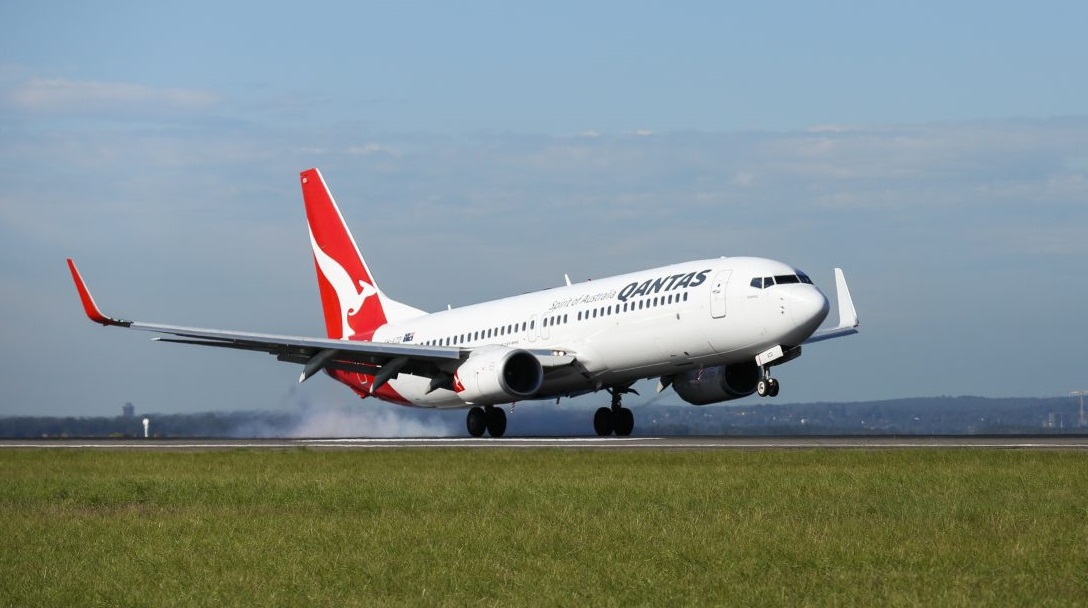
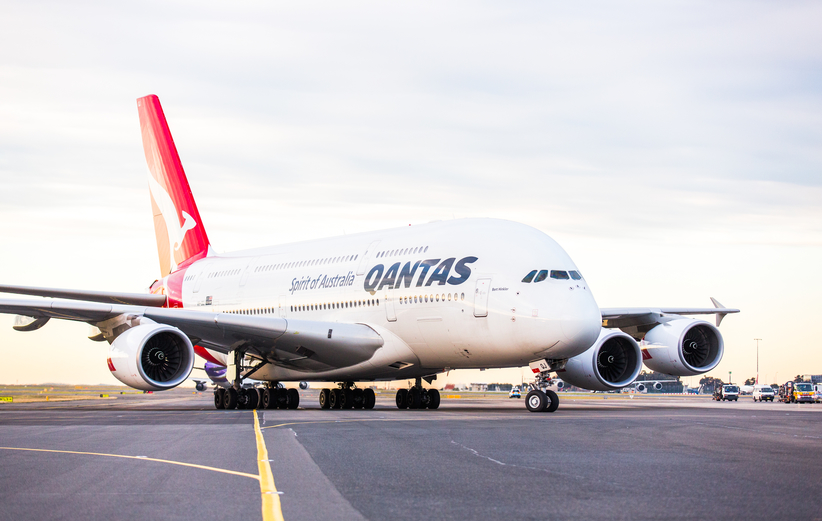
The airline will ground over 150 aircraft, including all of its Airbus A380, Boeing 787-9 and Boeing 747 jets. The bulk of Qantas’ fleet, the Boeing 737-800, will be expected to operate only domestic services, which will also see a 60% reduction in schedule.
Seems like suspension will commence 26 Mar
A look at Expertflyer revealed that almost all international services operated by Qantas have been zeroed out from 26 Mar 2020.
Singapore’s seven daily services to Australia and UK – except QF2 to Sydney – have been zeroed from 26 Mar 2020 (Thu).
Singapore’s QF1 service to London will operate its last flight on 25 Mar at 11.55pm, arriving into London Heathrow at 7.15am the next day.
The return service QF2 will leave London on 26 Mar, arriving into Singapore on 27 Mar. QF2 will be the last Qantas flight out of Singapore on 27 Mar at 7.15pm, arriving into Sydney next morning at 6.10am.
In the meantime, travellers going to Perth will be accommodated to the smaller Boeing 737 until 25 Mar, instead of the usual A330.
Similarly, Qantas will also be cutting off services to other parts of Asia, including Denpasar-Bali, Bangkok, Manila, Hong Kong and Tokyo from 26 Mar 2020.
Some ad hoc flights may be operated
In its communication, Qantas has said that it may operate some ad hoc services to maintain strategic links or those requested by the government for repatriation purposes.
These will be announced where necessary at a later date, upon discussion with the Australian Government.
All Qantas international lounges to close temporarily
Following the suspension of all international services, Qantas will also shutter all international business class and first class lounges in Australia and globally.
Qantas first class lounge and business class lounge will be temporarily closed
Qantas to extend frequent flyer status for a year
Given the extended period of time of non-flying, Qantas will also be extending the validity of all Qantas Silver, Gold, Platinum and Platinum One frequent flyers by a year.
Final thoughts
As the world grapples with Covid-19, these are indeed uncharted territory that many airlines are heading into. Qantas is not spared either.
Qantas Group CEO Alan Joyce has this to say:
“This is a very hard set of circumstances for our people, as it is for lots of parts of the community right now. No airline in the world is immune to this, with the world’s leading carriers making deep cuts to flying schedules and jobs. Our strong balance sheet means we’ve entered this crisis in better shape than most and we’re taking action to make sure we can ride this out.”
Alan Joyce, Qantas Group CEO
What should have been a celebratory year for Qantas as it turns 100 years old is now smeared with the effects of a deadly virus, which has reduced the airline to a domestic one for now.
The non-affiliated airline is finally hopping on the alliance bandwagon.
2020 is proving to be a really exciting year with a lot of unexpected twists.
After so many years of cultivating eclectic airline partnerships and wow-ing the world with crazy miles-buying deals, Alaska Airlines has announced a deepened partnership with American Airlines, and along with it, its intentions to join Oneworld by Summer 2021.
By ‘summer’, it can means anything between June to September.
Deeper partnership with American Airlines
The pledging of allegiance to Oneworld comes on the back of its latest partnership with American Airlines. Effective immediately, Alaska Airlines passengers and Mileage Plan elite members have greater access to American Airlines inventory, as well as benefits.
What this means for Alaska Airlines and its customers:
Customers can redeem Alaska Mileage Plan miles on all American Airlines flights (subject to award availability),
Alaska Lounge members can access American’s nearly 50 Admirals Club locations,
Customers can also continue to earn and redeem miles on Alaska Airlines’ current partners, including Singapore Airlines & Emirates.
In a few months’ time, Alaska Airlines Mileage Plan members can also earn miles on all American Airlines flight, both domestic and international.
Oneworld benefits come Summer 2021
Of course there are perks when Alaska Airlines officially joins Oneworld. These include a mapping of Alaska’s own frequent flyer tiers to the Oneworld tiers, as well as its corresponding benefits.
Alaska Airlines Mileage Plan tier
Oneworld tier
MVP
Ruby
MVP Gold
Sapphire
MVP Gold 75k
Emerald
Alaska Airlines tier mapping to Oneworld
What does this means for Alaska’s own partners?
Alaska Air has some of the most interesting mix of partners, which are all individually negotiated. This has resulted in a very special award pricing, where each award partner gets their own award chart, and a mixed carrier chart is somewhat impossible (with the exception of Alaska’s own metal plus a partner).
Also, the earn rates are incredibly generous at the moment. Just a case in point: a customer flying business class on Cathay Pacific from Hong Kong to London and back will earn a whopping 26,892 miles if they accrue their miles on Mileage Plan, while getting only 16,620 miles on Asia Miles.
On the redemption front, Alaska Airlines is also incredibly generous now. For 25,000 miles, you can redeem a one-way business class ticket on Japan Airlines within Asia, while a Oneworld member (e.g. Cathay Pacific) can charge up to 45,000 miles for a similar trip.
So with Alaska Airlines joining the Oneworld ‘family’, they will almost definitely be forced to keep in line. This could go a few ways:
1. Earn rates will definitely go down, while burn rates will definitely go up.
On a reciprocal basis, Alaska Airlines will be more than definitely be forced to ‘align’ their earn and award charts to what other member airlines are offering. So if you have been hoarding Alaska Airlines miles, time to use them, quickly.
2. Changes to partnerships with non-Oneworld airlines
While being a Oneworld member does not mean they have to cut off ties with non-Oneworld aligned carriers, you can almost imagine that these partnerships may just widening in time to come. Some partnerships may fall through, while others may be diminished.
Final thoughts
As the saying goes, good things don’t last. In this case, the benefits of being an Alaska Airlines Mileage Plan member – especially in this part of the world – is slowly eroding.
While you still can and is looking to burn your miles, credit your premium cabin revenue tickets to Alaska to bump up your mileage balance, but be sure to use them quickly before summer next year.
I was travelling to Italy over Christmas and New Year and took my flight with Qatar Airways, in economy (no less!) as I was travelling with some friends.
I thought it would be a good chance to take a look at the revamped economy class catering that Qatar Airways has shouted about in 2019 to see how it actually measures up.
The PR Spin
Qatar Airways did quite a fair bit of hype over their new and improved economy catering back in April 2019. Styled as Quisine, the PR spin has this to say:
Food portions have increased by 25 per cent – 50 per cent, with a greater focus on the use of local, fresh and healthy ingredients that are in season. Meals will also feature individually-wrapped artisanal warm infused bread and an individual bottle of water. A wider selection of mid-flight movie snacks includes a tantalising array of cheese and crackers, chocolate bar, potato crisps and popcorn, with innovative flavours such as Himalayan Salted Caramel and French Butter and Pink Salt provided by gourmet popcorn brand 4700BC.
This was almost reminiscent of what Qantas did back in 2015, although that squarely had the effect of reducing a tray full of food into just one single entree, which to many people took away the joy of flying (there’s hardly any joy left in economy class, honestly).
First, my flights
A bit more details about my flights. My first flight departed Singapore at 2am and scheduled to arrive at Doha at 5am Doha time. My connecting flight was three hours later, departing at 8am from Doha and arriving into Italy at about 12pm local time.
My return flight from Rome was at 10pm, arriving into Doha once again at 5am. The last leg to Singapore was scheduled to leave Doha at 8am, arriving into Singapore slightly after 9pm.
As you can see below, I became an expert in Qatar’s economy breakfast and obviously painfully sick of it after my trip.
Sector
Flight
Depart
Arrive
Flight Time
Meals
SIN-DOH
QR945
0200
0530
8h 30m
Snack, Breakfast
DOH-VCE
QR125
0810
1235
6h 25m
Breakfast, Snack
FCO-DOH
QR114
2205
0515(+1)
5m 10m
Supper
DOH-SIN
QR944
0830
2115
7h 45m
Breakfast, Snack
Let’s talk about the menu first
Qatar Airways economy class Quisine menu card (click to open image in a new window)
In economy class, a menu card (as opposed to a booklet like how Singapore Airlines does it) is provided to every passenger.
On the left side of the menu is a graphical representation of the service order, which in this case goes by:
Take off
Menu card distribution
Pre-meal beverage service
Main meal service
Coffee/tea service
Water/beverage service
Pre-arrival snack service
Landing
The full offering is then presented on the right hand side, first the food, followed by the beverages.
What was served on board
Departing Singapore at 2am, this means that a snack and breakfast was served on my first flight. I went on board and dozed off immediately, thereby missing my snack, so it’s straight to breakfast for me.
For the breakfast on my first flight, I was pleasantly surprised that Qatar Airways offered three options, rather than two. I went for the nasi lemak. For those unfamiliar with the dish, it’s a Southeast Asian breakfast commonly found in Singapore and Malaysia, featuring a fragrant rice cooked in coconut oil and comes with a side of curry chicken, egg and a good sambal chilli.
This was how my breakfast looked like:
Qatar Airways economy class Quisine breakfast – Nasi Lemak(December 2019)
I actually took the same flight exactly a year ago, and also had nasi lemak. This was how it looked like a year ago:
Qatar Airways economy class breakfast – Nasi Lemak (December 2018)
Now, not that different isn’t it? To be fair, I can’t really tell if the portion is indeed now bigger, but based on the photos nothing really have changed. I still have a yogurt, a fruit and a croissant to go with my meal. I’m not that hard up about the cupped orange juice, given that I can always ask for a glass if I really wanted juice.
Here’s another option on the same flight, a spanish omelette with ham:
Qatar Airways economy class Quisine breakfast – Spanish omelette
On my next flight to Venice, I opted for a regular breakfast of scrambled eggs, potato wedges and sausage. This was not particularly memorable, but sufficient for a breakfast.
Qatar Airways economy class Quisine – Western breakfast
I’m not going to bore you with more of my critique, but i’ll let the photos do the talking:
Qatar Airways economy class Quisine dinner – Chicken baharat in Catalan sauceQatar Airways economy class Quisine breakfast – Plain congee with roasted cod flakesThis is just to show you how small the congee portion isPre-landing snack service – Fajita chicken pastry
Where are the movie snacks?
On my return flight from Rome, I stayed up through most of both flights and I only have this to say: Where are my snacks?
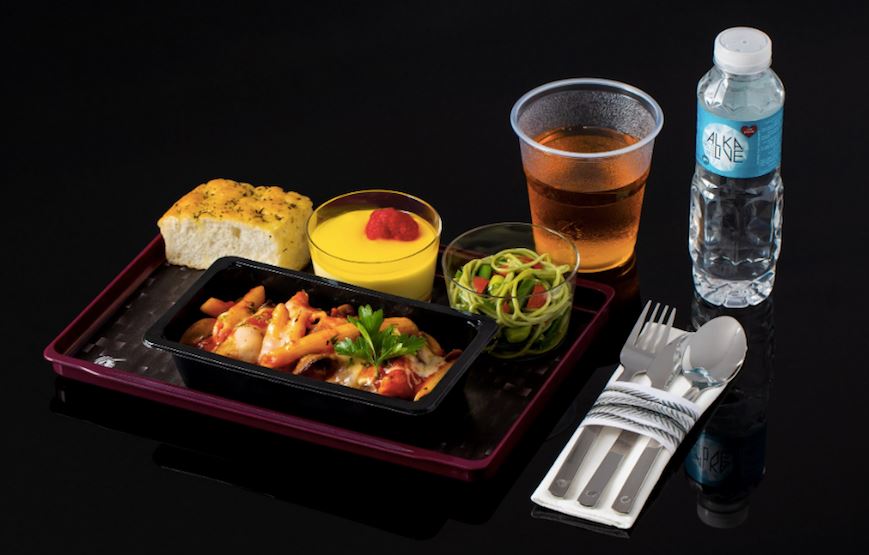
Qatar Airways Quisine movie snacks (Photo: Qatar Airways)
This was the marketing photo that was rather well publicised, and when I saw it, I was like, hey I want that popcorn, and cheese and crackers!
But nope, none of that was offered on any of my four flights, sadly. Sure enough, they did go around giving us chocolates and a packet of pretzels each time I asked for a drink, but the fancier snacks were nowhere to be seen.
Sparking wine and pretzels
Beverages
One thing worthy of mention is the quality of beverages served on board.
The bad news first: Qatar Airways partners with Pepsi for their catering, so fans of Coca Cola will be sorely disappointed. I know that some people can tell the difference between the two and particularly prefer one over the other.
And now the good news for people who needs a good drink or two. For a start, Qatar Airways serves sparkling wine in economy class, something that only a handful of airlines do.
If you are in a mood for something stronger, the choice of spirits that Qatar goes for include Bombay Sapphire gin, Smirnoff vodka and Dewar’s White Label blended scotch whisky. I’m not a judge of the whisky, but I’ll take Bombay Sapphire over Gordon’s dry gin any day.
If you prefer something non-alcoholic, Qatar Airways always serve up a good range of at least five different juices, on top of the usual soft drinks.
Final thoughts
Qatar Airways has one of the best economy class experiences if you ask me. The food is decent, they serve sparkling wine (and actually carry enough of it), and has a great variety of snacks. Come on, who else serves Godiva chocolates in economy class?
Having said that, my opinion is that the entire Quisine transformation in economy class is, after all, still a PR spin. The essence of the meal didn’t really change – I’m not certain if the entrees are indeed larger (they looked the same to me), and instead I’m missing a couple of items from the meal tray such as the chocolate bar.
I get that wastage for these items are usually rather high, so moving them from the tray where everyone gets one, to an on-request basis can be a more environmentally and cost friendly way of operating.
Having said that, by removing these little luxuries, the little changes do slowly chip away at the halo effect of flying the world’s best airline.
Although I’m based in Singapore, personally I’m more of a fan of Oneworld airlines rather than Star Alliance (and by extension, Singapore Airlines). As a matter of habit, I find myself booking on Oneworld carriers more than on Singapore Airlines, given the relative higher price of the latter out of Singapore.
Back in 2018, I paid good money to be part of Marco Polo Club (which is separate from the Asia Miles programme) and managed to get myself to silver after making several trips. The perks at this Oneworld Ruby level is pretty decent: while I’m flying Cathay Pacific or Cathay Dragon, I’ll get lounge access.
Cathay Pacific A330 business class seat
So after having a year of Marco Polo Club Silver and enjoying its pretty good perks, I thought I’ll try out Qantas Frequent Flyer and see how far I will get. I knew I was going to fly more in 2019 so I wanted to see if I will be able to fly enough to qualify for Gold, which will offer me more perks.
For a start, joining Qantas Frequent Flyer is free (note that if you reside in Australia or New Zealand, there’s a joining fee). This is in contrast with the USD100 I had to pay to join Marco Polo Club.
Qantas Frequent Flyer Gold benefits
For the uninitiated, Qantas Frequent Flyer (QFF) belongs to the Oneworld Sapphire tier, which is equivalent to Cathay Pacific Marco Polo Club Gold, or British Airways Executive Club Silver.
As a summary, this is what you get at QFF Gold, which is also what you get as a Oneworld Sapphire elite status holder:
Oneworld business class lounge access when travelling on Oneworld airlines
75% bonus Qantas points when travelling on Qantas, Jetstar, Emirates and American Airlines
Additional baggage allowances when travelling on Oneworld airlines
Oneworld Sapphire gives you business lounge access, such as this Cathay Pacific lounge at Changi Airport Terminal 4
Beyond the above, QFF offers some pretty unique perks, including:
Lounge access when travelling on Jetstar and Emirates
Access to Emirates lounges when travelling with Qantas
Additional baggage allowance
If you need detailed information on what QFF Gold offers, check out Qantas’ website here.
Lifetime Gold
More importantly, I have a chance to gun for lifetime Gold status at some point, when I hit 14,000 status credits (that’s another story for another day… maybe 20 years later).
Marco Polo Club has ceased their lifetime membership a while back so if I want to keep my status, I have to keep flying and accumulating 600 club points every single year.
How I did it
To qualify for QFF Gold, I’ll need to rack up 700 status credits in a year. To keep it in subsequent years, I only have to earn 600 credits each year.
This is a summary of the flights I took and the number of status credits I earned from each flight:
Flights
Trip Type
Qantas Points
Status Credits
Cathay Pacific business class Singapore to Okinawa (via HKG)
Return
7,750
280
Malaysia Airlines business class Singapore to Bangkok (via KUL)
Return
2,150
120
Qantas economy class Singapore to Perth
Return
4,050
50
Jetstar Max bundle Perth to Singapore
One way
4,050
50
Jetstar Max bundle Singapore to Ho Chi Minh Ctiy
Return
3,150
60
Jetstar Max bundle Singapore to Taipei
Return
4,400
80
Jetstar Max bundle Singapore to Bangkok
Return
3,150
60
Total:
28,700
700
So in total, I scored exactly 700 status credits and 28,700 Qantas points, enough for me to get QFF Gold.
Some people may argue that going to BKK via KUL is an absolute waste of time, which technically was not wrong. After all, why spend 5 hours travelling when you could spend just two?
However, this route is one of the best value to rake in status credits: at SGD600+ in business class for a roundtrip between Singapore and Bangkok, you get 120 status credits, working out to about a little above SGD5 per status credit.
As a point of reference, 28,700 Qantas points is enough for me to redeem a one-way economy class ticket to Sydney on Qantas, or a one-way economy class ticket to Japan.
One way Economy class ticket from Singapore to Sydney on Qantas: 25,200 points + $123.30One way Economy class ticket from Singapore to Tokyo-Haneda on Japan Airlines: 24,500 points + $106.90
How does this compare if I were to credit the points to Cathay Pacific Marco Polo Club or British Airways Executive Club?
For a start, over a third of my status credits came from Jetstar flights, so we are naturally comparing apples to oranges.
To recap, to reach the equivalent of QFF Gold, I’ll need either:
600 tier points for British Airways Executive Club + 4 segments on BA
600 club points for Marco Polo Club
Even if I swapped the Jetstar flights out for Malaysia Airlines or Cathay Pacific flights, this will be how my earnings will look like on BAEC and Marco Polo Club:
Flights
Trip Type / Fare Class
BAEC Avios
BAEC Tier Points
Asia Miles
MPC Club Points
Cathay Pacific business class Singapore to Okinawa (via HKG)
Return
6,222
160
10,000
120
Malaysia Airlines business class Singapore to Bangkok (via KUL)
Return
2,390
160
2,358
80
Qantas economy class Singapore to Perth
Return O class
1,214
40
0
0
Qantas economy class* Perth to Singapore
One way O class
607
20
0
0
Malaysia Airlines economy class* Singapore to Ho Chi Minh Ctiy
Return V class
422
20
0
0
Cathay Pacific economy class* Singapore to Taipei
Return Q class
1,056
20
2,660
30
Cathay Pacific economy class Singapore to Bangkok*
Return Q class
448
10
2,000
20
Total:
12,359
440
17,018
250
*substituted with the best matched Oneworld carrier routing
As you can see, the number of tier points and club points don’t quite get me to Marco Polo Club Gold nor British Airways Executive Club Silver, or even anywhere near.
In terms of the number of miles earned, 12,300 Avios is hardly enough to get you anywhere, while 17,000 Asia Miles can get you a one way ticket to Hong Kong, or even Shanghai, albeit in economy.
tl;dr – both Marco Polo Club and BAEC are solid programmes, but this will not help leisure traveller me get to the Oneworld Sapphire level as easily as with Qantas Frequent Flyer.
Jetstar Asia is a key advantage
The ability to earn Qantas points and status credits on Jetstar is also another huge plus for QFF. As I’m based in Singapore, taking Jetstar flights was easy, given it’s the home for Jetstar Asia.
To get points and status credits with Jetstar, you will need to purchase either the Starter Plus or Starter Max bundle. I usually go with the Max bundle, so that gives me 30kg check-in baggage allowance, a complimentary meal, seat selection on any seat in the aircraft, as well as a decent amount of Qantas points and status credits.
For instance, for an extra SGD180 (the price of the Starter Max bundles on a roundtrip) on a roundtrip between Singapore and Taipei, you get a whopping 80 status credits and 4,400 points on the fare (my total fare including the bundle was about SGD520). This is a very good value if you ask me, as I usually will purchase check-in bags and food on board anyway.
The best part is that if you travel with Jetstar, the flights count towards the four Qantas/Jetstar flight per year requirement in order to get Silver or higher status, which makes it really easy for Singapore-based travellers.
Maintaining QFF Gold in 2020
Will I strive for Gold in 2020? Definitely. I have a couple of trips on Qantas coming up in 2020, including one in Premium Economy that I’m dying to review.
Hoping to score the new Qantas A380 when I’m doing the premium economy cabin later this year (photo: Qantas)
On top of the Qantas flights, I also have a couple of weekend trips planned, and can easily take Jetstar on those trips to clock up status credits and maintain my Gold status.
Having said that, the caveat is this: QFF is a solid programme if you care about getting elite status that gives you perks such as extra baggage allowance and lounge access when you travel, rather than having cheap redemption options for award tickets.
It’s not that QFF does not allow you to redeem, but rather, Qantas still has an opaque “additional fees and surcharges” that comes with the redemption tickets, that may make the programme very unattractive. For instance, a one-way redemption in business class from Singapore to Sydney will set you back by over 68,000 points, and another $250 in fees and taxes.
All in all, I still find it very good value to go with Qantas Frequent Flyer, given that my total investment to get gold was slightly over SGD4,000, or about SGD5.70 per status credit, which is pretty economical.
And the perk of getting into a good quality (read: non pay-per-use lounge) lounge all the time? Very much worth the chase.