Tag: oneworld

  • Cathay Pacific Asia Miles and Marco Polo Club

    Cathay Pacific Asia Miles and Marco Polo Club

    Singapore-based members who are very familiar with Krisflyer (Mainly Miles have an incredibly resourceful guide) may fumble at the first glance of Asia Miles.

    Asia Miles is travel rewards programme, a fully-owned subsidiary of Cathay Pacific Group. Members of Asia Miles can earn miles through everyday activities such as dining, hotel stays and flights, and use the miles for flights, hotel stays, and even lifestyle goods.

    Marco Polo Club (MPC) is Cathay Pacific’s loyalty programme, rewarding frequent flyers with perks as they move through the tiers by accumulating club points. When you accumulate enough club points, you will get to a certain tier which will give you extra benefits from extra checked baggage allowances to lounge access.

    While Asia Miles is free to join and use, there is a first-time joining fee of USD100 for MPC, payable every year unless you earn a minimum of 20 club points, which can be earned rather easily with any return flight from Singapore to Hong Kong on Cathay Pacific.

    Note that club points cannot really be used to redeem for anything; these club points are simply a count on how much you fly in a year. For those familiar with Qantas Frequent Flyer and British Airways’ Executive Club, the club points are synonymous with status credits and tier points respectively.

    Marco Polo Club

    Frequently Asked Questions

    I have included some Asia Miles 101 FAQs below, so you can either click directly to it or slowly read through this lengthy article.

    What’s the difference between Asia Miles and Marco Polo Club? Are they the same?

    Asia Miles is a travel rewards programme, meaning you get miles (the programme currency) for your activities, i.e. flying with Cathay Pacific, dining, credit card points, etc. This is a free programme, similar to Krisflyer. There are no tiers or levels in this programme – everyone earns at the same rate, and uses the same redemption charts.

    Marco Polo Club (MPC) is Cathay Pacific’s loyalty programme, which give you status points (Club Points) when you travel with them or other oneworld airlines. There’s no other way to earn Club Points. There is also an annual fee of USD100 to join the MPC, but this can be waived if you earn at least 20 Club Points in any programme year.

    Back to top

    How do I earn Asia Miles?

    There are several ways to earn Asia Miles.

    Flights: This is the most straightforward way. Flying with Cathay Pacific, Cathay Dragon or oneworld airlines will earn you both Asia Miles and Marco Polo Club points.

    Cathay Pacific has moved towards a fixed miles award system since 2018, so the amount of miles you earn from flying depends on (i) the fare class of your ticket,and (ii) which distance category your journey fall into.

    This is the chart:

    Standardised mileage earn chart with Asia Miles

    Hotels: Asia Miles also partners many hotel partners that allow you to convert your hotel loyalty points to Asia Miles.

    Some examples below:

    • LeClub Accor: 2 points to 1 Asia Mile
    • Hilton Honors: 10 points to 1 Asia Mile
    • World of Hyatt: 2.5 points to 1 Asia Mile OR 500 Asia Miles per stay
    • IHG Rewards Club: 5 points to 1 Asia Mile OR 500 Asia Miles per stay
    • Marriott Rewards: 3 points to 1 Asia Mile, bonus of 5,000 Asia Miles for every 60,000 points converted; OR 1 Asia Mile per USD2 spent on stay

    And many more. For more details, refer to Asia Miles website.

    Credit Cards: Asia Miles is probably the second most accessible mileage conversion programme after Krisflyer in Singapore. Many credit card rewards programme in Singapore will allow you to transfer your points to Asia Miles. See more details in the question below.

    Of course, there are other ways to earn Asia Miles, including car rentals and other obscure manners which I will not cover. For details, refer to the Asia Miles website.

    Back to top

    Can I transfer credit card points to Asia Miles?

    Credit Cards: Asia Miles is probably the second most accessible mileage conversion programme after Krisflyer in Singapore. Many credit card rewards programme in Singapore will allow you to transfer your points to Asia Miles.

    For starters, some of the most widely-used miles earning credit cards are existing partners of Asia Miles:

    • UOB PRVI MasterCard
    • UOB PRVI Amex
    • DBS Altitude Visa
    • BOC Elite Miles MasterCard
    • Citibank PremierMiles
    • Citibank Rewards
    • Standard Chartered Visa Infinite
    • American Express Platinum Credit Card, and many more.

    Most bank programmes in Singapore already have Asia Miles have a conversion partner, and the rates are similar to what you get with Krisflyer.

    From time to time, Asia Miles run targeted offers to encourage members to transfer to Asia Miles. For instance, DBS was running a 15% bonus offer to transfer DBS reward points to Asia Miles in early 2019, so you shouldn’t rule out similar offers in future.

    Back to top

    What can I use my Asia Miles for?

    Asia Miles can obviously be used to redeem for Cathay Pacific, Cathay Dragon and many oneworld flights, including those operated by Qantas, Japan Airlines and American Airlines. For more details on redeeming flights on Cathay Pacific, as well as tips and tricks, click here (coming soon).

    Beyond the oneworld alliance, Asia Miles has also gotten some other partner airlines on board, including Air Canada, Air New Zealand, Alaska Airlines and Lufthansa.

    On top of that, like many other airline frequent flyer programme, you can also use your Asia Miles for hotel stays, attractions, and lifestyle awards, although these are really not the best way to use your miles.

    One unique proposition of Asia Miles is the ability to use your miles for Asian pop concerts, typically held in Hong Kong, Macau or Taiwan. Some of the concerts that you could previously book for included Andy Lau, Khalil Fong and Mayday. The redemption rates are not that cost effective – for instance, a Mayday concert going for JPY12,800 (~SGD158) was going for 24,000 miles, working out to 0.6 cents per mile, which is not a great use of miles unless tickets are sold out everywhere else.

    Back to top

    How much is one Asia Mile worth?

    This is a perennial question on top of everyone’s mind – how much is one mile worth?

    The usual answer will be: it depends.

    For an economy class redemption (which is highly not recommended), the value can go down as low as under 1 cent, to over 3 cents.

    Business class redemptions can range between 3-6 cents per mile, depending on destination, airline and dates.

    First class redemptions can go as high as 10 cents per mile, but not likely achievable given that the inventory is typically limited.

    Of course, the above valuation is a simple one: it takes the commercial value of the ticket, divided by the number of miles required for a similar class of travel. There’s also the other school of thought on how much you are willing to pay for the ticket, that’s probably closer to the actual value you attach to a mile.

    Back to top

    What are the different statuses you can achieve with Marco Polo Club?

    Marco Polo Club offers four tiers to its members: Green, Silver, Gold and Diamond. Green is the entry level tier, while Silver, Gold and Diamond comes in after accumulating Club Points within a programme year.

    To requalify for Green each year, you will need to accumulate 20 club points each year. That’s pretty simple – the cheapest return economy fare from Singapore to Hong Kong that’s eligible for Asia Miles will get you 20 club points. If you fail to earn at least 20 club points, note that you will have to pay the USD100 fee in lieu of it.

    Silver, Gold and Diamond will come at 300, 600 and 1,200 club points respectively. That sounds like an awful lot but trust me, there are too many diamond members in the programme.

    One important thing to note if you are starting from the bottom (i.e. Green): each time you reach a new tier, your club point resets. So if you are starting from Green and wants to achieve Gold or Diamond within a single year, you will need 900 club points for Gold, and 2,100 club points for Diamond. Ridiculous, I know.

    For a summary of what Asia Miles can be used for and what each MPC tier offers, see the table below:

    Back to top

    How do I earn status with oneworld?

    Silver, Gold and Diamond also correspond to oneworld’s Ruby, Sapphire and Emerald status respectively, which standardises the tiers across its member airlines. This also means you get corresponding benefits when travelling with oneworld member airlines. For instance, if you are an MPC Diamond, you will be treated like a Qantas Frequent Flyer Platinum member when you travel with Qantas.
    Back to top

  • LOUNGE REVIEW: Cathay Pacific Singapore Lounge, Changi Airport Terminal 4

    LOUNGE REVIEW: Cathay Pacific Singapore Lounge, Changi Airport Terminal 4

    The Hong Kong Singapore Lounge is one of the latest in the Cathay Pacific’s network, opened less than 18 months ago when Singapore Changi Airport opened its newest terminal, Terminal 4.

    Being one of the major airlines operating out of Terminal 4 since the terminal opened back in 2017, the Cathay Pacific Singapore lounge is the only airline lounge at Terminal 4. It is a fairly cosy one, with 849 square metres of space and offering seats for over 200 customers at any point in time.

    Who can access this lounge?

    Apart from Cathay Pacific’s own business and first class passengers, Marco Polo Silver, Gold and Diamond members can also access the lounge when travelling on a Cathay Pacific flight out of Singapore. Oneworld sapphire and emerald members may also use the lounge as long as they are travelling on a oneworld-member operated flight on the same day, although I’m not sure if you should make the trek to Terminal 4 just for this lounge when the Qantas lounge at Terminal 1 is probably a better choice.

    The lounge

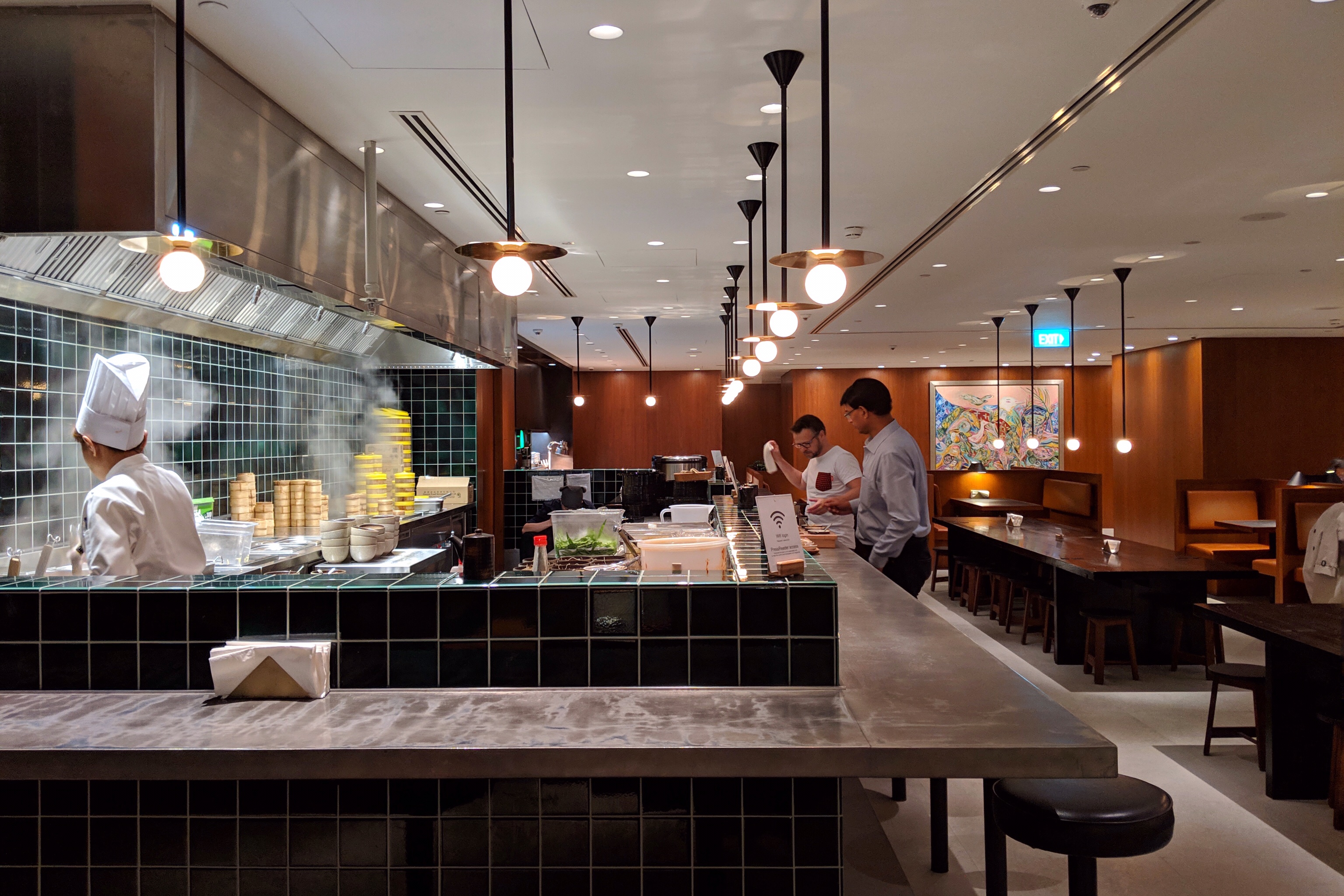
    The Cathay Pacific Singapore lounge features two main seating areas. The first is at the noodle bar, with plenty of two and four-seater booths, along with bar seats at the noodle bar and a long communal table adorned with stools.

    On the terrace overlooking the transit area of the terminal features several armchairs and coffee tables, perfect for a late night pre-departure drink. This is also where the self-service buffet area is placed.

    Cathay Pacific brought its famous noodle bar to the Singapore lounge as well, which has become a perennial favourite for customers around the world.

    The noodle bar serves up small bowls of the signature Hong Kong Wanton Noodles, along with other type of cooked-to-order items that reflects the local culture. For instance, the Singapore lounge serves a version of laksa as well, similar to the Qantas Singapore lounge.

    Another thing on offer was the steamed chicken dumplings (siew mai). While this is traditionally made with pork, I guess chicken may be a little more palatable to the diverse range of customers passing through.

    On the buffet table was also the standard western breakfast offering, including scrambled eggs, bacon, sausages and also a Chinese favourite, rice porridge.

    The lounge also offer a range of reading materials such as newspapers and magazines, although I didn’t really see anything picking something up to read while I was there.

    The only difference between the Singapore lounge and the Hong Kong lounges is the absence of shower rooms, given that Cathay Pacific only flies to Hong Kong and Bangkok from Singapore. Also, no other oneworld airlines are operating from Terminal 4, so that lessens the need for shower rooms.

    Final words

    The Cathay Pacific Singapore lounge is probably one of the newest ones on its network. While fairly small when you compare it to the labyrinth in many of the Hong Kong lounges, this lounge contain many wins – such as the noodle bar – which sufficient catered to the needs of the customers.

    I am a fan of Cathay Pacific’s lounges in Hong Kong, having been to several of them, including the Deck and the Wing business lounges. Cathay is known to provide a solid lounge product, with good space design, ample seating and very decent food. Of course, given its popularity, the lounges in Hong Kong International Airport are usually very packed, so it’s pretty refreshing to go into a less crowded Cathay Pacific lounge.

  • FLIGHT REVIEW: Japan Airlines Business Class Sky Suites III, Singapore – Tokyo (Haneda)

    FLIGHT REVIEW: Japan Airlines Business Class Sky Suites III, Singapore – Tokyo (Haneda)

    Japan Airlines / 4 Nov 18 / B777-200 / JL38 SIN-HND / Business Class / 11K

    I had to go to Shanghai for business at short notice, so routing was pretty difficult. Given flights into Shanghai was pretty full, I ended up booking myself on JAL on a slightly circuitous route, via Tokyo Haneda.

    I have travelled on JAL several years ago on a holiday, albeit in Economy, but was incredibly impressed with the comfort and space of the seat, and more remarkably the in-flight catering too.

    So this time round, I was equally excited to have a chance to try their business class product, in particular, the latest Sky Suites III.

    Japanese airlines have always been known to offer a great quality of service, synonymous with their culture of hospitality. However, despite that, they have never been as popular as some of the other Asian carriers such as Cathay Pacific and Singapore Airlines, which I can only imagine is due to its relatively uncompetitive pricing and less aggressive marketing activities outside of Japan.

    On the Boeing 777-300ER that I travelled on today, the business class section features a reverse herringbone layout of 1-2-1, all fitted with the Sky Suites III.

    Japan Airlines have got two key layouts to its business class cabins: the Sky Suite and the Sky Suite III. The Sky Suite is either a 2-3-2 configuration on the Boeing 777s or a 2-2-2 layout on the 787s. While all the seats boasts of unimpeded aisle access, this is achieved through the partitioning of the seats in a creative manner so that one does not have to jump over your seat neighbour, but instead walk out in a respectable manner.

    The Sky Suite III appears on most of the intra-Asia flights (and some Honolulu services), but the older Sky Suite features on most American services.

    You might be curious to know what happened to the Sky Suites II – they are exclusively on the Boeing 767s that Japan Airlines still operate to select destinations, but for the purpose of today’s review let’s forget about them.

    Japan Airlines business class – seat 11K

    Back to the Sky Suites III. At first glance, the seat is incredibly claustrophobic. There was hardly room for me to walk into my seat due to the way the seat was angled, and the way the pull-down table was fitted.

    The pull-down table was in a compartment in front of the seat, to the side of the in-flight entertainment screen. This creates a little bulk that juts out, restricted the passage in and out of the seat.

    What that means is that, whenever I want to get in or out of my seat, I’ll have to squeeze out of my seat sideways, which was certainly not without bumps in the middle of the night if I needed the bathroom.

    Once seated, the good news is that there’s plenty of legroom. Under the entertainment screen was a cubbyhole that forms part of your bed, and that hole extends quite deep in, I think I could let my six-month old baby sleep inside there, no problem.

    The seat itself isn’t very wide, but as most Japanese are pretty small in size, this is not exactly a problem.

    In-flight wifi instructions and rates

    It’s worthy to note that the flight offers in-flight wifi at a nominal fee starting at USD10.15 for an hour to USD18.80 for the entire flight, which was pretty standard for in-flight wifi services. I don’t usually log on to wifi in-flight (I like the feeling of being uncontactable, even if it’s for a few hours), but having this option is always good especially if you are supposed to stay contactable.

    If you are like me who prefers to read, there are also an array of reading materials from newspapers to magazines available at the galley for passengers to pick up. Unfortunately for me, most of them are in Japanese.

    Newspapers and magazines

    The service

    Despite the very late scheduled departure time out of Singapore, there is still a snack option for those who may be hungry.

    JAL’s in-flight dining is styled as BEDD Sky Auberge. I did some googling after getting off the flight but didn’t get any satisfactory answer as to what BEDD stands for. The only thing the marketing spiel mentioned was that the last D of BEDD stands for Dine, Delicious and Dream. Okay…

    Nonetheless, it’s heartening to know that Japan Airlines still offer two meal services (albeit one is a snack or refreshment), as Singapore Airlines have moved towards simply offering a single meal for the almost seven-hour flight.

    On menu for the late night snack today was a grilled chicken, as well as a chawanmushi, or steamed egg custard.

    I didn’t try any of those, and decided to head straight to bed.

    For breakfast, there was a breakfast order chit that was placed on my seat before I got there, asking if I wanted breakfast and my preferred choice of breakfast. While we were still on the ground, the cabin crew came around to collect those forms. I opted for a Japanese breakfast.

    About 90 minutes before landing, the cabin crew came around to wake passengers up for breakfast. My table was promptly set, before the crew came by with some water and juice.

    Shortly after, a very beautiful Japanese breakfast set was placed in front of me. It was probably the best breakfast I had in the air. Ever.

    Right in front of me was an assortment of fruits, chicken roll with burdock, tamago (egg), and grilled fish cake, Japanese pickles, and some simmered eggplant.

    The main grilled dish was a grilled salmon, accompanied with steamed koshihikari rice and miso soup. I couldn’t ask for more.

    I slowly savoured every single item, which was so delicately and immaculately presented, a total joy to see and to eat. The taste was on point, the rice was warm and fluffy, and the salmon tasted as though it was freshly prepared. It was indeed one of the finest meals I had on a plane.

    To wash off the meal, I had two coffees. For those who don’t know, JAL curate their own coffee collection, called the JAL Cafe Lines, where they work with a Japanese coffee master who recommends the coffee used in-flight.

    And with the end of the meal service, the cabin crew was very prompt to come around to keep everything in preparation for landing.

    Final thoughts

    All in all, my flight was probably close to my dream business class flight: excellent food, polite service, and a seat where most of the things worked. Japan Airlines is one of the airlines where the moment I got on, I have a strong sense that I was already there in Japan – the cuisine, the service, the environment was just so Japanese, and this worked for me.

    I like how the service was polite, seemingly genuine, and more importantly, perceptive. They know when to come around, and when to give you space.

    The seat may not be great, but it was good enough to sleep in. The cubby hole is actually incredibly important. With a lot of airlines now compacting business class seats in a similar fashion where the foot well extends into the seat in front of you, what is usually the case is that the holes are too narrow to fit different sleeping styles. In this case, the JAL seats work for me.

    The only shortcoming of the seat was probably the table. I’m thinking there must be a better place to store the fold-down table from, as it is a rather big bulge that eats into the seat space at the moment.

    While they do not offer perks such as pyjamas and offer only a small basic amenity kit, most times, these things can be mitigated by bringing along your own supplies.

    Having said that, I didn’t have a chance to check out the in-flight entertainment this time round, so that will remain a missing part of the puzzle as to whether this is the best business class I’ve ever taken.

  • Qantas to open first class lounge in Singapore in 2019

    Qantas to open first class lounge in Singapore in 2019

    Qantas Airways will open a brand-new first class lounge at Changi Airport by next year. Located at Terminal 1, the new lounge promises an elevated experience for its first class passengers, Qantas Platinum frequent fliers and oneworld Emerald members.

    (more…)

  • FLIGHT REVIEW: Qantas A380 First Class, Sydney – Singapore

    FLIGHT REVIEW: Qantas A380 First Class, Sydney – Singapore

    Qantas Airways / 17 Oct 18 / A380-800 / QF1 SYD-SIN / First class / 5F

    I had the rare chance to experience the Qantas A380 first class, when I return from my business trip to Sydney. While I usually take the A330 business, this time round due to some meetings I had earlier in the day so  I ended up having to take the last flight of the day back to Singapore: the flagship QF1 service which goes onwards to London. By a stroke of luck, I managed to sneak a seat in the forward most cabin!

    Qantas operates six services from Singapore daily, two each to Sydney and Melbourne, and one each to Brisbane and Perth. The Sydney and Melbourne services are both served by an A330 and an A380. I usually prefer the A330 as it’s a smaller aircraft with an incredible business class product (read: less people, less crowd), but the A380 is also amazing in its own right.

    F525DA83-5750-45B4-BE83-A0C6F7B8A9D4.jpeg
    Qantas A380

    The A380 needs no introduction; it’s a perennial favourite with many travellers due to its size and stability. For Qantas, the A380 is its flagship aircraft, with the First Class product found exclusively on its fleet of 14 A380s.

    Qantas operates a four class product on the A380, with 14 first class ‘suites’, 64 business class seats, 35 premium economy seats and 371 economy seats.

    AF1BCEEC-0C85-4D0D-B642-76CC9789E781
    Qantas First cabin

    Note that I use quotes around the word suite, because unlike the Singapore Airlines A380 suites – both old and new – that have been very well publicised (and reviewed), the Qantas First class is more of an open seat product that offers a fair amount of privacy.

    The first class cabin is at the front on the lower deck, with economy seats taking up the remainder of the deck. Business and premium economy takes the upper deck, and also a very small section of economy class seats at the rear of the upper deck which makes it feel rather exclusive. These seats are often blocked for Qantas platinum (and above) frequent fliers due to its popuarity.

    The seat

    Qantas calls its 14 First Class products as ‘suites’, which will make you feel hugely disappointed if you are thinking of First Class products such as Singapore Airlines’ Suites, or Etihad’s First Class Apartments.

    These suites are in fact open seats in a 1-1-1 configuration, with 5 seats on each side of the plane (seats A and K), and 4 in the middle (seats F). The product is more similar to the first class product you find on Cathay Pacific’s B777, which also boasts a 1-1-1 configuration in its first class.

    21650F94-FA8A-4992-8A71-4F064A8F6312
    Qantas A380 first class layout

    05639DB7-B484-4DCD-AB0B-35FD9946F01B
     Qantas A380 first class, seat 5F

    Each of the seat is designed to face forward during take off and landing, but while in the air, the seat can be rotated to an angle for you to stretch out and for more privacy. The window seats swings towards the window, while the middle column F seats swings towards the left.

    That also means that access to the middle seat is on the right-hand aisle, sharing an aisle with the K seats. Hence, the A seats typically is a lot more private as they have the exclusive use of the left aisle and also the overhead cabins, so be sure to choose those seats if they are usually very popular.

    For this flight, I had seat 5F, which was the middle seat in the last row of the First cabin. The middle F seats have a privacy partition that will come up when the aircraft reaches cruising altitude.

    34F0B4FB-9B1A-4657-89CD-CD3EFB3539C5.jpeg
    Qantas first class, seat 5F

    Upon getting to my seat, I noticed that there were no overhead bins above the middle seat for my bags. I had to stow them above seat 5K, which was not ideal because that means retrieving any item from the bin will mean disturbing another passenger. But given that the seat was large enough for me to dump whatever I need at my seat, this was hardly a problem.

    2B23CED6-490F-4D96-A549-DD3CC5246F28.jpeg
    Sheridan bedding

    When the seat gets turned down into the bed, this is when magic happens. Qantas uses bedding and quilts from Sheridan, which includes a thick memory-foam sheepskin mattress as well as a fluffy duvet. There was also a pillow menu, but I was very much happy with what was already on my seat. While I usually don’t sleep well in the air, this is one of the rare instance where I fell asleep really quickly and took a really long nap, because it was that good.

    The service

    The flight I was on today was delayed at Sydney by an hour. While we were waiting at the gate, the pilot made the effort to come out and explain to the passengers the cause of the delay (the aircraft was released late from maintenance) and gave an estimated time of departure and I thought this was a very good move.

    Most people stayed around at the gate, most some decided to head off to walk around the terminal some more. I headed out for a cup of coffee, before returning to board the aircraft close to the new departure time.

    4BC05B06-8620-4894-9A0B-D5800DA6E3E8.jpeg
    Dedicated boarding zones at Sydney International Airport

    As I was one of the first passengers to board, the cabin crew serving the First cabin, Nestor and Jenny, came around to introduce themselves and also offered drinks, amenity kit and a set of pyjamas. The amenity kit and pyjamas were branded Martin Grant.

    Quickly, I went to change into my pyjamas despite it being a day flight. The pyjamas were incredibly comfortable, although a tad short for the torso even for my Asian build. There was no personal coat rack, but the crew was quick to collect my clothes to hang in the common coat rack at the head of the cabin.

    B8677F4B-4ED4-4102-AE60-1704076CE9B9.jpeg
    Before take-off: Taittinger Comtes de Champagne

    My choice of pre-departure drink was of course the champagne, and the bubbles on board today was the Taittinger Comtes de Champagne Blance de Blancs 2006, a very crisp and tasty vintage. Very delicious, so I had two even before we got to the runway. Along with the bubbles we were offered olives and almonds to go along with the drink.

    Later on, another crew, Jayson came around introducing himself as the galley operator and also helped handed out hot towels, before coming around to keep them again.

    Just before take-off, the cabin crew came around to clear the drinks and soon we took to the skies.

    Once we are in the air, that’s when dinner service began. The dinner menu was dished out, along with a wine list. And this is what’s on offer tonight:

    Canapes

    Caviar on toasted brioche with cauliflower puree

    Prawn cocktail

    To start

    Green pea and mint soup with snow pea salad

    Caramelised oinion tart with anchovy, roasted cherry tomato, goat’s feta and basil

    Tagliolini pasta with spanner crab, garlic, chilli and parsley

    Warm salad of harissa spiced turkey with quinoa pilaf, citrus and pistachio

    Our signature steak sandwich with tomato and chilli relish

    Main

    Polenta with chargrilled radicchio, baby carrots, green bean pistou and hazelnut crumb

    Seared blue eye with green beans, snow peas, lemon and olive oil

    Jiangsu style steamed blue eye with bacon and mushroom broth, wheat noodles and Asian greens

    Crumbed pork cutlet with salmoriglio, shaved fennel, potato, asparagus and herb salad

    Rockpool Bar & Grill style beef fillet with green beans, mac and cheese and your choice of Neil’s barbecue sauce, seeded or hot English mustard

    To finish

    Selection of cheese served with accompaniments

    Gingerbread with baked rhubarb, meringue, and vanilla yoghurt

    Chocolate malted tart with creme fraiche

    Maggie Beer ice cream

    Seasonal fruit

    Koko Black hand made chocolates

    Potato chips

    Amaretti biscuit

    While the in-flight kitchen got busy, Nestor came around pretty quickly with the canapes and my third glass of champagne.

    5BFAEEFA-109A-466C-9ABE-5F1746A5D0AB.jpeg
    Canapes

    Now, I’m not a big fan of caviar, but unlike the generous serving of caviar offered by Singapore Airlines and Cathay Pacific in their first class, Qantas offers only one morsel served on a tartlet. What if I really liked it and wanted more? Obviously I never got around to ask that question.

    The prawn cocktail was more of a boiled prawn on some iceberg lettuce and an unknown citrus-y dressing, which was still good. The combination results in pretty much a juicy and crunchy bite which was incredibly enjoyable.

    Another crew, Jenny came around to take orders for dinner. My choice for the evening was the signature steak sandwich, and the steamed blue eye (which was a fish) with wheat noodles. She then asked for my choice of wine to go along with the meal, and I decided to risk it by letting her decide.

    While she came around to set the table a couple of minutes later, she told me that she will bring along a chardonnay and a pinot noir to pair with the food. She also asked if i’d like some bread on the side, but since I was going to have the sandwich, I declined the bread. I have had bread on Qantas flights before, but not a terribly big fan of it as they serve sliced bread rather than whole buns which I usually prefer. Having said that, if you ever fly out of Australia on Qantas in first or business, the butter Qantas uses is from Pepe Saya, a locally made butter which is incredibly tasty and fragrant.

    The sandwich I ordered as a starter came along some time later. I have heard quite a bit about this sandwich: it was a long-time menu item in First on Qantas, and story has it that when Qantas tried dropping the item, it met with protest from its customers so they brought it back as a staple.

    E9CCCC6D-A7F8-4FD1-AAC8-18D6AF141AF3.jpeg
    The Qantas signature steak sandwich

    The sandwich was a fairly simple dish of a wedge of steak, rocket leaves, and the famous tomato and chilli jam. And this jam was clearly the wow factor: slightly sweet, slightly tangy, slightly spicy, full of flavour. The steak was surprisingly tender, although the bread was a little too hard for my liking. I gave up on the bread after gnawing through half the sandwich.

    Next up was the Jiangsu steamed blue eye with bacon and mushroom broth, wheat noodles and Asian greens. While I love a good fish dish, I am usually quite wary of steamed fish in-flight given that in-flight meals are prepared almost a day before the flight, so anything steamed would have become stale by the time they are loaded onto an aircraft. However, this fish was a surprise: it has a firm touch on the outside, while soft and tender yet not to the point of mushiness on the inside. Best part of it? It doesn’t smell fishy.

    079D5937-C860-482E-953B-48786A66B41E.jpeg
    Jiangsu steamed blue eye with wheat noodles

    At this time I need to mention the wines. The chardonnay was good, but the pinot noir blew me away. It was the Tolpuddle Vineyard 2017 Pinot Noir, which to me was light on tanin but so full on flavour. I’m no wine expert, but I think this one instantly became my favourite red for the moment.

    By the time I was done with the fish, I was surprisingly rather full, even though I was rather famished when the flight first took off. I took a glance at the time, it was about three hours into the flight and that means about 9pm in Sydney, which was way past dinner time. But of course, I needed to finish off the night with some dessert first. I went for the Maggie Beer affogato ice cream. For those who are not familiar with the brand, the ice cream is really more like a frothy thick cream that is easy to scoop, rather than the frozen cream that you may find in a typical tub of ice cream.

    3C6979F5-6E6E-4564-913F-7EC93799F087.jpeg
    Maggie Beer affogato ice cream

    While it is rather delish and makes for a great finish to the meal, I was honestly expecting more for a first class cabin dessert rather than having a cup of ice cream dished out to me as-is.

    And shortly after that, the crew swiftly came by and offered more wine (which I declined), before keeping everything away. I ended the evening with the remainder of my pinot noir (and another), before reclining my seat to rest for the rest of the flight.

    51322395-E682-4738-99E5-72CA3B063BAD.jpeg
    Pre-arrival refreshments

    The pre-arrival meal was not on the menu, but Jenny came by about an hour before landing, offering a choice of fried rice (I didn’t manage to catch the accompaniments), the signature steak sandwich that I had earlier, as well as fruits. As I wasn’t feeling terribly hungry, I went for the fruit plate as well as a pot of T2 peppermint tea.

    After I was done with supper, Nestor showed me where my clothes were, and I went to get changed in preparation for landing.

    The entertainment

    Forget the IFE, let’s talk about something more critical first: there was no in-flight wifi.

    Just last year, Qantas made news when it introduced high-speed wifi on its domestic flights in Australia, which was supposed to be so fast that you could stream Netflix on it. On the other hand, they have been slow in offering wifi on its international services and I’m still waiting for them to even offer basic wifi to begin with.

    056E1474-ECFD-43EC-9224-6BB5CC857D8B.jpeg

    The in-flight entertainment was probably the weakest link of the first class offering. Qantas introduced the A380 First suites back in 2008 (this is a 10-year old product!), which came with these huge screens for its time. However, the screens were never upgraded and by today’s standard, I think they were sorely lacking in speed and resolution. The software was sluggish, and every click through the remote took a while to register.

    In terms of the content mix, there were hits and misses. Qantas made a big play last year when they introduced box sets to provide full season entertainment as other airlines typically carry only a couple of episodes each month. I took a browse, but disappointingly I didn’t recognise most of the shows, save for a couple.

    As an Asian film buff, I took a browse at the Asian movie offerings. 25 movies, I saw, but when I delved deeper, about half of them were Indian films. I wonder why, given that Qantas does not even fly to India!

    So naturally, I gave up on the IFE and watched a couple of shows on my iPad that I’ve downloaded before the flight before heading for a nap.

    Final thoughts

    The Qantas First cabin was definitely an experience to hold. It is pretty remarkable that a 10-year old product still work incredibly well, and this is in part a continual upgrade of the softer products such as the introduction of Sheridan bedding, the Martin Grant designed amenities that are tasteful and functional.

    E4DC19CF-295C-4506-88E1-9220A0A52524.jpeg
    Martin Grant amenity kit

    Where the food is concerned, at first glance, one may feel that the sizes of the dishes aren’t fit for a royal banquet, as most airlines will go over the top to stuff their best customers. Of course, really seasoned travellers will know better than to stuff their faces with food, but in the Asian context, having an abundance of food is a symbolic sign of hospitality, rather than practicality. For instance, on Singapore Airlines, every meal was essentially a five to six course dinner, and I had to skip some courses to complete all of it.

    However, the gem comes in the service: it’s attention yet not over the top, in its signature casual Aussie style but not rude. The menu, while relatively simple, the magic behind it is in the service offered by the cabin crew as they explain that the menu is indeed scalable for the customers of all appetite sizes, where you can order one or more from every section in the menu.

    The quality of food is definitely tip-top, my steak sandwich definitely delivered, and the main was definitely of restaurant quality, which is a feat to achieve in the skies. All these, accompanied with an excellent wine list.

    26C54708-25AA-419E-9E39-9A14F05B66AA.jpeg
    Qantas A380 first class, seat 5F

    The weakest link of the experience is definitely in the lack of wifi and the in-flight entertainment. As an airline with a significant proportion of network serving Asia, the lack of Asian content is incredibly wanting.

    Having said that, Qantas has earlier this year announced a refresh of the A380 cabin products, including the overhaul of the business and premium economy cabins, and a refresh of the first class product. While not a redesign of the product, this is not a bad move — why will you want to reinvent the wheel when its not broken?