Tag: flight review

  • FLIGHT REVIEW: Singapore Airlines B787-10 Business Class, Singapore-Perth

    FLIGHT REVIEW: Singapore Airlines B787-10 Business Class, Singapore-Perth

    Singapore Airlines / 4 August 19 / B787-10 / SQ215 SIN-PER / Business class / 12K

    Earlier this year I was planning for a National Day long weekend getaway with some friends, so I decided to dump some of my miles into a Bangkok-Singapore-Perth redemption for 32,500 miles (one-way) just before the devaluation of the Krisflyer miles kicked in.

    Singapore Airlines had started operating its B787-10 on select services to Perth since earlier this year, so I thought it was prime time to check out the latest seats and service in business class.

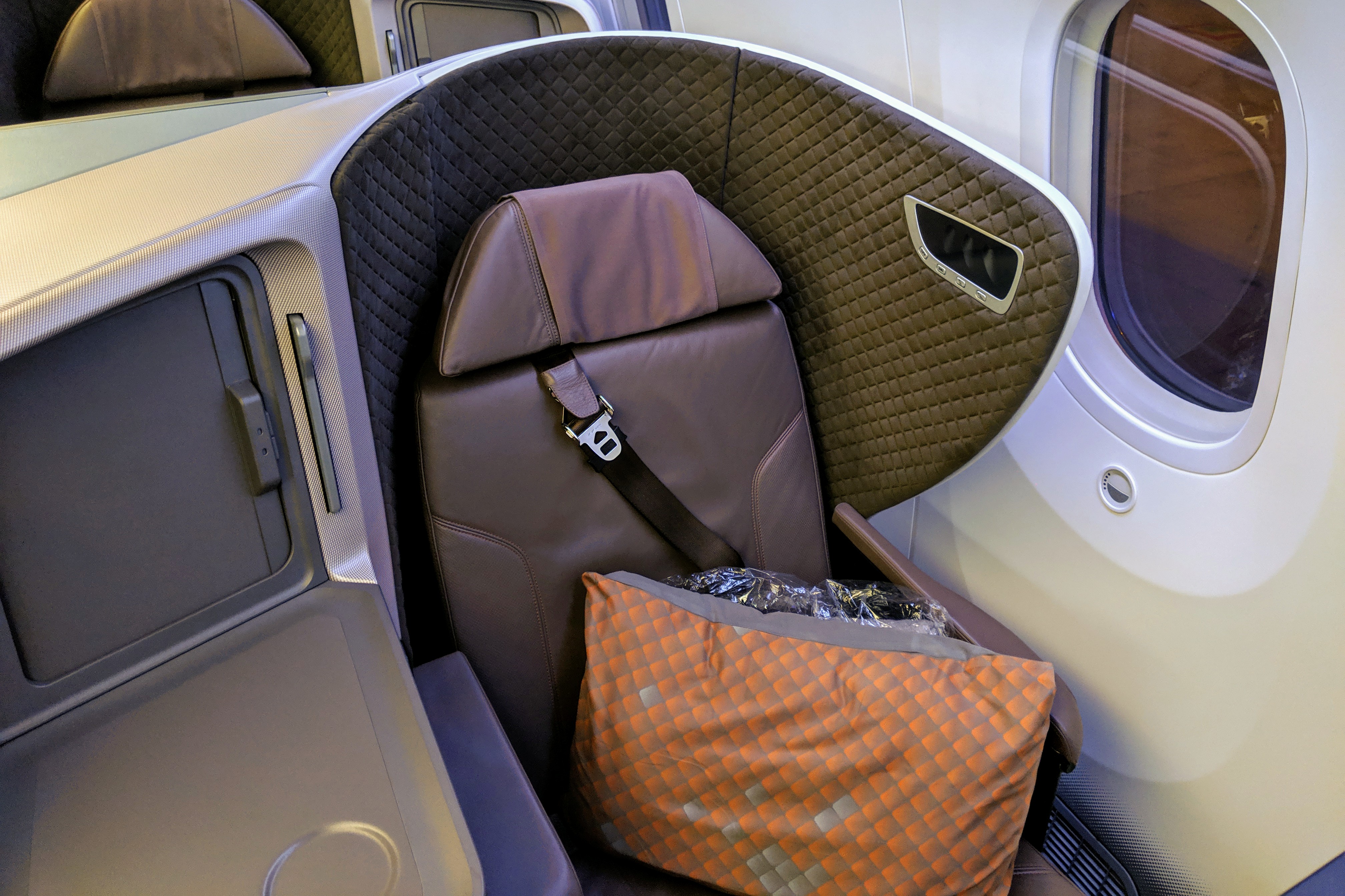
    Singapore Airlines new generation regional business class seat

    Singapore Airlines operate 4 services between Singapore and Perth daily. Out of Singapore, two of the services are in the morning, one was in the evening and one was overnight. On the return leg from Perth to Singapore, there is one service each in the morning, afternoon, evening and overnight.

    For my SQ215 service today, departure was at 6.45pm and scheduled to arrive into Perth at 11.55pm. All Singapore Airlines Australia-bound services depart out of Terminal 3 at Changi Airport.

    Singapore Airlines business class check-in counters

    Check-in was a relative breeze with many check-in rows for customers to proceed to. As a default, business class passengers can proceed to row 6 for a traditional check-in by an agent, but they can also head to row 4 to drop their bags if they have already completed their online check-in earlier.

    The lounge

    At the time of writing, Singapore Airlines has already announced a phased refurbishment of its lounges in Terminal 3. On the day of my flight, the Krisflyer Gold lounge has moved to Murhaba Lounge, but the SilverKris lounge for business class passengers was still in operation (see my earlier review here).

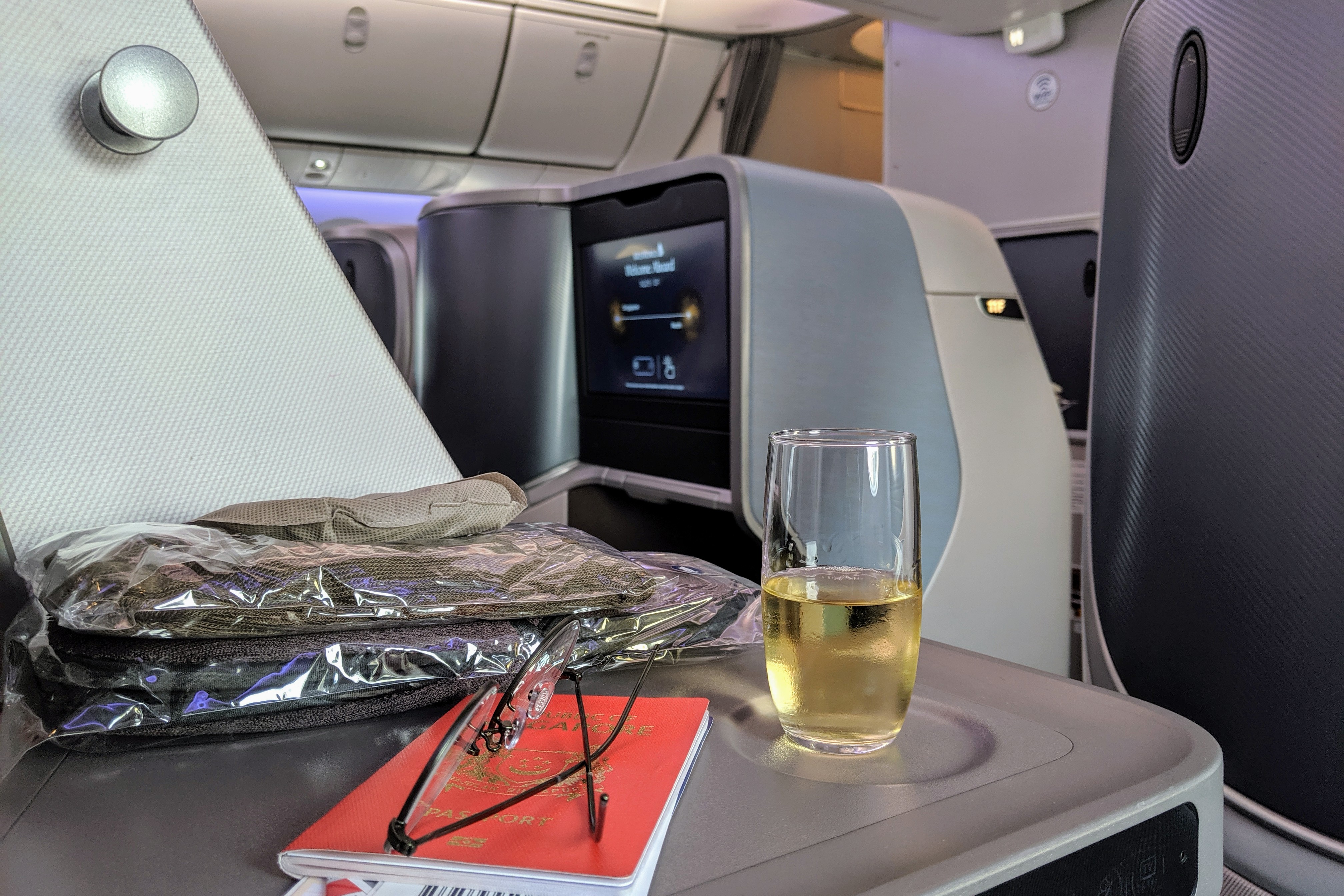
    I went in for a quick glass of champagne before making my way to the gate.

    The aircraft

    SQ215 was operated by a Boeing 787-10 today. The Singapore-Perth route is operated by a mix of the regional A350-1000s, B787-10s as well as some old A330s. Singapore Airlines has most recently announced that from October onwards, the A330 will no longer be on the Perth services, so all premium cabin passengers will enjoy a lie-flat new regional business class product.

    For those following Singapore Airlines’ fleet renewal closely, you will know that SIA has now 12 Boeing 787-10 in its ranks, with another three birds joining the fleet by the end of year.

    Singapore Airlines B787-10 business cabin

    All of Singapore Airlines’ Boeing 787-10 are used for regional services, hence they only have two classes: business and economy. In business cabin, there are 36 seats over nine rows, with four across each row. In business class, the seat that Singapore Airlines have chosen is the STELIA Symphony, a brand new design that Singapore Airlines have decided on and announced with much fanfare back in 2018.

    All seats have direct aisle access, an upgrade from the previous 2-2-2 regional products found on the A330. 

    The seat

    I have done a review of this seat for my Bangkok-Singapore flight earlier this year. This time round, I had the chance to book a seat with the seat next to the window, and have the console separate my seat from the aisle. If you ask me, this is a much better option as it offers a lot more privacy.

    Seat 12F across the aisle

    Even though this is my second time on this aircraft, I still maintain that the seat feels a little tight, although arguably much less than the JAL seats. The seat comes with adjustable armrests on both sides, which one can leave up or push it down to level with the seat for a more spacious seating.

    Singapore Airlines have aligned the seats in such a way that in alternate rows, couples travelling together can choose a pair of middle seats with their seats right next to each other.

    Alternating seats for the middle pairs – choose wisely!

    As previously mentioned, the seat controls have been upgraded significantly from previous iterations of the Singapore Airlines business class seat. Loyalists will know that the previous iterations of the business class seats – especially the long haul seats – are built to be manually turned into beds upon request.

    For the Boeing 787-10, Singapore Airlines have adopted an electronically-controlled system. The seat controls are located on the side of the table-console. At a touch of the button, you will be able to recline the seat into a fully flat bed.

    Electronic controls for the seat (above the handset)

    On the side console was also a small compartment which contained the headphones, and also contained the power socket and charging ports. For take off and landings, the compartment needs to be closed, so effectively you won’t be able to charge anything during this time.

    The tray table is stowed under the in-flight entertainment screen in front of you. There is a button to eject the tray, which you then unfold into a larger table.

    The service

    Flight time today is about 4.5 hours, which is a relatively short flight. Unlike short-haul services around Southeast Asia, Singapore Airlines do provide some amenities for business class passengers, including slippers, eye masks and socks.

    From top left, clockwise: eye shades, slippers, socks

    Customarily, the cabin crew came around to offer a pre-departure drink of either champagne, juice or water. Champagne is always my choice of drink, unless it’s way too early in the day. For the uninitiated, Singapore Airlines serve Charles Hensieck champagne in business. Hot towels were also dished out during this time, as the cabin crew collected another round of drink orders for after take-off.

    Just after doors are closed and the aircraft is on its way to the runway, the cabin crew came around and swiftly retrieved all the glassware.

    Soon we are on our way. As there was only one meal service, there was no rush to serve. The cabin crew came around with the drinks that we ordered before take-off. This was when I experienced a little lapse. I had initially ordered a Shiraz, but a white wine was brought to me instead. After clarifying my order, the wine took a while to come again because the cabin crew forgot to bring it out for me. It was a relatively small matter, but for an airline who had set the bar so high with regard to service, this was a little annoying. I got an extra pour of the Shiraz (which turned out to be pretty decent) from a very apologetic leading stewardess, so I guess I’ll let this slide.

    Dinner service commenced about an hour into the flight, so if you are the sort who needs an early dinner, you’re better off grabbing a bite in the lounge first.

    As I have previewed the on-board menu earlier through Manage My Booking and wasn’t impressed with the selections, I have went ahead with a Book the Cook selection of Nasi Lemak, which the cabin crew came around to confirm just before the meal service.

    For those who are interested, the menu for the evening read as below:

    Canape:
    Singapore Chicken and Beef Satay

    Appetiser:
    Parma Ham and Mozzarella Cheese Caprese

    Main Course: choice of
    Seared Salmon Trout with Campagne Vinaigrette
    Singapore Roti Prata
    Wok-fried Beef in Black Peppercorn Sauce
    Sous Vide Pork Tenderloin with Light Tarragon Sauce

    Dessert: choice of
    Haagen Dazs Strawberry Ice Cream
    Tiramisu

    Selection of Cheese

    Fruit from the Basket

    Assorted Bread Rolls and Gourmet Breads

    Fine Pralines

    Coffee and Tea

    It’s a full meal service, and in my opinion with a little more choices than what was available on my Singapore-Beijing service.

    Having said that, Singapore-Australia flights tend to be competitive given the relatively high yields out of the Australian market, so I’m certain that Singapore Airlines will pull no stops to impressing customers with the service quality on the Australian services.

    The famed Singapore Airlines satay was served about an hour into the flight. What always amuses me is how the satay is served before they dress your table for dinner. If you don’t take either chicken or beef, you can always request for more of the other meat you prefer. On some flights, they also serve lamb satay instead of beef.

    Chicken and beef satay canapes

    Dinner begins proper once I was done with the satay. The cabin crew came around to lay out the table cloth, before dishing out the tray with the appetiser and offering yet another drink. Another crew followed closely behind, offering a choice of bread rolls and garlic bread. 

    Appetizer: Parma Ham and Mozzarella Cheese Caprese

    After the appetiser was completed, the stewardess came around to clear the plate and shortly my Book the Cook meal of Nasi Lemak was in front of me.

    For those who had not tried the dish before, it comes with sambal prawns, a slice of otah, omelette and a fried chicken drumstick. The coconut-infused rice was on point, complemented by a sweet and spicy sambal chilli. The accompaniments were pretty rich as well, making the dish a perfect one. My only complaint was the chicken, my personal preference would have been a chicken fillet rather than a chicken drumstick, so that it’s easier to manage.

    Book the Cook: Nasi Lemak

    For dessert, there was a choice between the ice cream and a tiramisu. If you have followed me long enough, you will know that I will almost always go for the ice cream. My previous experience with SIA business class desserts have always been disappointing as they tend to ‘overdo’ it, for example adding toppings to the ice cream. However, the ice cream this time round turns out pretty perfect if you ask me: a simple scoop of strawberry ice cream, topped with just a simple wedge of chocolate.

    Haagen Dazs ice cream

    I also ordered a cup of decaf coffee, which was promptly served after dessert along with a choice of pralines personally offered by the in-flight manager.

    The entire dinner service was completed in about an hour, by which time we were about half way into the flight to Perth. I rounded off the flight with another glass of Shiraz.

    Final thoughts

    The Boeing 787-10 aircraft is a boost to the Singapore-Perth services, which used to be serviced by the A330s using a regional 2-2-2 configuration in the business cabin. 

    The new seats, with all seats having direct aisle access, was a much needed upgrade, given that the only other competitor on this route, Qantas, has a similar seat type on the A330 they operate. Having said this, Singapore Airlines will be moving to a full new generation business class layout, featuring the latest regional business class product on all of its Perth flights from October 2019 onwards, operated by either the B787-10 or the A350 regional configuration aircraft.

    Sunset on flight

    Having said this, my comments about the seat comfort still stands. The in-flight entertainment screen was a little too close to my face for my liking, and the side console makes the passage between the aisle and the seat a little tight.

    This time round, as I have chosen a window seat with the seat right next to the window (as opposed to having the console next to the window), the seat felt a lot more private than my Bangkok-Singapore sector experience. These seats tend to be very popular for solo travellers, so be sure to book them as soon as you can.

    As I have mentioned earlier, the service quality of the Australia-bound services tend to be better as compared to other mid-haul destinations, and this is no exception for my flight today. So if you are ever planning a trip Down Under, you will have every reason to expect a tip-top service in SIA business class.
  • FLIGHT REVIEW: Cathay Pacific A330 Business Class, Singapore – Bangkok

    FLIGHT REVIEW: Cathay Pacific A330 Business Class, Singapore – Bangkok

    Many people associate Cathay Pacific with its home base of Hong Kong, which isn’t surprising given that there are over 50 flights a week from Singapore to Hong Kong. While Cathay Pacific is one of the preferred choice when travelling to Hong Kong, what some people may not know is that Cathay Pacific also offers a daily service to Bangkok from Singapore.

    The Cathay Pacific Singapore-Bangkok daily service is one of Cathay’s unique fifth freedom flights around the world, and the only one operating between the two Southeast Asian cities.

    I decided to take a slight detour to Bangkok today while on my way to Hong Kong, to check out if this option is indeed a much better choice than other full service carriers.

    The schedule

    Cathay Pacific runs a return flight between Singapore and Bangkok daily, in addition to its eight daily services to Hong Kong.

    At the time of writing, the daily schedule is as follow:

    FlightRouteDeparture
    Time
    Arrival
    Time
    DayAircraft*
    CX712SIN-BKK13201500DailyA330-300 / A350-900
    CX717BKK-SIN11551525DailyA330-300 / A350-900/1000

    *Aircraft types are always subject to change

    While Cathay has an issue of aircraft consistency, they don’t really have an issue with cabin product consistency. Unlike Singapore Airlines, Cathay essentially only have two business class seat types – the regional business class and the long-haul business class product, both of them are used on services to Singapore.

    The lounge

    All business and first class passengers will be able to access the Cathay Pacific lounge at Terminal 4 before their flight. The lounge is pretty new, having opened back in November 2017 when Cathay Pacific moved to Terminal 4.

    Cathay Pacific Changi Airport Terminal 4 lounge

    Of course, if you are holding a oneworld Emerald equivalent status (including British Airways Executive Club Silver, Qantas Frequent Flyer Gold), you will also be able to access the lounge as well.

    The aircraft

    On my A330 aircraft today, there are three classes: Business, Premium Economy and Economy. In business, there are 39 seats over 10 rows. There’s a small premium economy section consisting of 21 seats over three rows, while in economy there are a total of 191 seats. It’s a fairly loose configuration, given that an A330 can carry over 300 people at max.

    Pre-departure drinks

    Note that there are three versions of the A330 that Cathay Pacific operates. Two of them have the long-haul Cirrus business class seats, while the last one uses the regional recliner business seats, which unfortunately is used on the Singapore-Hong Kong services at times. If you are not sure, just check up the seat map of the flight before you book.

    The seat

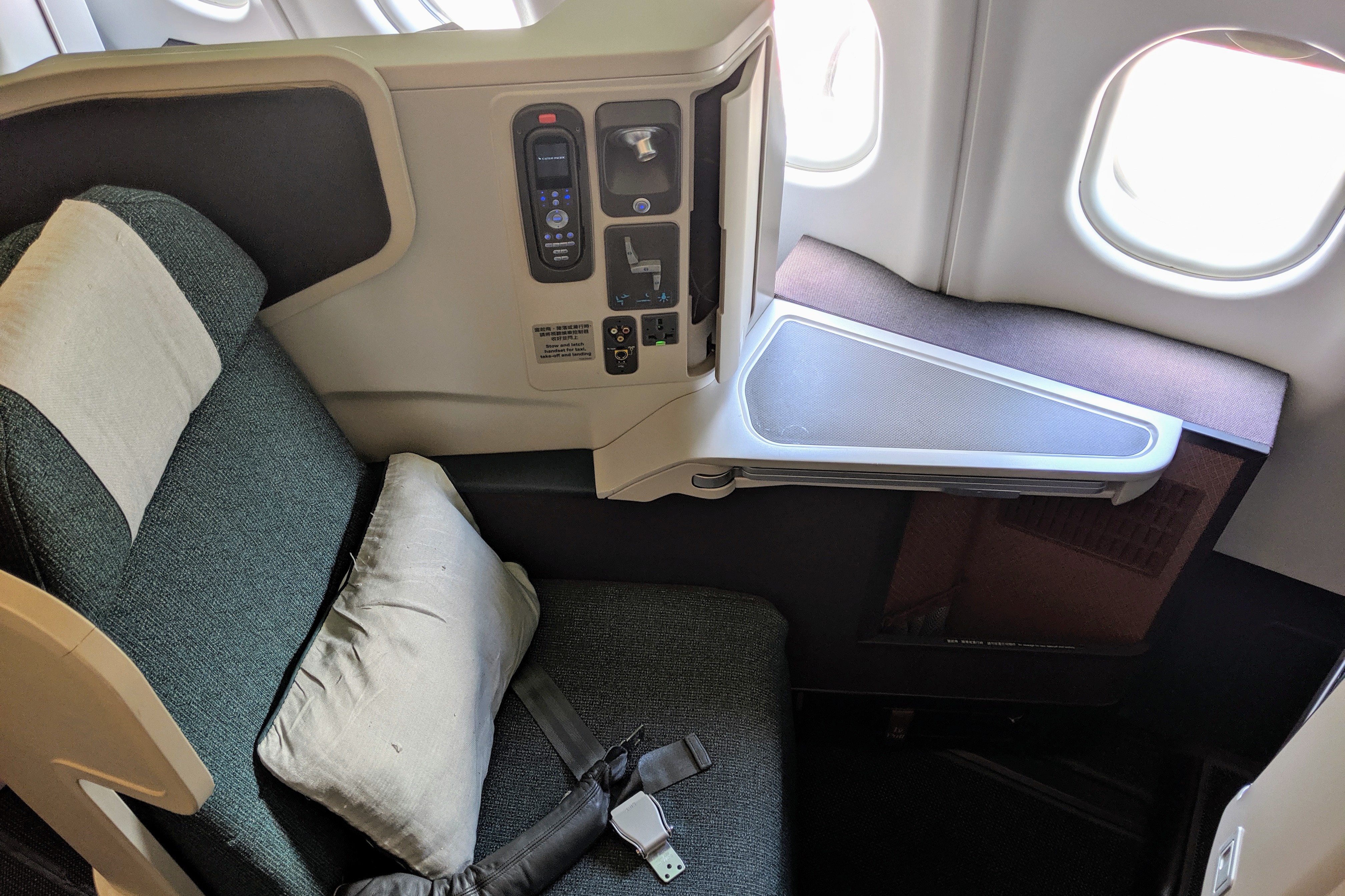
    Fortunately for me today, the cabin product on the Singapore-Bangkok sector was the long-haul business product. The cabin is laid out in a 1-2-1 configuration in a reverse herringbone format, with all seats having direct aisle access. Seats are Cirrus seats, designed by Zodiac Aerospace, and can be found on several other carriers including Air France, American Airlines, and Delta.

    The beauty of such 1-2-1 configuration is that it works for both couples and solo travellers. If you are travelling solo, the window seats work best, but if you are travelling as a pair, the middle pair seats will be your ideal positions.

    Given it’s a long-haul business class product, the seat can be converted into a lie-flat bed at a touch of the automatic controls, with the seat flushed with the ottoman in front of the seat.

    Ottoman that can be used as a footrest too

    Every seat has a in-flight entertainment screen that folds out from the seat in front of you. When stowed in the original position, the screen will be at a 90 degree angle from you, so that means that you don’t get any entertainment during take-off, landing and taxiing. If you ask me, this is about the only weakness of the seat design.

    Seat controls, power sockets are conveniently located next to you

    The seat controls are conveniently located at the side of the seat. The entertainment control handset is stowed next to you, with the power socket and audio inputs right next to it. This makes it very convenient to access and use, particularly with the side table right next to all the sockets.

    The service

    The flight time today is under two hours, making it a very short flight for a meal service. Given it’s a mid-day flight, lunch was served.

    For those who are familiar with Cathay Pacific’s services to Hong Kong, you will know that it usually does a three course meal in business class, with each course served separately.

    Given the short length of today’s flight, the meal service is therefore similar to what Singapore Airlines offer on its short haul services, where everything is served on a single tray.

    For starters, there was a bowl of fresh fruit, with no other options available.

    There was three choices of main course:

    • Stir fried beef, sha cha sauce, kailan, oyster mushroom and egg fried rice
    • Pan fried salmon fillet with sumac spice, carrot potato mash, quinoa with zucchini, peas, sun blushed tomato and dill mustard sauce
    • Grilled chicken with Bali sauce, fried noodles with vegetables and chilli sauce

    Apart from the menu that was already placed on my seat, what’s good about the Cathay Pacific business class meal service was that the cabin crew will wheel out a trolley with all the mains available, so you can visually take a look at the options before deciding what you want. I always thought this was a much better option, because words can only conjure an image of what the dish might look like, which more often than not turns out to be different from what is plated.

    I went with the salmon with quinoa. Shortly after the main was served, another cabin crew trailing behind came around with a basket of bread, and I gladly chose garlic bread to go with my meal.

    What differentiates Cathay Pacific from Singapore Airlines was their dessert service. Singapore Airlines typically does a cake or a room temperature dessert service.

    Loyalists will know that Cathay Pacific dishes out Haagen-Dazs ice cream for its passengers, and this is no different even for this short-haul service and definitely a plus for me.

    For those who are interested in the beverage list, here are the wines and champagne on offer today:

    Cathay Pacific ex-Singapore wine list

    The Entertainment

    I am a huge fan of Cathay Pacific’s in-flight entertainment system. As earlier mentioned, the only draw back was the design of the screen, which flips away from the seat during take-off and landing, so that means that you won’t be able to watch your shows from gate to gate.

    Cathay Pacific in-flight entertainment system

    Back to the content. Cathay Pacific boasts a wide variety of entertainment options on its IFE, and what I personally enjoyed the most was the huge range of Chinese and Asian content. I find that particularly lacking on other carriers, including Singapore Airlines.

    Beyond Hong Kong produced shows, they also carry a healthy amount of China, Taiwan, Japan and Korean content, including some more obscure options that may be hard to find. Some of the best shows I’ve watched are on Cathay flights. Having said that, they are also pretty strong in their Hollywood offerings – you will be able to find some of the hottest films on their system.

    Noise-cancelling earphones

    Final thoughts

    The Cathay Pacific fifth freedom service between Singapore and Bangkok is a very much welcomed competition if you are looking beyond the Star Alliance carriers (i.e. Singapore Airlines and Thai Airways).

    While it’s pretty much a very short flight, coupled with its brand-new lounge at Changi Airport, this is a product that works and is a very worthy alternative to what Singapore Airlines can offer. Schedule wise, while it only offer one flight a day, the middle-of-day timing also works pretty while for both business and leisure traveller – I could still head to work in the morning and still make it on the flight, while the return flight affords me some time in the morning in Bangkok before coming back to Singapore in time for dinner.

    For those with Asia Miles, the redemption on this flight is however slightly more pricey than Krisflyer. You will need 25,000 Asia Miles each way in business class on Cathay, as compared to 21,500 Krisflyer miles each way on Singapore Airlines.

  • FLIGHT REVIEW: Singapore Airlines B787-10 Business Class, Bangkok – Singapore

    FLIGHT REVIEW: Singapore Airlines B787-10 Business Class, Bangkok – Singapore

    Singapore Airlines / 22 Apr 19 / B787-10 / SQ983 BKK-SIN / Business class / 14A

    I was redeeming my Krisflyer miles for a trip down to Perth, and I remembered that I could add on a leg within Southeast Asia for an additional USD100. As I had a trip to Bangkok some time earlier in the year, I decided to add on a Bangkok-Singapore flight to make the full use of my miles.

    Bangkok Survarnabhumi airport is a massive animal, but Singapore Airlines almost always depart from D gates. Singapore Airlines also operate a SilverKris lounge at the airport, right across from gate D7.

    Singapore Airlines Boeing 787-10 business class

    The aircraft

    The Boeing 787-10 is the new generation aircraft that Singapore Airlines have decided on for its short and medium haul flights. At the time of writing, the aircraft type is progressing replacing the A330-300s on several routes, including to Osaka, Taipei and Perth.

    The aircraft has a two-class configuration: business and economy class, with 36 and 301 seats respectively, for a total of 337 seats. In business class, the seat that Singapore Airlines have chosen is the STELIA Symphony, a brand new design that Singapore Airlines have decided on and announced with much fanfare back in 2018.

    In a departure from its previous regional configuration on the A330-300, Singapore Airlines have gone with a 1-2-1 seat layout, forgoing the wide seats its famous for and gone for the alternating pattern with a side console. This layout is similar to what other airlines such as Qantas have on their widebody aircraft.

    The seat

    The Boeing 787-10 I travelled on has 36 business class seats across 9 rows in a 1-2-1 configuration, which means that all seats have direct aisle access. At the time of booking, all the window seats with the side console dividing the seat from the aisle have been taken up, which was rather surprising.

    The 2018 regional business class seat

    At first seating, the seat feels a little tight. The seat comes with adjustable armrests on both sides, which one can leave up or push it down to level with the seat for a more spacious seating.

    Unlike the Qantas layout, Singapore Airlines have aligned the seats in the such a way that in alternate rows, couples travelling together can choose a pair of middle seats that is right next to each other.

    Alternating couple and aisle-siding seats for the middle section

    You will also notice there’s a sort of privacy divider between each seat and the aisle, making the seat feel really private as you will be avoiding any kind of awkward eye contact with your neighbours across the aisle if you happen to be just looking around from your seat.

    Privacy divider on every seat

    The controls on the seat have been very much updated from previous iterations of the Singapore Airlines business class seat. Loyalists will know that the previous iterations of the business class seats – especially the long haul seats – are built to be manually turned into beds upon request.

    Seat controls and entertainment handset

    For the Boeing 787-10, Singapore Airlines have adopted an electronically-controlled system. The seat controls are located on the side of the table-console. At a touch of the button, you will be able to recline the seat into a fully flat bed.

    On the side console was also a small compartment which contained the headphones, and also contained the power socket and charging ports. For take off and landings, the compartment needs to be closed, so effectively you won’t be able to charge anything during this time.

    Storage compartment on the side console

    One thing to note is that the foot well is rather small. When I tried it, the only comfortable position is when you sleep facing upwards. If you are a side sleeper like me, you will be more comfortable curling up your legs, rather than try to slot them into the foot well. If you are very tall, good luck to you.

    Tiny footwell

    The tray table is stowed under the in-flight entertainment screen in front of you. There is a button to eject the tray, which you then unfold into a larger table.

    For an extra perk, the two front row window seats – 11A & 11K – both contain an extra storage space that also serves as a bassinet space. If you manage to get those seats, the space is very handy to keep your bags within reach during flight.

    Bassinet space at seat 11A

    The service

    The flight time today was just under 2 hours, and a full meal was served.

    As usual, as the economy class is still boarding, the cabin crew came around with a choice of pre-departure drinks. As always, I’ve gone with a glass of champagne. The choice of bubbly today was the Charles Heidsieck, the choice of champagne that Singapore Airlines go for its business class.

    Shortly after take off, dinner was served rather quickly. The menu for the day read as below:

    Appetiser:
    Marinated fried tofu and cashew nut salad with thai chili sauce

    Main course:
    Seared kurobuta pork loin with bourbon sauce
    Deep fried sesame coated chicken with asian green, carrot, fried noodles and oyster sauce
    Hor Mok Pla, or thai style minced fish with coconut cream and spices, sauteed vegetables and fried rice

    Dessert:
    Raspberry choux

    Assorted bread rolls and gourmet breads

    Coffee and tea

    Given the short flight time, the meal was served on a single tray, rather than through a multi course presentation.

    Single tray service for short haul flights

    The only real choice you get on short haul flights are a choice of main course. For flights out of Bangkok, note that there’s also no Book The Cook options so you are pretty much limited to the menu choices.

    I decided to go with the pork loin, which I thought was the least bad options based on the choices available. At first bite, I was pleasantly surprised at how tasty it was. The pork was tender and the texture was in fact closer to chicken, rather than pork.

    The jus was pretty good as well, although I’m sure that would have been laden with sodium.

    The star of the meal was in fact the dessert. The cake was balanced in its sourness and sweetness, making it a perfect end to the meal.

    Along with the meal, there was also the usual choice of four wines, two whites and two reds. I went with the french red bordeaux (as opposed to the italian red), which wasn’t particularly memorable, although it wasn’t bad.

    Champagne barely half-filled

    I was done with my meal pretty quickly and soon enough the cabin crew came around to clear my tray. I then asked for another glass of champagne, which was promptly brought to me. I was rather amused at the serving though: it was barely one-third filled. I understand that service guidelines typically require most beverages to be filled to roughly about half, or two-thirds of the glass to minimise spillage, but one-third of a small, tall glass is kind of ridiculous.

    Needless to say, I had to ask for a second serving.

    Final thoughts

    It’s great that Singapore Airlines has finally moved to a 1-2-1 configuration for its regional business class seats, which is a much needed upgrade from the previous 2-2-2 cabin which I unfortunately had to experience when I went to Beijing.

    Having tried the seat for the first time, while sleek, I personally felt that the seat was rather tight. Even though it seemed like there was a lot of space, but in reality the seat width didn’t feel spacious, especially when the armrests are up.

    Fully flat bed at a touch of a button

    The screen also seemed like it was right in my face, although one may argue that’s not too bad a thing actually as I could actually touch the screen without stretching.

    The design of the seat could also use some tweaking. Realistically speaking, the compartment next to the seat which had a sliding door wasn’t much of a use. If I have placed some small articles in it, I had to shut the door in order to prevent the items from falling out in case of turbulence. A container-style compartment would have worked much better.

    In-flight entertainment

    The seat controls next to the seat was also often accidentally triggered by my resting arm when my armrest is down, which was rather annoying.

    On the service front, as usual it was impeccable, and a tray service even in business class is pretty standard for a short flight like this. However, I would really appreciate if there was a semblance of option, even for something as simple as desserts where some things such as ice cream are easy to uplift.

  • FLIGHT REVIEW: Malaysia Airlines Boeing 737-800 Business Class, Kuala Lumpur – Singapore

    FLIGHT REVIEW: Malaysia Airlines Boeing 737-800 Business Class, Kuala Lumpur – Singapore

    Continuing my journey from Ho Chi Minh City, the flight for the day is a short business class ride from Kuala Lumpur to Singapore with Malaysia Airlines.

    The Kuala Lumpur to Singapore hop is an incredibly short one, typically the aircraft only cruises for less than thirty minutes before descending.

    My ride today is on a Boeing 737-800, which Malaysia Airlines have plenty of. Between Singapore and all the Malaysian destinations it flies to, Malaysia Airlines only use the Boeing 737-800.

    The aircraft

    Malaysia Airlines’ Boeing 737-800 features 16 business class seats, laid out in a 2-2 configuration across four rows. In economy class, there are 144 seats, laid out 3-3 across 24 rows.

    Malaysia Airlines B737-800 business class

    The business class seats are recliners, which is perfectly fine for ridiculously short haul routes like mine. What you need to be aware of is that Malaysia Airlines also uses these narrowbody aircraft on some mid-haul route, including the Shanghai Pudong — Kuala Lumpur red eye service that I took some time ago, and also sometimes to Perth. So, always check the aircraft before you book.

    I’ve pretty much covered most of the seat in my review from Ho Chi Minh City to Kuala Lumpur, so there really isn’t much to add.

    The service

    Given that this was a ridiculously short flight with under an hour flying, one should not expect anything much.

    The business cabin was only half full when the aircraft door was closed. Only when the economy class passengers were all boarded and the aircraft door was closed then a cabin crew came around to offer a pre-departure drink of either apple, orange or guava juice.

    Pre-departure drink: orange juice

    One thing to note in case you don’t already know this: Malaysia Airlines have taken off alcoholic beverages from all flights under three hours for a few years now, that effectively means all domestic service, as well as most of the regional services within Southeast Asia, no longer carry booze.

    Shortly after I picked up the orange juice, the crew came around with a cold towel. Being pretty grossed out by the state of the cleanliness on my last flight, I used it to clean the armrests again.

    Soon we were on our way. The moment we are at cruising height, the cabin crew around to offer a snack: a choice between a tuna sandwich, or a curry puff. I decided to go with the sandwich, which was quickly brought to me on a tray, with a piece of Beryl’s chocolate.

    Spicy tuna sandwich

    It was… alright. I also asked for a glass of sparkling water, which was promptly brought to me, along with the rest of the bottle.

    After I was done with the sandwich and my drink, the cabin crew came around offering a choice of hot beverage, which I was pleasantly surprised at, given the short length of the flight. I opted for a green tea, which again, was brought to me rather quickly. I had at least another 15 minutes with the tea before it was being kept for landing.

    Final thoughts

    Given that this is an incredibly short flight, there really isn’t much to expect out of a flight like this. It’s ridiculous to expect anything to eat on a flight like this, and you are better off filling yourself up with food before or after your flight.

    The cabin crew is extremely efficient, which isn’t hard to achieve with only half the business seats filled.

    Spritzer sparkling water

    The aircraft is incredibly old, but good enough for a short hop from Kuala Lumpur to Singapore. I generally have no issues with old aircraft, but what really bugs me is the state of cleanliness of the aircraft. Fortunately, this aircraft was a lot cleaner than the previous one I took from Ho Chi Minh City to Kuala Lumpur.

    At the time of writing, a return business class ticket between Singapore and Malaysia is about S$700 from Singapore, or RM2,200 from Kuala Lumpur. If you are redeeming miles, that will set you back by at least 32,000 miles. No one should really be spending that kind of money or miles for a journey like this, and the only reason why you should fly this is if you are connecting on to somewhere else.

  • FLIGHT REVIEW: Malaysia Airlines Boeing 737-800 Business Class, Ho Chi Minh City – Kuala Lumpur

    FLIGHT REVIEW: Malaysia Airlines Boeing 737-800 Business Class, Ho Chi Minh City – Kuala Lumpur

    I was travelling from Ho Chi Minh City back home to Singapore, so decided to do a mileage run with a oneworld carrier given that I was trying to keep my frequent flyer status on Qantas for another year.

    Having done some research, I realised that Malaysia Airlines was my best bet given that it goes via KL, as that gives me two sectors and a lot more points and status credits with Qantas Frequent Flyer than travelling on a direct flight.

    Standby at airport: Go shows

    I showed up way too early at Tan Sohn Nat International Airport for my 7.10pm flight, and wanted to check if I could standby for an earlier ticket. I had done it pretty often with Qantas in Australia, or to some extent with airlines in US as well, so I thought I could try.

    While I tried to check in, I was told by the agent that the fare class for my ticket was ineligible for what they called ‘go shows’, and asked that I wait around to 4pm before my flight opens for check in. Obviously I wasn’t going to wait around for 2 hours to check my bag, so I asked to speak to the airport manager.

    When I later spoke to the airport manager, he explained that their customer management system has recently been changed and they are no longer allowed to put people on a different flight from what was booked.

    In summary, any sale tickets – whether in Business or Economy – will not allow you to show up for an earlier flight. From some online research the only exception seem to be out of Singapore.

    Having said that, the airport manager made an exception to allow me to do an early check-in (they do not offer ECI at SGN), and invited me to head to the lounge early.

    Security, immigration, lounge

    Note that the airport only offers dedicated immigration counters for Sky Priority members, a Skyteam initiative, as Vietnam Airlines is an alliance members. Unfortunately that also means that all other airlines customers, including premium passengers, will have to join the general line. If you are an ASEAN passport holder, fortunately the dedicated counter queue tends to be shorter.

    Once you have passed through immigration, you will see that there’s a dedicated business and first class security lane so feel free to use that.

    The lounge that Malaysia Airlines uses at Tan Sohn Nat International Airport was the Saigonnais Lounge, a third-party lounge operated by Sasco, the airport operator. In fact, all the lounges at the international terminal are operated by Sasco.

    Saigonnais Lounge, Tan Sohn Nat Airport International Terminal

    The aircraft

    After spending about three hours at the lounge, I finally head to the aircraft to start my journey.

    My ride today is on a Boeing 737-800, which Malaysia Airlines have plenty of – 48 to be exact. MH typically uses the 737-800s for its domestic and regional services, some as far as Taipei, Shanghai and Perth.

    Malaysia Airlines Boineg 737-800 Business class

    MH was expecting to bring in some MAX 8 and MAX 10 from this year onwards, but given the recent incidents around the MAX variants it remains to be seen if that will still happen. At the time of writing, MH has yet to make any changes to their order.

    Malaysia Airlines’ Boeing 737-800 features 16 business class seats, laid out in a 2-2 configuration across four rows. In economy class, there are 144 seats, laid out 3-3 across 24 rows.

    The business class seats are recliners, which is perfectly fine for short haul routes. The seats come with 42 inches of pitch, offering plenty of legroom. The seat measures 21 inches across, wide enough for even a fairly big sized person.

    Malaysia Airlines Boeing 737-800 business cabin with 16 seats

    Be careful though, Malaysia Airlines also uses these narrowbody aircraft on some mid haul route, including the Shanghai Pudong — Kuala Lumpur red eye service that I took some time ago. So if you want to have a good rest, either avoid overnight services altogether on MH, or check the aircraft before you book.

    The seat

    The seat has got simple mechanical controls: one button to control the seat back recline, another one for the legrest. Both of these have to be set to the default position for take off and landing. Note that this is a recliner seat, while it has a considerable recline, these are not flat beds – don’t expect to sleep well on them.

    The tray table is stowed in one of your armrest. In the middle armrest between each pair of seats, you will find the controller for your in-flight entertainment system.

    Controller for in-flight entertainment system

    As I was seated in row 1, the in-flight entertainment screen is also stowed under the middle of the pair of seats. To take out the screen, you will have to push it in first before it pops out. There was no instructions so I had to look around and fiddle with the screen before I could get it to come out, which was pretty frustrating.

    The service

    The cabin today was only about half full, so there was only about one person for every two seats. In the business cabin, there was two cabin crew, so the passenger to crew ratio was very good.

    There was also a variety of newspapers being put in every magazine holder in front of the seat: you don’t really get a choice, but every seat seem to get a different newspaper so you can always swap with your seat neighbour if you wanted something else.

    Pre-departure drink – no alcohol served

    As a pre-departure service, I was offered a couple of guava, orange or apple juice. I went with the pink guava (I may have gotten this wrong) and was pleasantly surprised at how tasty it was. I was then offered a cold towel to refresh myself.

    One thing to note: Malaysia Airlines have stopped serving alcoholic beverages on its flights under three hours for a couple of years now, so there was none available on this flight.

    Soon we were on our way, and the cabin crew came around handing out menu cards.

    Business Class menu cards

    There was a simple dinner service on this short two-hour ride. Despite the short ride, there was three options available for the main course:

    • Ayam Panggang Madu (Grilled honey chicken)
    • Pad Gra Pow (Thai-style stir fried beef with rice)
    • Pan-Roasted Garoupa with Tomato and Chilli Jam

    I went for the Ayam Panggang Madu, and everything was served on a single tray, including a side salad to start with, and an orange cake for dessert. One of the cabin crew also came around with a selection of breads. I decided to go with garlic bread which, to my disappointment, was cold.

    Dinner service – Ayam Panggang Madu

    While the meal didn’t exactly look very palatable, the surprise was in the cake: it was so delicious, and not too sweet, so I finished it all.

    After the meal service, my tray was promptly cleared and I was offered a hot drink. Checking the menu, I decided on a Rooibos tea, which took a while to come. However, the tea was pretty heartening and in my opinion a good way to end off the flight in absence of a glass of wine.

    Red Rooibos tea

    In-flight entertainment

    As I was in the bulkhead seat, the in-flight entertainment seat was stowed at the side of the seat. With no instructions on how to get it out, I struggled with the screen for a good while before figuring out to use it.

    The screen is a touch screen, but for the germaphobes, there’s also a remote control stowed at the side of the seat.

    In-flight entertainment screen needs to be upgraded

    Given it was a short flight, I didn’t bother watching any shows. I scrolled through the selection, which wasn’t huge but pretty current. The screen was quite small for a business class cabin, and the resolution of the screen was quite bad as well. There was a pair of headphones that was dished out at the beginning of the flight, but again, it looked like they have been in use for the last decade.

    Final thoughts

    Malaysia Airlines has a fairly large fleet of Boeing 737-800s, so if you ever need a hop in Southeast Asia, there’s a good chance you will have to ride one of these.

    Let’s face it: the business class product is not stellar on any Boeing 737s, including SilkAir’s (not until they get the flat beds). The other major issue with MH’s planes are the state of the cleanliness. While airplanes are rarely the cleanest place on earth, it’s really something else to have armrests as dirty as theirs.

    On the service end, MH obviously fared much better. The Malaysian hospitality is warm, the food tasted good, and everyone was pretty attentive and proactive.

    What I’m really unsure of is the removal of alcohol beverages on journeys under three hours.